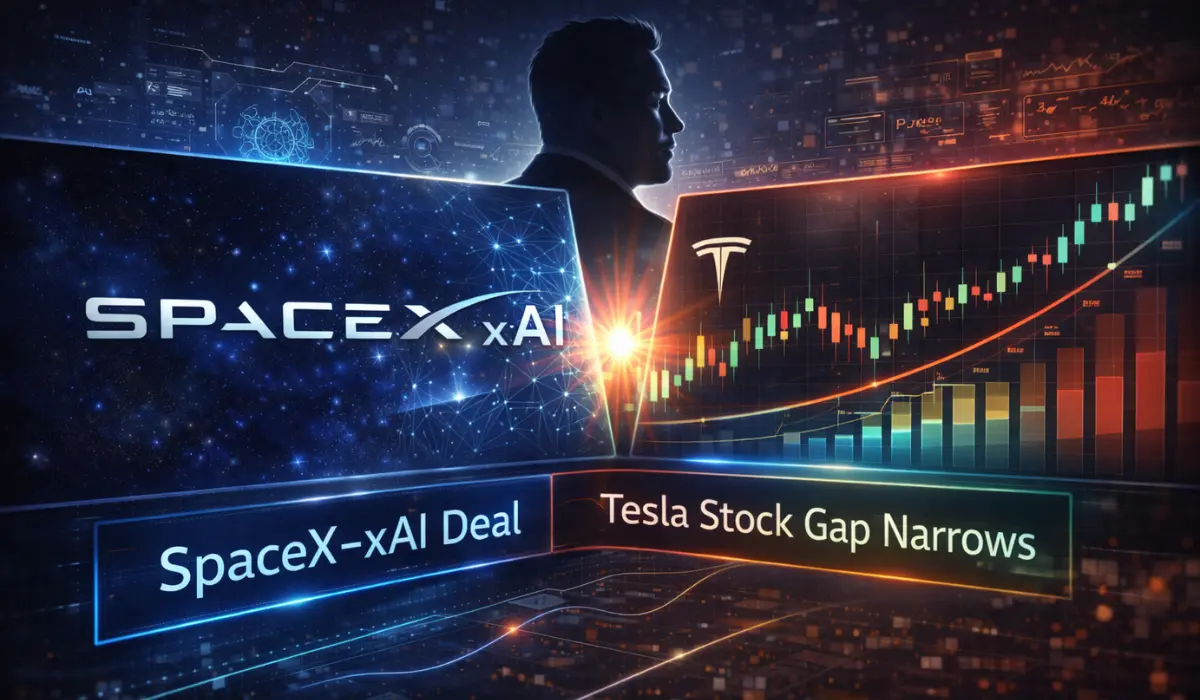
The gap between Elon Musk’s private and public empires is narrowing fast. Following SpaceX’s merger with artificial intelligence startup xAI, the newly combined entity is now valued at an estimated $1.25 trillion, bringing it within striking distance of Tesla Inc. (TSLA), which currently carries a market capitalization of roughly $1.58 trillion. The approximately 26% valuation gap marks a historical low between Musk’s two most powerful corporate pillars.
The transaction, which effectively folds xAI into SpaceX’s rapidly expanding aerospace and satellite infrastructure, has intensified debate around vertical integration, regulatory oversight, and whether Musk is building the world’s first fully integrated “off-world AI” ecosystem.
While announcing the merger, Elon Musk wrote on X, “Building an interstellar civilization”.
A Strategic Lifeline for xAI or a Platform Shift?
Founded in 2023, xAI was valued near $250 billion before the merger but faced mounting scrutiny from analysts over its aggressive cash burn and escalating competition in the generative AI space. Critics have characterized the deal as a quiet bailout, while Musk and his allies frame it as a strategic evolution, one that embeds AI directly into physical infrastructure rather than relying solely on terrestrial data centers.
At the center of this strategy is SpaceX, independently valued at $800B to $1T, driven by its dominance in launch services, government contracts, and the rapidly scaling Starlink satellite network. By integrating xAI’s Grok large language model into SpaceX’s ecosystem, Musk is positioning AI not just as software, but as an operational layer across communications, navigation, and future space-based compute.
Space-Based Data Centers and the Vertical Integration Thesis
The merger strengthens the so-called “Muskonomy” thesis: vertically integrated businesses spanning hardware, energy, data, and AI. Analysts say the long-term vision hinges on space-based data centers, where solar power and orbital cooling could theoretically reduce the energy constraints facing Earth-bound AI infrastructure.
Starlink, already critical to global broadband access, is expected to play a foundational role in supporting distributed AI workloads and low-latency inference for defense, aerospace, and autonomous systems. Grok’s integration could further enhance real-time decision-making across SpaceX missions and satellite operations.
Tesla as the Valuation Benchmark
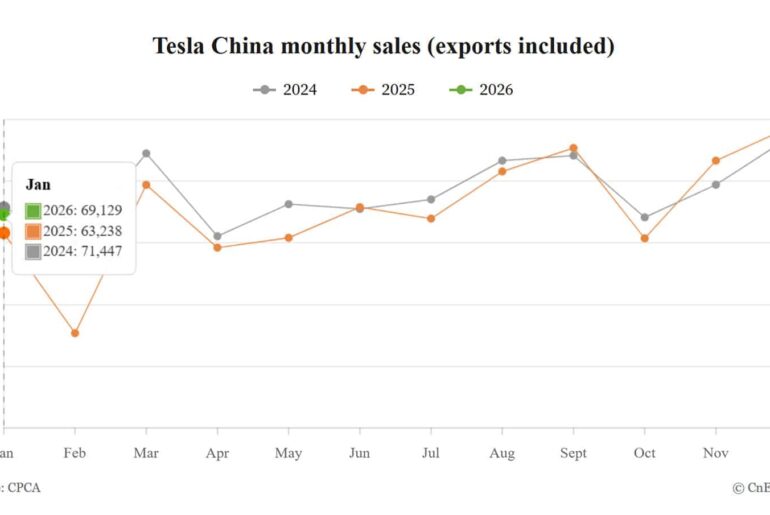
Despite remaining the largest publicly traded Musk entity, Tesla is increasingly viewed as the benchmark rather than the growth leader. While Tesla recently invested $2 billion in xAI, its core EV business faces margin pressure, intensifying competition, and questions around long-term growth rates.
Market observers note that if SpaceX were public today, its blended aerospace-AI profile could command a premium multiple, especially compared with traditional automakers transitioning into autonomy and robotics.
Regulatory and IPO Implications
The merger is expected to draw heightened scrutiny from U.S. regulators, particularly the SEC, as well as national security stakeholders such as NASA and the Department of Defense, both of which rely heavily on SpaceX for mission-critical operations. Any concerns around AI control, data sovereignty, or dual-use technology could influence contract reviews.
Meanwhile, speculation is building around a potential IPO, rumored for Summer 2026, that could eclipse Saudi Aramco’s historic public offering. If realized, it would represent not just a financial milestone but a structural shift in how AI, aerospace, and infrastructure converge under a single corporate umbrella.