South Korean automaker Hyundai Motors delivered a total of 55,624 vehicles across all powertrains last month in the United States.
Overall deliveries rose 2.1% year over year while hybrid sales surged approximately 60%, making January 2026 the strongest start to a year in the brand’s history.
Hyundai cited “surging hybrid demand [and] strong electrified performance”, as well as the strong sales “across Hyundai’s core SUVs”, which achieved a market share of around 77%, leading to the new record.
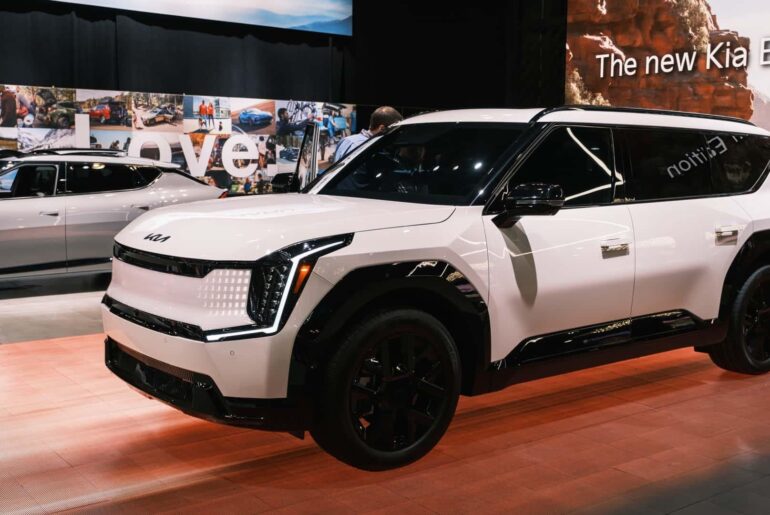
The Hyundai Group‘s brand Kia also recorded a 13.1% increase in the country last month, despite seeing its EV sales drop significantly.
BEV Sales
Within the battery electric vehicles (BEVs) in Hyundai‘s US portfolio, the Ioniq 9 three-row SUV – which was launched in the market last May – accounted for 580 units.
The model’s figures surged 52.6% compared to last December, with 380 units.
However, both the Ioniq 5 compact SUV — which includes the N line — and the Ioniq 6 sedan witnessed a sales decline last month in the US.
The compact SUV’s figures decreased 5.5% to 2,126 from 2,250 EVs recorded a year ago, while the electric sedan slumped 60.5% year-over-year to 344 units.
The Kona Electric is also available in the US market, but Hyundai North America does not provide a breakdown between its petrol and BEV versions.
ICE and Hybrid Sales
The North American chief Randy Parker described on Tuesday the surging demand for hybrid vehicles as “the star of the month”.
This significant increase was mainly due to the 43.o% increase in the Hyundai Santa Fe hybrid electric (HEV) version’s total sales and the launch of the new Hyundai Palisade Hybrid last September.
Offered in both internal combustion engine (ICE) and hybrid options, Hyundai Tucson was the best-selling model for the brand last month in the US.
However, the 5-seat compact SUV’s registrations fell 4.0% to 14,428 vehicles from January 2025’s 15,025 units.
Alongside the Tucson, the Santa Cruz and Sonata also saw their US deliveries decrease last month.
The combined pickup truck and SUV model’s figures plunged 32.1% year-over-year to 1,212 vehicles, while the mid-size sedan registered 3,140 units, marking a 34.0% drop compared to January 2025.
Last month’s highest year-on-year rise belonged to the Palisade, with a 28.7% increase to 8,604 vehicles.
The Kona subcompact SUV — including its BEV variant — saw its sales grow by 21.9% to 5,321 units from the 4,365 units recorded in January 2025.
Sales of the Venue and Santa Fe SUVs grew 10.4% and 8.6%, respectively, while the Elantra compact sedan’s registrations only grew 2.5% to 9,091 vehicles.
2025 Performance
Last year, Hyundai Motors sold a total of 4,138,389 vehicles worldwide, 0.8% below the 4.17 million-unit sales target.
However, global retail shares accounted for 4,108,605 units, a 2% year-on-year increase.
Specifically in the US, Hyundai sold 901,686 vehicles in 2025, 772,712 of which were retail sales.
Total figures marked a record for the third consecutive year, while the company achieved its strongest-ever annual retail sales result for the five years straight.
Electrified vehicles – which include BEVs, HEVs, and plug-in hybrid vehicles (PHEV) – represented 30% of the retail sales across all powertrains.
The automaker’s North American subsidiary highlighted that HEVs jumped 36% compared to 2024, while BEVs grew 7% year-on-year.
2026 Plans
Last month, Hyundai Motors announced that it aims to sell 4.16 million vehicles globally this year, up o.5% from 2025’s total sales.
At the Brussels Motor Show, the automaker unveiled the Staria Electric, which will be launched in the South Korean and European markets in the first half of this year.
The MPV is planned to expand to other regions later in the year.
Additionally, the Seoul-based brand is set to globally debut the new fully electric Ioniq 3 in April.
The model will become the company’s first compact EV under the Ioniq series.
Meanwhile, Hyundai will also introduce new iterations of its models, including the Ioniq series and Palisade.