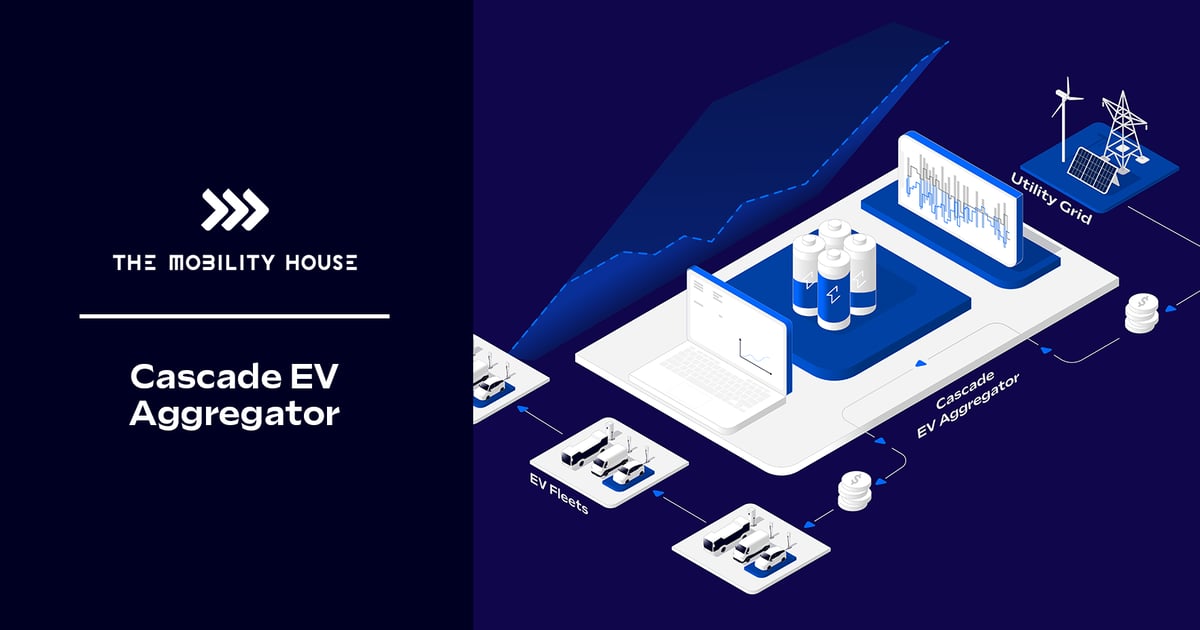
The Mobility House North America has launched Cascade EV Aggregator, a comprehensive vehicle-to-grid (V2G) integration platform designed to transform EVs into coordinated energy resources for utilities across the US and Canada.
The technology represents what the company describes as the “most versatile EV load aggregation tool in North America”, enabling charging and discharging optimisation across diverse asset classes from residential chargers to electric school bus fleets.
Cascade EV Aggregator addresses growing utility concerns about managing increasing EV loads while unlocking the grid services potential of EV batteries.
The platform operates as an intermediary layer between utilities and distributed EV charging infrastructure, creating individualised charging plans that balance grid requirements with vehicle mobility needs.
Russell Vare, vice-president of vehicle-grid integration at The Mobility House North America, explained the platform’s significance for grid operations.
“Cascade provides a critical aggregation layer and optimisation that coordinates charging activities to enable EVs to participate in virtual power plants,” Vare stated.
“This is a powerful tool that enables vehicles to deliver flexibility to the grid at scale, making homes and businesses more energy and financially resilient.”
The platform’s technical capabilities encompass both unidirectional smart charging for load shifting and bidirectional V2G operations that enable EV batteries to export power back to the grid.
Cascade receives real-time signals from utilities or market programs and translates these into optimised charging schedules across thousands of sites. The system then aggregates responses to provide essential grid services, including demand response, dynamic rate optimisation, and grid constraint management.
This launch builds upon The Mobility House’s established foundation in V2G integration technologies. The company previously collaborated with SiGENERGY to publish a white paper identifying V2X as the cornerstone of energy flexibility, demonstrating the technical foundation underlying Cascade’s development.
The platform represents a natural evolution of the company’s existing ChargePilot charge management system, which handles fleet-level optimisation while Cascade operates at the utility-scale.
The Mobility House has positioned Cascade to work alongside existing charge management systems rather than replacing them. While ChargePilot manages charging optimisation for individual fleet operators, Cascade coordinates with multiple charge management systems across service areas to create grid-level flexibility.
This architecture allows utilities to benefit from EV charging coordination without disrupting established fleet operations.
Currently, the platform is enabling V2G participation for electric school bus fleets operating in California, Massachusetts and New York. These implementations provide real-world validation of the technology’s ability to balance educational transportation requirements with grid service provision.
The company’s strategic partnerships have established precedents for utility-scale EV integration initiatives. The Mobility House previously partnered with Toyota and British Gas to develop European EV charging infrastructure, and also collaborated with Itron and New York State to advance fleet electrification.