Key Takeaways Tesla’s energy generation and storage business is posting record deployments as EV deliveries decline.Tesla expects deployments to rise from Megapack 3 and Megablock, with production starting in Houston.Tesla’s energy unit posted $12.7B revenue in 2025 and expects to recognize $4.96B of deferred revenue in 2026.
While Tesla’s (TSLA Quick QuoteTSLA – Free Report) electric vehicle (EV) business is under pressure, with deliveries declining for the second straight year in 2025, another part of the company is going strong. Tesla’s energy generation and storage business is a major growth engine, supported by strong demand for its Megapack and Powerwall products.
Powerwall is designed for homes and small commercial users, helping customers store energy and manage electricity costs. Megapack, on the other hand, targets large-scale needs for utilities, data centers, and industrial customers. Together, these products have fueled a sharp rise in deployments. Over the past three years, Tesla’s energy storage deployments have grown at a whopping 168% CAGR.
Tesla reported record energy storage deployments both in Q4 and in full-year 2025. Deployments reached 14.2 GWh in Q4 and 46.7 GWh for the year, up 49% year over year. Tesla expects deployments to rise further with the launch of Megapack 3 and the new Megablock solution. Production of Megapack 3 and Megablock is set to begin at Megafactory Houston this year. Meanwhile, the global Powerwall network supported over 89,000 virtual power plant events in 2025, across more than one million installed units, helping homeowners save over $1 billion on electricity bills.
Financially, the segment is delivering impressive results. Energy generation and storage revenues climbed to $12.7 billion in 2025, up 27% from the prior year. The business accounted for 13% of Tesla’s total revenues, compared with 10% in 2024.
Importantly, Tesla’s energy growth is supported by strong revenue visibility. Large storage projects are typically milestone-based, meaning revenues are recognized as projects progress rather than at contract signing. Tesla expects to recognize $4.96 billion in deferred revenues this year from energy projects already underway—more than double the amount recognized in 2025. This reflects a deep backlog and underscores sustained demand for Megapack solutions.
Profitability is strong. Gross profit reached a record $1.1 billion in Q4, marking the fifth consecutive record quarter. For the full year, gross profit rose to roughly $3.8 billion, up 44%, with margins around 30%. This makes energy Tesla’s most lucrative segment by margin.
While management has warned of potential margin pressure from low-cost competition, policy uncertainty, and tariffs, Tesla’s energy business stands out for its scale, profitability and growing demand. At a time when EV demand is uneven, the energy and storage business is proving to be Tesla’s most resilient and dependable growth engine.
How F and GM Are Expanding Their Energy Storage Push
With electricity demand rising and data center buildouts accelerating, legacy auto giants like General Motors (GM Quick QuoteGM – Free Report) and Ford (F Quick QuoteF – Free Report) are moving quickly to build a presence in this space as EV demand becomes less predictable.
In late 2025, Ford announced plans to convert part of its Kentucky battery plant, built with SK On, to produce batteries for energy storage. Ford is also allocating factory space in Marshall, MI, to manufacture cells for residential energy storage, while still supporting EV production. Ford has already invested about $10 billion across its Kentucky and Michigan facilities and is committing another $2 billion to expand its energy business. For Ford, energy storage offers a way to monetize existing battery assets and offset EV volatility.
General Motors has taken a more structured approach through GM Energy, a unit it launched several years ago. GM expanded its energy push with the PowerBank, a residential storage product introduced in late 2024. GM Energy is working with Redwood Materials to repurpose both new and used EV batteries for stationary storage. In October, GM said GM Energy sales had increased fivefold since January, with revenues growing 30% month over month.
The Zacks Rundown on TSLA Stock
Shares of Tesla have gained 8% over the past year, underperforming the industry.
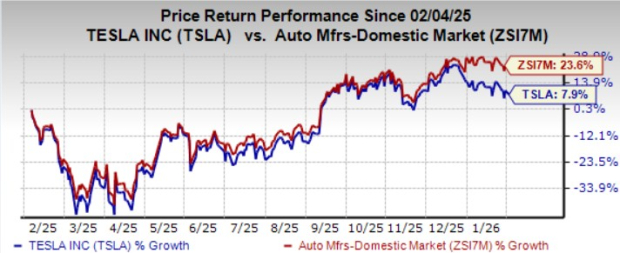 Image Source: Zacks Investment Research
From a valuation standpoint, TSLA trades at a forward price-to-sales ratio of 15.07, above the industry and its own five-year average. It carries a Value Score of F.
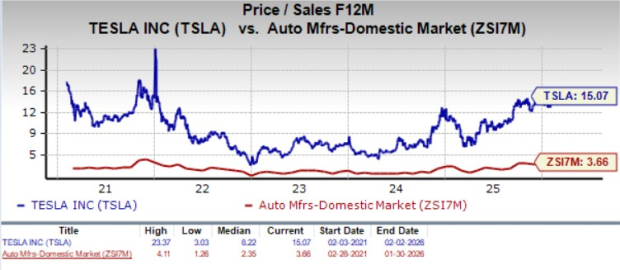 Image Source: Zacks Investment Research
See how the Zacks Consensus Estimate for TSLA’s earnings has been revised over the past 90 days.
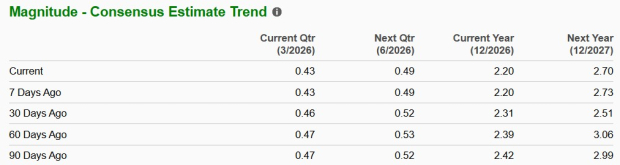 Image Source: Zacks Investment Research
Tesla stock currently carries a Zacks Rank #4 (Sell).
You can see the complete list of today’s Zacks #1 Rank (Strong Buy) stocks here.