In January, BYD reported delivering a total of 210,051 new energy vehicles (NEVs), which include battery-electric vehicles and plug-in hybrids. While NEVs also encompass vehicles with range extenders and fuel cells, BYD does not produce these drivetrains. The figure covers both passenger cars and commercial vehicles, such as trucks and buses. Compared to January 2025, that represents a decline of 30.1 per cent, and a 50 per cent drop compared to the previous month.
The situation is similar for passenger cars, which constitute the majority of BYD’s business. In January, the company delivered 205,518 NEV passenger cars, marking a 30.7 per cent decrease year-on-year and a 50.4 per cent decline compared to December 2025. Both the passenger car and overall figures are closely aligned with January 2024 levels. However, commercial vehicles saw a slight increase, with 4,533 units delivered—a 10.8 per cent rise compared to the previous year.
The drivetrain split within BYD’s passenger car sales reveals an interesting trend. Recently, the ratio between battery-electric vehicles and plug-in hybrids was nearly 50:50. In the full year 2025, BYD delivered approximately 2.26 million BEVs and 2.29 million PHEVs. However, in January 2026, the balance shifted significantly towards plug-in hybrids: battery-electric cars accounted for 83,249 units, a 33.6 per cent decline year-on-year. Plug-in hybrids, on the other hand, experienced a comparatively smaller drop of 28.5 per cent, totalling 122,269 units. This shift has transformed the 50:50 split into a rough 60:40 ratio in favour of PHEVs. However, this does not necessarily indicate a success for part-time electric vehicles—it marks the tenth consecutive month of year-on-year declines, with BYD’s PHEV sales consistently below 2025 levels since May.
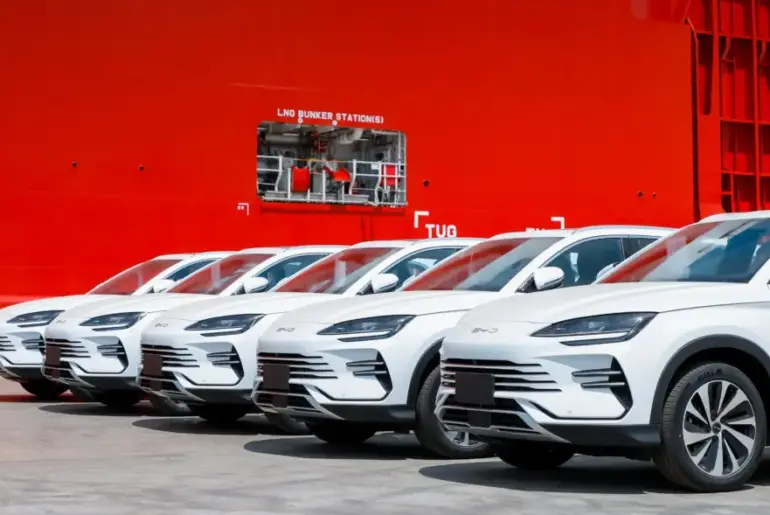
The ongoing price war among electric vehicle manufacturers in China is widely regarded as the primary reason for these declines and the shifting drivetrain distribution. However, BYD appears to be struggling to connect with Chinese customers as effectively as it did last year. As a result, the company is increasingly focusing on sales outside China. In January, BYD exported 100,482 NEVs, a 51.5 per cent increase year-on-year but a 24.5 per cent decline compared to December. Nevertheless, future overseas sales are expected to be increasingly produced outside China, which will not help utilise domestic production capacity. As recently announced, BYD’s first European car plant in Szeged, Hungary, has now entered trial production.
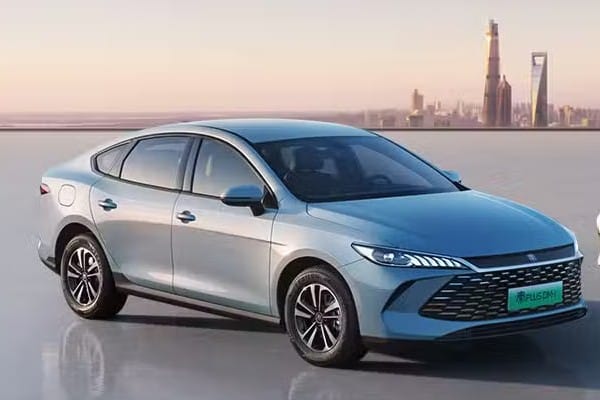
With sales to private and business customers in China becoming increasingly challenging, BYD is evidently working to establish an additional sales channel. The company has now launched Linghui, a ride-hailing brand in China. Under this fifth brand, vehicles will be specifically offered for ride-hailing services. The exact positioning of the brand remains unclear, as BYD has provided limited information at the launch of Linghui’s Weibo page. However, it was previously revealed in the Ministry of Industry’s vehicle catalogue that Linghui will initially offer three battery-electric saloons and one PHEV minivan. The most affordable model, the Linghui e5, is based on the BYD Qin Plus EV and is a 4.80-metre-long electric saloon.
According to Car News China, Linghui will focus on selling vehicles for ride-hailing services, taxis, and company fleets. To achieve this, a dedicated distribution network tailored to these business customers—distinct from the conventional passenger car sales network in China—is likely to be established. It remains unclear whether Linghui will permanently focus on BYD-based vehicles or eventually introduce more independent models.
cnevpost.com (January sales), carnewschina.com (Linghui)