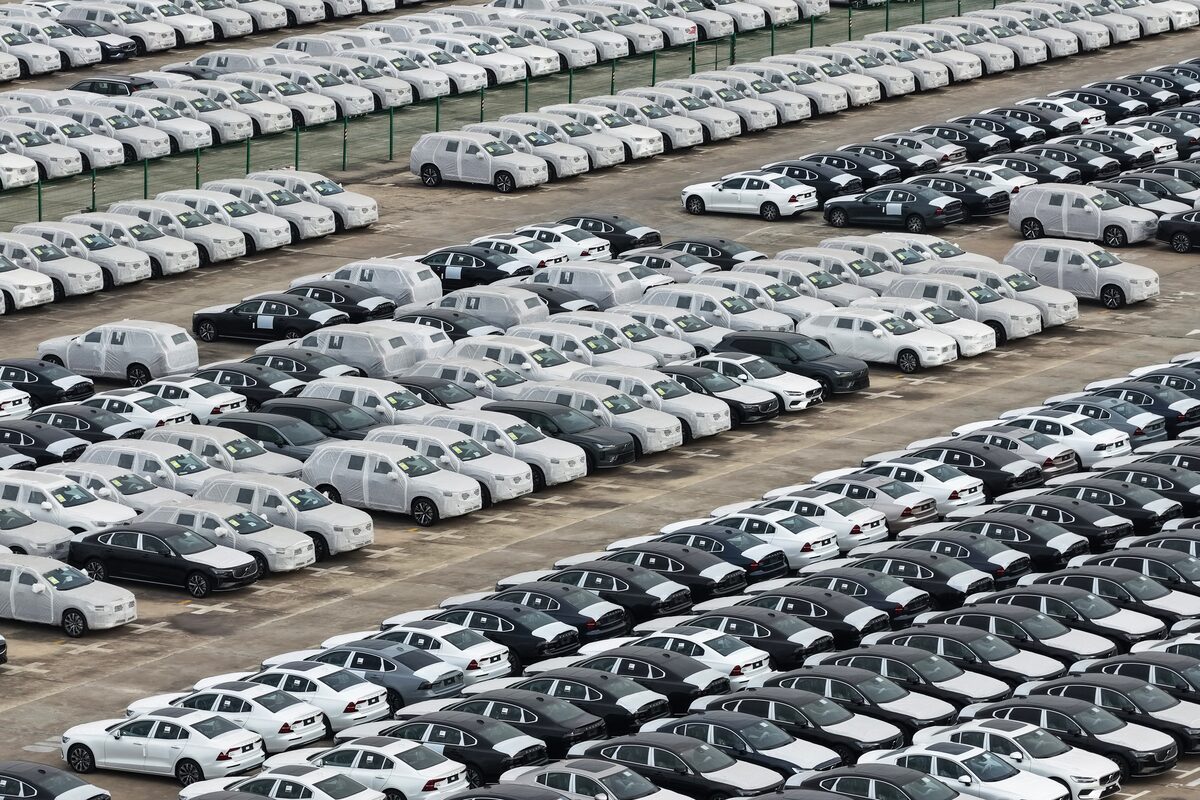
Vehicles awaiting to be exported at the Nanjing Port Longtan area, in China’s eastern Jiangsu province, on Dec. 8, 2025.STR/AFP/Getty Images
Ottawa is under more pressure than ever to abandon its policy requiring electric vehicles to make up a growing share of Canadian car sales, after its deal with Beijing to begin allowing Chinese-made EVs into the country.
And how Prime Minister Mark Carney responds to those demands – as his government wrestles with a complex set of calculations around whether to try to maintain the policy in some form, and what could replace it if not – will be one of the biggest reveals in a new national automotive strategy to be released as early as this week.
Introduced under former prime minister Justin Trudeau, the Electric Vehicle Availability Standard (EVAS) sets a target of 60 per cent of all passenger vehicle sales being electric by 2030, and 100 per cent by 2035. It’s effectively aimed at pushing automakers to increase their EV offerings to Canadian consumers, while providing demand certainty to charging-infrastructure investors and power-grid planners.
Also commonly known as the zero-emissions vehicle (ZEV) mandate, it has long been vocally opposed by the domestic auto industry, and Mr. Carney effectively suspended it five months ago by dropping its initial target of 20 per cent EV sales in 2026.
Citing the turmoil from U.S. President Donald Trump’s automotive tariffs, he pledged a 60-day review with an eye to making the policy more flexible going forward, but there have been no updates since.
Editorial: Put the market in the driver’s seat for EVs
Now, in addition to arguing that there is not enough EV consumer demand to meet the targets, industry is complaining that EVAS’s credit-trading mechanism – in which automakers exceeding their EV sales targets can sell credits to those failing to meet theirs – would effectively serve as a subsidy to Chinese companies selling only EVs.
The Canadian Vehicle Manufacturers’ Association (which represents General Motors Co., Ford Motor Co. and Stellantis NV) says those subsidies could add up to nearly $1-billion for the initial 49,000 Chinese vehicles that Canada is set to allow at a low tariff rate.
That’s probably an overestimate, predicated on credits trading for more than they actually would.
But similar complaints are being expressed by other industry groups, including Global Automakers of Canada, whose members include Honda Motor Co. and Toyota Motor Corp., (the other two companies that assemble cars in Canada). An obvious worry for these groups is greater market impact if Ottawa further opens the door to Chinese EVs and the credits are still available.
The general sense in the industry is that Mr. Carney’s government is at least somewhat sympathetic to these concerns, and lukewarm on the ZEV mandate model in general.
Ottawa, Seoul agree to work on bringing South Korean auto sector manufacturing to Canada
But ditching the policy altogether, with no replacement, could leave the government with little strategy to reduce greenhouse-gas emissions from transportation, further eroding its environmental credibility after already gutting much of the agenda put in place by Mr. Trudeau to combat climate change. It could also leave Canada alongside the U.S. in transitioning more slowly to EVs than most other countries.
That has Ottawa grappling with a bunch of imperfect options.
One of them is to re-embrace tailpipe standards, which is what Canada primarily used to combat road pollution before ZEV mandates came into vogue. They essentially involve setting industrywide requirements for reducing average emissions per vehicle, which automakers tend to prefer because of other compliance options – such as improved fuel efficiency and alternate fuel use – in addition to EV adoption.
The problem is that Canada has traditionally just adopted tailpipe standards used in the United States. That would no longer fly, from an environmental perspective, because Mr. Trump (with the backing of most traditional automakers) is set to impose very lax ones.
So, Canada would either have to find other countries to sync with, possibly looking toward those in Europe, or else craft its own tailpipe rules for the first time. Either process, particularly the latter, could be painfully slow.
How the arrival of Chinese EVs in Canada might lead to cheaper cars
Alternatively, there are various options floating around for how Ottawa could keep the ZEV mandate while making it easier for automakers to meet their obligations or counterbalancing Chinese advantage.
One of those would involve bringing back EV rebates, which Ottawa has been promising in some form since last year’s expiration of a federal program worth up to $5,000 of each consumer EV purchase, but tying those subsidies to the vehicles and their components being made in Canada (or perhaps made in North America since Canadian EV production is for now rather limited).
Another would be to change EVAS’s rules to somehow restrict Chinese companies from earning or selling credits.
A disincentive to go either of those routes, particularly the latter, is that they would be at odds with Ottawa’s recent efforts to defrost relations with China (largely in the interest of Canada’s agricultural sector), and could conceivably invite retaliation. They might also run afoul of international trade laws, although that may not be a big concern in the current geopolitical context.
If the government wanted to get really ambitious, yet another option would be to change EVAS to reward automakers with a Canadian footprint.
Andrew Coyne: No, Canada is not selling out to Beijing
As currently written, companies can earn tradeable credits not just for selling EVs, but also for investing in charging infrastructure.
Bentley Allen, a prominent industrial-policy expert at the non-profit Transition Accelerator, has been trying to sell Ottawa on the idea of expanding the credits system further to also reward investments in the domestic EV supply chain – including vehicle assembly, the manufacturing of batteries and their components, and perhaps even mining.
That approach would at least make life easier for companies already making such investments – notably Stellantis, Honda and Volkswagen – while incentivizing the rest to do so. But the marriage of consumer, environmental and industrial policy would require very sharp design, to avoid the whole thing becoming unwieldly, legally fraught or too easy to exploit.
Not that any of the other options are simple, either.
To some extent, any clear decision on the sales mandate’s future will be welcomed by an industry that can hardly afford lingering domestic policy uncertainty atop all the other headwinds that it’s facing.
For everyone else, it will offer a window into where this government’s priorities lie, as it balances the trade-offs between the demands of the multinational auto giants that have long dominated the Canadian sector, the increasingly dominant Chinese players seeking inroads, and this country’s place in the global shift toward electrification.