Unlock the Editor’s Digest for free
Roula Khalaf, Editor of the FT, selects her favourite stories in this weekly newsletter.
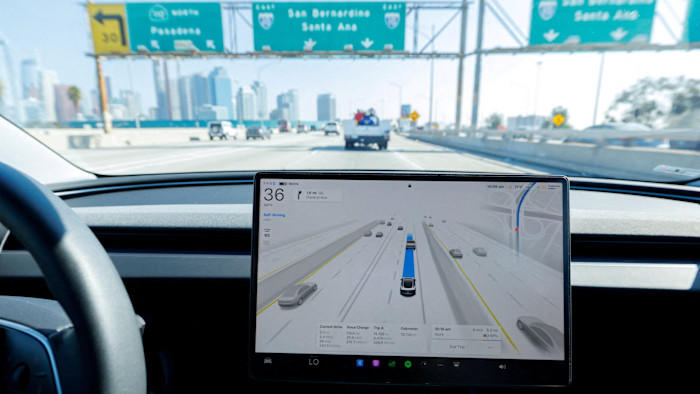
For car insurers, the arrival of self-driving vehicles is something of a lemon. One company that thinks it has the answer, aptly enough, is Lemonade. The US “insuretech” company has launched an attempt to lure Tesla drivers, promising them roughly 50 per cent lower rates when they deploy the electric vehicle maker’s “full self-driving” mode.
Autonomous vehicles and the related business of self-driving taxis present several industries with existential problems. Rideshare operators such as Lyft and Uber are vulnerable in a future world where a household can “lend” its electric car to a fleet when not in use, as Tesla boss Elon Musk proposed in his company’s earnings call on Wednesday.
Insurance, too, is in line for a big upset. If autonomous cars are safer, it means fewer payouts for accidents. But if the human driver becomes obsolete, then so does the need to insure them. In the US, insurance largely attaches to the driver, as distinct from the UK, where a policy is tied to both the driver and the car. Instead, it would be carmakers and robotaxi operators such as Waymo that would require coverage.

The pace of disruption is up for debate. Morningstar analysts, for example, think the transition will be gradual. Intermediate stages of autonomy might lead to drivers becoming much safer as a result of their new tools, but without rates dropping commensurately. That would create the happy balance of fewer accidents necessitating payouts by insurers, but with still-solid premiums.
Lemonade, meanwhile, is taking a blunt approach in order to win market share. Last week it launched its new deal for autonomy-embracing Tesla drivers, saying it had studied data from Musk’s company to determine how much additional safety self-driving afforded.
The insurer, whose pre-IPO backers included Japan’s SoftBank, is far from traditional. Despite a $7bn market capitalisation it is not profitable, making $100mn of operating losses in the past year with break-even not expected until 2027, according to Visible Alpha analysts. It also positions itself more like a software company, reporting metrics such as ebitda, than a conventional insurer.
Lemonade’s Tesla deal will be a test of whether AI really can give insurers an edge in underwriting risk. The balance is delicate. Autonomous cars are graded by the Society of Automotive Engineers on a scale of zero to 5 depending on how much a driver must be involved. Waymo scores a 4; Tesla a 2.
A study from Swiss Re and Waymo said a Waymo electric car generates less than one property damage claim per 1mn miles, achieving a rate four times better than human drivers. Tesla too says its autonomous cars crash far less than those with humans behind the wheel. Over time, insurers will have to face this huge change in their business model. Lemonade thinks there is money to be made along the way.