Wedbush Securities analyst Dan Ives is doubling down on his bullish thesis for the “fourth industrial revolution,” identifying Tesla Inc. (NASDAQ:TSLA) and Nvidia Corp. (NASDAQ:NVDA) as the two indispensable pillars of the burgeoning physical AI market.
The Two Titans Of Physical AI
While the tech world remains captivated by Large Language Models (LLMs) and chatbots, Ives argues that the most significant value is shifting toward machines that interact with the physical world.
For Ives, two companies stand alone at the summit of this transition.
“It just comes down to like physical AI, the two best physical AI plays in the market, Tesla, and the other one, it’s the godfather of AI, Jensen, Nvidia,” Ives stated.
“Those to me are the two biggest and the best physical AI plays in the world,” Ives told CNBC International.
Tesla’s Software Pivot And The $800 Bull Case
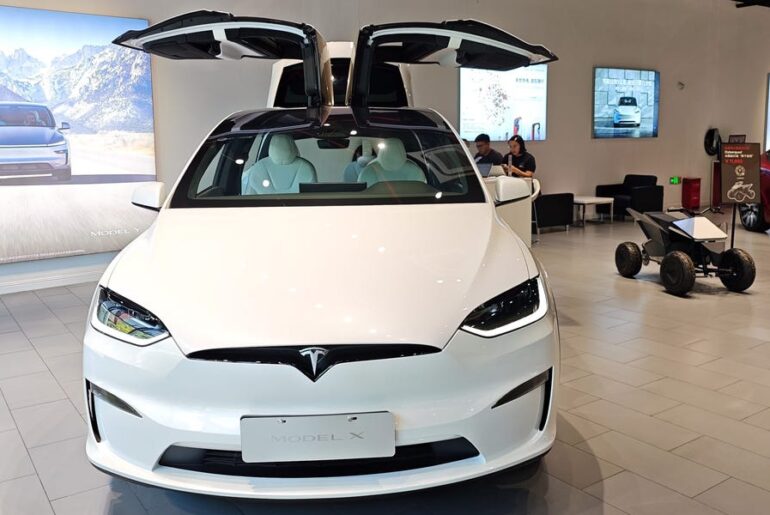
For Tesla, the narrative has shifted from vehicle delivery counts to high-margin software adoption.
Ives believes that Full Self-Driving (FSD) technology is the primary engine that will transform Tesla’s valuation, forecasting a potential leap in adoption from 12% to 50%.
“I believe we talk about $600 base case, but $800 bull case, is… ….the margin story that’s going to start take hold,” Ives explained.
He described 2025 as a “huge transition year” leading into a “golden year” in 2026, driven by the convergence of FSD, autonomous Cybercabs, and robotics.
Nvidia: The Infrastructure Powering The Boom
While Tesla represents the “Visionary” application of physical AI, Ives views Nvidia as the bedrock of the entire movement. He characterizes Jensen Huang’s company as the essential provider of the hardware that makes autonomous systems and industrial robotics possible.
According to Ives, Nvidia will “continue to lead the infrastructure powering the AI boom.”
He argues that the company remains “four to five years ahead of any other chip player,” making it the primary beneficiary of the massive capital expenditure currently flooding the tech sector.
The Energy Bottleneck And Vertical Integration
As the “arms race” for AI supremacy intensifies, Ives warns that the primary constraint is no longer capital or engineering, but power.
He noted that there are currently more data centers under construction than active data centers, putting an unprecedented strain on the grid.
To survive this “power crunch,” Ives suggests that vertical integration—including custom cooling and on-site generation—is the only viable path forward.
“The only thing that’s stopping it is not capbacks. It’s not technology. The only stops are the shortages that we see in terms of energy,” Ives concluded.
Nvidia And Telsa: Price Action
So far, in 2026, shares of Tesla have declined by 4.91%. It was up 30.57% over the last six-months and 4.07% over the year. Meanwhile, Nvidia is up 1.94% YTD, up 7.39% in six months, and 54.44% over the year.
Benzinga’s Edge Stock Rankings indicate that TSLA maintains a weaker price trend over the short term but a strong trend in the medium and long terms, with a moderate quality ranking.
NVDA, on the other hand, maintains a stronger price trend over the short, medium, and long terms, with a robust growth ranking as per Benzinga’s Edge Stock Rankings.
Disclaimer: This content was partially produced with the help of AI tools and was reviewed and published by Benzinga editors.
Image via Shutterstock