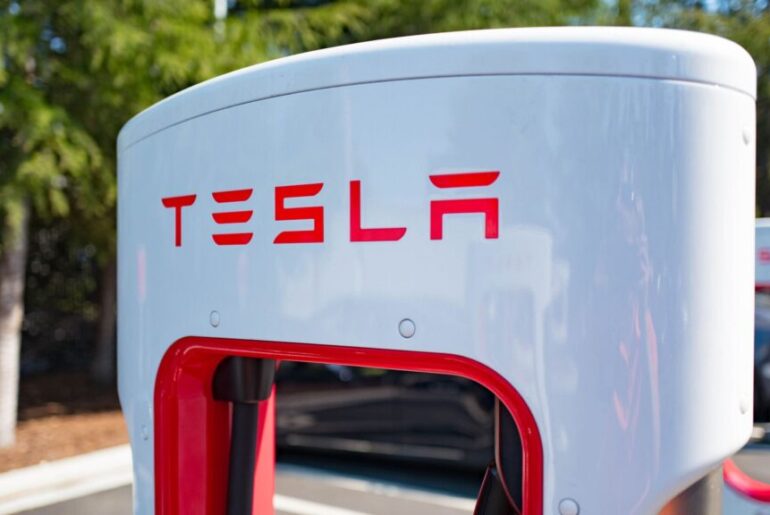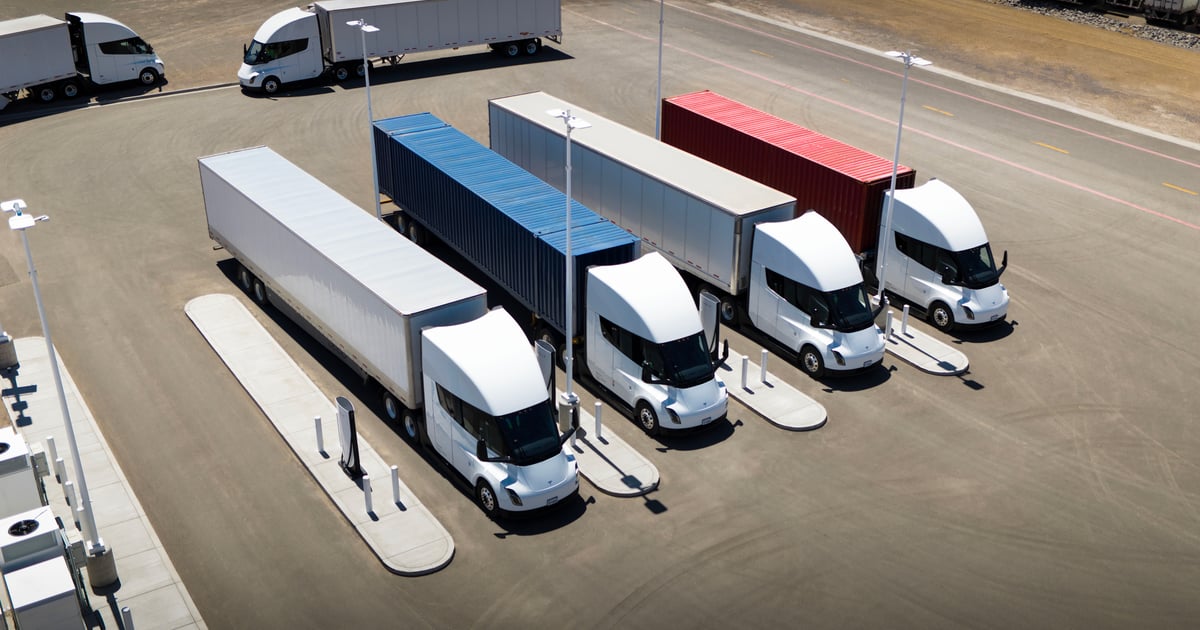
Tesla Semi charging facilities will be installed at Pilot Company sites along major highways in the US.
Under a deal secured between Tesla and Pilot, the latter’s ‘travel centres’, featuring refuelling for vehicles, and food and accommodation for long-haul truck drivers, will install chargers for Tesla’s Semi electric trucks.
The first sites are expected to open in summer this year. Each will host four to eight charging stalls and use Tesla’s V4 cabinet charging technology, delivering up to 1.2MW at each stall.
They will be installed along I-5, I-10, and ‘several’ major corridors where the companies said the need for heavy-duty charging is highest.
I-5 is the primary north-south highway along the US west coast, and I-10 runs east-west across the southern US. It is an area targeted for electric truck charging deployment by other firms, such as Greenlane and Windrose, too. Tesla’s chargers will be installed at Pilot sites in California, Georgia, Nevada, New Mexico and Texas.
These are regions where EV uptake, and support for it, is relatively high, and this demand for the charging for electrified trucks is more likely to make the installation of charging profitable.
The level of demand for these chargers specifically is somewhat questionable given that the network will only be compatible with Tesla Semi trucks, although Pilot said this could be expanded to include other manufacturers in future.
Tesla has only delivered about 200 Semi trucks to date, despite first teasing the offer in 2017. It was officially unveiled in December 2022 but mass production has been delayed several times in the three years since.
Tesla claims that its Semi trucks can be fully recharged by its chargers in 30 minutes. It is pitched to have up to 500 miles range on a full charge, and is described on the Tesla website as having ‘badass’ performance.
In its Q4 earnings call for 2025, which EV Infrastructure News will cover in full, the company said tooling for the Tesla Semi is in place at its Nevada manufacturing site, and that it is readying factories to ramp up production of the vehicle.