Maxwell Woody wasn’t expecting what the numbers revealed. He’d built the model to compare ownership costs across powertrains and cities, testing scenarios where electric vehicles might have an edge. Some urban areas, perhaps. Certain vehicle classes.
“I expected EVs would be cheaper in some scenarios, for some cities or vehicle types,” he says. What he found instead was remarkable for its consistency: used battery electric vehicles came out cheaper than petrol, hybrid, or plug-in hybrid alternatives across nearly every comparison. All five vehicle classes, almost all 17 cities. Every ownership period tested.
The timing matters, because transportation is the second-largest chunk of the average household’s budget, after housing, and new EVs typically cost more upfront than conventional alternatives. Yet 70% of vehicle purchases in the US happen in the used market, where different economics apply. Woody, a research assistant at the University of Michigan’s Centre for Sustainable Systems, wanted to know what those economics actually looked like.
His team started with something that’s never been used for vehicle depreciation research before: Craigslist. They gathered 4 million raw data points from used car listings posted throughout 2024, screening them down to 260,000 usable listings. Sabina Tomkins at Michigan’s School of Information led the data collection effort, pulling listings from within 50 miles of 17 major US cities. The self-reported data required extensive cleaning. Sellers don’t always list accurate mileage, and prices can include everything from hopeful asking prices to desperate fire-sales. But the sheer volume provided something previous studies lacked: a snapshot of what actual people were paying, or at least asking, for used EVs in 2024.
What emerged was a depreciation pattern that creates an unexpected window. Battery electric vehicles lose value faster than other powertrains in their first few years, then settle into similar depreciation rates afterward. A three-year-old used EV might retain only 58 to 67% of its original price, compared with 70 to 84% for a petrol vehicle. That steep initial drop is what makes used EVs such a comparative bargain.
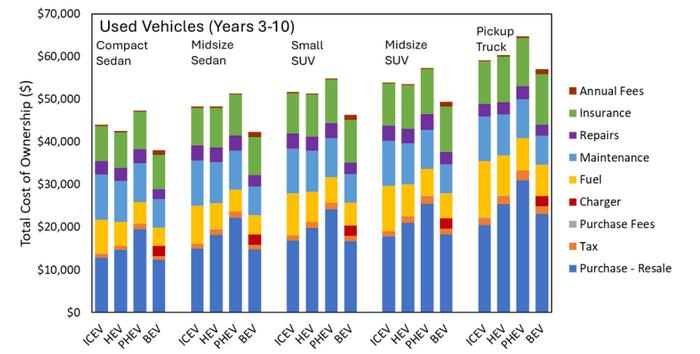
Consider a midsize SUV. Buying it new with a petrol engine and driving it for seven years, then selling it after ten years of total vehicle life, would save you about $3,000 compared to buying that same vehicle brand new. Not bad. But buying a three-year-old electric version instead? That saves $13,000 over the same seven-year ownership period, according to Woody’s modelling. The pattern holds across vehicle types, from compact sedans to pickup trucks.
“Electric vehicles have lower maintenance and repair costs than other powertrains, but the initial depreciation of the vehicle is really what drives the savings,” Woody says. Lower charging costs help, of course, especially if you can plug in at home during off-peak hours. Maintenance factors in too; EVs have fewer moving parts, no oil changes, less brake wear thanks to regenerative braking. Yet it’s that rapid early depreciation, currently seen as a liability for new EV buyers, that creates the cost advantage in the used market.
The team combined their Craigslist depreciation curves with virtual vehicle models from Argonne National Laboratory, monthly petrol and electricity prices, and data on insurance, maintenance, repairs, and fees. They tested five charging scenarios, from cost-conscious drivers who charge entirely at home during off-peak hours to those relying primarily on public fast chargers. In most cities, a BEV owner using only public charging would spend two to four times what a home charger would pay, sometimes more than a hybrid owner spends on petrol. Yet even in this worst-case scenario, the used EV maintained lower total ownership costs than conventional alternatives in most locations.
Boston and San Francisco proved the exceptions, where used EVs and hybrids came out roughly equal. Both cities have high electricity costs that diminish the BEV’s usual fuel savings. San Francisco’s peak home electricity rates can exceed DC fast-charging prices, eliminating the advantage of home charging. In Boston, which lacks time-of-use pricing entirely, BEV owners can’t optimise charging times to capture cheaper overnight rates.
There’s a catch, naturally. Used EVs won’t match new ones for battery capacity or range. Degradation is real, though typically modest; most manufacturers warrant batteries for at least eight years or 100,000 miles. So used EVs may not suit long-haul drivers who regularly exceed their reduced range. But for local driving? The thousands in lifetime savings stack up quickly, particularly since 85% of 2023 BEV purchases came from first-time electric vehicle buyers who’ve yet to replace that initial purchase.
Greg Keoleian, a professor at Michigan’s School for Environment and Sustainability and the study’s senior author, notes the tension in the findings. “It’s not the most positive news if you’re in the market for a new EV, knowing that your resale value may be impacted by the faster depreciation,” he says. “But if you’re in the market for a used vehicle, it’s very positive news.”
The depreciation gap itself will probably shrink as electric vehicles become more common. When EVs represented a tiny fraction of the market, uncertainty about battery longevity and limited charging infrastructure made buyers wary of used electric cars. As those concerns ease and more people gain experience with EVs, used electric vehicles should start holding their value more like conventional cars. Which means this particular bargain might be temporary. Good news for new EV buyers’ resale values, less good for future used-car shoppers hoping to replicate these savings.
For now, though, the numbers are clear. “Encouraging more adoption of EVs is key to decarbonizing the transportation sector and cost is a big factor in purchasing decisions,” says Keoleian. “So this is positive news, I think, for helping encourage consumers to buy EVs.” The team has already started tracking 2026 resale data to see whether the pattern holds. But the study published this week in Environmental Research Letters makes the current picture plain: if you’re shopping for a used car and can charge at home most of the time, the cheapest option might be the one you least expected.
Study link: https://iopscience.iop.org/article/10.1088/1748-9326/ae38f8
There’s no paywall here
If our reporting has informed or inspired you, please consider making a donation. Every contribution, no matter the size, empowers us to continue delivering accurate, engaging, and trustworthy science and medical news. Independent journalism requires time, effort, and resources—your support ensures we can keep uncovering the stories that matter most to you.
Join us in making knowledge accessible and impactful. Thank you for standing with us!