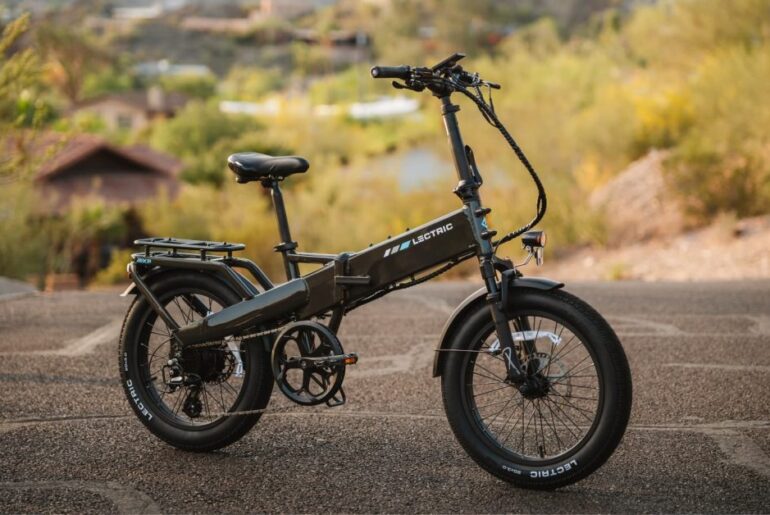
A few years ago, I had to road test lots of e-bikes. My favourite was made by a Dutch company called VanMoof — powerful, elegant, and easy to handle. After a week testing it out for an article, I was severely tempted to buy one, before I saw the £3,190 price tag. Ouch.
Though VanMoof’s prices have since calmed down a bit, top-end e-bikes remain seriously expensive bits of kit. Despite this, they are shipped from factories in China or Taiwan in nothing more than a big cardboard box. When VanMoof started exporting to the United States, it realised that as many as a quarter arrived damaged, with the boxes bashed. Was the solution a wooden crate? Too heavy and expensive. Maybe lots of Styrofoam? Not very eco-friendly. Why couldn’t its shippers treat the bikes with as much care as something equally expensive such as a flatscreen TV?
That was a lightbulb moment for co-founder Ties Carlier. He suggested keeping the same cardboard box, but printing a big picture of a flatscreen TV on the front. Almost overnight, damage costs fell by 70 to 80 per cent.
Soon, other bicycle companies started copying the trick. This week, I saw a box for a Genesis bike with the image of a flatscreen TV on the front. It’s a really clever innovation — what’s inside hasn’t changed, but what you print on the box completely changes how you treat and view the product.
“Packaging often gets a really raw deal,” Zak Lowe tells me. “But there is so much thought that goes into good packaging.”
He’s a designer of packaging, so he would say this, but he points out that most design graduates want to become the next Sir Jony Ive or Sir James Dyson, inventing high-end consumer products, not cardboard boxes.
Packaging really matters, however, especially because of the explosion in home delivery. Lowe’s company, EP, recently won an award for something that solves a very modern problem: how to ensure a cup of coffee delivered to your home arrives without spilling all over the Deliveroo or Uber Eats bag. Yes, I know, it would be far easier to leave your sofa and actually walk to the coffee shop, but there’s a reason why at least 1.5 million UK people are on skinny jabs.
Most fast-food chains use a second lid, stickers, or even wrap the entire cup in cellophane to stop it spilling en route. Most of these solutions don’t work. Lowe came up with “splashstop”. It is a disk of grease-resistant paper that fits over the top of a cup of coffee and then is secured with the lid. It stops all spills and it costs a fraction of a penny. There is, however, a strategic arrow-slit in the paper disk, which allows the consumer to sip the coffee through the lid, without removing the paper.
Even if you never order coffee for home delivery, many of us buy everything from dog food to computers online, which adds up to a lot of packaging. Beyond the Box, a campaign group, estimates each UK home receives over 200 boxes a year.
The biggest home delivery company of them all, Amazon, ships between 20 million and 25 million packages each day around the world. It has, however, quietly made huge strides in cutting down on cardboard in recent years. The horror stories of consumers being sent a remote control in a box the size of Luxembourg are no longer true.
I am loath to defend Jeff Bezos’s cash-generating machine, but over the last decade it says it has avoided using more than 4 million metric tons of packaging globally by switching increasingly to envelopes and ditching exterior boxes. Why put a shoe box in another box? Just send the shoe box.
My favourite innovation comes from Bissell, which makes carpet cleaning machines. For its pet-hair cleaning vacuum, it designed, with Amazon, a box that could be repurposed as a “cat cubby”, a cardboard house with a strategically placed entrance hole. Boxes don’t need to be boring.
In Germany, Nivea has developed a bottle for a moisturising cream that can be rolled up, like an old-fashioned toothpaste tube, so that you can squeeze out the last drop and not waste any cream.
John West used to shrinkwrap its four-packs of tuna, a standard practice. Now the four tins are secured with no more than a strip of metal tape. You separate the stack of tins by simply twisting — the metal strip stays on the tin and can be recycled with the can. So simple and so clever, but that innovation — saving money and plastic — was the result of months of work from a UK design house, Touch.
Because the ice caps are melting and the old world order is upended, it is easy to think everything is getting worse. But when it comes to packaging, we have made lots of small, incremental improvements. Yes, removing a lithium battery from its tamper-proof case is trickier than splitting the atom, but have you noticed that toys are no longer screwed into their boxes with impossibly tiny fixings?
DS Smith, the UK’s biggest maker of cardboard boxes, often now puts unusually shaped objects not in rectangular but in trapezoid receptacles. It did this recently with a vacuum, and because the trapezoid boxes could be stacked together — like a 3D puzzle — into a huge cube, it could fit 576 of them into a lorry, rather than the previous 288, saving a vast amount on fuel.
Many people see packaging as nothing more than a menace, the flotsam and jetsam of consumerism that is slowly destroying the environment. But when packaging is done well, it is a thing of wonder that not only protects the planet but makes the world a slightly better place. We should celebrate it more.