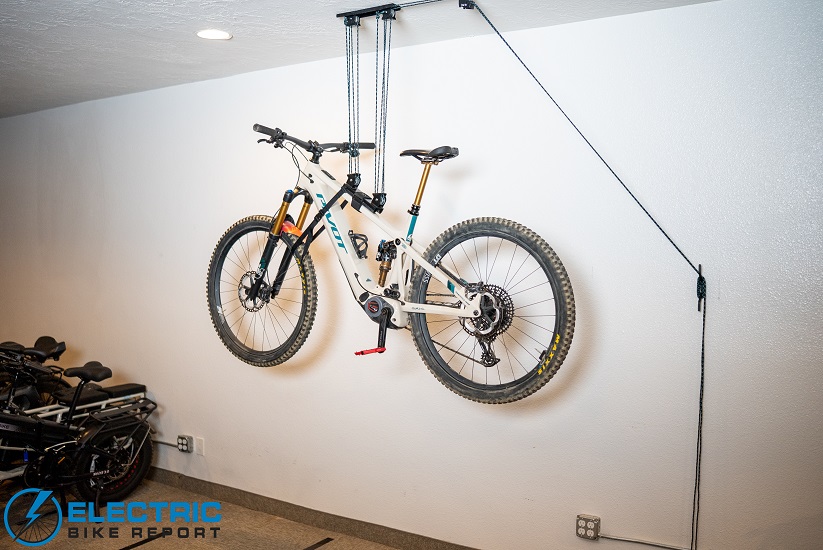
Getting a bike lifted is basically a two-step process. Wrap the main strap around the top tube or the downtube on some step-throughs (more to come on this) and then loop the wheel strap through the front rim and spokes. If your bike has fenders, make sure you stay inside the fender arms so you’re not bending anything out of shape. Once everything’s snugged down and the front wheel can’t turn (nor the handlebars, by extension), you’re ready to lift. The contact points use rubber pads or soft materials, so you’re not risking scratches or frame damage.
If you’ve ever raised or lowered a set of blinds, this isn’t drastically different. Pull the rope at an angle to raise the bike and lock it into place, then tie off the extra slack at the wall cleat. To lower it, pull down at an angle directly beneath the brake to release the lock and let it glide back down. It’s simple and intuitive, just watch your hands to avoid any rope burn.
With the 4:1 mechanical advantage, you’re effectively lifting only 17.5 lbs at max capacity—less effort than picking up my toddler.
The main detail here for e-bikers is respecting the weight limit. Many e-biks exceed 70 lbs, but can make weight by ditching the battery (not a bad idea for winter storage anyway to bring it out of the cold garage), or fenders and racks.
Since the bike is hanging in the air, it may sway a little. It’s harmless, but some folks online crank the system all the way up to pin their handlebars against the ceiling. I wouldn’t recommend that with most e-bikes, as their displays, buttons, and control panels can get banged up if you’re stuffing them into drywall. I’d just live with a little movement, personally.
Here is the main limitation: step-through frames. With no top tube to strap to, you’re forced onto the downtube. On many e-bikes, that tube is either oversized to house a battery or just beefier in general to support the extra weight of a motor and pack. In my testing, half a dozen step-through e-bikes either had tubing too large for the Velcro strap (which has about 6″ or 150mm of circumference size max that it can accommodate) or were so rear-heavy (hub motors) that the hoist shifted until the bike wanted to hang vertically.
It might work for certain ST bikes, but in general, I’m not sure I recommend it.
Outside of that caveat, the system works exactly as advertised with a top tube to grab onto (including mid-step frames with top tubes at a steeper angle that I tested). It’s an easy, low-cost way to clear walking lanes.