
Listen to the article
4 min
This audio is auto-generated. Please let us know if you have feedback.
Dive Brief:
Canada and China have reached terms of a trade agreement to lower tariffs on China-built electric vehicles in exchange for reduced duties on a range of Canadian exports, according to a press release from the office of Canada Prime Minister Mark Carney.
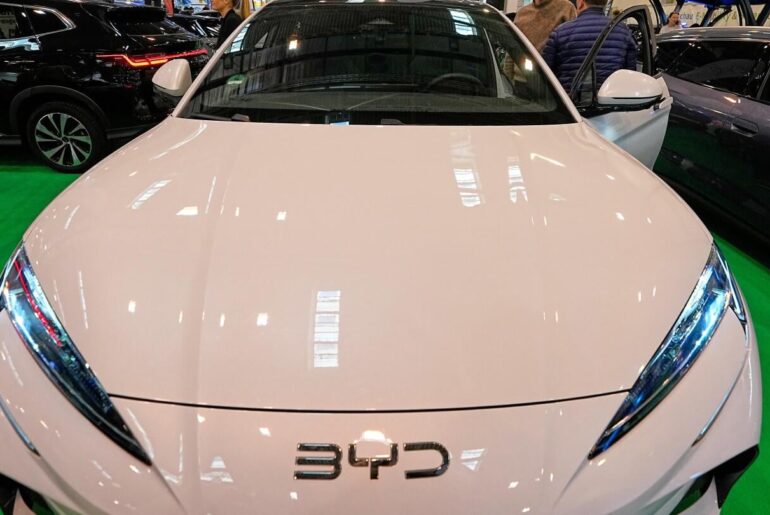
Per the pact, Canada agreed to allow up to 49,000 China-built electric vehicles to enter the country at a most-favored nation tariff rate of 6.1% on an annual basis, removing a 100% rate set in 2024.
As part of the agreement, reached after Carney’s visit to China this week to meet with government officials, in the next five years, more than 50% of the EVs imported under the quota must be affordable models with an import price of $35,000 CAD or less.
Dive Insight:
Canada’s new trade agreement with China breaks with the U.S., which imposed an additional 100% tariff on China-built EVs in September 2024 on top of a 2.5% duty that was already in place. The tariffs were installed by the former Biden Administration to protect the U.S. auto industry from what the government said were “unfair trade practices.”
The steep tariffs effectively keep China-built EVs out of the U.S. market. But China’s OEMs are now targeting the EU, South America and other regions for global expansion.
The 49,000-vehicle quota for China EVs represents less than 3% of Canada’s new-vehicle market, according to a government press release. Canada plans to work with China-based OEMs to ensure the EVs are certified to meet Canadian motor vehicle safety standards in a timely manner, per the release.
The agreement is also expected to drive significant new Chinese joint-venture investments in Canada, including a build-out of the country’s EV supply chain. The Canadian government said the investments will help “protect and create new auto manufacturing careers” for Canadian workers. The deal also includes scaling two-way investments in clean tech, such as batteries, solar, wind and energy storage.
In addition, Canada plans to extend to the end of 2026 previous remission measures for steel and aluminum products imported from China that are in short supply in the country, per a government bulletin. In total, the measures cover 66 lines of product-specific remissions, including 11 full remissions and 55 partial remissions.
As part of the trade agreement, Canada expects that China will lower tariffs on Canadian canola seed to a combined rate of approximately 15% by March 1, down from the current combined tariff level of 85%. The reduction would significantly improve market access for approximately $4 billion of Canadian canola seed exports to China annually, per the bulletin.
Canada also expects that other Canadian export products, such as canola meal, lobsters, peas and crabs, will not be subjected to relevant anti-discrimination tariffs by China, beginning March 1 and lasting until at least the end of the year. The move would significantly improve market access for $2.6 billion of Canadian agricultural goods, the bulletin states.
China is the second-largest single-country trading partner to Canada, totaling $118.9 billion in two-way goods traded in 2024. Of this amount, Canadian exports to China were valued at $30 billion. The new agreement targets a 50% increase in Canadian exports to China by 2030.
The two countries plan to review the progress made to implement aspects of the agreement in three years while continuing to discuss additional trade issues in the coming months, according to the bulletin.
“By leveraging our strengths and focusing on trade, energy, agri-food, and areas where we can make huge gains, we are forging a new strategic partnership that builds on the best of our past, reflects the world as it is today, and benefits the people of both our nations,” Carney said in a statement.