3
As Ford’s F-150 Lightning EV goes away, Chevy’s electric pickup gets Trail Boss trim
 By KEVIN WEAKS
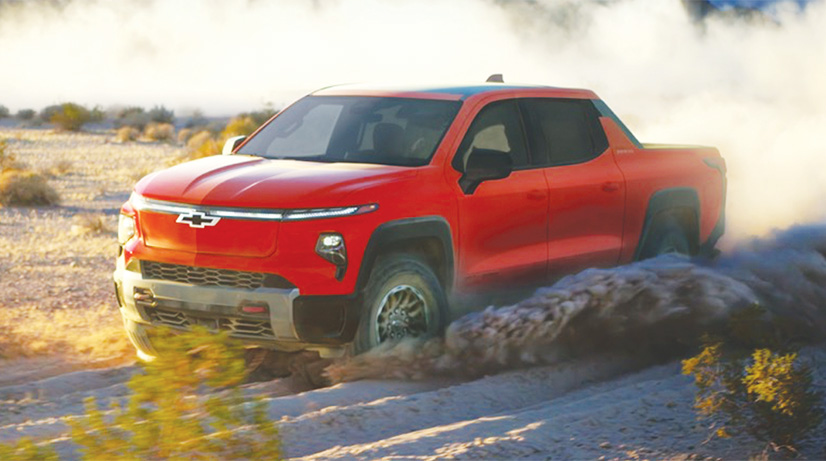
 OFF-ROAD TRAIL BOSS TRIM – Chevrolet now offers its popular off-road Trail Boss trim as part of the 2026 Silverado EV lineup. Trail Boss features up to 760 hp and all-wheel drive is standard.
Global electric vehicle sales surged in 2025 with China and Europe leading the growth. But not in the U.S.A. Expiring tax credits and an administration that favors the oil industry are among the reasons that Ford Motor Co. announced that it has ceased production of the all-electric F-150 Lightning, its flagship full-size electric pickup. It will be replaced by a plug-in hybrid version.
While the folks at Ford are slamming the brakes on all-electric vehicles in favor of less-expensive hybrids, General Motors is putting the pedal to the metal. Not only is Chevrolet continuing to promote its Silverado EV pickup, it is adding another trim line that pushes the starting price to more than $70,000.
Chevrolet now offers its popular off-road Trail Boss trim as part of the 2026 Silverado EV lineup. Previously available on Silverado and Colorado, the rough and ready Trail Boss option offers customers the ability to leave the pavement behind while enjoying the benefits of an electric truck.
“Trail Boss has been one of the highest turning trims in our portfolio since we first launched it on the 2019 Silverado,” said Chevrolet Vice President Scott Bell. “Adding Trail Boss to Silverado EV gives customers an option that builds on our strong truck pedigree, high electric range and off-road capability.”
SLOW ELECTRIC VEHICLE SALES
The all-electric F-150 Lightning was a big deal to Ford. It was announced in 2021 with great hoopla and an appealingly low price of just $40,000. But once it actually hit production lines, Ford was never able to sell it for anything close to the promised price tag. (The 2026 F-150 Lightning and the Chevrolet Silverado EV both have starting prices in the mid-$50,000s.)
The cancellation of the popular Ford F-150 Lightning shocked the electric truck world. The innovative Lightning proved extremely popular, consistently leading electric pickup sales for much of 2025 — even topping the segment in the first and third quarters — driven partly by expiring incentives. It was the best-selling EV pickup in the U.S. But the profit margin was in the negative column resulting in significant financial losses for Ford’s EV unit.
So, while Ford redirects its EV strategy toward hybrids, GM is cautiously moving ahead with its electric truck lineup despite lower-than-expected sales. In fact, some industry wags suggest that GM executives are just as concerned about the future of some of their electric truck offerings, including the Silverado EV and GMC Sierra EV (which the Silverado outsells two-to-one). Meanwhile, GM continues to work on reducing battery cell costs and that the savings will hopefully allow GM to bring Silverado EV prices closer to parity with gas-powered Silverados.
GM is also counting on its purpose-built battery platform and large-scale battery joint venture plants, which is the opposite of a company preparing to pull the plug. They developed a dedicated EV architecture which could be globally scaled to get to profitability.
SILVERADO EV VS. F-150 LIGHTNING
The biggest difference between the F-150 Lightning and the Silverado EV comes from how they were designed. The Silverado EV is built from the ground up as an electric vehicle, using GM’s Ultium lithium-ion platform with motors, battery, and suspension integrated into the structure.
The Lightning takes a different approach, using the familiar F-150 body-on-frame design and electrifying it. Each approach brings tradeoffs, including weight, payload and overall driving character.
The Silverado EV’s much larger battery adds weight but gives it more range. The Lightning, being lighter in comparison, offers better payload capability. Range is the topic that dominates most EV conversations, and the difference here is substantial. The Silverado EV with its massive battery can deliver close to 500 miles of range under ideal conditions. The Lightning extended range version delivers roughly 320 miles.
It’s worth noting that both trucks turn their batteries into mobile power stations. Each offers multiple power outlets in the bed, cabin, and front trunk, making them useful for job sites or camping. The Silverado provides slightly more onboard power at just over 10 kilowatts, while the Lightning offers just under 10.
The Silverado EV’s tech-laden cabin has room for five, and there’s 11 cubic feet of cargo space in the front trunk. The Silverado EV features a “midgate,” allowing the rear cabin and bed to combine into an extended cargo area of over 11 feet. This makes carrying long items like lumber or fishing rods far easier without a trailer. The Lightning does not have a midgate, but it counters with generous interior storage and a highly usable rear seating area that folds to create a large flat load space.
All Silverado EV models come with an 11.0-inch digital gauge cluster and a massive 17.7-inch center touchscreen. The infotainment system uses Google-based software and can be reconfigured to the driver’s preferences. Unlike the Hummer EV, which comes with up to three electric motors, the Silverado EV is powered by two. The base WT trim (from $55,395) makes do with a mere 510 horsepower, the Trail Boss (from $72,095) has up to 725 hp, and the LT offers up to 760 hp. All-wheel drive is standard, while a rear-wheel-steering system and an adaptive air suspension are optional; a set of huge 24-inch wheels is also available. A Max Range LT version tops the bill at $91,795.
The Silverado EV is available with three different battery options: Standard, Extended and Max. With the Max, the entry-level Work Truck has an EPA-estimated range of 493 miles. Compare that with the Standard pack, which is limited to a 286-mile range. The LT with the Extended battery is rated for 410 miles of range, same as the Trail Boss, and choosing the Max pack nets both a GM-estimated range of 478 miles.
The EPA says that the 2026 Silverado EV will return 70 MPGe in Work Truck trim and 68 MPGe in LT trim. MPGe stands for miles per gallon of gas equivalent, an EPA metric that estimates PHEV and EV vehicle fuel efficiency. With a maximum tow rating of 12,500 pounds and an1,800-pound payload rating, it gives up just 800 pounds in towing and 400 pounds of payload to the gas-fed Silverado.
(Contact Kevin Weaks at [email protected].)