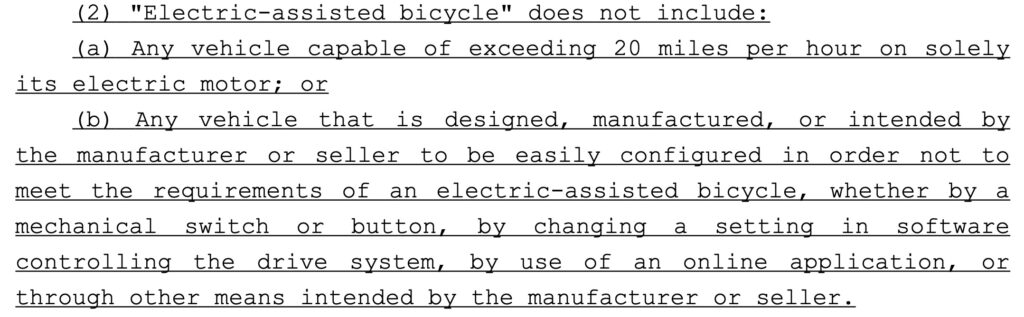
 Excerpt from the initial draft of HB 2374 – 2025-26.
A new bill in the Washington State House would make a number of changes to the statewide e-bike and motorcycle laws in an attempt to address the growing problem of very powerful and fast electric two-wheelers sold and operated with somewhat confusing and unclear legality. While many of the bill’s measures are common sense, bill writers may also want to explore what they can do to help electric motorcycle riders comply with state law. We will get to HB 2374 – 2025-26 later in this post, but first we need some background.
The core of the problem is essentially an extension of long-standing problems surrounding the use of non-street-legal motorized dirt bikes that are sold for “off-road use only” but are often ridden on public streets anyway. These motocross-style motorcycles are often missing the mirrors, lights and other requirements to legally license them for use on roadways in Washington State. However, electric motor and battery technology advancements have made electric versions of these bikes (“e-motos”) much more easily attainable, and in some cases they are even sold as electric bicycles (“e-bikes”) even though they are capable of power and top speeds far exceeding the existing electric bicycle classes defined in state law. Electric motorcycles are also much more easily disguised as legal electric bicycles, making the infraction much less obvious than someone riding a roaring motocross bike down the road. There are also serious questions about misleading marketing, including whether parents might think they are buying their child a regular electric bicycle when in fact they have bought them an illegal motorcycle disguised as an electric bicycle.
I see and hear people who are confused about the difference between these devices all the time. Current state law meets national standards by defining an electric-assisted bicycle as a bicycle with working pedals and an electric motor that can provide power up to a limit of 750 Watts that fits into one of three classes:
— Advertisement —
Class 1: Pedal-assisted device that stops providing assistance beyond 20 mph
Class 2: Throttle-controlled device that stops providing power beyond 20 mph
Class 3: Pedal-assisted device that stops providing assistance beyond 27 mph
Different agencies and local jurisdictions can create their own rules based on the classes, such as Seattle’s rules that allow Class 1 and 2 bikes to use sidewalks, trails and bike lanes but not class 3 (except for certain cases in which a path is the only practicable option, like many of the city’s bridges). The state also limits the use of e-bikes on soft surface trails like mountain bike trails. But in most cases, Class 1 and 2 e-bikes are treated under the law the same as regular bicycles because 20 mph is a top speed that is within reasonable reach of many pedal bike riders.
An important detail that I see people get wrong or gloss over all the time (such as this video from the Berm Peak YouTube channel) is that people look at any e-bike that looks like a dirt bike as though it is an e-moto. Styling has nothing to do with it. There is nothing wrong with someone who wants a Class 2 e-bike that looks like a motocross bike. I don’t personally want a bicycle with a non-adjustable seat and poorly-functioning pedals, but to each their own. If it meets the power and speed limits of a Class 2 e-bike, then it’s a Class 2 e-bike. Of course if someone is riding one irresponsibly then that’s an issue, but you could say that about any non-licensed wheeled device from pedal bikes to skateboards.
However, if a bike is sold as a Class 2 e-bike but those power and speed limits can be easily bypassed, that is a serious problem. Motorcycles are not themselves bad, but they are regulated and licensed for very good reasons. Every bit of extra weight and speed makes a vehicle significantly more dangerous to both riders and others. People often do not understand that the impact force of an object quadruples when its speed doubles. So a person operating a vehicle going 40 mph not only has half the time to react to avoid a collision compared to a person going 20 mph, they also have a much longer stopping distance and quadruple the kinetic energy in the occasion that a collision does occur. So switching a mode on a 20 mph e-bike so it can go twice as fast is not a trivial action. It has turned the device into something very different that needs different rules and regulations.
— Advertisement —

HB 2374 – 2025-26 contains several actions. First, it clarifies the difference between legal e-bikes and e-motos, including a section that specifically defines vehicles that do not count:
(2) “Electric-assisted bicycle” does not include:
(a) Any vehicle capable of exceeding 20 miles per hour on solely its electric motor; or
(b) Any vehicle that is designed, manufactured, or intended by the manufacturer or seller to be easily configured in order not to meet the requirements of an electric-assisted bicycle, whether by a mechanical switch or button, by changing a setting in software controlling the drive system, by use of an online application, or through other means intended by the manufacturer or seller.
I am not a lawyer, so I have no idea if this is the best legalese to achieve the goal, something I imagine will be considered as the bill moves through the legislature, but the intent is to close the loophole that e-motos can be marketed and sold as e-bikes and then easily reconfigured by users to bypass the speed and power limits.
The bill then adds a new legal definition for an “electric motorcycle” (basically stating that it exceeds the e-bike limits) and adds them to existing sections in the law related to motorcycles. It also clarifies that “foot pegs are not considered pedals.”
Finally, the bill adds a new section that tasks the state Department of Licensing with convening a group of transportation, traffic safety, local government, and active transportation nonprofit representatives to develop a report addressing enforcement of these rules as well as the regulation of vehicle modifications and marketing. There are no teeth in this new section, but the group’s report could form the foundation for future action whether at the agency or legislative levels. It could be the basis for police crackdowns, for example. Or perhaps it could lead to lawsuits against companies marketing e-motos deceptively. These are details the group would figure out.
One of the more difficult tasks is how to determine whether a bike has illegal power limits or not. As we noted earlier, stylings mean nothing. It’s a simple matter of free speech, much like clothing. If someone wants their Class 2 e-bike to look like a motocross bike, that’s their right. So how, then, would a police officer know who to stop? This is going to be very tricky to get right since leaving too much up to officer discretion often leads to inequitable enforcement. Writing enforcement best practices that can be implemented without introducing new channels for biased policing will be challenging.
The bill is also missing efforts to support responsible e-moto riding. The bill reads as though e-motos are entirely bad, but don’t we want more people to get around our state using electric vehicles? While legislating against behaviors and outcomes we don’t want (like kids riding motorcycles!), perhaps it’s also worth figuring out how to support what we do want. Stay tuned for more.