January 15, 2026
By Karan Singh
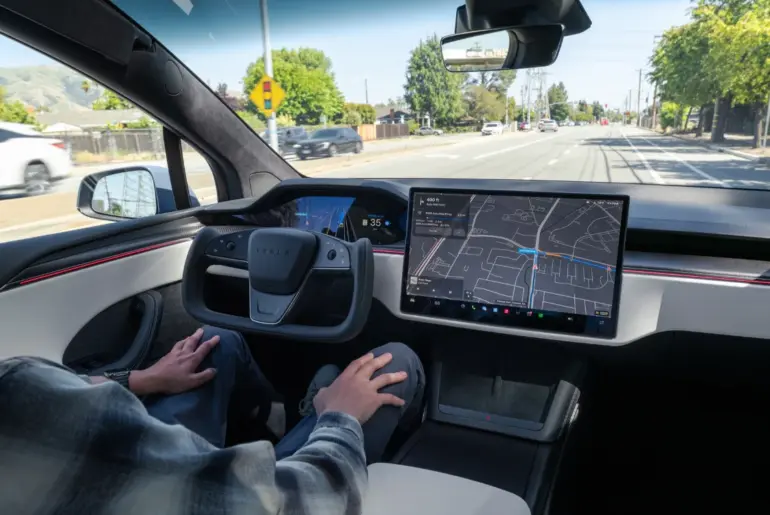
Earlier today, Elon Musk announced that Tesla will stop selling FSD as a one-time purchase and instead require owners to subscribe to FSD. The deadline to purchase FSD is February 14, 2026. After that date, the software will be available exclusively as a monthly subscription.
While most owners now subscribe to the service rather than purchase it, it’s mostly because of the high up-front cost of FSD. Tesla priced FSD as high as $15,000 in September 2022, before gradually lowering the price to the current $8,000 in the U.S.
However, this change may be more about Tesla’s future plans than owners’ payment preferences.
Musk’s Milestone & Steady Revenue
If there is one thing that investors want, it is predictable revenue streams, and subscription-based FSD delivers on exactly that.
While one-time purchases create jagged revenue spikes as most users buy FSD with the purchase of a new vehicle, subscriptions create a steady, predictable cash flow.
This change also aligns directly with Elon Musk’s 2025 CEO Performance Award, which specifically targets a milestone of 10 million FSD subscriptions — not purchases.
By making the subscription model the only way to access FSD, Musk is effectively accelerating its path toward that operational goal while satisfying Wall Street’s desire for stable Software-as-a-Service revenue models.
The Hardware Loophole
Perhaps the biggest benefit for Tesla is legal and operational. By removing the upfront purchase option, Tesla is effectively eliminating the “forever promise” of hardware capability that has plagued it so heavily in the past.
When a customer buys a license to Full Self-Driving, they have a reasonable expectation that the product will eventually be fully autonomous, which is what they paid for. This has led to intense debates, lawsuits, and ongoing perception issues with FSD purchases on hardware 3 vehicles, which now need to be retrofitted with new hardware.
A subscription model solves this problem instantly. Now, when a customer subscribes to FSD, they’re subscribing to what FSD (Supervised) is capable of today – not a promise for future autonomy. If an older vehicle can eventually no longer run the latest models, the owner simply stops subscribing, absolving Tesla of the obligation to perform costly hardware retrofits on aging vehicles.
The Math Didn’t Work
For most consumers, the $8,000 upfront cost had largely stopped making sense financially. At the current price of $99 per month, it takes roughly 6.5 years of continuous payments to equal the lump-sum purchase price.
That calculation doesn’t even take into account the ability to use that money elsewhere – whether it be on an investment in Tesla stock, or perhaps purchasing that wheel, interior, or exterior upgrade you wanted instead of FSD.
In addition, if you totaled your vehicle, some insurers wouldn’t factor in the cost of FSD into the value of your vehicle. Your FSD license would essentially vanish if you couldn’t take advantage of an FSD transfer deal.
With the break-even point pushed so far out and the economics against it, subscribing has been the financially superior move for the vast majority of owners for quite some time now.
Autonomy Is Worth Much More
This change to a subscription model raises several questions about Tesla’s future packaging of FSD. Tesla currently bundles FSD with the Model S, Model X, and the Cyberbeast with the Luxe package, suggesting we’ll either see a price reduction or a repackaging to adjust the licensing terms.
Furthermore, a subscription-only offering provides Tesla the chance to segment out FSD. That means we could eventually see different tiers of FSD – including a cut-down Autopilot version, today’s current FSD (Supervised), a next-gen FSD (Unsupervised), and potentially a commercial license as well that could be used for Uber and other services.
Looking at it from the other side, this change could indicate that Tesla feels it’s close to unsupervised FSD. If Tesla solves true autonomy, the value of FSD will fundamentally change from a driver-assist future to a personal chauffeur service worth tens of thousands per year.
A subscription model is much more convenient for Tesla, as it allows them to change the terms at will. While $12,000 is a significant amount of money, Tesla would be leaving money on the table if it sold true autonomy for that price without restrictions.
By locking users to a subscription model now, Tesla retains the ability to adjust that monthly fee as FSD’s value continues to improve over time.
Subscribe to our newsletter to stay up to date on the latest Tesla news, upcoming features and software updates.
January 14, 2026
By Karan Singh
Last week, The Boring Company (TBC) laid out a detailed roadmap for the Holy Grail of transportation in Sin City: a direct, underground connection between the Las Vegas Strip and Harry Reid International Airport.
According to TBC President Steve Davis, the company has already begun limited airport pickups, which begins a four-phase rollout that will ease surface-level traffic.
Four-Phase Roadmap
The airport connection isn’t happening all at once; it is being activated in stages to get passengers moving from point to point immediately.
Phase 1
Phase 1, which is active now, involves limited test rides (about 50 per day), using existing TBC Loop stations at Resorts World, Encore, Westgate, and the Las Vegas Convention Center. Just this week, 100 of the fleet’s 130 Teslas were outfitted with the required airport transponders, allowing them to pick up passengers and operate on a hybrid route that combines tunnel travel with surface streets.
Phase 2
Phase 2, which is scheduled to begin in the coming months, is a new 2.2-mile dual-direction tunnel currently under construction. This new section of the tunnel will run from Westgate toward Paradise Road. Once active, vehicles will exit the tunnel system much closer to the airport, removing two miles of surface traffic from the journey.
Phase 3
The next big expansion begins in Phase 3, where the tunnel network will extend even closer to Terminal 1 at Harry Reid. This also bypasses one of the heaviest traffic intersections in Las Vegas – Tropicana and University Center. To support this volume, Phase 3 will also double the Loop fleet to nearly 300 vehicles.
Phase 4
Phase 4 is the final step, with a dedicated underground station built directly at the airport terminals, allowing passengers to step off a plane and into a Tesla without ever seeing the desert sun.
FSD Goes Underground
While the expansion continues, the vehicles inside the tunnel are also getting an upgrade.
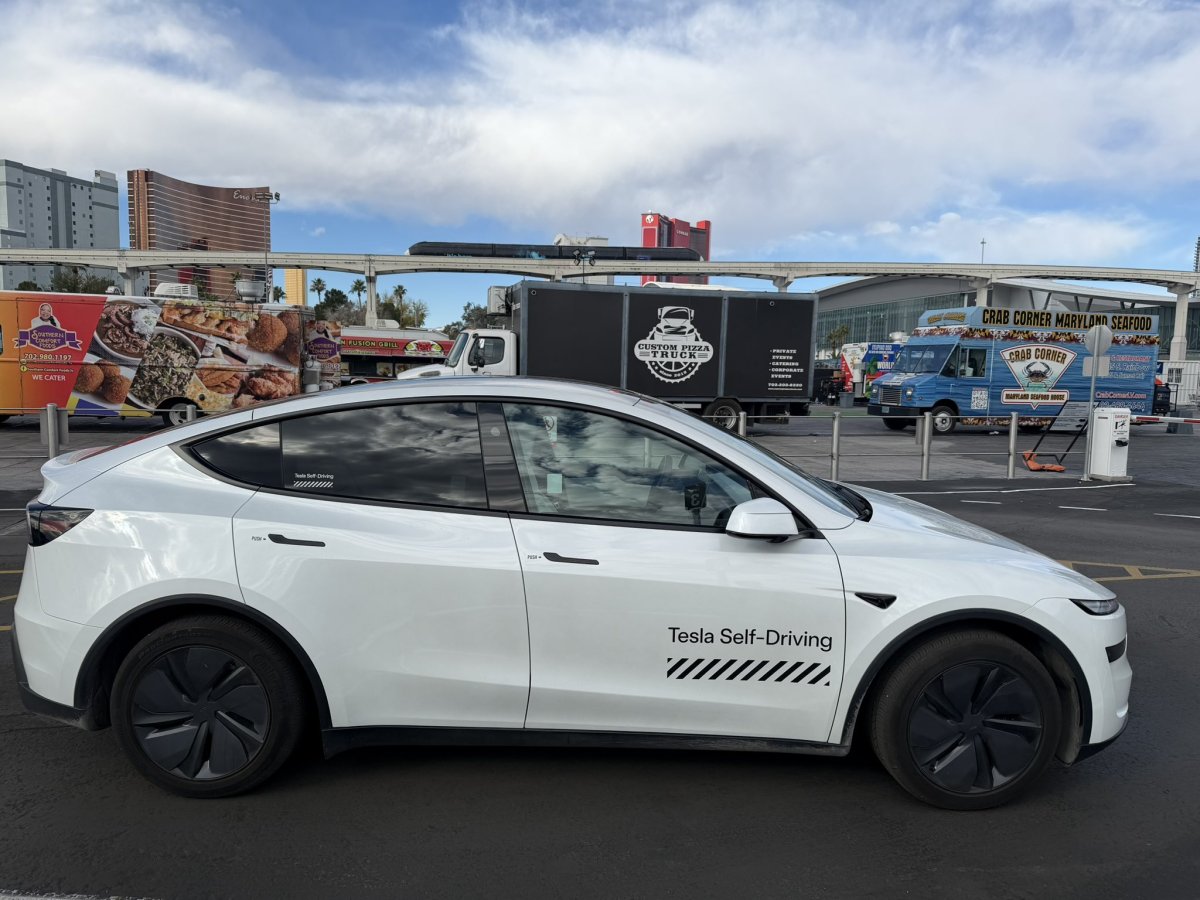
TBC vehicles have been spotted this week sporting new Tesla Self-Driving decals, and are using FSD (Supervised) for the first time to begin traversing the loop. The vehicles are still monitored by TBC employees, so they aren’t autonomous quite yet.
Just got to ride in the first car in the Boring Loop with Full Self-Driving!
The car flawlessly took us from Central Station to the Encore with zero input from the safety driver except the start button. @elonmusk @boringcompany pic.twitter.com/5SMoermDM5
— Ryan Zohoury (@RyanZohoury) January 9, 2026
This transforms the Vegas Loop into a validation track for FSD, focused on testing its close-in capabilities to drive in the tight Boring Loop. The controlled environment will eventually support speeds up to 150 mph in certain straightaway sections.
2027 Target
To finish the full 68-mile Vegas Loop by the targeted 2027 date, TBC needs to speed up – not just the cars, but the paperwork.
TBC needs over 600 additional permits across Clark County to complete the system. At the current pace of one approval every 1-2 weeks, the project would take decades. TBC is working with local officials to try to streamline an operator-style permitting process, similar to how SpaceX operates Starbase, to facilitate approvals.
January 14, 2026
By Karan Singh
Yesterday, Tesla released the next version of FSD to its early access group. FSD v14.2.2.3 arrives with update 2025.45.8. While it appears to be a minor revision to FSD v14.2.2.2, users are already noticing behavior changes.
The release notes remain unchanged, but early-access FSD testing suggests this release includes further improvements and not merely minor fixes.
Tesla FSD v14.2.2.3 finds its way down a 5 level parking garage, pulls up to the ticket dispenser, then exits when the arm lifts.
Chefs kiss. pic.twitter.com/0bYYtDTrUp
— Zack (@BLKMDL3) January 13, 2026 Low Speed Awareness
The most tangible improvement in v14.2.2.3 appears to be in its low-speed spatial awareness, specifically regarding FSD Autopark. Historically, FSD’s parking, when not initiated manually via Autopark, was often hesitant, requiring multiple shuffles to align the vehicle properly, or, rarely, missing entirely.
Recent testing shows improved parking at the destination, with the vehicle now more confident and able to park in a single maneuver. Across various parking scenarios, ranging from perpendicular charging stalls to tight parallel street parking, FSD achieved success without requiring any corrections or realignment. FSD now positions itself for reversing with greater forethought, likely a sign of FSD’s improving reasoning capabilities.
Parking with FSD v14.2.2.3 has been excellent for me.
Normal parking spots, Tesla Superchargers, and third-party chargers were all great- I tried them all. pic.twitter.com/ZAD3eOWH1o
— Zack (@BLKMDL3) January 13, 2026
That reasoning is most evident in a moment when FSD navigated a parking garage incorrectly, then self-corrected with a 3-point turn and continued.
This precision is also extending to the last few inches of the drive. Early access users are also seeing the vehicle center itself better in a parking spot or when pulling over.
High Speed Reactions
On the other side of the velocity spectrum, v14.2.2.3 is also showing increased confidence in spirited driving scenarios. When using Mad Max on technical canyon roads, FSD now feels more capable.
Tesla FSD v14.2.2.3 takes me to the Tesla Diner through tight canyon roads with zero human intervention. pic.twitter.com/Ycqws20tK5
— Zack (@BLKMDL3) January 13, 2026
The small refinements here mean that FSD now reacts correctly during dynamic turns, keeping itself properly centered. This confidence also translates to the highway, with the overall experience smoother and both Hurry and Mad Max better positioned for overtakes and merges.
FSD v14.2.2.3 is a reminder that in the world of AI and neural networks, tiny step-change improvements can often be bigger than they seem. While the version number and release notes suggest a trivial change, early testing paints a much smoother, well-thought-out drive.
Update 2025.45.8
FSD Supervised 14.2.2.3
Installed on 0.3% of fleet
Last updated: Jan 15, 1:20 am UTC
FSD v14.2.2.3 is still limited to early access customers and a few select owners, but we could see it roll out to additional customers this week. The next major FSD update, FSD 14.3, is expected to bring reasoning capabilities.