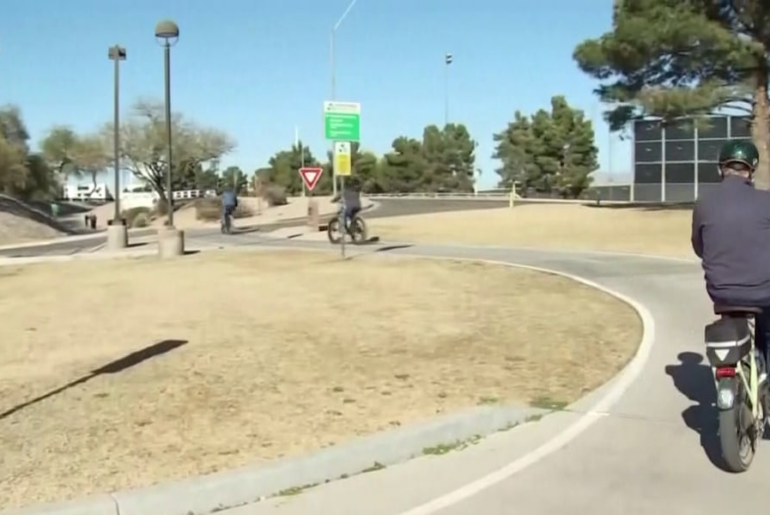
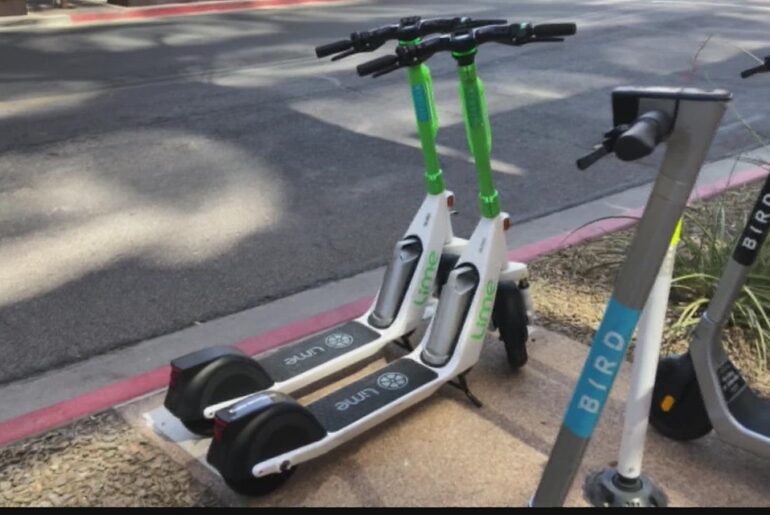
(TNS) — On one of the first balmy days of the new year, you were as likely to see an electric scooter zipping along the pathway around Burleson’s Bailey Lakeas you were a runner motivated by holiday resolutions — despite the fact that e-scooters aren’t allowed in city parks (more on that later).
Nevertheless, pedestrians strolling next to the lake were wise to pay attention, listening for the soft whir announcing an approaching e-scooter — or maybe an e-bike — from behind. Make any sudden moves, and you put yourself in danger of being clipped.
It’s the same if you spend time on sidewalks around Fort Worth, especially near TCU, where it’s easy to find yourself in an impromptu game of chicken on narrow walkways with a student on an e-scooter heading directly at you. And in neighborhoods, residents have growing concerns about youngsters riding electric dirt bikes — a popular Christmas present this past holiday.
WHAT DO TEXAS LAWS SAY ABOUT E-BIKES, E-SCOOTERS AND ELECTRIC DIRT BIKES?
TEXAS LAWState statutes do not allow cities to prohibit e-bikes from places where nonelectric bicycles are allowed, except for areas that aren’t open to motor vehicles and that have “a natural surface tread made by clearing and grading the native soil without adding surfacing.”
The state transportation code stipulates that e-bikes must have motors that disengage when the rider applies the brakes or stops pedaling. Three classes of e-bikes are defined in the state code, and only people 15 or older can legally ride a Class 3 e-bike, which has a top assisted speed of between 20 and 28 miles per hour.
According to state law, e-scooters are allowed on roadways where the posted speed limit is 35 mph or less, and they are permitted on sidewalks and bike paths. But a county or city can choose to prohibit e-scooters from certain sidewalks, paths and roadways for safety reasons.
Electric dirt bikes would fall under the category of “pocket bike” or “mini-motorbike” in the Texas statutes. Those are limited to private property and are not allowed on highways, roadways, streets, sidewalks, bike lanes or bike paths.
Local laws vary by municipality, but here is a rundown of a few nearby cities.
BURLESON
It’s true: in Burleson, e-scooters are barred from public parks, even though you still see plenty of them on park trails.
Jen Basham, Burleson’s parks and recreation director, said e-bikes are permitted in parks as long as they have pedals, the top assisted speed doesn’t exceed 28 mph and the electric motor is less than 750 watts.
The e-scooters, on the other hand, are not allowed because they are primarily throttle powered. Anything not propelled by the foot, Basham, said is off limits. Naturally, that also includes the electric dirt bikes, which are also a common sight in Bailey Lake Park.
In Burleson, there’s an ordinance prohibiting bikes, scooters and the like on sidewalks in the Old Town commercial district, but there’s no law prohibiting e-scooters or e-bikes on streets and sidewalks in other parts of the city, parks excluded.
Mobility devices used by people with physical limitations, however, are exempt from any prohibition in Burleson parks. Basham said when the city was fine-tuning its policy around electric bike and scooter use, there was a conscious effort to not exclude people who depend on those kinds of devices for recreational enjoyment.
KELLER
The city of Keller adopted an ordinance in December aimed at making electric bicycle use safer. Among other provisions, the ordinance echoes the state law in saying no one under age 15 can operate a Class 3 e-bike in the city and e-bikes must have an electric motor that disengages when the rider brakes or stops pedaling.
E-bike riders in Keller can’t wear headphones, earbuds or ear plugs, and riders under 16 must wear a helmet. There’s no state law regarding helmets, but local governments can require them as they see fit.
The Keller ordinance further states e-bikes can’t be used to carry more people than they are designed for, and it sets the maximum speed limit for e-bikes at 15 mph.
Depending on the type, electric bikes can reach speeds of more than 20 mph before the electric motor turns off. Likewise, e-scooters can reach speeds exceeding 20 mph. Some models of electric dirt bikes can exceed 30 mph, and some of the higher-end models reach speeds approaching 50 mph or more.
A Keller spokesperson said the new ordinance only addresses e-bikes, at least for now, and the rules don’t apply to e-scooters.
FORT WORTH
The Fort Worth city code doesn’t directly address e-bikes and e-scooters, so the standard state laws would apply. That means e-bikes and e-scooters are allowed on city roads (with a speed limit less than 35 mph) as well as on sidewalks and paths, except in areas where there are posted restrictions on wheeled vehicles.
It’s a violation of city code to ride a bicycle in a reckless manner, and it’s safe to assume e-bikes are included in that. Bicycle riders under 18 also have to wear a helmet.
The Star-Telegram contacted a Fort Worth police spokesperson for more, but the department did not provide additional information.
COLLEYVILLE
Of the cities in Tarrant County, Colleyville has some of the most stringent regulations governing e-bikes and e-scooters. In May, the city adopted a new ordinance that set the maximum speed limit for e-bikes and e-scooters at 10 mph on sidewalks and trails and 20 mph on the Cotton Belt Trail, which runs from North Richland Hills to Grapevine.
As in other places, no one under 15 can ride a Class 3 e-bike, but Colleyville further restricts anyone under 10 from operating Class 1 and Class 2 e-bikes. Additionally, Class 3 e-bikes require an identification sticker from the Colleyville Police Department.
E-bike and e-scooter riders under 16 can’t wear headphones, earbuds or earplugs. Riders younger than 16 also can’t ride e-scooters on privately maintained roads or on roads with a posted speed limit over 30 mph.
TCU SCOOTER POLICY
A TCU spokesperson told the Star-Telegram university officials are working up a new campus policy governing the safe use, storage and charging of “personal mobility devices,” i.e., e-scooters and e-bikes, to address safety issues.
The spokesperson didn’t go into specifics, but he said TCU’s student government supports the policy change, which is being considered by university leaders. An implementation date is yet to be determined.
Around TCU, one resident who spoke with the Star-Telegram raised concerns about Snag delivery people operating e-scooters in an unsafe manner. Snag is an app-based delivery service for TCU students that operates out of Blue Bonnet Circle. The service provides things like snacks, drinks and grocery and convenience items, touting 10-minute deliveries.
Watching delivery people coming and going from Snag’s Blue Bonnet Circle facility on a recent weekday, some wore helmets and some didn’t. None, however, appeared to be driving recklessly. The Star-Telegram left a message for Snag to ask about the safety requirements for delivery people, but that message wasn’t returned.
COMPLAINTS IN NORTH FORT WORTH’S HERITAGE NEIGHBORHOOD
Residents in the Heritage neighborhood recently took to a community Facebook page and an online message board to vent their frustration with kids riding electric motorbikes and e-bikes, particularly in greenbelt and park areas, like Sinclair Park on Heritage Trace Parkway.
“Anyone just hear the parade of motorcyclists (8 kids) riding their motor bikes along the jogging trail of Sinclair Park?” one resident wrote on Facebook.
“We have kids in our neighborhood that apparently received electric bicycles and we’ve been amazed at how fast they are being ridden both in the street and on the sidewalks,” wrote another.
Jennifer Samuels, vice president of the Heritage Homeowners Association, said she’d seen the social media posts and heard complaints from residents about the e-bikes and motorbikes, and she shared with the Star-Telegram a message from the HOA’s general manager that said the association was working with the local Fort Worth police neighborhood officer to address those concerns.
“A reminder will be sent out to residents reinforcing that dirt bikes and other motorized vehicles are not permitted on the trails,” the general manager’s message said.
The dirt bikes aside, which aren’t allowed on public roads or public property, Samuels said the HOA doesn’t have rules in place governing e-bikes and e-scooters on neighborhood streets and sidewalks. As previously established, city code permits those, assuming riders aren’t operating them recklessly.
All concerned citizens can do is call the police if they see someone riding an electric dirt bike or mini-motorbike on public property, or call and report it if they observe someone operating an e-bike or e-scooter in a reckless manner. But it’s also incumbent upon e-bike and e-scooter riders to ride with caution, remembering that pedestrians have the right of way on walkways and roadways.
©2026 Fort Worth Star-Telegram, Distributed by Tribune Content Agency, LLC.