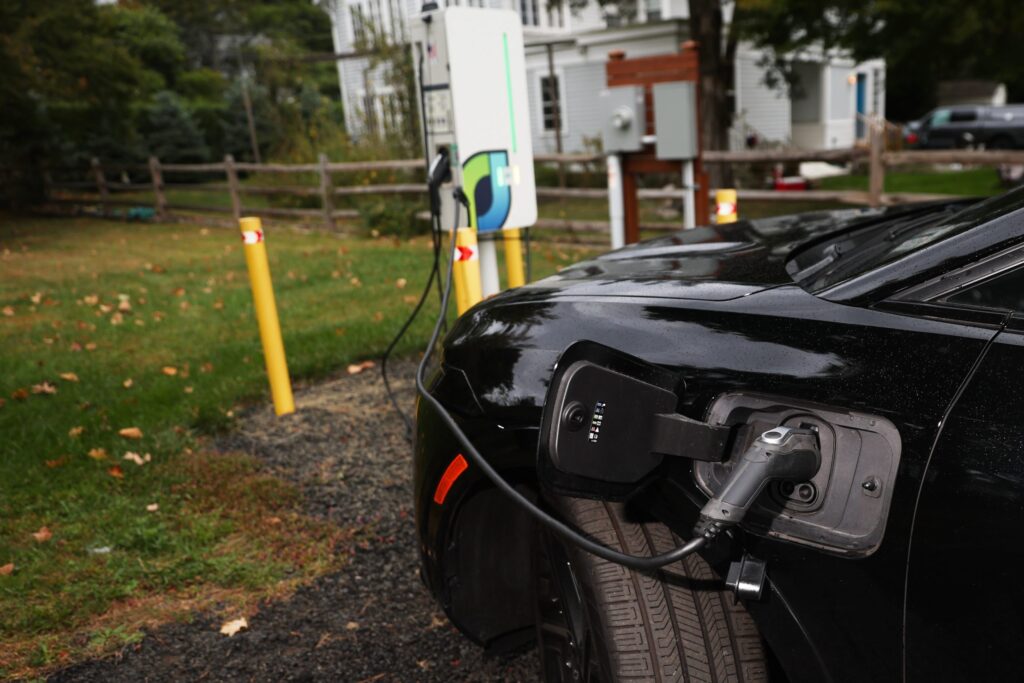
The 180-mile drive from Melissa Birch’s north-central Minnesota home to the Twin Cities in her all-electric Chevy Bolt has become “dramatically” easier in the last few years.
That’s thanks to a six-fold increase in the number of electric vehicle fast-chargers along the route, Birch wrote last January in a blog post for Minnesota Clean Energy Resource Teams, her employer.
“It has gotten to be so that I can get pretty much anywhere I need to go,” she said in an interview last month.
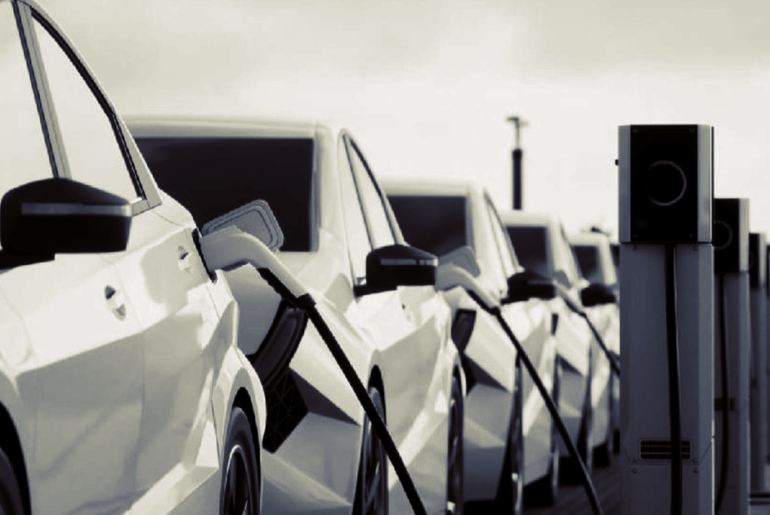
Though most charging sessions still happen at home, Minnesota’s steady buildout of public chargers is reducing range anxiety for EV drivers whose travels take them farther afield. Minnesota had more than 2,800 public charging plugs for electric vehicles in October, according to a state database. Eight-hundred thirty-four of those were direct-current fast chargers, or DCFCs, that can fill up most EVs in an hour or less.
That’s a marked improvement from 2022, when Minnesota had just 273 public DCFC plugs, though still far short of the 4,000 DCFCs the Minnesota Department of Transportation says it needs by 2030. Local governments, public utilities and for-profit companies like Tesla continue to install new chargers, with increasing focus on underserved stretches of rural Minnesota. Station utilization is slowly but steadily rising even as EV sales cool.
Long-distance EV drivers like Birch can thank Congress for creating at least three public charging programs under former President Joe Biden, allocating billions of dollars of grant funding to state and local governments to install or replace charging stations at community hubs and along busy travel corridors. Those funds enabled thousands of planned charger deployments nationwide, bolstering private capital and nongovernmental sources like the Volkswagen Clean Air Act settlement.
But due in part to the Trump administration’s all-out effort to roll back federal support for less-polluting technologies like renewable energy and electric vehicles, Minnesota’s public charging network faces an uncertain future. State data shows installations slowed in 2025 after two years of brisk growth. EV drivers still complain of frustrating experiences with older, unreliable chargers, particularly at small-town and wayside stations that may be the only option for miles.
Meanwhile, the North American EV market faces policy headwinds that could dent future demand. Local and national experts frame these issues as growing pains, not existential threats to the future of electric mobility. But they acknowledge that more must be done to ensure a truly frictionless EV road-trip experience in Minnesota and beyond.
Bumps in the road, some bigger than others
Shortly after taking office, President Trump froze funding for all three federal programs, upending long-term transportation electrification plans in Minnesota and other states. Trump’s administration in August reluctantly followed a court order to restart the National Electric Vehicle Infrastructure program, but the Charging and Fueling Infrastructure and Electric Vehicle Charger Reliability and Accessibility Accelerator programs remain paused amid ongoing litigation.
U.S. sales of battery-powered vehicles plunged after President Trump signed a law in July repealing federal tax incentives. Not long afterward, Ford pulled the plug on the all-electric pickup it once expected to drive mass EV ownership in rural America. Ford and many of its competitors are instead looking to electrify the sorts of smaller, more affordable models that aren’t as popular with rural and suburban drivers. Transportation analysts have duly reduced forecasts for near-term EV adoption in the United States.
The uncertainty has roiled an already-competitive EV charging industry and heightened drivers’ reliability concerns. Several equipment and software providers have run into financial trouble, gone out of business or simply left the U.S. market since 2024. Complaints about broken equipment, glitchy payment apps and nonresponsive technical support proliferate on the popular PlugShare app, where drivers find and review public chargers.
A charger in Fairmont “charged my card but not my car,” one driver complained in October.
“This thing needs a reset or something. Still doesn’t work,” griped a return customer in Albany last month.
In Hutchinson, “[the] charger would start and stop within 1-3 minutes making it difficult to use,” said a third.
Rebecca Michael, communications manager for Otter Tail Power, said in an email that the western Minnesota utility’s roughly 20-charger network hit a “bump” this summer when it changed third-party network providers.
To minimize disruption during the transition, Michael said Otter Tail switched its chargers to “free-dispense mode,” temporarily forgoing revenue in favor of reliability in its largely rural service area. It’s also shoring up support for troublesome chargers by “improving remote diagnostics and standardizing troubleshooting through the app and support line while our new provider integration wraps up,” she said.
Remote support techs might be able to help with software issues, but they can’t fix busted hardware. That’s a problem for stations using legacy equipment from troubled or defunct manufacturers like Tritium, which went bankrupt in 2024.
A Tritium DCFC at the municipal campground in Grand Marais went down in May and remained offline into December while awaiting replacement parts, according to numerous Plugshare reviews. In the meantime, drivers have to settle for a slower “Level 2” charger at the campground that adds a few dozen miles per hour at most.
Rochester-based Southern Minnesota Municipal Power Agency maintains the Grand Marais campground station and about 15 others across the state, mostly in small towns. Each has at least one DCFC port and four Level 2 ports, Joe Hoffman, chief external affairs officer for SMMPA, said in an interview last month.
Hoffman, an EV driver himself, said he understands public frustration with nonfunctioning hardware.
“The situation can arise where you’re expecting to use a DCFC… and if not, you have to use a Level 2, which obviously takes more time,” he said. A long-term fix for the Grand Marais station would likely require “a tech [to] drive up from the Twin Cities,” he added, underscoring the logistical challenges of keeping rural charging stations in working order.
The good news, Hoffman said, is that SMMPA expects Tritium parts to remain available in the future. But that hasn’t stopped Minneapolis-based ZEF Energy, the utility’s third-party charging provider, from recommending a different hardware vendor for new or replacement chargers, he said.
Utilities, automakers lead the reliability charge
SMMPA deployed its first chargers in 2020, when rural plugs were few and far between.
“In the Redwood Falls and Prestons of the world, there were not any EV chargers. … This was largely developed as a public service,” Hoffman said, referring to two SMMPA member cities. The network has been a hit, recording around 27,000 charging sessions since 2021.
Otter Tail Power began building out its own charger network in 2023 as part of a five-year pilot approved by Minnesota regulators. The utility says it aims to “ease [range] anxiety and remove obstacles to EV adoption by making more charging stations accessible throughout our service area.”
Station hosts run the gamut — a hotel and convention center in Crookston, a Subway in Dawson, a liquor store in Perham — but most “appreciate the extra foot traffic and like having EV charging as an added amenity,” Michael said. To reduce the number of troubleshooting questions hosts have to field, Otter Tail has upgraded onsite signage, added station status updates to its website and “pointed drivers to the app and support line,” she added.
Minnesota Power, the Northland utility now majority-owned by private equity giant BlackRock, also aims to reduce range anxiety with the 16-station fast-charging network it plans to complete this year.
Katie Frye, Minnesota Power’s manager of customer programs and distribution services, said the buildout would meet an immediate need for more DCFC stations in the utility’s spread-out service territory while catalyzing infrastructure investment to meet future demand.
“The electrical infrastructure needed to support EV charging in our community is a longer-term benefit of this project and will help to support future EV charging needs in the region,” Frye said.
To ensure reliability, Minnesota Power built a minimum uptime guarantee into its five-year service agreement with ZEF Energy and set aside additional funding for servicing needs after the agreement expires, Frye said. The utility designed the stations “to ensure these 16 chargers experience as [few] operational interruptions as possible” with features like redundant equipment and “minimal parts,” she added.
Related: Improvements to electric vehicles ease concerns about range loss in cold climates
Katelyn Bocklund, senior program manager for transportation and fuels at the Great Plains Institute, a Minneapolis-based clean energy nonprofit, said in an interview that the system as a whole is likely to improve as newer charging equipment and apps replace older, less reliable ones.
One reason for that is the auto industry’s embrace of the North American Charging Standard, the plug type popularized by Tesla. Model-year 2025 and later vehicles from Ford, General Motors, Hyundai, BMW and many others come with a type of port called NACS, giving drivers seamless access to Tesla’s vast, reliable Supercharger fast-charging network.
State data shows Tesla operates more Supercharger stalls in Minnesota than any other operator, including homegrown favorite ZEF Energy. Nationwide, the difference is even starker: Tesla has more DCFC ports than all other charging network operators combined, according to the mobility analytics firm Paren.
The broad view among EV charging experts is that “the NACS system is just better designed and that’s why the industry is shifting that way. … [Tesla] really worked out the kinks from the beginning,” Bocklund said.
Most non-Tesla EVs on the road today have a competing plug standard, CCS, that Bocklund said will remain widely available at charging stations even as NACS grows. Most CCS vehicles can now use Tesla fast chargers with an adapter plug after the EV maker opened access to other brands last year.
A third standard, CHAdeMO, is far less common on U.S. vehicles and rarely deployed at new charging stations. Drivers of CHAdeMO cars — mostly Nissan Leafs sold before 2026 — may want to buy an adapter if they haven’t already, Bocklund said. (The redesigned 2026 Leaf has a NACS port.)
Another factor set to meaningfully improve EV charger reliability and the overall driver experience: “plug and charge” capability. Many newer charging stations automatically deliver power to compatible (generally late-model) EVs when the driver plugs in. This feature reduces drivers’ exposure to faulty equipment, like payment card readers worn down by exposure to the elements, while eliminating the hassle of finding the right app or fumbling with a credit card in the cold.
“I don’t even travel a lot and I have five different apps for EV charging,” SMMPA’s Hoffman said.
Filling in the gaps (and keeping the pedal down)
Though it’s easier for rural EV drivers to get around Greater Minnesota thanks in part to utility-led charger deployments, MnDOT says the state’s rural stretches still need many more ports.
The department’s two overlapping scenarios — “end range anxiety” and “accelerate [EV] adoption” — show significant gaps remaining on busy thoroughfares in northern and western Minnesota, such as US-2, US-59, US-71 and MN-210.
MnDOT is doing its part to help. Later this spring, it plans to open up bids for the next and possibly final round of NEVI funding. The money could help fill in gaps in some of the highest-need areas along those corridors, Amber Dallman, MnDOT director of MnDOT’s Office of Sustainability and Public Health, said in an email.
It’s a notable change from the two previous NEVI rounds, which mainly supported chargers at truck stops and convenience stores within spitting distance of Interstates 35, 90 and 94.
Those earlier rounds funded a total of 24 stations, so the next tranche won’t make a dramatic difference in charger availability. But it will support high-quality plugs. Dallman said that “while Minnesota is not directly responsible for the operational reliability of transportation systems,” it does require grant-funded chargers to maintain a minimum uptime of 97% over a five-year period. A separate Minnesota Pollution Control Agency grant round will tap the last of its Volkswagen settlement money to fund at least 13 DCFC chargers with similar reliability standards.
“We are committed to ensuring a dependable network by holding our grantees to high standards,” Dallman said.
For EV drivers, the Walz administration’s enthusiastic support for electric transportation is a welcome contrast with neighboring states like South Dakota, which has slow-walked its NEVI charger buildout and has fewer charging points per road mile than every state but North Dakota.
Bocklund and Hoffman warned, however, that other well-intentioned state requirements could hinder charger deployment and push hosts of unprofitable sites to rethink their commitments. Of particular concern for Bocklund’s group is a state tax on most fast chargers based on the amount of energy they dispense.
That tax is set to take effect next year and could increase the average charging session cost by about 12.5%, Bocklund’s colleague Carolyn Berninger wrote in July.
“This is a public service, not a profit center… [the new rules] may discourage some of our smaller rural communities from continuing to maintain their EV chargers,” Hoffman said.
Related