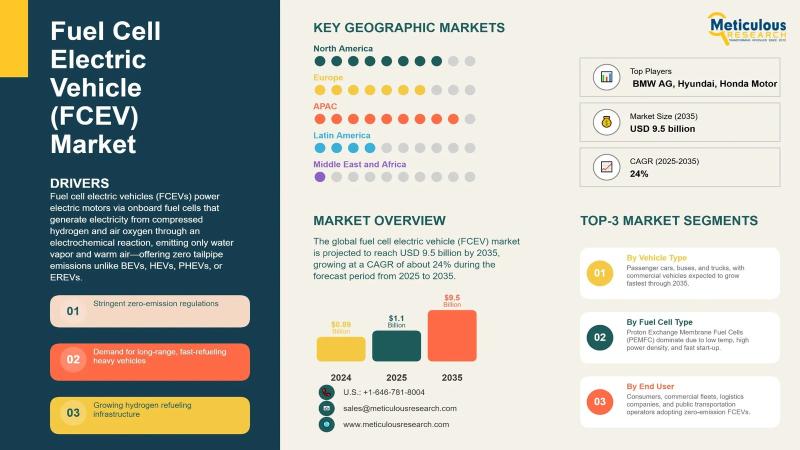
 Fuel Cell Electric Vehicle Market to Reach $9.5 Billion by 2035, Driven by Heavy-Duty Applications and Hydrogen Infrastructure Expansion. The global fuel cell electric vehicle market is experiencing remarkable growth as governments and industries explore zero-emission alternatives beyond battery technology. Valued at USD 1.1 billion in 2025, the market is projected to surge to USD 9.5 billion by 2035, representing a compound annual growth rate of approximately 24% over the forecast period.
Fuel cell electric vehicles generate electricity onboard through an electrochemical process combining compressed hydrogen with oxygen, producing only water vapor. Unlike battery electric vehicles, FCEVs deliver driving ranges of 300 to 500 miles and refuel in just 3 to 5 minutes-making them especially appealing for long-distance travel and heavy-duty transportation where battery weight and charging downtime pose significant challenges.
Download Sample Report Here: https://www.meticulousresearch.com/download-sample-report/cp_id=6324
Since Toyota introduced the Mirai in 2014 as the first mass-produced fuel cell vehicle, the technology has matured considerably. Enhanced fuel cell stack efficiency, reduced platinum catalyst requirements, and durability extending beyond 5,000 operating hours have enabled FCEVs to expand from passenger cars into buses, trucks, and commercial fleets.
Fuel Cell Electric Vehicle Market Snapshot
The comprehensive analysis covers 2025 through 2035, examining market size, competitive landscape, company rankings, trends, and growth drivers across vehicle types, fuel cell technologies, power outputs, range capabilities, end users, and major global regions.
Key Highlights of the Fuel Cell Electric Vehicle Market
Asia-Pacific currently dominates the market, powered by extensive hydrogen infrastructure development in China, Japan, and South Korea, alongside substantial government subsidies for commercial fleets. Commercial vehicles-particularly buses and trucks-are positioned for the fastest growth through 2035 as fuel cell technology addresses range, payload, and refueling limitations that challenge battery electric alternatives.
Proton Exchange Membrane Fuel Cells remain the technology of choice for automotive applications thanks to low operating temperatures, quick start-up capabilities, and high power density. Toyota and Hyundai lead the passenger segment, while Chinese manufacturers including SAIC, Foton, and Yutong dominate fuel cell bus and truck deployments.
Browse in Depth: https://www.meticulousresearch.com/product/fuel-cell-electric-vehicle-market-6324
What Is a Fuel Cell Electric Vehicle (FCEV)?
Fuel cell electric vehicles occupy a unique position within zero-emission transportation. Rather than relying on externally charged batteries, FCEVs generate electricity internally through hydrogen fuel cells. Compressed hydrogen stored onboard reacts with atmospheric oxygen to produce electricity that drives an electric motor.
FCEVs stand out through several key characteristics: refueling takes just 3 to 5 minutes, comparable to gasoline vehicles; driving range typically spans 300 to 500 miles; zero tailpipe emissions with only water vapor released; and fully electric drivetrain without combustion engine support. These features make FCEVs compelling for applications demanding extended range, maximum uptime, and operational flexibility.
Major Trends in the Fuel Cell Electric Vehicle Market
Shift Toward Commercial and Heavy-Duty Vehicles:
The industry is increasingly concentrating on buses, trucks, and logistics fleets, where battery electric vehicles struggle with excessive weight, extended charging times, and limited range. Fuel cells deliver superior economics and operational efficiency for long-haul routes and high-utilization applications.
Development of Third-Generation Fuel Cell Systems:
Toyota and BMW announced collaboration in September 2024 to develop third-generation fuel cell systems targeting mass production by 2028, aiming to dramatically reduce costs while enhancing efficiency and durability for broader adoption across vehicle categories.
Growth of Green Hydrogen Production:
While nearly 98% of current hydrogen production relies on fossil fuels, green hydrogen produced through renewable-powered electrolysis is gaining momentum. Costs are expected to drop below €2 per kilogram by 2030 in renewable-rich regions. The U.S. Inflation Reduction Act’s $3 per kilogram clean hydrogen tax credit is accelerating investments.
Expansion of Liquid Hydrogen Refueling:
Liquid hydrogen refueling is emerging as a crucial enabler for heavy-duty FCEVs due to superior energy density. South Korea opened its Incheon Gajwa liquid hydrogen station in 2024 and plans to deploy 280 such facilities by 2030.
Key Drivers of the Fuel Cell Electric Vehicle Market
Zero-Emission Regulations and Government Incentives:
Stringent emission standards and generous policy support drive market expansion through U.S. clean vehicle tax credits and hydrogen production incentives, China’s national and provincial FCEV deployment targets, and EU Alternative Fuels Infrastructure Regulation mandating hydrogen stations every 200 kilometers along major corridors.
Decarbonization of Heavy-Duty Transportation:
Medium- and heavy-duty vehicles contribute nearly 25% of global transport-sector carbon dioxide emissions. Fuel cell trucks offer extended range and rapid refueling compared to battery electric trucks, positioning them as a viable pathway to zero-emission long-haul logistics.
Major Opportunities in the Fuel Cell Electric Vehicle Market
Commercial Fleet Electrification on Fixed Routes:
Buses and trucks on predictable routes enable efficient hydrogen refueling infrastructure deployment at depots. Successful implementations include Hyundai XCIENT Fuel Cell truck deployments in Switzerland and South Korea, alongside large-scale fuel cell bus programs throughout China.
Expansion of Hydrogen Refueling Infrastructure:
Accelerated hydrogen station rollouts are removing key adoption barriers. By 2024, China operated 384 stations, South Korea had 198, Japan reached 161, and Europe operated 294 stations, with Germany and France leading.
Fuel Cell Electric Vehicle Market Segmentation Analysis
By Vehicle Type:
Passenger cars hold the largest share in 2025 due to early commercialization of models like the Toyota Mirai and Hyundai NEXO. However, commercial vehicles are expected to achieve the highest growth rate through 2035.
By Fuel Cell Type:
PEMFC technology dominates the market, preferred for automotive applications because of low operating temperatures, high efficiency, and rapid response characteristics.
By Range:
The 300 to 500 kilometer range segment captures the largest market share, effectively balancing cost considerations, infrastructure availability, and performance requirements.
Buy the Complete Report with an Impressive Discount: https://www.meticulousresearch.com/view-pricing/1641
Regional Analysis: Who Leads the FCEV Market?
Asia-Pacific leads the global market in 2025, propelled by China, South Korea, and Japan. Europe is strengthening its position through infrastructure expansion and regulatory support, while North America’s market remains concentrated primarily in California and select states.
Key Companies in the Fuel Cell Electric Vehicle Market
Major players include Toyota Motor Corporation, Hyundai Motor Company, Honda Motor Co., BMW AG, Daimler Truck AG, SAIC Motor Corporation, Foton Motor Group, Zhengzhou Yutong Bus, Ballard Power Systems, and Plug Power.
Recent Developments in the Fuel Cell Electric Vehicle Market
Toyota launched the 2026 Mirai in December 2025, offering approximately 402 miles range. Hyundai unveiled the all-new NEXO in October 2025. Toyota announced a third-generation fuel cell system in February 2025 targeting cost reduction and commercial vehicle applications.
Related Reports:
Electric Commercial Vehicle Market: https://www.meticulousresearch.com/product/electric-commercial-vehicle-market-5766
Electric Vehicle Market: https://www.meticulousresearch.com/product/electric-vehicle-market-5179
About Us:
We are a trusted research partner for leading businesses worldwide, empowering Fortune 500 organizations and emerging enterprises with actionable market intelligence tailored to drive revenue transformation and strategic growth. Our insights reveal forward-looking revenue opportunities, providing our clients with a competitive edge through a diverse suite of research solutions-syndicated reports, custom research, and direct analyst engagement.
Each year, we conduct over 300 syndicated studies and manage 60+ consulting engagements across eight key industry sectors and 20+ geographic markets. With a focus on solving the complex challenges facing global business leaders, our research enables informed decision-making that propels sustainable growth and operational excellence. We are dedicated to delivering high-impact solutions that transform business performance and fuel innovation in the competitive global marketplace.
Contact Us:
Meticulous Market Research Pvt. Ltd.
1267 Willis St, Ste 200, Redding,
California, 96001, U.S.
Email: sales@meticulousresearch.com
USA: +1-646-781-8004
Europe: +44-203-868-8738
APAC: +91 744-7780008
Visit Our Website: https://www.meticulousresearch.com/
For the Latest Update, Follow Us:
LinkedIn-https://www.linkedin.com/company/meticulous-research
This release was published on openPR.