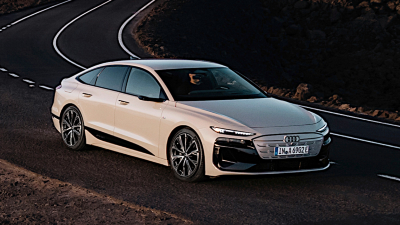
The A6 Sportback E-tron is primarily intended to prove that a fully electric Audi can comfortably cover long distances. We tested the 800 V Audi.
Audi A6 Sportback E-tron
Audi AG
Expectations regarding quality and range are particularly high in the upper mid-range segment. Thanks to modern diesel engines, ranges of just under 1,000 km on a single tank of fuel are usually no problem here, and the proportion of customers who actually take advantage of these driving distances is comparatively high. Consequently, it seems difficult to convince the A6 target group of the benefits of a BEV. That is why Audi is aggressively entering the race with an electric range of 754 km for the A6 Sportback E-tron Performance.
The basic specifications are impressive: An 800 V system with a battery capacity of 100 kWh (94.9 kWh net), 270 kW maximum power, and 565 Nm peak torque. A charging capacity of 270 kW is also possible at an HPC charging station, and 11 kW at an AC charging station. In the test car, there are notes hanging from the rearview mirror explaining how journalists can use route guidance to prepare the battery for the smoothest possible high-speed charging, so that the charging stop is completed in 21 minutes with maximum power from 10-80 %. But more on that later.
Interior + Electronics
While the smartphone is still connecting to the car, setting up profiles and exchanging data, my gaze wanders through the impeccable interior. The car has fabric-covered sports seats with faux leather applications, and parts of the trim are also covered in fabric. The contrast to the painted surfaces, brushed aluminum, and screens not only looks great, it also feels incredibly good. Hygge – cozy – as the Danes would say. Audi calls it anthracite fabric cascade, and I think it’s simply magnificent. The steering wheel is flattened at the top and bottom, with displays lighting up behind, above, and next to it. Even the front passenger now has a touch panel on which they can enter navigation commands or scroll through the audio controls. The system also allows the installation of approved apps, so the co-pilot can organize the in-car entertainment. The sports seats are as comfortable as they look and offer plenty of lateral support.
The feeling of space is good, but the rear view in particular is limited. This is remedied by a whole army of sensors and cameras that can illuminate every angle of the vehicle. The rear seats are also contoured, but even passengers of normal height find their knees bent at a sharp angle and their thighs not resting flat on the upholstery, which is due to the battery housed in the underbody. The trunk of the A6 E-tron Sportback has a capacity of 502 liters. The stylish hatchback limits the loading height compared to the Avant models, but the trunk is still generously sized and very usable.
Drive + Chassis
The A6’s drive is confident. No longer rough and brutal, but finely tuned and powerful at all times. Admittedly, the rear-wheel drive alone is enough to significantly improve dynamic handling, but having the elemental force of the electric motor at your feet when cornering is really fun. The power delivery is also very discreetly controlled here. Without any drive influences on the dynamically controlled active steering, the Audi can be steered very precisely. The spontaneously available power tempts you to drive sportily, but the Audi’s talents also lie in cruising and speedy travel.
The suspension is comfortably designed and effectively masks the relatively high vehicle weight of 2,250 kg. Even short, hard bumps are only felt discreetly by the occupants. However, our test car was also equipped with the optional air suspension. Those who want a sporty, hard ride can lower the suspension and increase the damping. The recuperation power of the drive can be adjusted in four stages via a pedal on the steering wheel, from maximum gliding properties with no braking effect to a one-pedal driving experience with high braking effect in the fourth stage. The mechanical service brake thus becomes a safety reserve.
Driver Assistance Systems
Electric driving is fun, no question about it, but the Audi also offers a number of ADAS systems for everyday driving when the roads are crowded or the route is boring. Our test car comes with adaptive cruise control, lane assist including lane change, highway and traffic jam assist, and sign and traffic light recognition. In accordance with EU regulations, some of these are active every time the engine is started, such as lane assist and the acoustic speed warning. The latter is somewhat overreactive, kicking in immediately, even if you exceed the speed limit by just 1 km/h – although it doesn’t emit an annoying whistling sound like many of its competitors. However, even the cruise control allows minor speeding before braking. So it’s no wonder that the test car already had a freely adjustable selection button on the steering wheel to deactivate it.
The lane assist does its job well, especially where it is more of a comfort than a safety system, on well-developed, multi-lane federal highways and motorways, as well as in cities. When the roads become narrower or there are no clear markings, the system quickly becomes overwhelmed and tends to intervene inappropriately. In city traffic and on the highway, you can rely on the assistants to a large extent. If desired, the speed is automatically adjusted to speed limits. When driving in convoy and at speeds lower than the speed limit, the car accelerates when the left turn signal is activated to assist with overtaking.
Charging Routine
As already mentioned, the Audi’s battery can deliver energy at the same rate as it can absorb it. However, for optimized charging, the energy storage device should be preconditioned accordingly. This is exactly what happens when a charging station is entered as a navigation destination. However, a display showing the optimal charging conditions would be nice. It is also unclear whether the conditioning is maintained in the event of delays, such as when waiting for a free charging station. All of this is irrelevant if the infrastructure simply cannot keep up. The selected 300 kW charging station turns out to be a 150 kW station, which significantly prolongs the charging process, but at least remains stable. This is by no means a given, as the other charging stations in the area clearly illustrate. None of this is the fault of the vehicle, which is well equipped for tight parking garage charging situations with a CCS plug (left) and another Type 2 plug (right).
Conclusion: Audi A6 E-tron Performance
First and foremost: The maximum range was not achieved in the test, as the kilometers covered were simply too much fun. Test consumption settled at 21 kWh/100 km (WLTP 15.9-14.0). This allowed the Audi to be driven in a decidedly sporty manner. The electric drive is a joy in every situation, apart from the top speed, which is limited to 210 km/h but can be reached in no time at all. The test car could hardly be upgraded in terms of equipment, with the air suspension, dynamic steering, and Matrix LED lights being particularly impressive. The interior with fabric-covered trim strips is a real highlight, although the usefulness of a passenger display is certainly debatable. The added safety of a HUD, in this case with extended functions such as lane display and graphic navigation, is certainly debatable too, but I liked it very much.
That leaves the question of price: The Audi A6 E-tron Performance starts at €75,600, while the Edition One models with very extensive equipment come in at €99,375. Certainly not a bargain, but on the other hand, Audi impressively demonstrates how well high-quality electric mobility can work.
This is a partly automated translation of this German article.