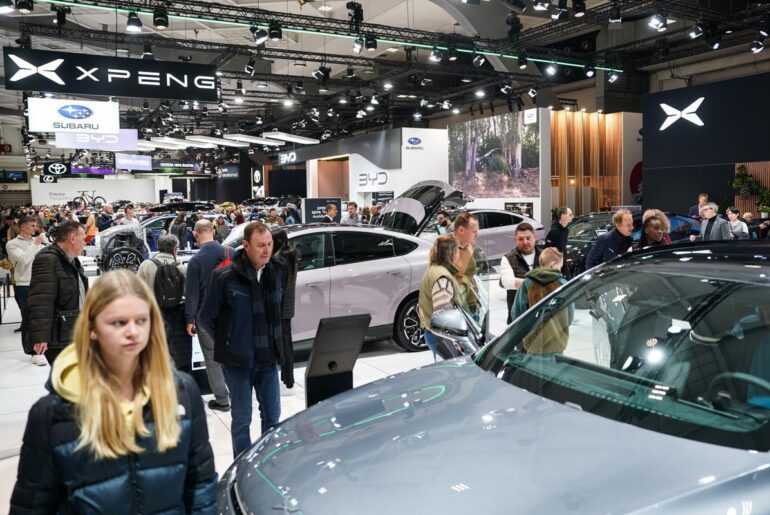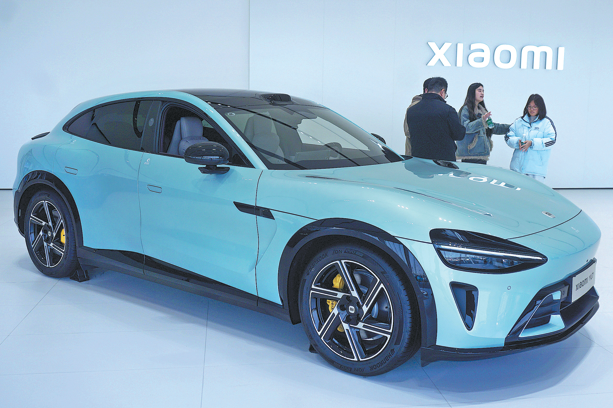
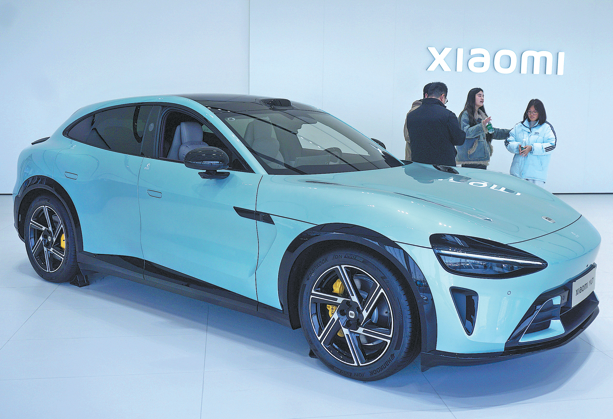
Customers check out a Xiaomi YU7 electric vehicle at a Xiaomi Auto store in Hangzhou, Zhejiang province, on Jan 4. LONG WEI/FOR CHINA DAILY
Xiaomi Corp has announced an ambitious strategic roadmap for 2026, targeting annual sales of 550,000 vehicles. This plan follows a remarkably strong performance in 2025, when the company delivered approximately 410,000 vehicles, significantly exceeding its initial projection of 300,000 units.
The substantial over-achievement in 2025 has provided strong momentum and confidence for the company”s accelerated growth, said Xiaomi.
In November, Xiaomi Corp’s electric vehicle unit celebrated a significant milestone, as its 500,000th car rolled off the production line at its super factory in Beijing.
This achievement came just 602 days, or under 20 months, after the official launch of its first model, the SU7, on March 28, 2024, setting a new global record for the fastest pace to this production mark among new energy vehicle makers, the company said.
Lei Jun, founder, chairman and CEO of Xiaomi, said that this milestone “signifies that Xiaomi’s auto unit’s comprehensive capabilities, including research and development, manufacturing, sales, delivery and service, have been fully validated”.
The production landmark followed a robust quarterly earnings report released in November. In the third quarter, Xiaomi delivered over 100,000 vehicles, a record for any single quarter and a surge of 173.4 percent year-on-year. Total deliveries for the first three quarters of the year surpassed 260,000 units, with September and October each seeing over 40,000 vehicles delivered.
Notably, the smart EV segment reported revenue of 28.3 billion yuan ($4.05 billion) and achieved its first quarterly profit in the third quarter.
Xiaomi said the company’s manufacturing push is bolstering the supply chain, directly benefiting over 300 auto parts enterprises.
Meanwhile, Xiaomi’s competitor Huawei is also working to step up its presence in the auto market.
The Harmony Intelligent Mobility Alliance, which consists of five car marques Huawei has built with Chinese carmakers, announced in December it would unify standards and pool resources to further consolidate its established position in China’s NEV market.
At an event in Shanghai, executives from Huawei and its automotive partners — Seres, Chery, BAIC,JAC and SAIC — said they will deepen cooperation across software platforms, service networks, charging infrastructure and joint marketing.
“The move signals a shift from isolated efforts to ecosystem-driven collaboration,” said Yu Chengdong, head of Huawei’s smart car business. “Unified standards and shared resources will help deliver more consistent value to users.”
The collaboration covers all brands operating under the Harmony Intelligent Mobility Alliance, which are: Aito, Luxeed, Stelato, Maextro and Shangjie.
Combined they have produced over 1 million vehicles, with around a quarter from Aito, the earliest member of the five.
Huawei and Xiaomi are both beefing up efforts to hone their prowess in autonomous driving with big research and development investment and staff recruitment.
Yang Ming, a professor at Shanghai Jiao Tong University, said that from a technical perspective, in recent years, continuous improvements in computing power, sensor solutions and large language models, along with a significant reduction in the cost of core hardware such as lidar, have collectively driven the maturity of the industry chain. These factors have laid a solid foundation for the implementation of L3 autonomous driving, Yang added.
“China and the United States are at the global forefront in intelligent driving, with Europe also striving to catch up, indicating a clear competitive landscape,” said Zhang Yongwei, president of China EV100, a Beijing-based industry think tank.
“Only by conducting pilot programs, validating technology in real-world scenarios and ensuring robust verification can a foundation be laid for subsequent large-scale application of L3 vehicles,” Zhang said.