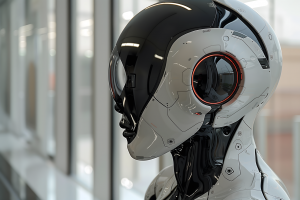
In early 2026, the race for “physical AI” – the shift from intelligence confined to screens to machines that move, see, and act in the real world- has become the defining battle in artificial intelligence. Tesla (NASDAQ:TSLA) sits at the center of this narrative. Despite declines in its core EV business, its roughly $1.4 trillion valuation is increasingly justified not by car sales but by expectations around autonomous driving, robotaxis, and Optimus humanoid robots. Physical AI is no longer a side story for Tesla. It is the core of the investment thesis.
What could change is the emergence of a formidable challenger.
Nvidia (NASDAQ:NVDA), now valued near $4.6 trillion, is repositioning itself from the backbone of data-center AI to the “nervous system” of physical AI. At CES 2026, Nvidia reframed the conversation from AI that talks and codes to AI that reasons, simulates, and moves—laying out a platform designed to power robots and autonomous vehicles across the industry, regardless of brand. The result is a high-stakes contrast: Tesla betting on vertically integrated products to defend its valuation and Nvidia aiming to own the infrastructure layer that could underpin physical AI everywhere.
Tesla: Owning the Machine
Unlike most AI companies, Tesla’s advantage in physical AI is rooted in manufacturing. Its Gigafactories give it experience scaling complex machines with deep automation, a capability that is difficult to replicate. By early 2026, Tesla has leveraged data from millions of vehicles to train its Full Self-Driving system, but its real moat may be with vertical integration across hardware, software, and production. The Optimus humanoid robot reflects Tesla’s effort to extend its vision-based intelligence beyond driving into physical labor, with early deployments happening inside its own factories.
Tesla’s product roadmap reinforces this integrated strategy. The steering-wheel-free Cybercab is designed from the ground up for an AI driver, while custom silicon, actuators, and battery systems remain in-house. This end-to-end control enables rapid iteration, allowing Tesla to move from prototype to scaled production far faster than traditional manufacturers.
Nvidia: Owning the Intelligence Layer
With a valuation of roughly $4.5 trillion in early 2026, Nvidia has emerged as a serious physical AI challenger—not by building robots or vehicles, but by owning the computing infrastructure that powers them. Nvidia dominates AI training, inference, and simulation, giving it leverage across nearly every meaningful physical AI effort without the burdens of manufacturing, regulation, or consumer-facing risk. At CES 2026, the company positioned Physical AI as its next major growth frontier, laying out an end-to-end stack spanning perception, reasoning, training, and real-world action. This includes Cosmos for real-world reasoning, Isaac GR00T and Isaac Lab-Arena for humanoid control and large-scale testing, and Alpamayo and Drive for autonomous driving—signaling a platform strategy rather than a single product bet.
Nvidia’s advantage rests on chips, software, and scale. The upcoming Rubin platform and edge modules like Jetson Thor enable real-time perception and decision-making without reliance on the cloud, while the Drive platform supports advanced autonomy programs across more than 50 OEMs with sensor redundancy in complex environments.
Beneath the semiconductors sits a deep software moat, with CUDA’s 4-million-strong developer base. Unlike Tesla, Nvidia avoids vertical ownership of machines, instead partnering with players such as Boston Dynamics, Caterpillar, and Hyundai across industrial and commercial robotics. This horizontal, asset-light strategy — which is backed by more than $40 billion in annual free cash flow – allows Nvidia to scale broadly, positioning it as the default infrastructure layer for physical AI, even as Tesla retains advantages in tightly integrated, vertically owned products.
The Race Ahead
Tesla’s physical AI ambitions are visible and ambitious, but execution risk remains high. Scaling autonomy and robotics requires sustained capital, just as automotive volumes and margins come under pressure, impacting cash flows. Nvidia, by contrast, operates behind the scenes, powering much of the world’s AI training and increasingly embedding itself across the robotics and autonomy stack, largely insulated from which hardware platforms ultimately succeed.
To be sure, physical AI is not a zero-sum game at the product level, but it may become one at the infrastructure layer. Tesla is betting on owning and monetizing specific machines. Nvidia is positioning itself as the indispensable nervous system beneath them all.
The key trends to watch in 2026 are straightforward: whether Tesla can move from prototypes to scaled, profitable deployment, and whether Nvidia can convert its platform dominance into durable physical AI revenue beyond data centers. Those outcomes will likely decide where the economics of physical AI ultimately accrue.
The Trefis High Quality (HQ) Portfolio, with a collection of 30 stocks, has a track record of comfortably outperforming its benchmark that includes all three – the S&P 500, S&P mid-cap, and Russell 2000 indices. Why is that? As a group, HQ Portfolio stocks provided better returns with less risk versus the benchmark index; less of a roller-coaster ride, as evident in HQ Portfolio performance metrics.
Invest with Trefis Market-Beating Portfolios
See all Trefis Price Estimates