For retirees, the days of the bulky Buick or tough-to-park Pontiac are long gone. Kelley Blue Book recently released its list of the top cars for seniors, many of which are standard sedans or smaller SUVs that pack big safety features into more manageable body sizes. Notably, KBB ranked the 2025 Hyundai Ioniq 5 as one of the best cars for seniors due to the fact that even the base model offers features typically associated with more expensive trims — making the car a great way for drivers hesitant to make the switch to an electric vehicle to finally “pull the plug” on gas.
With a base sticker price of $43,795, the 2025 Hyundai Ioniq 5 brings top-tier electric vehicle technology within the financial reach of a wider range of buyers than higher-end brands like Tesla or Rivian. This makes it ideal for retirees managing a fixed monthly spending budget but who want contemporary amenities in their vehicle.
Hyundai certifies up to 318 miles of range and 320 horsepower, with the ability to fast-charge from 10% to 80% in around 20 minutes. The car is sleek, easy to drive, and able to fit a hefty grocery run without taking up too much space in the driveway. There’s more than the price and base specs that make the 2025 Hyundai Ioniq 5 ideal for retirees, however. It’s an electric car that may save you a bunch of money in the long run.
Read more: Retirees Be Warned: These Are The 12 Worst Vehicles You Can Buy
Why the 2025 Hyundai Ioniq 5 is ideal for retirees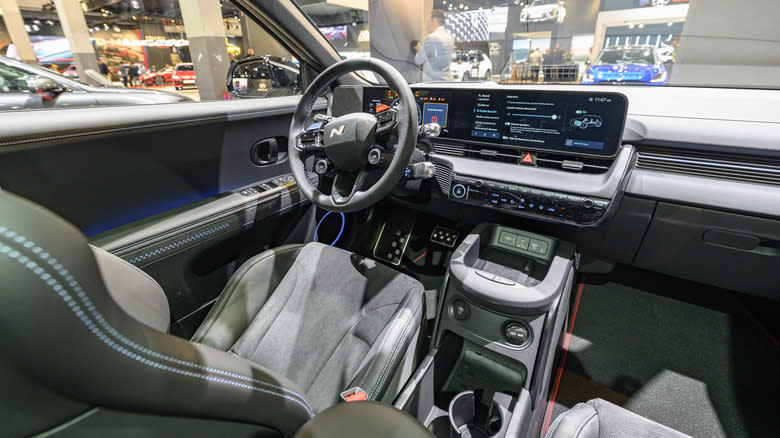
A console in the Hyundai Ioniq 5 N – Sjoerd Van Der Wal/Getty Images
The 2025 Hyundai Ioniq 5 is an electric crossover SUV, ideal for seniors because it retains many of the safety features expected in a larger SUV but in a size that’s easier to manage (and park). Assist notifications are standard and include lane change, forward collision avoidance, and blind-spot collision avoidance. The vehicle features Hyundai’s “i-pedal” driving system, which allows you to drive with only the gas pedal, as braking is triggered automatically as pressure on the pedal is eased. This regenerative braking method doubles as a great way to add more battery power during city driving.
Few electric cars at this price offer the range of the Hyundai Ioniq 5. The 2025 model has a fuel efficiency rating of 115 MPGe, meaning that it uses energy so efficiently that an internal combustion vehicle would need to drive 115 miles per gallon in order to match. The vehicle’s console also connects to smartphones and offers easy routing for when directions are needed.
It’s important to note that, with an electric car, there’s no need to “heat up the engine” when it’s cold or turn the car off while your partner runs into the store. You can even leave the car’s air conditioning running with a dog inside on a hot day while you shop or dine, a feature made famous by Tesla but that is standard in any electric car. That’s because, with no engine running, there’s no need to shut the car off completely when parked for short periods.
Additional benefits of an electric car like the Hyundai Ioniq 5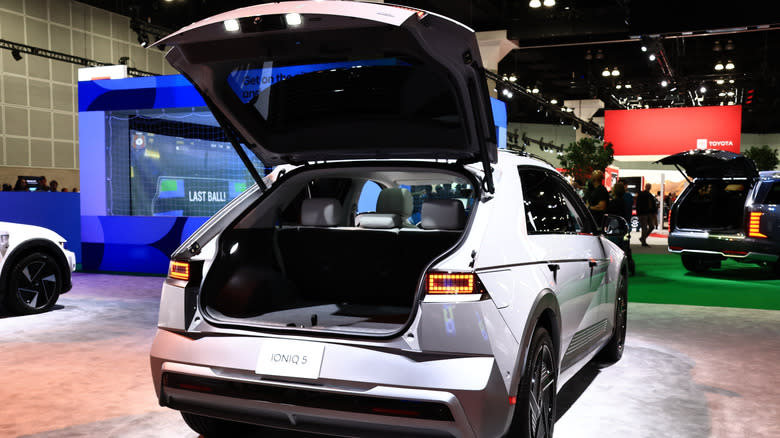
A Hyundai Ioniq 5 with trunk open at car show – Walter Cicchetti/Shutterstock
Of course, making the switch from an internal combustion engine to an electric one takes some consideration. Working in the buyer’s favor here is the fact that electric vehicles like the 2025 Hyundai Ioniq 5 are tech-savvy and easy to use. There are, however, some notable differences when owning an electric car.
First, the vast majority of charging is done at home and overnight, where you’ll pay your local electric rate set by the utility company. If you’re worried about your electric bill going up, charging the Hyundai Ioniq 5 at home is far cheaper than buying gas or filling up at a public charging station, where rates vary and are set by the station owner. If you have rooftop solar at your home, charging the car may be even cheaper.
Even on the occasion that you do charge at a public charger, it’s still generally much cheaper than buying gas, and maintenance on electric vehicles is far cheaper than on gas-powered alternatives, largely because there are fewer parts that need upkeep. CNET analyzed the total operating cost per mile of an electric vehicle versus a similar gas counterpart, and found the total operating cost of the EV to be 17 cents per mile, compared to 24 to 27 cents per mile for the other.
Unlock your financial potential. Add Money Digest to your preferred sources for smart money insights!
Read the original article on Money Digest.