Follow us today…


Early-production vehicles have always carried a certain mystique, part promise and part gamble, and nowhere is that more evident than in the owner-to-owner comparisons now surfacing around the Tesla Cybertruck.
A recent post from a 2025 Cybertruck AWD owner who spent time with a 2024 Foundation Series loaner offers a rare apples-to-apples look at how Tesla’s flagship truck has subtly shifted from its launch form into regular production. The conclusions are not dramatic, but they are telling.
The most immediate difference noted was in the seats, an area where tactile impressions matter more than spec sheets. The Foundation Series seats were described as noticeably softer, with vegan leather that felt more premium and cushioning that invited long stints behind the wheel. By contrast, the 2025 AWD seats came across as wider and firmer, competent but unremarkable, drawing an unflattering comparison to mainstream pickup seating. This is not a failure of function so much as a recalibration of feel, and it hints at Tesla’s evolving priorities as production scales.
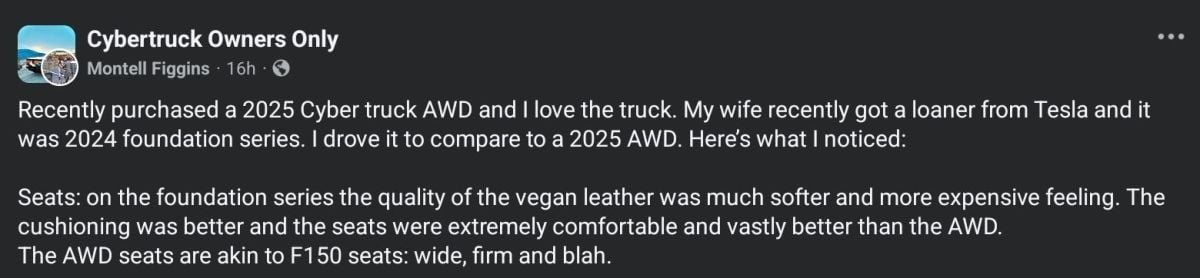
“Recently purchased a 2025 Cyber truck AWD and I love the truck. My wife recently got a loaner from Tesla, and it was a 2024 Foundation Series. I drove it to compare it to a 2025 AWD. Here’s what I noticed:
Seats: In the foundation series, the quality of the vegan leather was much softer and more expensive-feeling. The cushioning was better, and the seats were extremely comfortable and vastly better than the AWD.
The AWD seats are akin to F150 seats: wide, firm, and blah.
The interior quality of the doors, seals, and fixtures seemed much better on the foundation series. Nothing in particular, it just felt more solid than the AWD. You can feel a slight difference in build quality.
The driving experience was noticeably louder from the all-terrain tires on the foundation series. It also drove a lot harder. You could feel the grip of the tires, but also the road imperfections, a bit more. The AWD is super smooth and very quiet; you don’t feel the road as much.
The cyber wheels on the foundation look better and make the truck look better, also.
Just my opinion to help others.
Had I read a post like this, I might have looked for a used foundation series over a new AWD, or at least compared them before I made
A choice.”
Interior quality followed a similar theme. Nothing was singled out as defective or poorly executed in the AWD, but the Foundation Series simply felt more solid. Door panels, seals, and fixtures conveyed a sense of tighter assembly and higher perceived quality.
Tesla Cybertruck: OTA Updates & Interior Design
The Tesla Cybertruck is an all-electric pickup with no gasoline or hybrid option offered.
It uses an enclosed truck bed with a powered cover, allowing cargo to be locked and protected from the weather.
The interior relies heavily on a central touchscreen, with very few physical buttons compared to traditional trucks.
The Cybertruck supports over-the-air software updates, meaning features and behavior can change after purchase.
These are the sorts of differences that are hard to quantify and easy to dismiss until you experience them back to back. Once you do, they linger in your mind longer than acceleration figures ever will.
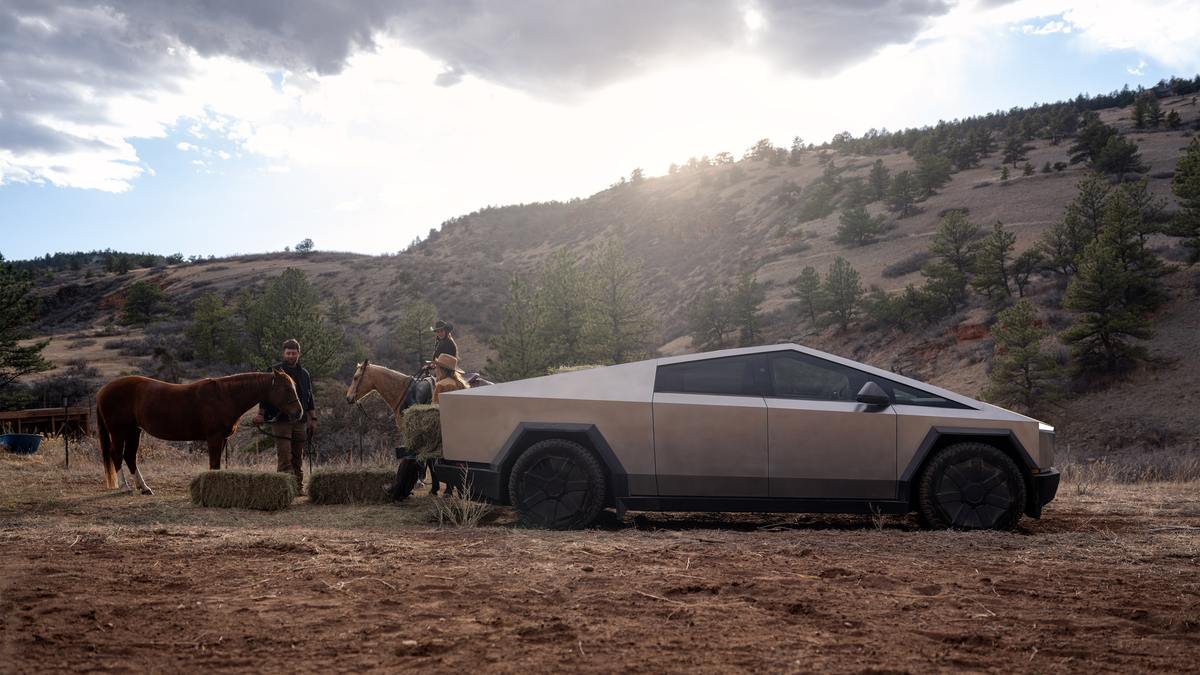
On the road, the character split becomes clearer. The Foundation Series, riding on aggressive all-terrain tires, communicated more of the surface beneath it. There was more road noise, more texture, and a sense of mechanical grip that reminded the driver that this is a very heavy truck with very serious rubber. The AWD, by comparison, came across as smoother and quieter, filtering out imperfections and isolating occupants more effectively. Neither approach is inherently better, but they cater to different expectations of what a Cybertruck should feel like day to day.
Wheel and tire choices play an outsized role here, and several commenters picked up on that immediately. The Pirelli Scorpion tires fitted to the AWD were credited for much of its smoothness, reinforcing the idea that Tesla’s changes may be as much about configuration as cost-cutting. Meanwhile, the Cyber wheels on the Foundation Series drew praise for their appearance, lending the truck a more dramatic, cohesive look that some feel is missing from later trims.
What makes the post resonate is its lack of agenda. The owner is clear that they love their 2025 AWD and are not looking to stir regret or outrage. Instead, the tone is reflective, even slightly wistful. Had this comparison been available earlier, they might have shopped differently, perhaps seeking out a used Foundation Series or at least insisting on a side-by-side drive before committing. That kind of hindsight is familiar to anyone who has bought a first-year vehicle and watched it evolve.
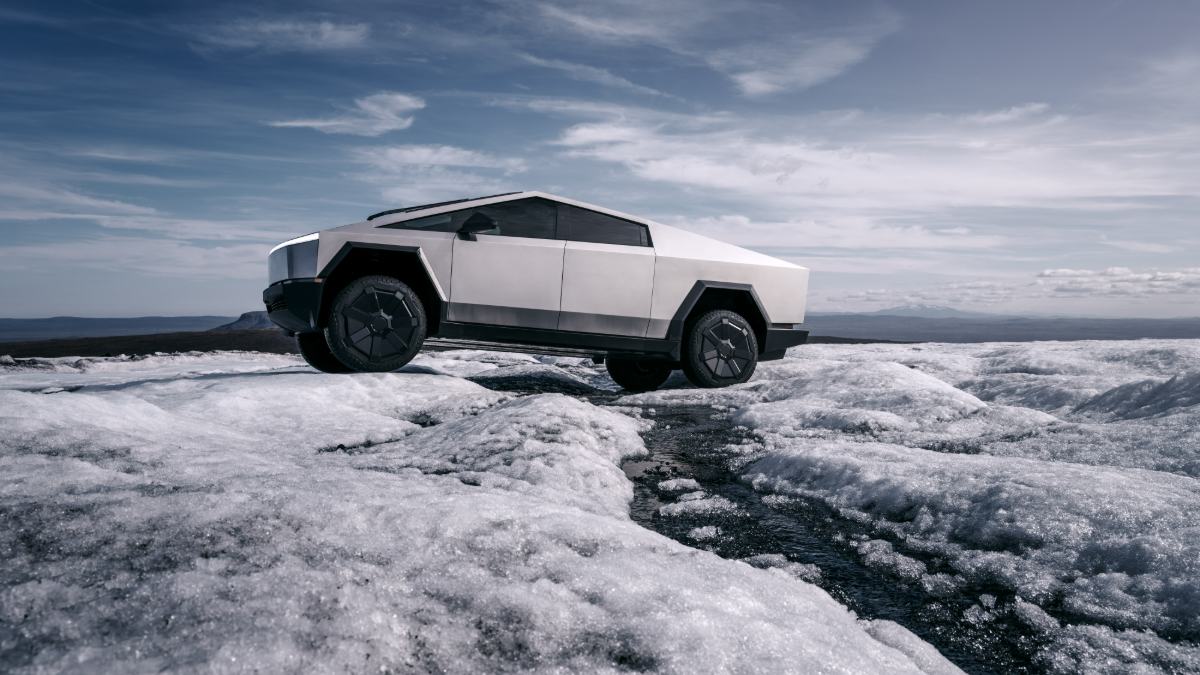
The comments beneath the post underscore how quickly these impressions translate into perceived value. One reader admitted feeling better about spending an extra $20,000 after reading the comparison, while another noted that the stereo in the Foundation Series seemed noticeably better, particularly in the bass. Whether those differences are real, subjective, or a combination of both, they contribute to the growing sense that the Foundation Series represents a high-water mark for materials and indulgence.
Taken together, this is less a critique of the 2025 Cybertruck AWD than a snapshot of Tesla’s transition from statement piece to standardized product. Early builds often receive extra attention, richer materials, and fewer compromises, simply because they have to impress. As production matures, those edges are softened in favor of consistency, efficiency, and broader appeal. For prospective buyers, the lesson is simple and timeless: if you can, drive both. In a vehicle as unconventional as the Cybertruck, the differences that matter most are often the ones you only feel once you sit down, shut the door, and start rolling.
Image Sources: Tesla Media Center
Noah Washington is an automotive journalist based in Atlanta, Georgia. He enjoys covering the latest news in the automotive industry and conducting reviews on the latest cars. He has been in the automotive industry since 15 years old and has been featured in prominent automotive news sites. You can reach him on X and LinkedIn for tips and to follow his automotive coverage.
Follow us today…