Volvo Cars reported global sales of 75,049 cars in December, up 2 percent compared to the same period last year. For the full year 2025, Volvo Cars’ global sales stood at 710,042 cars, down by 7 percent. China, followed by the US, UK, Germany and Sweden were the five largest markets in 2025.
In total, Volvo sold 323,294 EVs and PHEVs in 2025, an 8% decline from 352,787 units in 2024.
Volvo’s regional sales data reveals stark differences across markets:
– Europe: sales reached 33,406 cars in December, marginally declined compared to the same period last year. However, sales of fully electric cars increased by 33 percent compared to the same period last year, while overall sales of electrified models increased by 2 percent. The electrified models accounted for 65 percent of all cars sold in Europe during the month. For the full year 2025, overall sales dropped by 10 percent to 332,667 cars, with EV sales down 22% and PHEVs declining 3%.
– United States: sales in the US increased by 1 percent in December, totaling 14,193 cars. Sales of electrified models decreased by 48 percent compared to the same period last year, mostly due to the adverse impact from the removal of subsidies on fully electric and plug-in hybrid cars. In 2025, overall sales stood at 121,607 cars, a decline of 3 percent compared to the previous year. All-electric sales jumped 91%, rising from 5,608 units in 2024 to 10,708 in 2025. PHEVs struggled badly, with sales falling 40%, from 37,294 to 22,379 units.
– China: sales in China reached 16,103 cars, up 1 percent compared to December 2024. Sales of electrified models stood at 5,690 cars, an increase of 128 percent while sales of plug-in hybrids grew 213 percent. In 2025, Volvo Cars’ total sales in China stood at 149,549 cars, down by 4 percent.
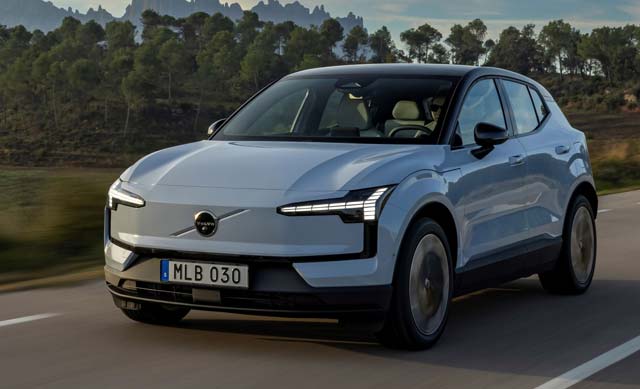
Volvo is hoping that new and updated models can help reverse these trends. In China, the newly launched XC70 is expected to boost PHEV sales in 2026. The company is set to begin production of the EX60, a fully electric midsize crossover built on an 800-volt architecture. The model is expected to deliver 670 horsepower, charge from 10% to 80% in just 20 minutes.
In 2025, the XC60 was the top-selling model with sales of 230,655 cars (2024: 230,853), followed by the XC40/EX40, with total sales of 166,920 cars (2024: 173,890) and the XC90 at 103,217 cars (2024: 108,621).
“We are pleased to end the year on a positive note with growth across key regions thanks to increased sales of our fully electric and plug-in hybrid offerings,” said Erik Severinson, Chief Commercial Officer. “Despite a challenging market that continues to be under pressure on multiple fronts, we are encouraged to see increased deliveries of our fully electric products, notably the EX90 and EX30. Furthermore, growing sales of the new XC70 long range plug-in hybrid underscores the car’s strength in the rapidly growing electrified segment in China. Overall, 2025 was a challenging year for Volvo Cars and the broader industry alike, but we have taken necessary measures to increase our share in the fast-growing BEV and PHEV segments, including the introduction of the game-changing EX60, to be revealed on January 21.”
Jan 8, 2026Blagojce Krivevski