By Shari Roan
A spike in complaints regarding e-bikes may result in the need for a city ordinance, according to information presented Tuesday to the Fernandina Beach City Commission.
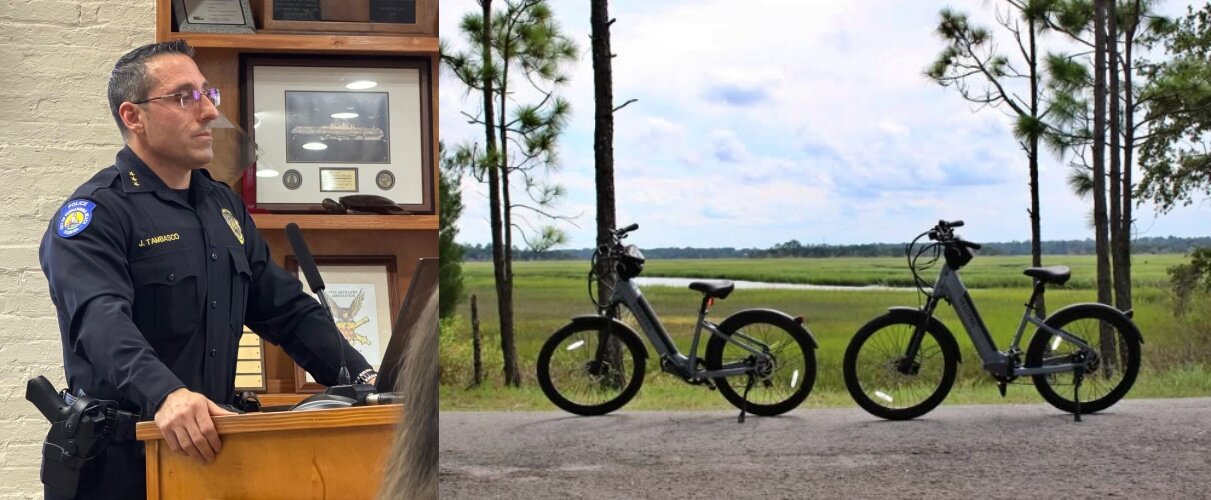
According to Fernandina Beach Police Chief Jeffrey Tambasco, city police logged 188 e-bike complaints involving juveniles in 2025, a surge from previous years. Federal authorities define e-bikes as having a motor power rating of less than 750 watts and fully operable pedals.
Florida law stipulates that e-bikes can be operated wherever bicycles are allowed, such as sidewalks, streets, bike lanes, multi-use paths and the beach. But, Tambasco told city commissioners: “The caveat to that is Florida statutes allow cities to enact ordinances to govern e-bikes and regular bicycle use.”
Only one e-bike was involved in an accident with a vehicle last year, Tambasco noted. However, the number of complaints signals a potential problem with e-bike use in the city. Tambasco said that many e-bike riders had fled by the time police arrived to investigate a complaint. However, in 87 cases, police intervened, usually issuing a verbal warning to the rider. Additional complaints sometimes triggered a call to the youth’s parents or a citation.
“It was a multi-tiered approach,” Tambasco said. “We have seen complaints go down with this approach.”
The police department also embarked on an e-bike education and enforcement campaign last year. While it may be worthwhile to expand that program, a city ordinance to better regulate e-bikes is a worthwhile idea, said commissioner Genece Minshew.
“We should think hard about what it is we can do that makes sense,” she said. “The other thing I would suggest, along with your public education, is a formalized program through the schools, maybe with your resource officers.”
Nationwide, the popularity of e-bikes has grown exponentially since the COVID pandemic, according to national studies. From children to seniors, e-bikes have broad appeal as an alternative mode of transportation. According to several analyses, e-bikes relieve traffic congestion, lower greenhouse gas emissions and are economical. E-bikes often provide older Americans a way to pursue cycling activities that they might otherwise give up.
However, safety concerns have risen alongside e-bike sales. A 2024 study in the journal JAMA Open Network found e-bike injuries more than doubled every year in a five-year period, rising from 751 injuries in 2017 to 23,493 in 2022.
E-bike accidents are thought to occur more than bicycle accidents because e-bikes can reach higher speeds and reduce operator reaction time, according to a 2024 study from the American College of Surgeons. A heavier battery can contribute to easier loss of control.
An e-bike operating at 20 mph “is incredibly fast,” noted commissioner Joyce Tuten. “Most people cannot power a bike that fast. Which means you have kids … going that fast, and they are not able to control these huge, heavy bikes.”
Governments from tiny to large are grappling with the problem, according to recent published reports. There is a lack of consistency around the country regarding laws and regulations to ensure safety. In some places, e-bikes have been banned. Some states have imposed minimum age requirements, such as 12 or 16, to operate e-bikes. Other states require registration or helmet use.
In Florida, legislators have e-bike regulations on their radar. In the upcoming 2026 session, House Bill 243 proposes reclassifying any e-bike that travels more than 28 miles per hour or is equipped with a motor 750 watts or more as an “electric motorcycle.” The bill would also prohibit modifying e-bikes to make them faster than the manufacturer intended and would require the Florida Department of Highway Safety and Transportation to keep track of accidents involving e-bikes, scooters and electric motorcycles.
City commissioners indicated support for further discussion of an ordinance. City officials could opt to set speed limits on e-bikes or even operator age limits. The U.S. Consumer Product Safety Commission (CPSC) recommends prohibiting children under age 12 from operating an e-bike that travels more than 10 mph.
The ordinance could cover whether e-bikes would be permitted on sidewalks, multi-use paths, beaches and in city parks. Currently, e-bikes are permitted on Amelia Island’s multimodal trails as long as riders don’t exceed the 10-mph speed limit.
“I personally would like to see enforcement on the beach,” Tuten said. “I’ve seen e-bikes flying down the beach.”
E-bikes have not emerged as serious issue downtown, although they are clearly popular among younger people, says Lulu Huppmann, executive director of Fernandina Beach Main Street, an organization that promotes the economic well-being of the Main Street District.
“I haven’t really heard anything about e-bikes becoming a problem, but I have witnessed a pack of younger people racing up and down the street doing wheelies and things like that,” Huppmann says. “E-bikes are a great mode of transportation, but I think there can be some rules set in place to alleviate possible issues, such as e-bikes hitting someone or someone hitting them.”
Mayor James Antun, who has a chiropractic office on Citrona Drive, said he has witnessed e-bikes on that busy road.
“My treatment rooms face the road where I’ve watched these [e-bikes] speeding by,” he says, noting the potential for cars making right- or left-hand turns hitting an e-bike. “The concern I have is an e-bike’s doing 20 miles an hour; a car doesn’t have time to anticipate that.”