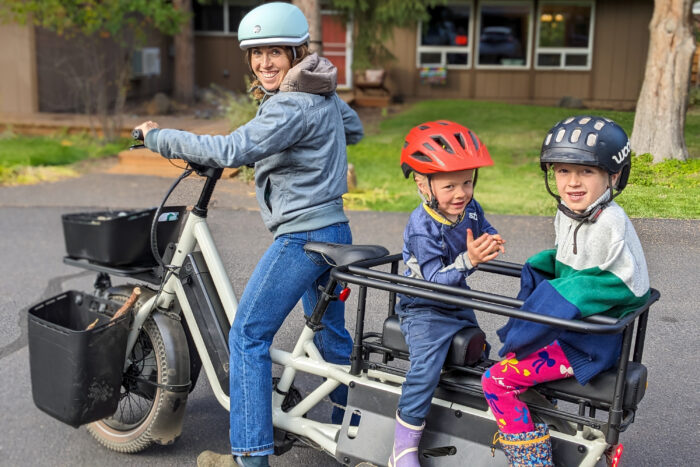
An electric cargo bike can completely change the way you approach life on two wheels. With high weight limits, large racks and boxes, and powerful electric motors, the right electric cargo bike can help you comfortably and easily haul everything from kids to groceries.
The e-bike market has expanded dramatically over the last few years, with brands popping up out of nowhere. With so many options to choose from, finding the right electric cargo bike to suit your specific needs can be a challenge. The electric cargo bikes we tested ranged from compact and nimble to e-bike versions of a freight hauler.
Our test team took these bikes on runs across smooth pavement, broken chip seal, and occasional dirt roads on trips to and from school, running errands around town, or heading to gatherings with friends. We’ve transported everything from kids, dogs, wood, tools, all kinds of outdoor gear, and even huge Costco and farmer’s market hauls to see how they perform in the real world.
From the top-rated Specialized Globe Haul LT to the budget-friendly Lectric XPedition, we highlight, categorize, and review the best electric cargo bikes we tested. If you’re new to electric cargo bikes, check out our buying guide below, which helps explain the different styles of e-cargo bikes on the market today.
Editor’s Note: We updated our Electric Cargo Bike guide on December 31, 2025 to add the Tern Orox S12, an all-terrain e-bike with a lofty load rating and big rubber to bump over rougher ground. We also added rating attributes to each bike, allowing you to compare them side-by-side.
The Best Electric Cargo Bikes of 2026
Best Overall Electric Cargo Bike
8.9/10 Rating
Best Budget Electric Cargo Bike
6.5/10 Rating
Best Compact Daily Commuter Electric Cargo Bike
8.0/10 Rating
Best Front Box Electric Cargo Bike
7.9/10 Rating
Best Value Mid-Drive Electric Cargo Bike
8.0/10 Rating
Best Convertible Rack System
7.9/10 Rating
Best All-Terrain Electric Cargo Bike
8.3/10 Rating
Large carrying capacity
Can haul three kids comfortably
Has throttle for easier stop and go riding
Fits multiple sized riders
Long for even a longtail cargo bike
Heavy
More expensive than hub drive competition
Chelsey Magness
Affordable
Surprisingly good torque sensor – smooth power delivery
28 mph top speed
Stable
Looks pretty good
Great range with single battery, outstanding range with double
Thumb shifters aren’t our favorite
Heavy with dual batteries
Stock headlight isn’t the brightest
Chelsey Magness
Large carrying capacity
Breaks down and folds quickly
Fits into small spaces
Has an integrated lock
Expensive
You’ll need to invest in some accessories for kid or cargo hauling
Chelsey Magness
Big load capacity — weight and volume
Smooth drivetrain
Great for small child transport
Impressive app
Handy integrated rear-wheel lock
Harsh ride over rough surfaces
Limited to 20 mph
Very heavy
Big price tag
Chelsey Magness
More affordable than other Tern models
Easy to modify with dozens of accessories
No app required
Outfitting with the right accessories can get expensive
Lower-tier components compared to other Tern models
Chelsey Magness
The tool-free convertible rack system is super usable and convenient
Stands up on end for storage
Good power for intended use
Great looking
Front rack in stock form could be inadequate for larger or heavier loads
Expensive
No throttle, limited to 20 mph
Chelsey Magness
Can carry a lot of cargo or passengers
Very comfortable handlebar grips and saddle
Dual battery system for extended range available
Cumbersome handling
Rough ride when the rear tire passes over obstacles
Price
Chelsey Magness
Other Electric Cargo Bikes to Haul It All
Affordable
No assembly required
Dual battery option for massive range
Comes with accessories that other brands charge extra for
Large range of fit
Handling can feel a bit twitchy at times
Heavy with dual battery and accessories installed
Chelsey Magness
Best-in-class accessories for kid comfort
Larger 24″ front wheel improves control and handling
Available in multiple frame sizes to fit a wide range of riders
Torque sensor provides smooth, predictable power and acceleration
Thoughtful components for safety and comfort
3 frame color options
Heavy, especially with added accessories
No option for dual batteries
No option to program to Class 3 speeds
Chelsey Magness
Powerful motor
Impeccable finish and attention to detail
700-pound total weight capacity
Loads of add-on options to dial it in for passenger comfort
Well-considered components – powerful brakes
Great controls and display
Handling takes some getting used to, but better with weight in cargo area
Battery charging port is in an inconvenient location
Takes up significant storage space
Expensive
Chelsey Magness
Class 3 capability
Smooth power delivery with torque sensor
Confident handling
Plush ride with suspension fork and wide tires
Safe Shield battery tech
More expensive than budget competitors
Slightly lower total weight limit – but should still work for most people
Heavy weight
Cargo accessories add to cost
Chelsey Magness
Lightweight
Carries large load while being small
Folds to fit into small areas
Pricey for what it is
Can only haul one child
Chelsey Magness
High weight capacity
Stable
30”-long rear rack
Lighter weight than most
Swappable components
Comes with some accessories
Pricey
Proprietary battery plug
Limited color options
Geared to climb/haul over speed
Chelsey Magness
Comes fully assembled
Has a secure lockbox
Durable, flat-resistant tires
Can haul up to 4 kids
Heavy
Hard to back up
Takes up a lot of storage space
Handling takes some getting used to
Chelsey Magness
Rides like a normal bike
Can fit a wide range of people
Sturdy
Smooth power delivery
Can be hard to store
On the pricey side
No throttle
Chelsey Magness
Electric Cargo Bike Comparison Chart
Electric Cargo BikePriceMotorBatteryWeightCarrying CapacityRange (claimed)Specialized Globe Haul LT$3,800700W rear hub772 Wh88 lbs., 3 oz.441 lbs.60 milesENGWE LE20$1,299-1,599750W rear hub921.6 or 1,843.2 Wh88 lbs.440 lbs.109 or 211 milesTern HSD P5i$5,30075 Nm Bosch mid-drive545 Wh61.5 lbs.397 lbs. 76 milesUrban Arrow Family Cargo Line$7,99985 Nm Bosch Cargo Line mid-drive545 Wh112.4 lbs.551 lbs.30 miles, avg.Tern Quick Haul Long D9$3,99985 Nm Bosch Cargo Line500 Wh64.6 lbs.419 lbs.26 – 53 milesYuba FastRack Cargo e-Bike$4,00060 Nm Shimano Steps E7000 mid-drive500 Wh76 lbs.440 lbs.Not specifiedTern Orox S12$6,59985 Nm Bosch Performance CX725 or 1,450 Wh73 lbs.462 lbs.100 or 200 milesLectric XPedition Cargo eBike$1,793-2,292750W rear hub624 or 1,248 Wh68 – 75 lbs.450 lbs.60 – 120 milesRadio Flyer Via Pro$2,909750W rear hub647 Wh73.5 lbs400 lbs.30 – 50+ milesFerla Royce 2 Cargo Bike$5,999 and up750W rear hub840 Wh158 lbs.700 lbs.up to 45 milesRad Power RadWagon 5$2,399750W rear hub720 Wh88 lbs.375 lbs.20 – 60 milesTern HSD P9$3,699Bosch Active line mid-drive400 Wh57 lbs.375 lbs. 69 milesXtracycle Swoop 2.0$4,999Shimano Steps EP6 mid-drive630 Wh62.9 lbs.470 lbs.30 – 60 milesBunch Original Family Cargo Bike$6,499500W rear hub
614 Wh152 lbs.350 lbs.30 milesYuba Spicy Curry$5,99985 Nm Bosch mid-drive500 Wh60 lbs.300 lbs.55 milesScroll right to see more specs.
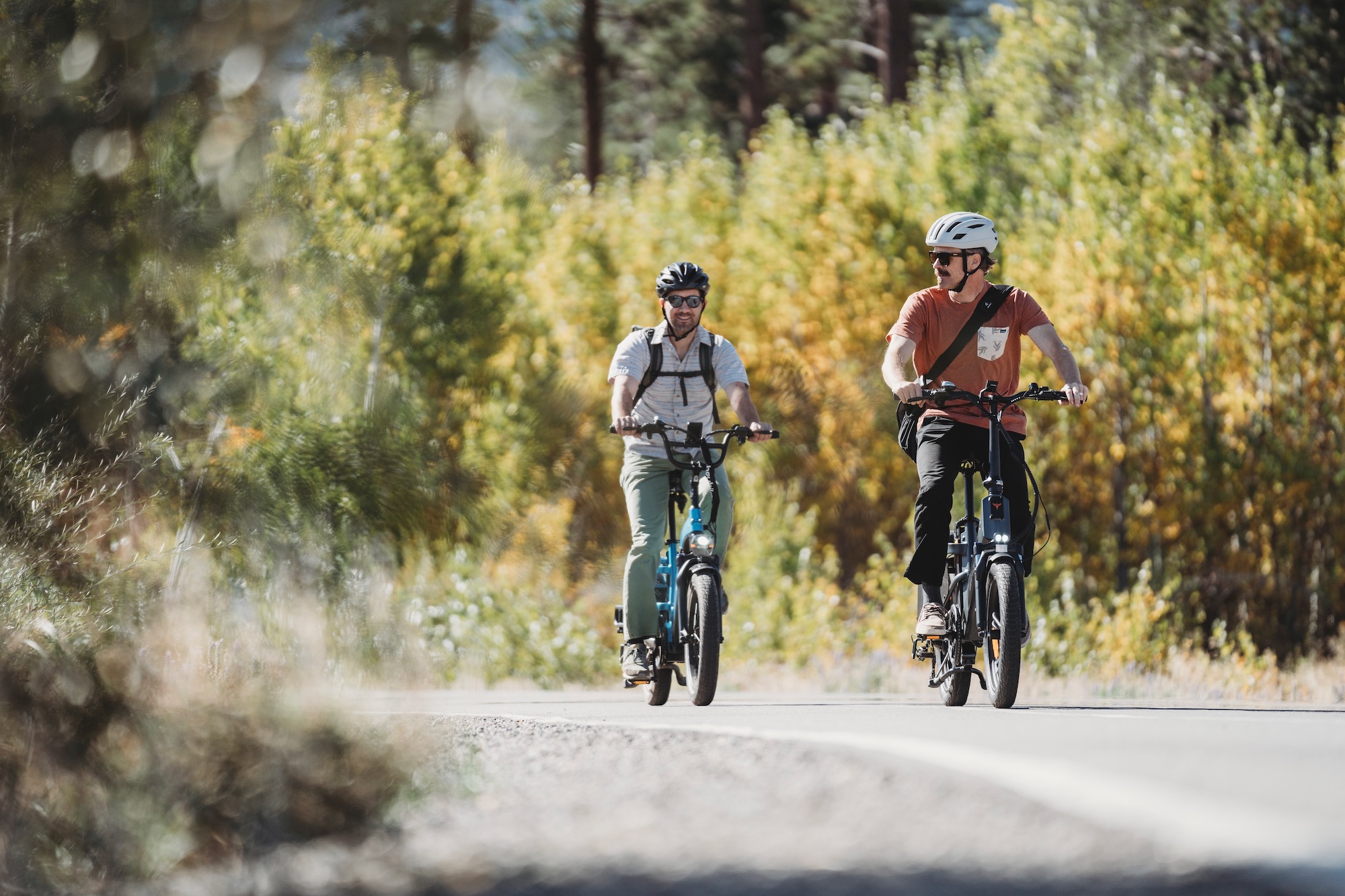 Testing electric cargo bikes with the GearJunkie team; (photo/Tucker Adams)
How We Tested The Best Electric Cargo Bikes
Magness, Ishii, and Benson have tested and continue to test countless bicycles and all related gear at GearJunkie, including e-bikes. For this buyer’s guide, our experienced team ran personal, business, and family errands aboard as many electric cargo bikes as they could get their legs over.
They ran short errands across smooth pavement in urban areas to longer missions in remote areas (Ishii had to ride over 2 miles on dirt to get his mail and five times further to get groceries). Magness often carried multiple children and pets around the bustling year-round outdoor playground of Bend, Oregon.
Ishii hauled tools all over his property near Austin, Texas, while maintaining wells, fences, and outbuildings. Benson pushed the bikes he tested to their cargo and power limits while getting groceries and running other errands in the hilly terrain near his mountain home in the Lake Tahoe area.
We assembled each bike ourselves, following printed or online instructions and using the included tools when applicable. While setting each bike up, we were able to assess each model’s range and ease of adjustments for users of varying heights. While riding, our testers focused on important performance characteristics like handling, stability, power delivery, top speed, range, user interface/controls, comfort, and cargo-carrying capability.
Some bikes operated flawlessly and smoothly for the test duration, while others fell apart or failed within the first few miles. This curated list represents thousands of miles of cumulative riding, hundreds of hours of assembly and maintenance, and equal amounts of frustration and joy. We did the hard work for you, suffered the disappointments, and reported the good finds so you can spend your hard-earned money wisely. We realize any bike on this list is a significant investment.
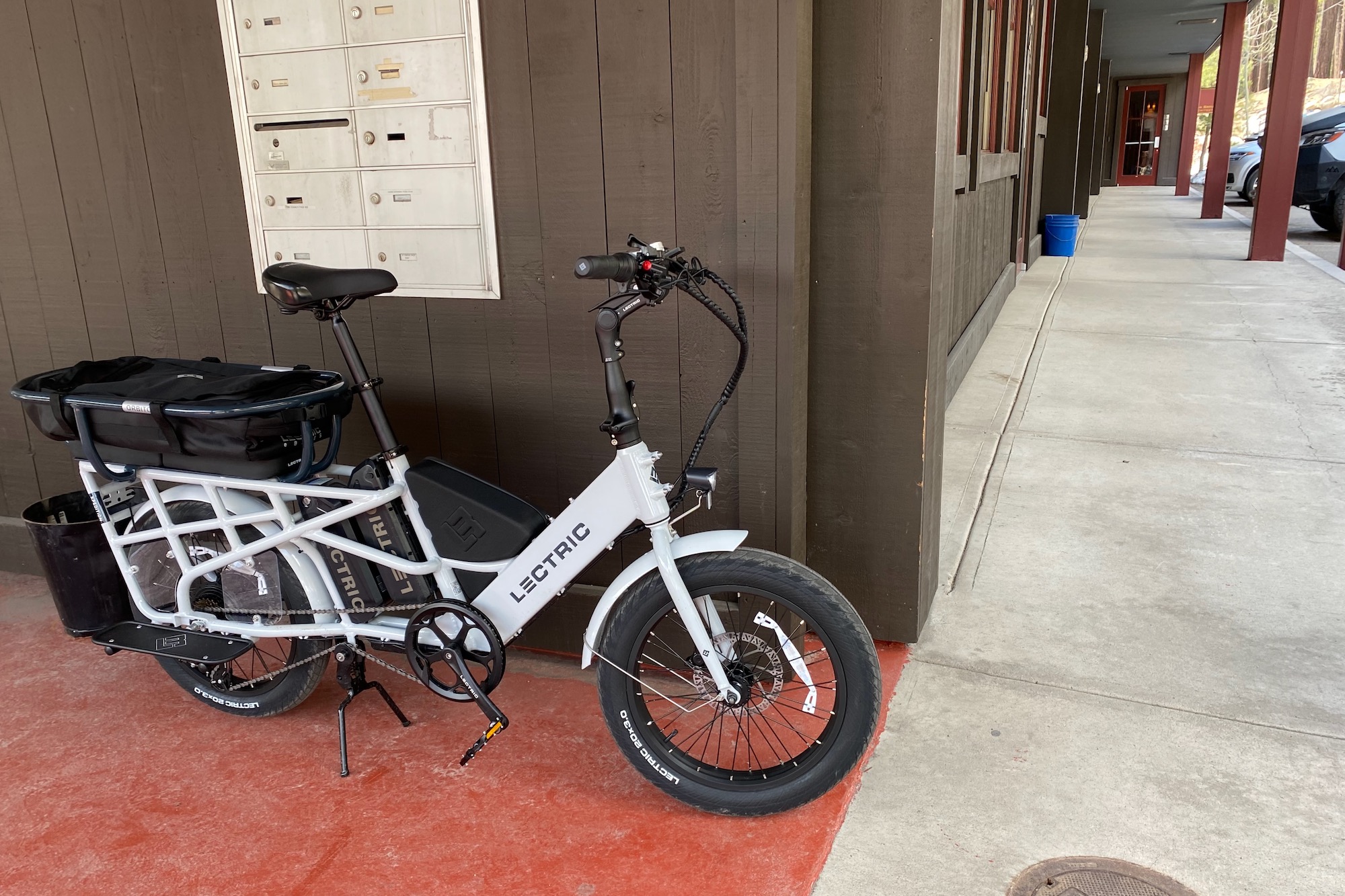 Our testers used these bikes just like you would. Here, the Lectric XPedition is parked while running errands around town; (photo/Jeremy Benson)
Our Expert Testers
Chelsey Magness, Seiji Ishii, and Jeremy Benson did the bulk of our electric cargo bike testing. In addition to the models they tested, we also include a few other electric cargo bikes in this guide that have recently been tested by other members of the GearJunkie editorial team.
Magness is an adventure racing world champion and mother of two. She lives a two-wheeled life at home, both while training and running family and business errands via pedal power. She is a long-time contributor to GearJunkie in the cycling category and draws from an extensive and deep well of experience and knowledge in both the competitive and lifestyle branches of cycling.
Ishii has been involved with cycling for nearly four decades, starting with road racing in the 1980s. He has watched mountain biking explode, road racing implode, and witnessed the emergence of both gravel and electric bikes. And through it all, he has been a cycling dork. He started as a freelance cycling and climbing contributor to GearJunkie and now resides as the cycling and climbing editor.
Benson is also an editor at GearJunkie and has been professionally testing and reviewing bikes and related gear for the past 8 years. In addition to mountain and gravel bikes, he’s tested over 30 electric bikes of all styles, 12 of which have been cargo models. His experience has given him an extensive knowledge base and a keen sense of what differentiates the performance of the electric bikes he tests.
New York City-based Matt Jancer has also lent a hand (and two bike-savvy feet) in our cargo bike testing, braving the traffic of Times Square and venturing further afield to the more wild parts of the state at times.
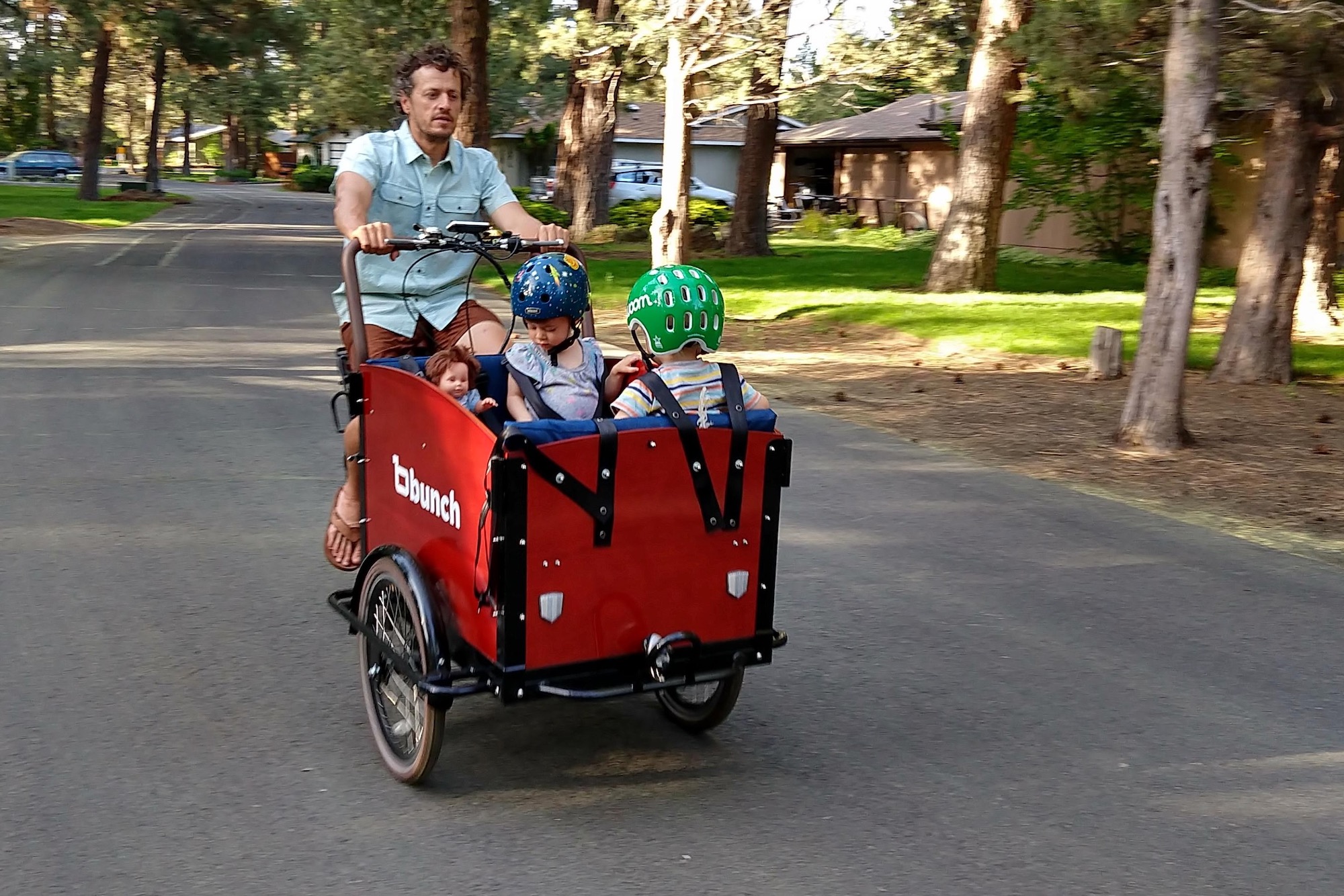 Hauling the family around the neighborhood with the Bunch Original Cargo Bike; (photo/Chelsey Magness)
Buyer’s Guide: How to Choose an Electric Cargo Bike
Before delving into our buyer’s guide, it’s wise to discern how you will really use a cargo bike. The type, size, and weight of your intended cargo will help determine the style of electric cargo bike that will suit you best.
The terrain, road or off-road surface, time of riding, urban versus rural environment, and weather also impact significant choices like wheel size, tire type, lighting needs, seating, and security. Storage space is also a concern, especially in urban environments.
The first thing to consider, though, is the style of electric cargo bike you need. While long-tail, long John, and front-box trikes all aim to transport cargo, one style or another may suit your needs best.
Not sure if a cargo bike is the best fit for your needs? We’ve tested sleeker e-bikes for commuting as well as folding electric bikes for easier transport or storage. Interested in something with more off-road capabilities? Check out our guides to the Best Electric Bikes and the Best E-Bikes for Hunting.
Electric Cargo Bike Styles
Electric cargo bikes fall into three general style categories. All of them are functional for transporting yourself and plenty of other items (including children), but they vary in where and how they support cargo.
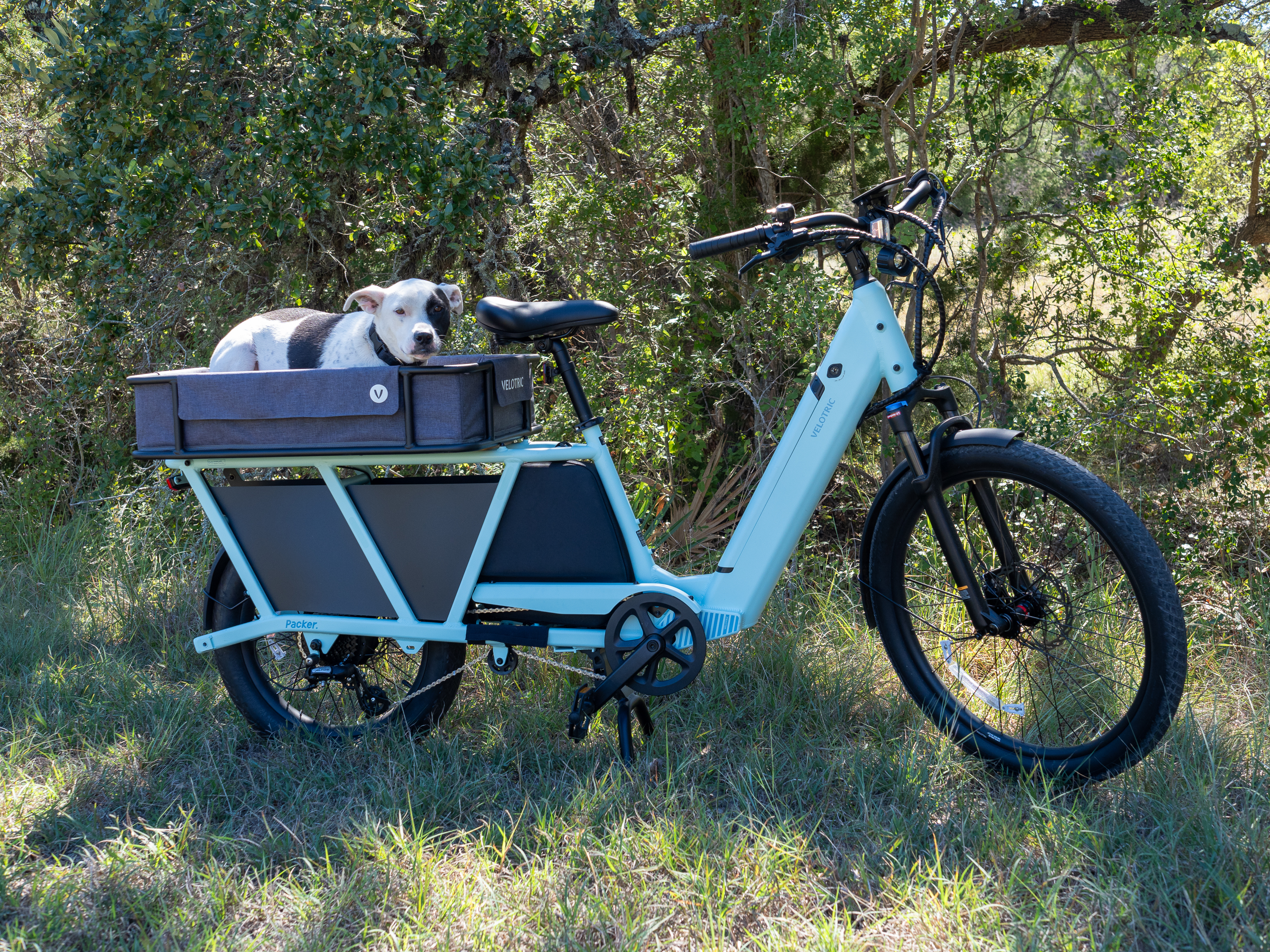 The Velotric Packer 1 is a capable, maneuverable long-tail bike with a range of up to 52 miles; (photo/Seiji Ishii)
Long-Tail
Long-tail cargo bikes are arguably the most common and popular style of electric cargo bikes that we see in the U.S. These look and ride more like traditional bikes and have a large rear cargo rack — the long tail — and can typically fit up to three total passengers or other types of cargo.
One of these is the rider, and the rear rack can usually be configured up to two kid-size passengers with additional accessories like pads, handles, and seats (depending on the bike and length of the rear rack). Most can also fit a clip-on seat for younger kids (9 months and up).
Long-tail bikes aren’t just good for transporting the family, however. The rear rack can also be configured to haul pets, groceries, and other cargo with various baskets, bags, etc. Most brands offer a wide range of aftermarket accessories to accommodate a wide variety of cargo-carrying needs. Depending on what you intend to carry with your bike, it is often wise to check each brand’s available accessories to make sure they’ve got what you need.
 Testing the long-john-style Urban Arrow Family cargo bike; (photo/Bryon Dorr)
Long John
Some front-loading bikes are also known as long-john or bucket bikes. As the name suggests, they have the cargo box up front with the front wheel stretched out in front of you. Some also have the capacity for another passenger to ride on the back.
This style takes a little practice when you first get on, as it handles slightly differently than a traditional bike due to its length and weight. They also happen to be among the nicest and most expensive options — the Urban Arrow Family Cargo Line goes for an eye-watering $7,999.
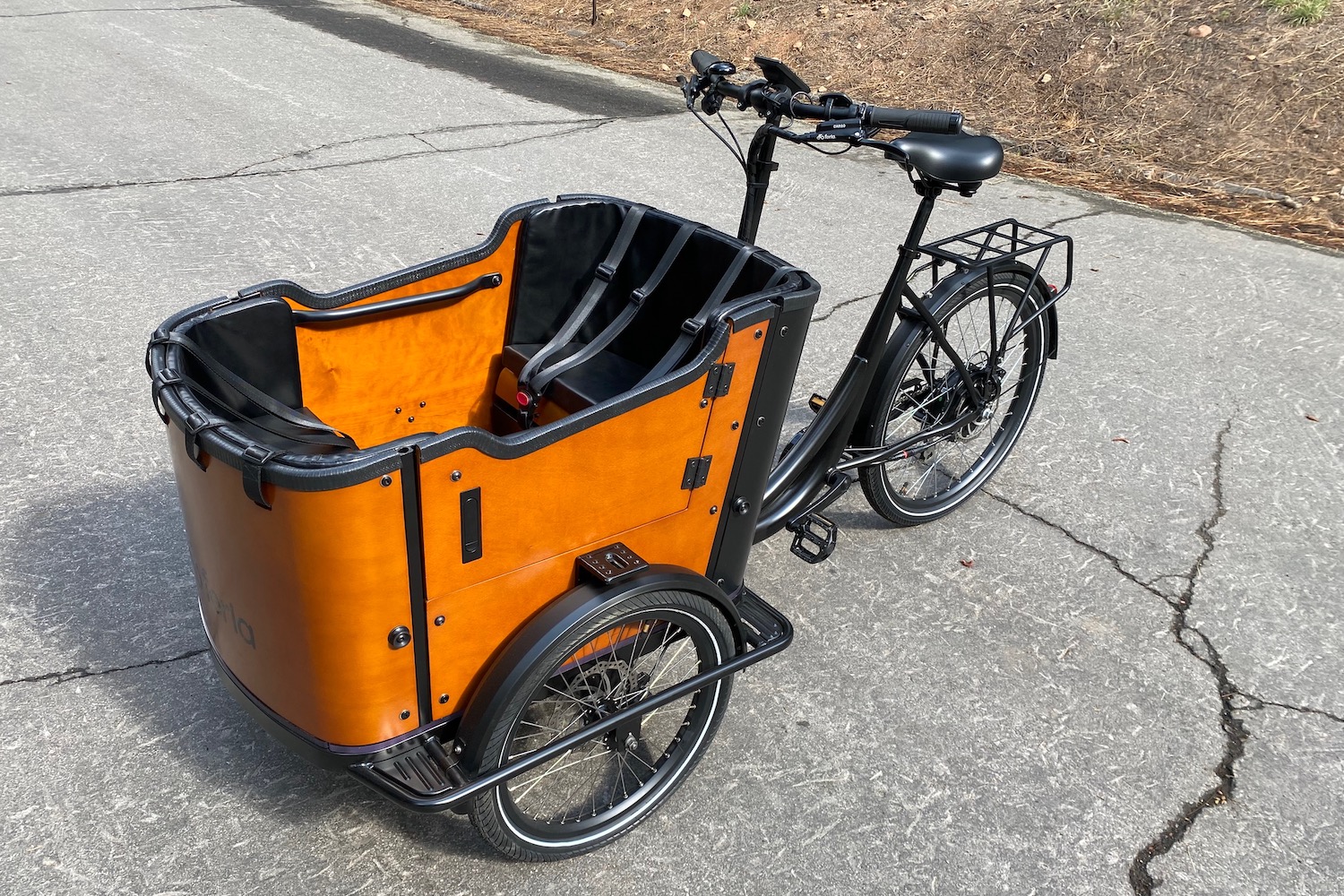 The Ferla Royce 2 is a front-box cargo bike that can haul up to 4 kids and a rider; (photo/Jeremy Benson)
Front Box Trike
Front box trike cargo bikes are similar to the long john models in that they carry cargo in a box at the front of the bike. They differ in that the front cargo box sits between two front wheels. It depends on the model, but this style can fit as many as four kids in the box and sometimes an extra kid or panniers on the back. If you’re not transporting kids, loads of other gear can quickly and easily be loaded in the box.
Both the Bunch Original Family Cargo Bike and the Ferla Royce 2 are great examples of this style of electric cargo bike. We really appreciated the utility and family-friendliness, though the three-wheel design limits their maneuverability.
This style of bike handles quite differently from a traditional bike and is best suited to slower speeds and cautious riding. Both of the models we’ve tested also happen to be fairly expensive.
What Are You Hauling?
Before starting your search, ask yourself what you will use the bike for most. Grocery shopping? Kid pickups and dropoffs? Delivering pizzas? Taking your dog to the dog park? Hauling the boards to the local surf wave? All of the above? When you narrow your search down in this way before you start looking at the options, it makes it less overwhelming.
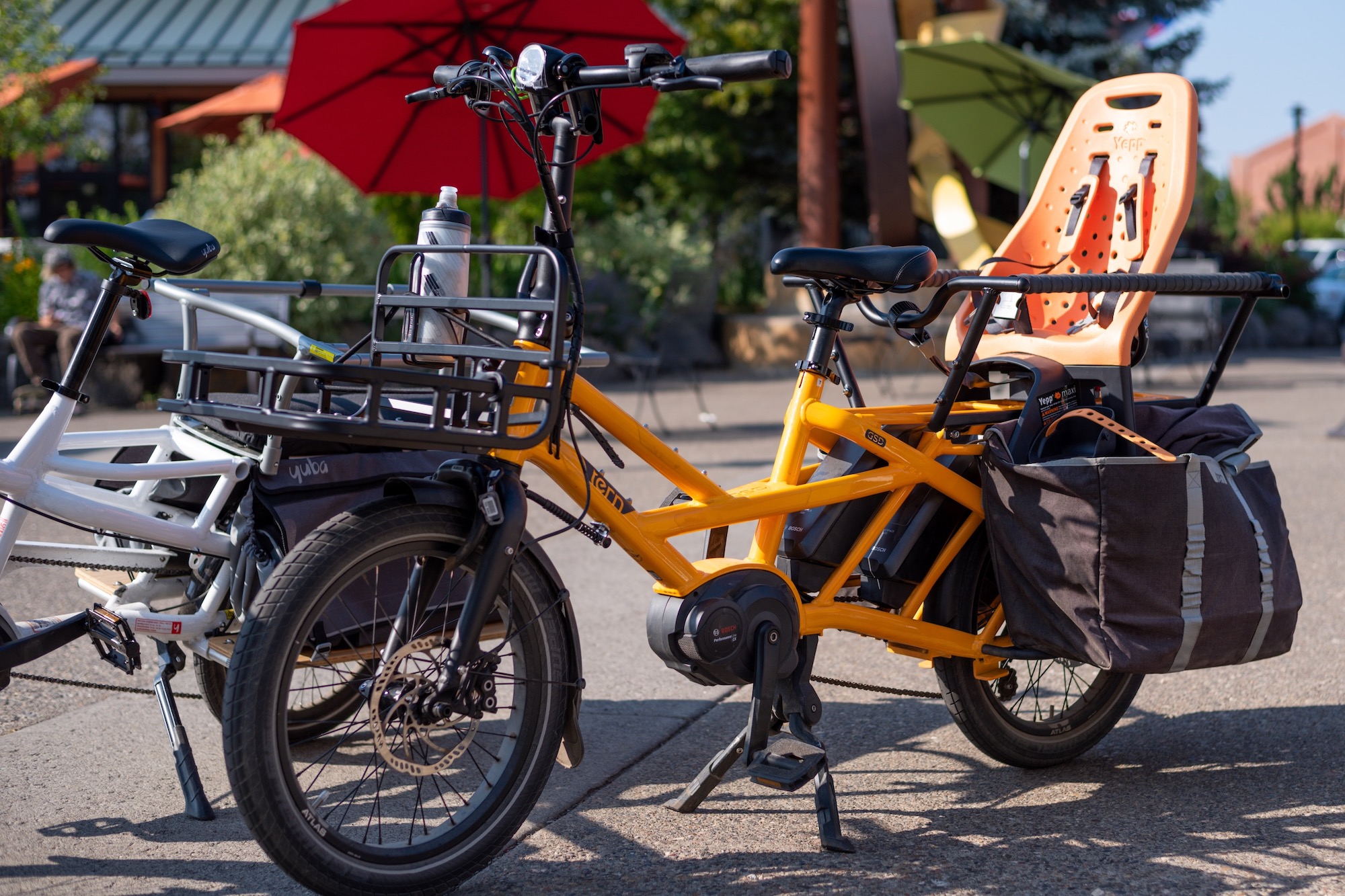 Knowing what you’ll be transporting with your cargo bike will help you decide which model is right for you and the accessories you’ll need; (photo/Jason Cornell)
The size of what you are hauling can determine the type of e-cargo bike, while the total weight of passengers and items plays into the carrying capacity. You will need both the ability to hold the sheer volume of your items and the weight of the intended cargo, plus passengers. You’ll also need to consider the size and type of cargo, as most bikes require accessories to customize the cargo-carrying capabilities to your needs.
E-Bike Classes
In the U.S., electric bikes are separated into classes based on top speed and whether or not they have a throttle. Whether or not you have the convenience of a throttle and how fast you want to go is up to you, and it may also be influenced by the surfaces you ride and the cargo you’re carrying. Likewise, you may also want to consider the regulations where you live, as many bike paths have speed limits, etc.
Class 1: Class 1 bikes provide pedal assistance only and are limited to a top speed of 20 mph. They do not come equipped with a throttle, so they only provide power output when the rider is pedaling.
Class 2: Class 2 bikes also have a top speed of 20 mph, but in addition to providing pedal assistance, they are also equipped with a throttle. The throttle can propel you with pure electric power (no pedaling) and may be helpful for some riders when starting from a stop with a loaded bike.
Class 3: Class 3 differs from classes 1 and 2 in that they provide pedal assistance up to 28 mph. These bikes may or may not have a throttle. If equipped with a throttle, the top throttle speed is still 20 mph.
Motor Type: Rear Hub vs. Mid-Drive
There are two main types of motors used on electric bikes — rear hub and mid-drive. Both have their pros and cons.
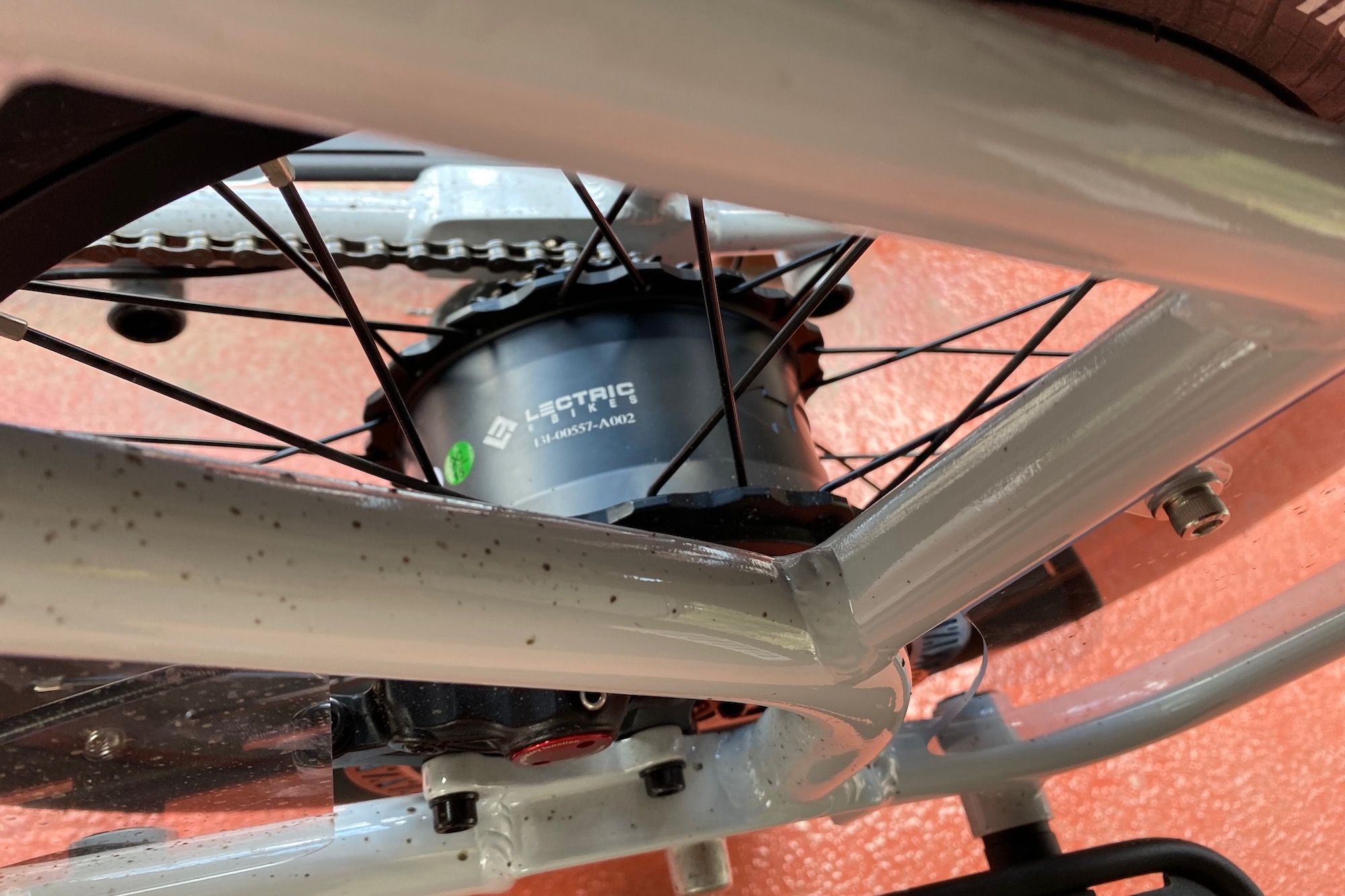 Rear hub motors are contained in the rear hub of the bike. They are typically a bit less expensive and typically provide the option for the bike to have a throttle as well as pedal assistance; (photo/Jeremy Benson)
Rear Hub Motors
As the name suggests, rear hub motors are contained within the hub of the rear wheel. These are super common because they are less expensive and provide the option to have a throttle on the bike.
Since their power delivery is often based on a cadence sensor, it typically doesn’t feel quite as smooth or refined as mid-drive systems. That said, they work well, have plenty of power, and are usually pretty low maintenance and easy to replace if needed.
Mid-Drive Motors
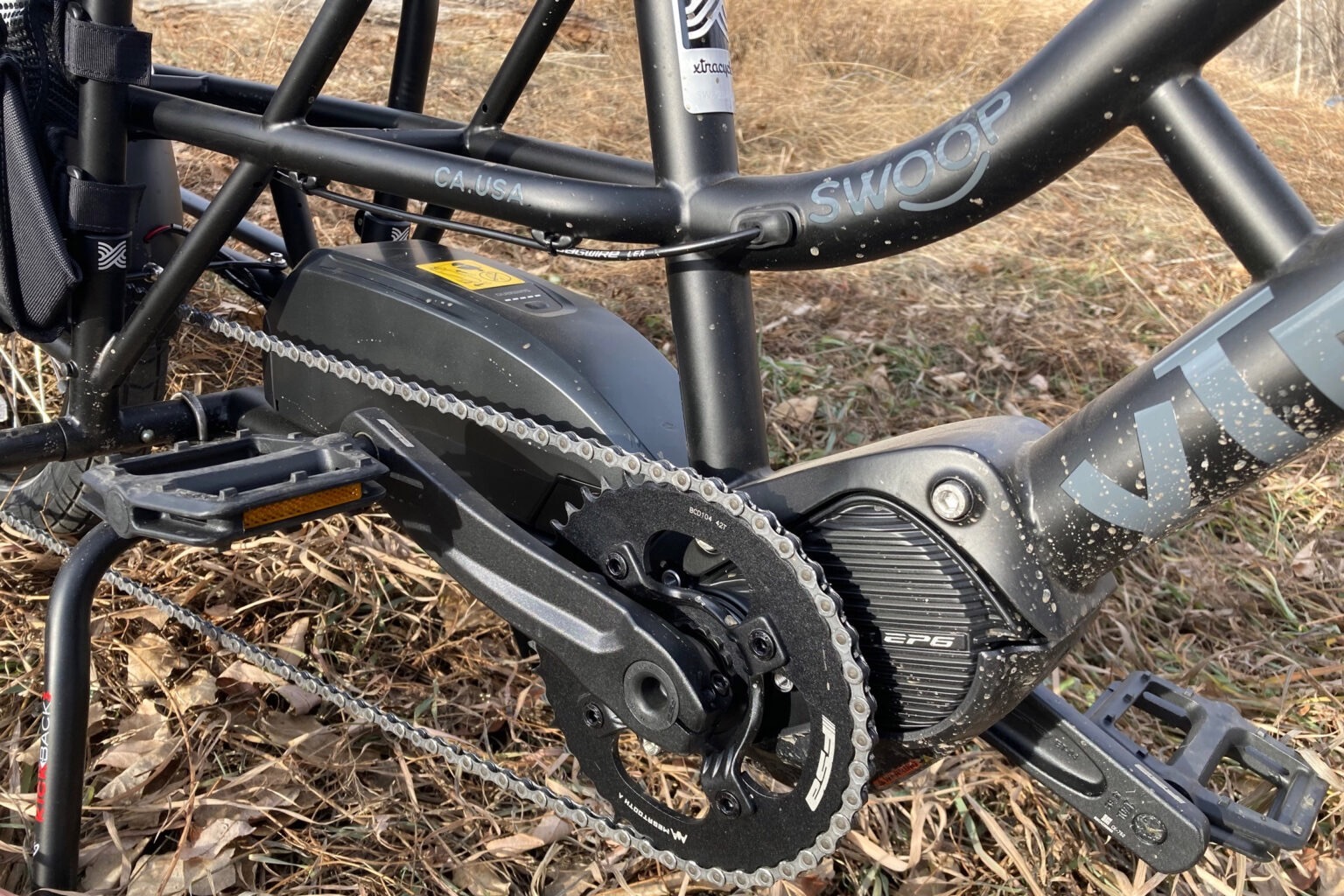 Mid-drive motors, like the Shimano Steps EP6 on the Xtracycle Swoop 2.0, are typically more expensive and provide a smoother and more refined power delivery; (photo/Cameron Martindell)
Mid-drive motors are typically integrated into the frame of the bike by the bottom bracket and connect to the cranks to transfer power into the drivetrain. This type of motor typically costs more and is found on high-end bikes. Mid-drive motors usually work with a torque sensor and have smoother, more natural-feeling power delivery than the less refined rear hub motors.
The motor location also helps distribute weight in the bike better. Beyond the higher cost, one of the primary disadvantages is that they typically can’t incorporate a throttle.
Range
A bike’s range, or the number of miles you can travel per battery charge, is an important factor to consider so you can be sure to make it to and from your destination without running out of juice. This distance is highly variable and depends on a combination of battery storage capacity and the amount of power you’re using. Generally speaking, the larger the battery, the greater the range.
There are several factors that impact a bike’s range, including the motor’s power, rider weight, cargo weight, terrain, temperature, and how much power you use. If you simply twist the throttle and make the bike do all the work, you’ll drain the battery much more quickly than you will if you push hard on the pedals in a low pedal assist mode.
Likewise, if you’re riding up and down hills, it will use more power than riding on flat roads. And it’s important to note that the manufacturer’s claimed range of an electric bike is usually an overestimation of what you’ll get in the real world.
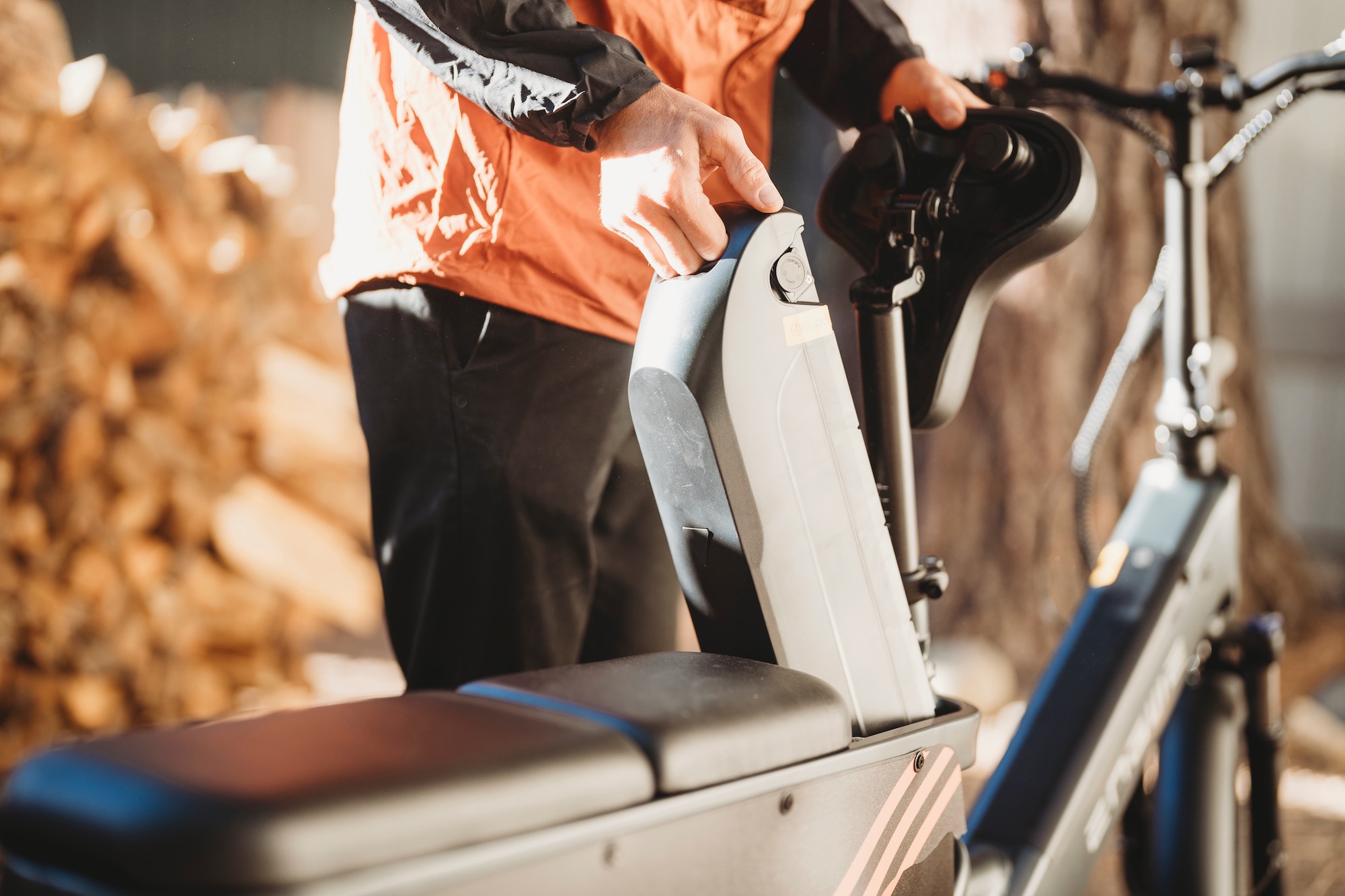 Adding the second battery to the ENGWE LE20, seen here, gives you a massive battery capacity and corresponding range potential; (photo/Tucker Adams)
More electric cargo bikes are coming out with the option of either attaching or hot-swapping an additional battery to extend the range between charges. For example, the Lectric XPedition and the ENGWE LE20 are both sold with either a single or dual battery. Even with single batteries, these bikes are plenty capable of going 30+ miles between charges, which should be more than adequate for most people’s daily needs.
Battery Size
A major factor in your bike’s range potential is the storage capacity of the battery. This is generally expressed in watt hours (Wh), and the higher the number, the more juice it holds. The bikes we tested have batteries ranging in size between 400Wh and 772Wh. A few outliers have the option for dual batteries for up to 1,000 or 1,344Wh!
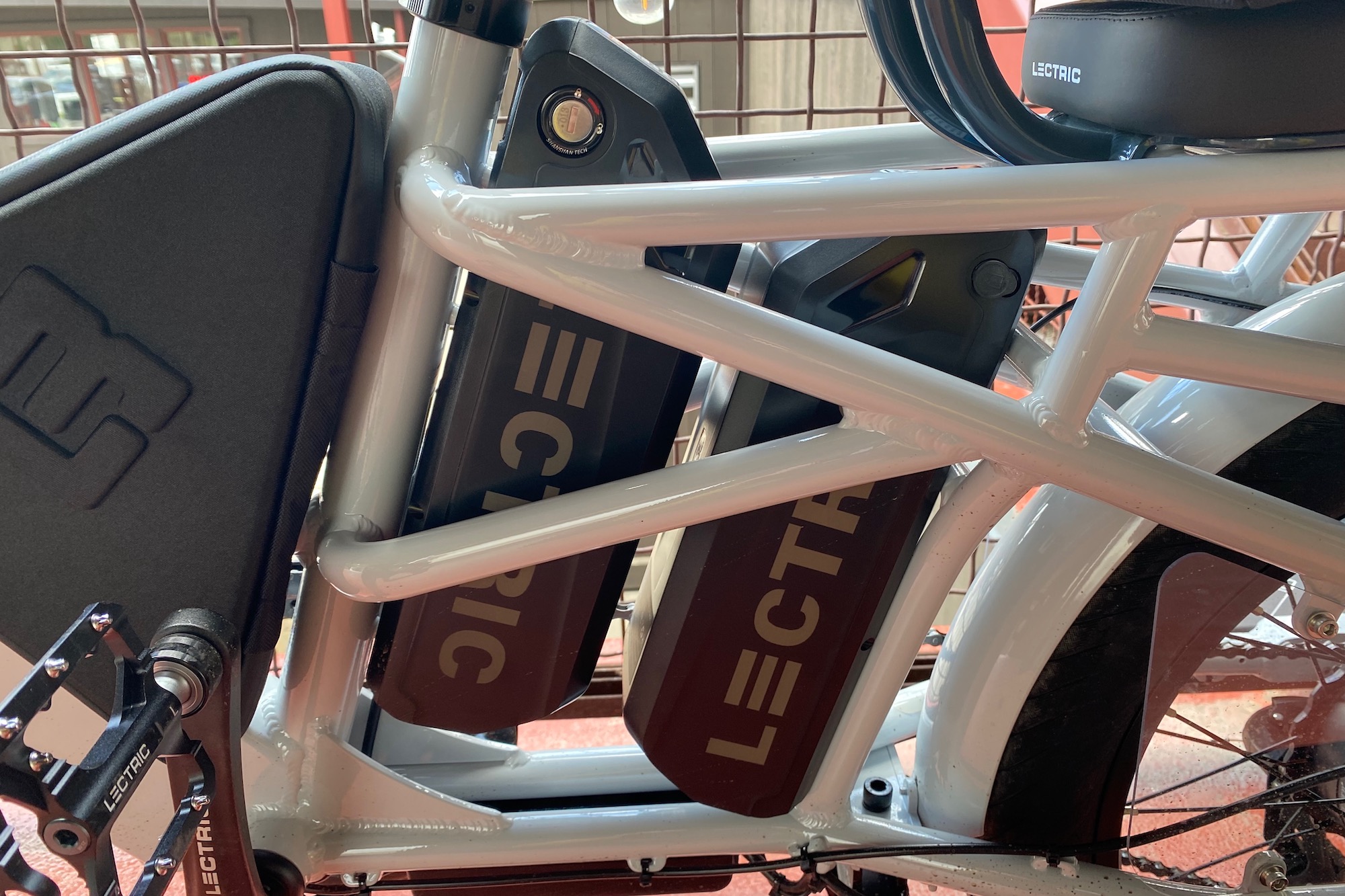 The amount of battery storage capacity is directly related to how far you can ride an electric cargo bike between charges. If you need to go the distance, consider a bike that has a large battery or check out a dual battery option like the Lectric XPedition; (photo/Jeremy Benson)
Power Output
How quickly your battery drains and the amount of range you can get from your bike depends entirely on how much power you use. So, by pedaling harder and using lower assistance modes, you’ll be able to ride farther than you would if you use higher modes and don’t put in as much of your own effort. Makes sense, right?
Storage Space
An often-overlooked factor is the storage space an electric cargo bike will require, which is typically much more than a standard e-bike. You’ll definitely need to consider your storage space when choosing an electric cargo bike. Some, like longtail versions, require substantial length, and front box trikes are much wider.
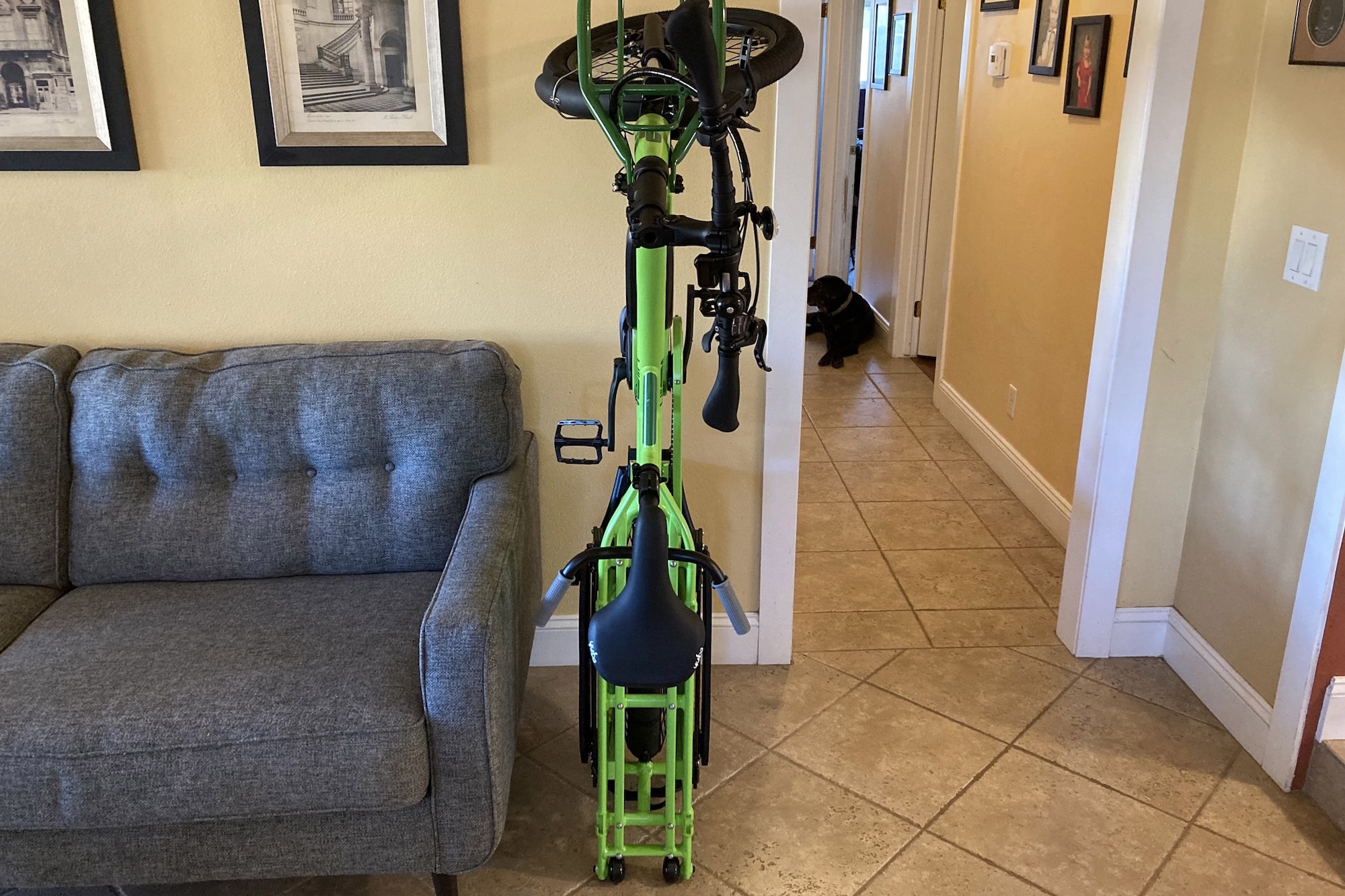 Electric cargo bikes are big, so storing them requires more space than typical bikes. Some models, like the Yuba FastRack, can be stood up on their end to reduce their footprint and fit into tighter spaces; (photo/Toby Hill)
Some electric cargo bike brands like Bunch understand that their models demand significant storage space and offer an outdoor cover to protect them while being stored outside. Thankfully, other brands like Yuba and Tern have designed their bikes to stand on their ends so they can take up much less space in your garage or apartment for storage than when they are on their wheels.
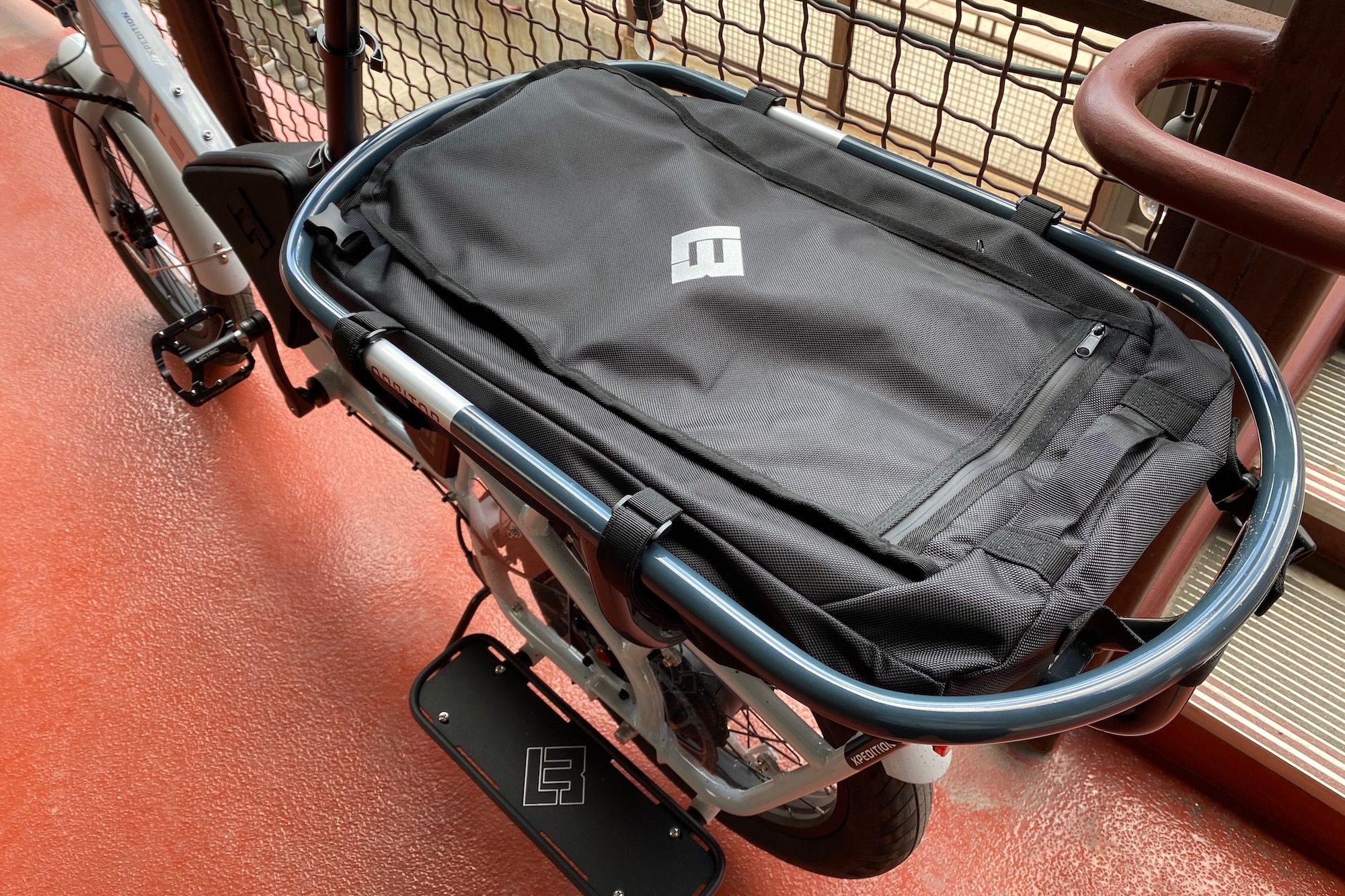 Lectric adds a lot of value to the XPedition with included accessories like seat pads, the Orbitor rail, running boards, a frame bag, and a cargo bag; (photo/Jeremy Benson)
Accessories
The point of cargo bikes is to carry cargo, and it is typically necessary to purchase add-on accessories to customize them for your specific needs. It depends on the brand or model in question, but some come with certain accessories included so you can carry passengers or items picked up on your errand runs without needing to shell out more cash right off the bat.
The Lectric XPedition we tested came with seat pads, running boards, an Orbitor rail, an Orbitor bag, and a frame pack included with the purchase. This bike was pretty much ready to carry just about anything once we installed them.
Unfortunately, included accessories aren’t the norm. For most of the other models we tested, you’ll need to purchase seats, baskets, running boards, and any other specific items required to transport the people or cargo you intend to carry. Thankfully, most brands offer a range of accessories designed to fit the bikes they sell, allowing you to carefully curate the perfect kid hauler, grocery-getter, or beach-going machine.
Thule’s Yepp child seats are a very popular option for small children, and some brands even make racks that can carry surfboards to the beach. Consider what you hope to carry with your electric cargo bike, and check the accessories pages to see which brands offer compatible add-ons to meet your needs.
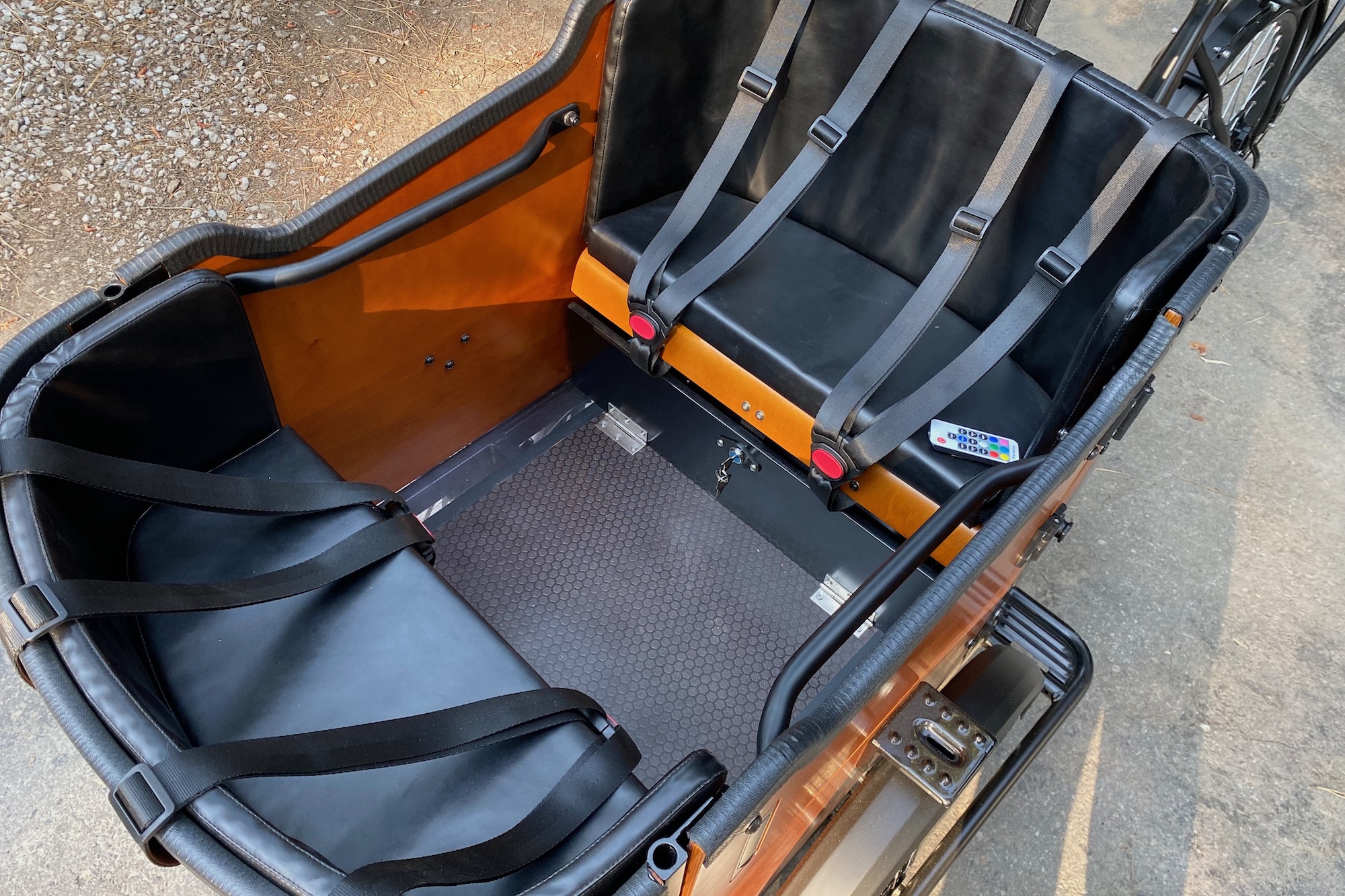 With seats and harnesses, the Ferla Royce 2 comes ready to carry children. Add-ons like canopies, a nonslip floor, or LED lights can be purchased to dial it in for your needs; (photo/Jeremy Benson)
Safety Concerns
Safety is another factor to consider when discussing electric cargo bikes. Not only are the bikes themselves longer and heavier than regular bikes, but adding significant weight in the form of child passengers or bulky cargo can further impact the bike’s handling.
We always recommend wearing a properly fitting bike helmet, not exceeding the weight limits of the bike or cargo areas, riding in control, and obeying the rules of the road. Ultimately, your safety is up to you, so use good judgment.
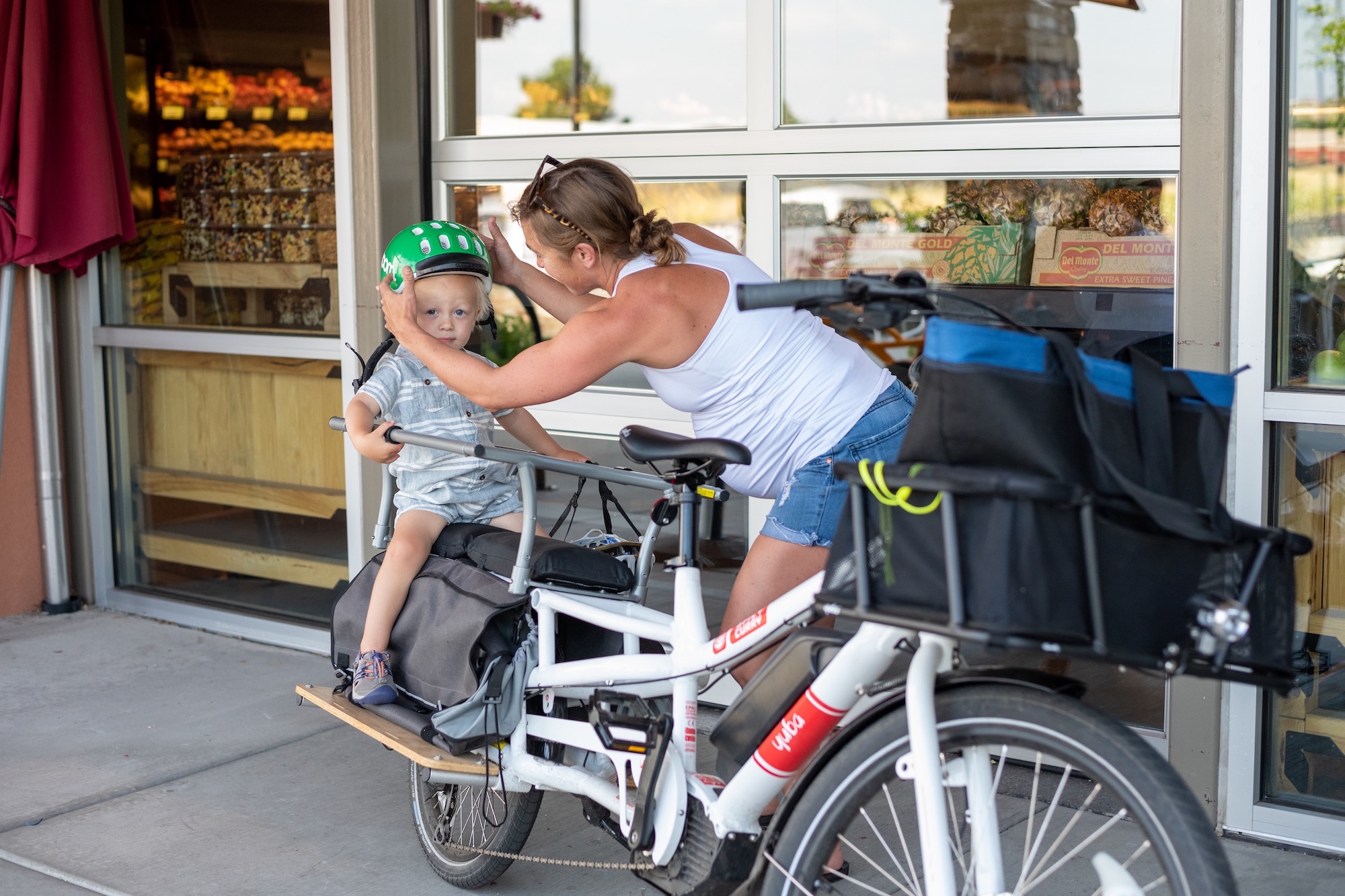 Safety first. Thankfully, there are a variety of seating options to transport kids on electric cargo bikes; (photo/Jason Cornell)
Riding With Kids
Cargo bikes are often marketed as being great for transporting kids and other passengers, and they definitely can be. Riding with passengers, especially children, can be dangerous. A huge variety of accessories are available for children, including children’s seats, railings, handlebars, etc. We recommend exploring the available options and selecting the size that best suits your child.
The weight of passengers will also affect the bike’s handling, so familiarizing yourself with a loaded bike by practicing in a more controlled environment may be a great idea before heading out into traffic. Again, we strongly recommend that all passengers on the bike wear properly fitting helmets and ride cautiously to keep themselves and their passengers safe. Ultimately, your safety and the safety of your children or cargo is up to you, so please use good judgment.
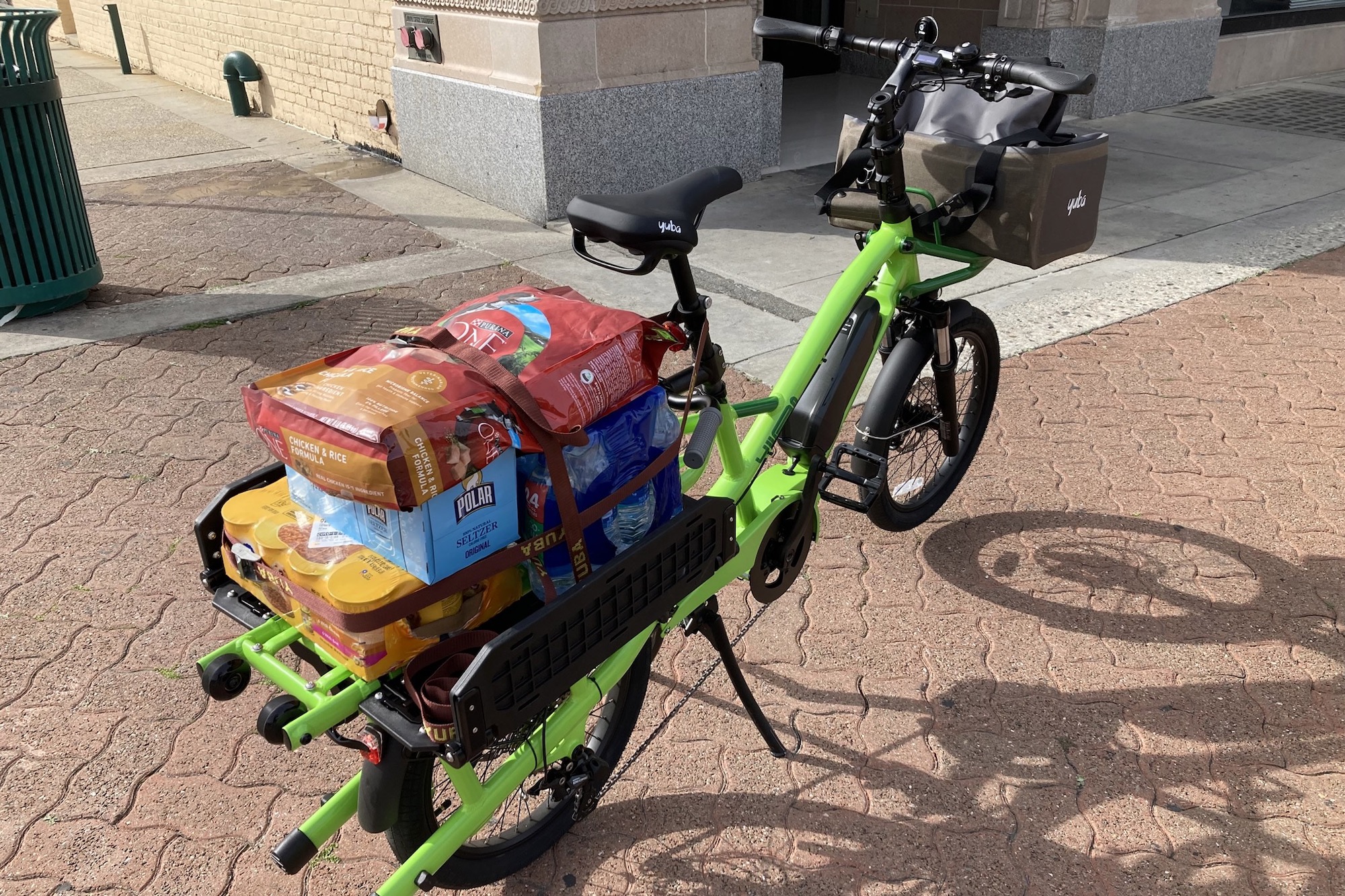 The Yuba FastRack loaded up with lots of heavy cargo on an errand run during testing; (photo/Toby Hill)
Riding With Cargo
Adding heavy weight to the front or rear of the bike in the form of non-human cargo can also impact the handling of the bike. Always ensure that your cargo is properly secured to keep the weight from shifting while you ride and to keep it from falling off the bike.
Most cargo bikes are quite stable as they are designed to carry heavy loads, but again, it may be beneficial to practice riding with a loaded bike to get used to the way it handles.
Security Concerns
Security of both the bike and cargo can be an issue, especially in urban centers. Many electric cargo bikes can be virtually locked via an app, which means the bike is electrically actuated to prevent someone from either riding it or rolling it away.
Some bikes include a built-in security cable or wheel lock for physically and visually protecting the bike from theft. Of course, you can always use a standard bike lock and cable to protect your investment. Electric cargo bikes are not cheap, so we always lock ours wherever we go.
Some electric cargo bikes can also have locking cargo areas. This is relatively uncommon but a nice feature to have.
Riding in Adverse Weather
Die-hard cyclists and dedicated commuters know that the weather makes no guarantees. What starts as a dry ride can quickly turn into a downpour. There are a couple of accessories and features you should consider if you plan to roll, regardless of whether the sun shows or not.
Fortunately, most electric cargo bikes come equipped with fenders to protect the rider from road spray, and most also come with integrated front and rear lights for changing light conditions. These features are appreciated and ensure that you’re ready for changing weather and that you’ll be able to see and be seen if you’re out after dark (or when it’s still light out).
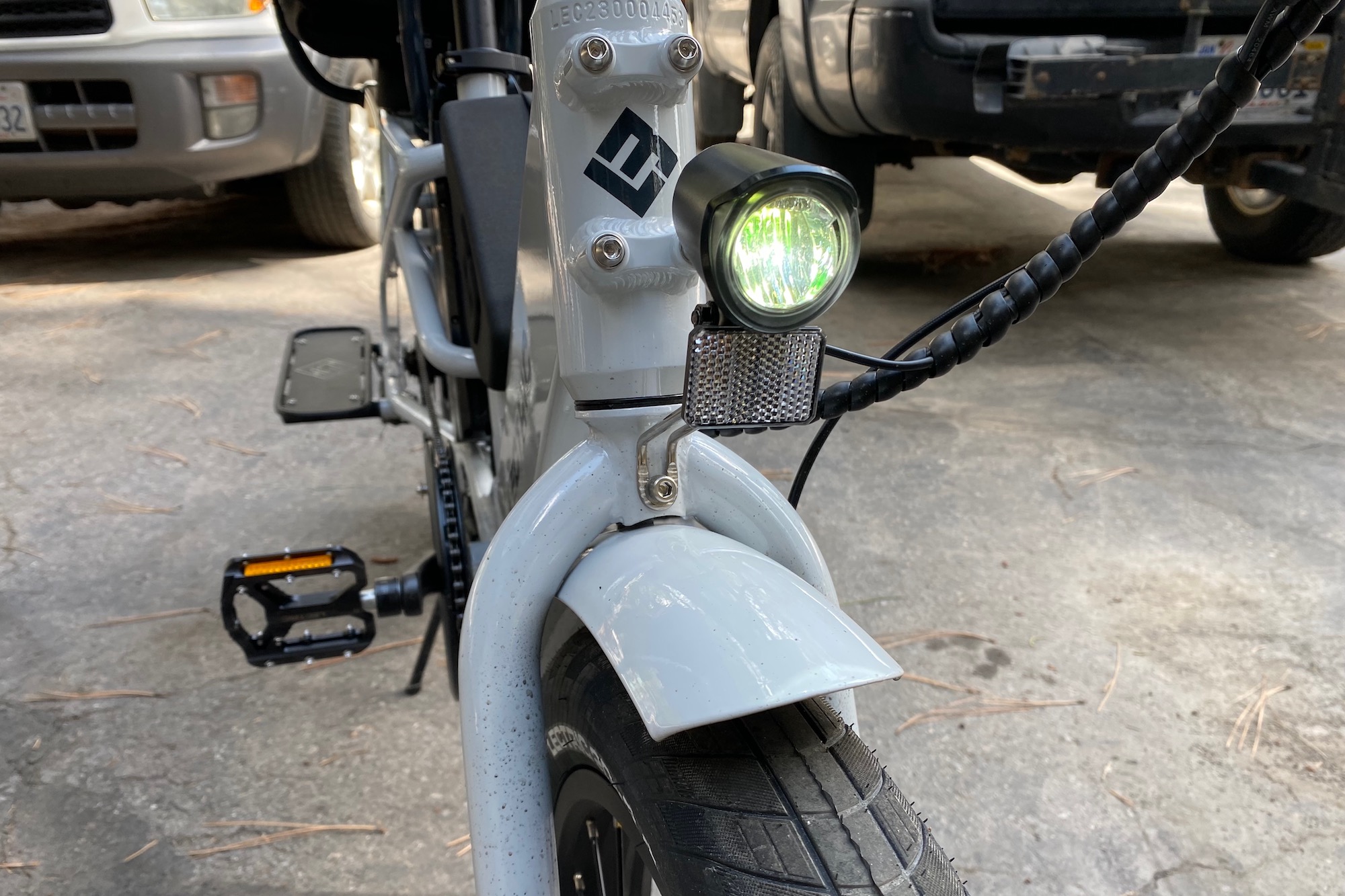 Fortunately, most electric cargo bikes come equipped with fenders and lights to handle changing weather and light conditions; (photo/Jeremy Benson)
Regardless of the electric cargo bike type, you will undoubtedly need to protect whatever you are hauling from precipitation at some point. Some brands offer dedicated and fitted covers for their bikes’ storage areas. If not, the bike will need a way to attach some type of cover or secure a dry bag, etc.
Some brands have accessories that can help protect the passengers from the elements as well, such as canopies. It’s worth noting that such accessories can create a lot of drag, reducing both speed and battery life.
Price & Value
New electric cargo bikes can range from around $1,500 to as high as $8,000 or more. So, what makes some bikes so much more expensive, and how much should you spend? Realistically, they all work pretty darn well, but spending more typically gets you a higher quality, higher performance bike.
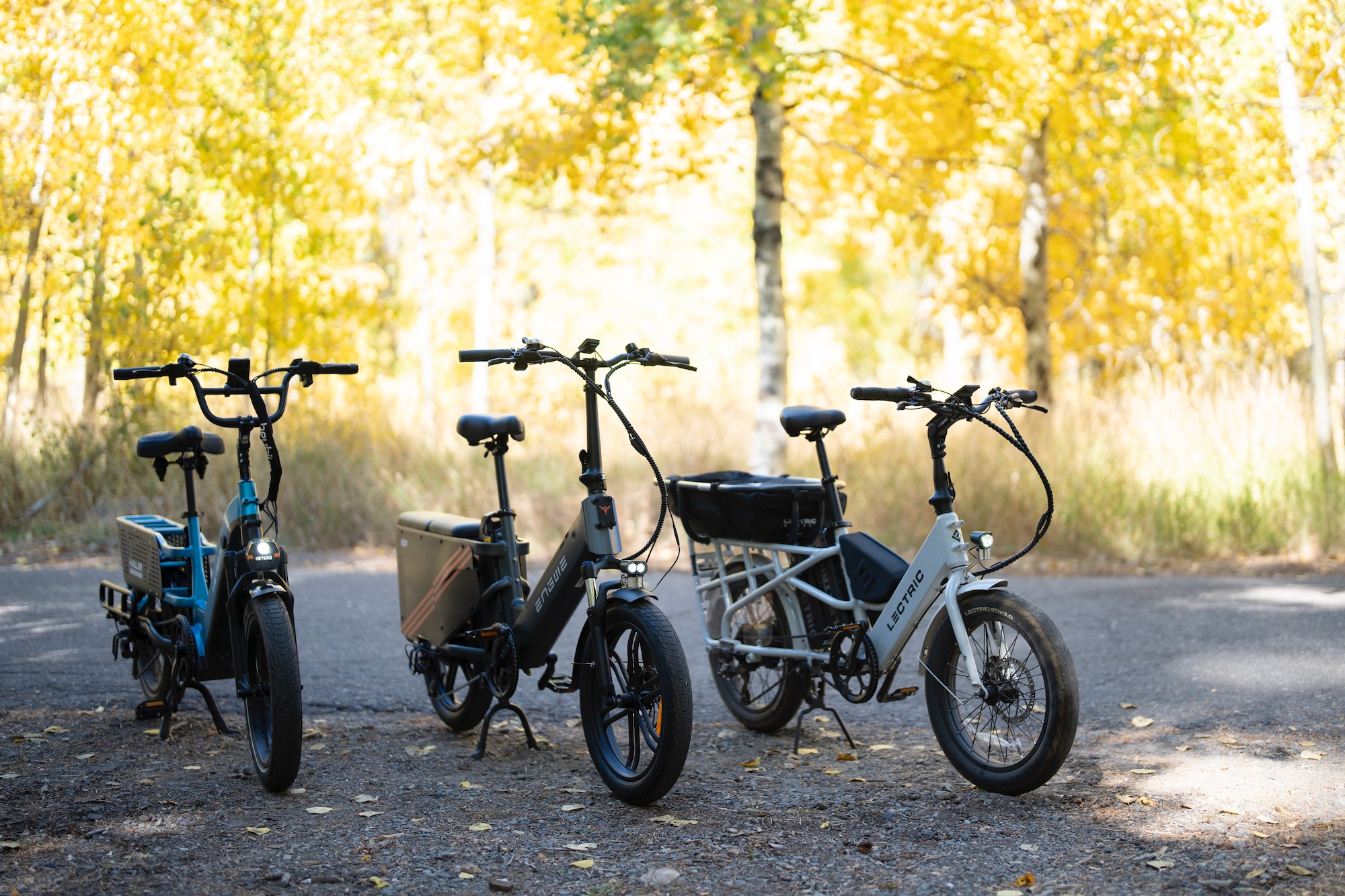 Affordable bikes like the ENGWE LE20 (middle) and the Lectric XPedition (right) prove that budget doesn’t mean bad; (photo/Tucker Adams)
Budget
Budget-friendly electric cargo bikes typically cost around $2,500 or less. These bikes are almost always sold directly from the brand to the consumer, usually have rear hub motors, and come equipped with lower-end but functional components. While the performance is a bit less refined, the affordable models we tested certainly get the job done.
A great example is the Lectric XPedition ($1,793). While the delivery may not be quite as smooth as higher-end models with more advanced torque sensors, it still has ample power to push speeds up to 28 mph. The components may not be name-brand, but they still work well enough for shifting between gears and controlling your speed. They may not be the brightest, but it comes with front and rear lights. Still, it can handle lots of cargo, just like the more expensive competition.
Similarly, the ENGWE LE20 ($1,299-1,599) costs even less but does great when the rubber meets the road. Its torque sensors do a fine job of delivering power smoothly, and its huge battery — plus the dual battery option — ensures you can make it there and back again. Add the accessories you need to haul kids or cargo, and it’s still a fraction of the price of the premium models.
Mid-Tier
Between around $2,500 and $4,000, we enter the middle of the electric cargo bike price range. While most still have rear hub motors, they typically come with more advanced torque sensors that provide a much smoother and more natural feeling power delivery.
The components are usually a step up from the budget models as well, with nicer shifters, higher-quality brakes, and brighter lights. Take the Specialized Globe Haul LT ($3,500), for example. This bike won numerous awards when it was launched — including our best overall title — for providing a price-to-performance ratio that few other bikes can match. It has plenty of power, a large battery and impressive range, an ultra-smooth and stable ride, great components, and an excellent feature set. You could spend more, but do you need to?
Likewise, the Tern Quick Haul Long D9 ($3,799) isn’t cheap, but it is one of the most affordable mid-drive cargo bikes you can find. It boasts impressive specs and a quality build that Tern’s bikes are known for, plus it comes with the excellent and powerful Bosch Cargo Line mid-drive motor. It tops out at 20 mph, and it doesn’t have a throttle, but it’s super smooth, quiet, and reliable.
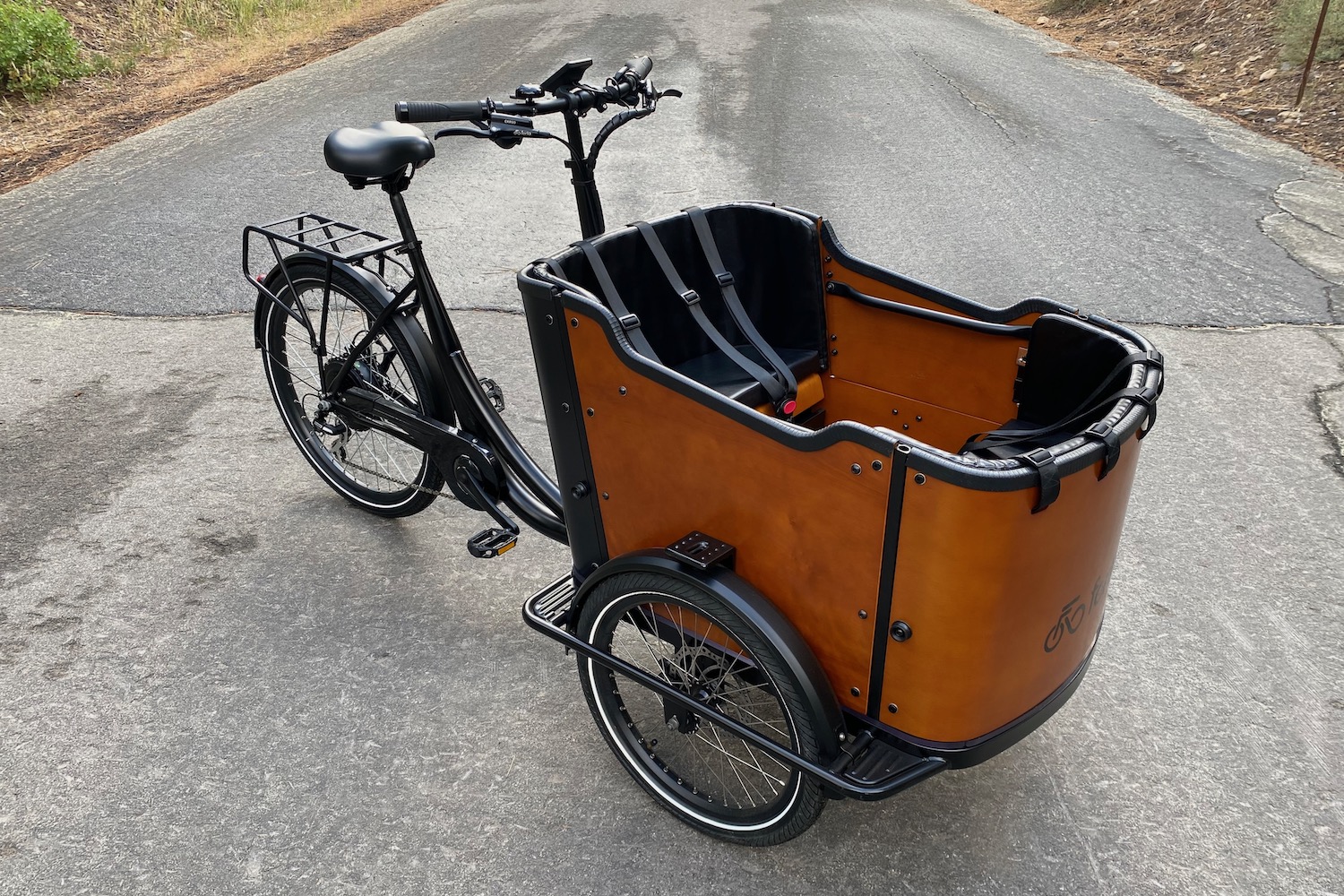 The Ferla Royce 2 is a high-end front box model that can transport up to four kids in comfort and style; (photo/Jeremy Benson)
Premium
From around $4,000 and up, we enter the high-end of the electric cargo bike market. These bikes typically come with fancier motors, top-of-the-line components, and front suspension or specialized designs for hauling kids or other cargo.
In this price range, long-tail models like Tern HSD P5i ($4,599) and the Yuba Spicy Curry ($4,000-4,800) feature mid-drive motors with the smoothest and most natural power delivery. They also come with top-tier drivetrains, excellent brakes, better controls and displays, and somehow manage to weigh significantly less — closer to 60 pounds — while being able to haul just as much.
Other bikes in this price range, like the Ferla Royce 2 ($5,999 and up) and the Bunch Original ($6,499), have more complex designs to carry cargo in the front. With three wheels and a large front box that can accommodate up to four small passengers and a rider, these bikes are arguably more capable of replacing a vehicle if they suit your needs.
The engineering and additional materials required to manufacture bikes like this contribute to the price, not to mention the premium wood finishes, as well as all the standard electric bike components. Still, they are less expensive than just about any vehicle and arguably a lot more fun for the whole family.
Long-john front-box cargo bikes tend to be the most expensive option. A prime example is the Urban Arrow Family Cargo Line with Smart System ($8,000). Beyond the price, everything about this bike is premium. The low-maintenance Gates belt drivetrain, powerful brakes, bright lights, and powerful Bosch Cargo Line mid-drive motor are all excellent. The quality components and excellent design contribute to a great performance and ride for passengers and riders.
Frequently Asked Questions
Electric cargo bikes can carry more cargo volume and weight than a standard e-bike. They have baskets, platforms, and other means to accommodate cargo and can be equipped with a variety of accessories to suit your specific cargo-carrying needs.
The frames, motors, wheels, and other components must be able to handle the added stresses from carrying potentially hundreds of pounds more than a single passenger e-bike. As a result, electric cargo bikes are often heavier and also longer than non-cargo models.
The assistance provided by the electric motor of an electric cargo bike makes riding with heavy loads much easier and feasible, especially over longer distances. The baskets, platforms, seating arrangements, and the large carrying capacity of electric cargo bikes truly open up possibilities that cannot exist on a standard bicycle or e-bike.
Many electric cargo bikes can replace cars for daily errands, especially in urban environments which can reduce your dependence on your vehicle and lower your spending on fuel. There are more electric cargo bike options than non-electric cargo bikes for these reasons.
But, an electric cargo bike is only worth the cost if you actually use it. Otherwise, it just becomes a large and expensive piece of gear taking up storage space. That said, they are typically quite durable and should provide many years of faithful service so we feel they are a sound investment that can actually save you money in the long term. On top of that, riding a bike can also do wonders for your health and well-being.
The additional and higher-quality chassis and wheel materials, larger battery and motor capacity, and extra features and accessories to handle the higher load ratings and passengers greatly add to the costs of electric cargo bikes.
Higher-end models utilize higher-quality mid-drive motors and name-brand components, which both contribute to the increased price. It’s also worth considering that you’ll likely need to spend a little more on accessories to tailor most cargo bikes to your specific needs.
Most e-bikes can go 20 mph, but some can go as fast as 28 mph. Some brands limit the speed of cargo bikes for safety reasons beyond what the class rating demands. For instance, the Bunch Original 3.0 is limited to 15 mph by the factory but can be changed by the user. Similarly, some bikes, like the Lectric XPedition and the Velotric Packer 1 come in class 2 settings but can be changed by the user to class 3 (up to 28 mph) through the display.

Cargo, commuter, folding, or mountain bike, we’ve tested the best electric bikes and have recommendations for all types of riders.

We tested 19 commuter bikes from top brands like Trek, Rad Power, Electra, Priority, and more to find the best.