Torrance will crack down on the use of electric bikes, commonly referred to as e-bikes, in the city — by implementing rules surrounding where and how they can be ridden.
In April, the City Council directed the Public Works and Traffic commissions to look into how Torrance could regulate the reckless operation of e-bikes. That set the stage for this week, when the council passed an ordinance to increase e-bike regulations, including by prohibiting electric bicycles that travel up to 28 mph from being used on city sidewalks, in parks or in Torrance facilities.
E-bikes are growing in popularity because they can often be a quicker and easier way to get around than walking, driving or riding non-motorized bicycles, and are increasingly being used by people of all ages. In Torrance, however, there have been multiple reports of unsafe behavior among e-bikers, resulting in accidents and injuries.
Earlier this month, for example, a 22-year-old individual was arrested for riding their e-bike inside the Del Amo Fashion Center — and nearly hitting a mall security officer who got in their path.
“When contacted by mall security personnel,” Torrance Police Department Lt. Charles Fisher said following the arrest, “the rider allegedly attempted to strike a security officer with the minibike, constituting an assault with a deadly weapon.”
While the individual was charged with a felony, the Police Department has limited enforcement ability otherwise, Fisher said.
“The city has received complaints about bicyclists riding their bicycles across or perpendicular to the portion of the path at Wilson Park that transverses the park, utilizing the hills on either side as ramps,” said a staff report written by Fisher. “This behavior poses a safety risk to individuals utilizing the path as intended, as well as to the bicyclist engaging in the behavior. Under the current version of section 49.2.7, no enforcement action can be taken against the bicyclist, unless their behavior is likely to cause or did cause injury or damage to the park, which is rarely the case.”
The City Council, however, adopted an ordinance on Tuesday evening, Dec. 16, that amends multiple sections of Torrance’s municipal code to enact increased regulations on e-bikes – something that’s been long awaited, said Councilmember Bridgett Lewis, who added that her grandson was hit by an e-bike in the past. The council approved the ordinance 6-1, with Councilmember Jeremy Gerson dissenting.
The code was amended to include class three e-bikes – a bike that offers pedal assistance up to 28 mph – under the definition of a bicycle, meaning they must follow all applicable traffic laws when it comes to where and when a bicyclist can ride.
The ordinance also prohibits class three e-bikes from being ridden on any sidewalks, or in city parks and recreational facilities. Regular bicycles are also not allowed on sidewalks in business districts or adjacent to schools, churches, recreation centers and playgrounds. And any stunt riding, including wheelies and other “acrobatic maneuvers,” and the use of handheld devices while operating a bicycle are prohibited for any bicyclist, under the ordinance.
The ordinance, however, does not have much in the way of actual penalties for violations. Instead, the city will focus mostly on “education-first enforcement,” according to the staff report.
“The focus is on unsafe behavior, not normal riding,” Fisher said. “The intent is not to criminalize recreational riding or childhood activity, for example. The ordinance is narrowly focused on unsafe behavior that creates a risk to others or damages public property.”
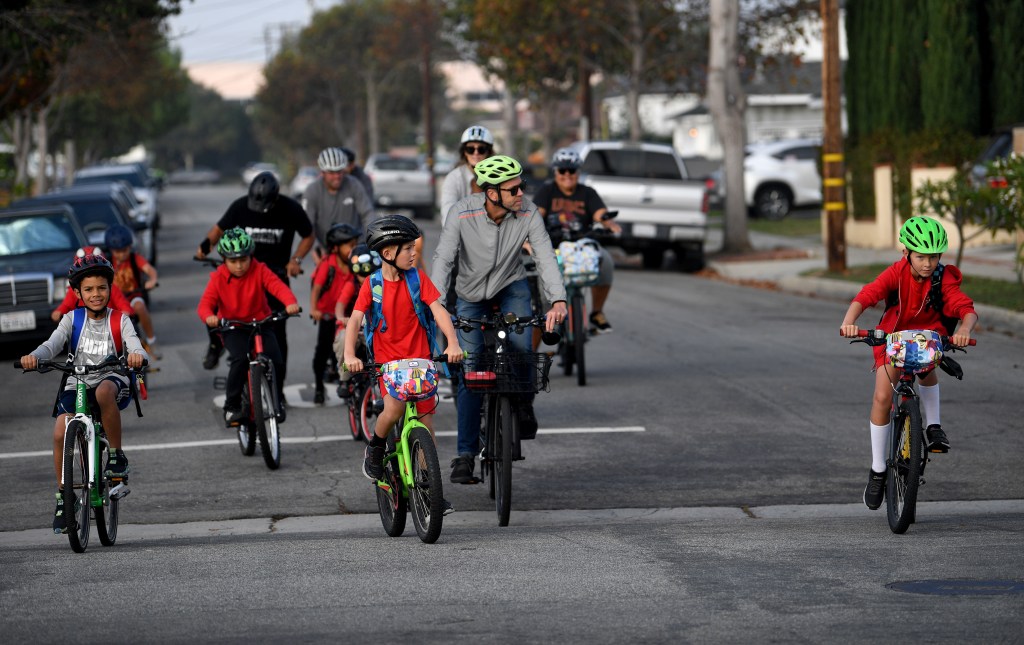
Many community members, however, said they thought these new regulations were too restrictive. Among them was Kyle Richardson, a local parent who started a “bike bus,” leading about 30 kids on a bike ride to school each Friday. The streets, Richardson said, are not always safe enough for elementary school kids to ride on.
“In our neighborhood, it is not uncommon to see cars traveling on Torrance streets 15 mph faster than the speed limit,” Richardson said in a written comment. “One such road in North Torrance is Yukon (Avenue). Yukon is a north-south road between 190th (Street) and Redondo Beach (Boulevard). Many students and parents use this road every day to take their kids to the various schools, the library and parks along Yukon (Avenue). Recently kids have been utilizing ebikes and using the sidewalk. These students and other South Bay bicycle riders are not acknowledged by stop lights, and so bicycle riders must often go along the sidewalk to initiate a safe crossing.
“To tell students they can no longer ride their ebikes on the sidewalk and must use the street,” he added, “is unsafe.”
Others who who spoke at Tuesday’s meeting said it may be better for the council to consider increasing the safety of Torrance streets for bikers before creating regulations that make it illegal for a child to ride their bike on the sidewalk.
One option the city could consider, said Councilmember Jon Kaji, is installing protected bike lanes. So instead of just a strip of white paint, bikers would be separated by some sort of barrier.
“I do think that in the future, the council should consider discussion on whether or not there may be some appropriate areas for the installation of protected bike lanes because e-bikes are a fact of life right now,” Kaji said. “I’m not saying that they’re appropriate for every street because some streets in our city are just too narrow, but I think we should be open to that discussion.”
There is a chance, however, that a regional effort by neighboring Redondo Beach could create a couple of protected bike lanes in Torrance — though the latter city’s officials have yet to assent to that.
Redondo Beach has been working for three years to create the Redondo Beach Boulevard Metro Active Transportation project – a 3.3 mile biking route that would go through Redondo Beach, Lawndale, Alondra Park, Dominguez Channel, El Camino Community College and Torrance.
Redondo Beach has received $8 million in funding from LA Metro and is the jurisdiction overseeing the project. The contracted consultant has reached the 15% design phase and, as of now, the design includes protected bike lanes through Redondo Beach and, tentatively, Lawndale. Torrance, however, is on the fence.
That’s because the project would result in a loss of parking, said Deputy Public Works Director Shin Furukawa. There are two sections of the proposed project within Torrance’s jurisdiction, one along the south side of 190th Street and another along the south side of Redondo Beach Boulevard.
The project, in fact, would reduce on-street parking on 190th Street by 30% and on Redondo Beach Boulevard by 8%, Furukawa said in a written statement. And the parking on those streets serve about 300 and 250 residential units, respectively.
“There are no other parking options for these residents,” Furukawa said, “and, therefore, the proposed elimination of on-street parking in these high-demand areas is an unacceptable negative impact.”
Torrance responded to Redondo Beach with these concerns and Ryan Liu, a traffic engineer for the the latter city, said they are working on a redesign to address the parking issues. The public works departments for the two cities also met earlier this month, though no conclusions were made, said Torrance spokesperson Jin Chun.