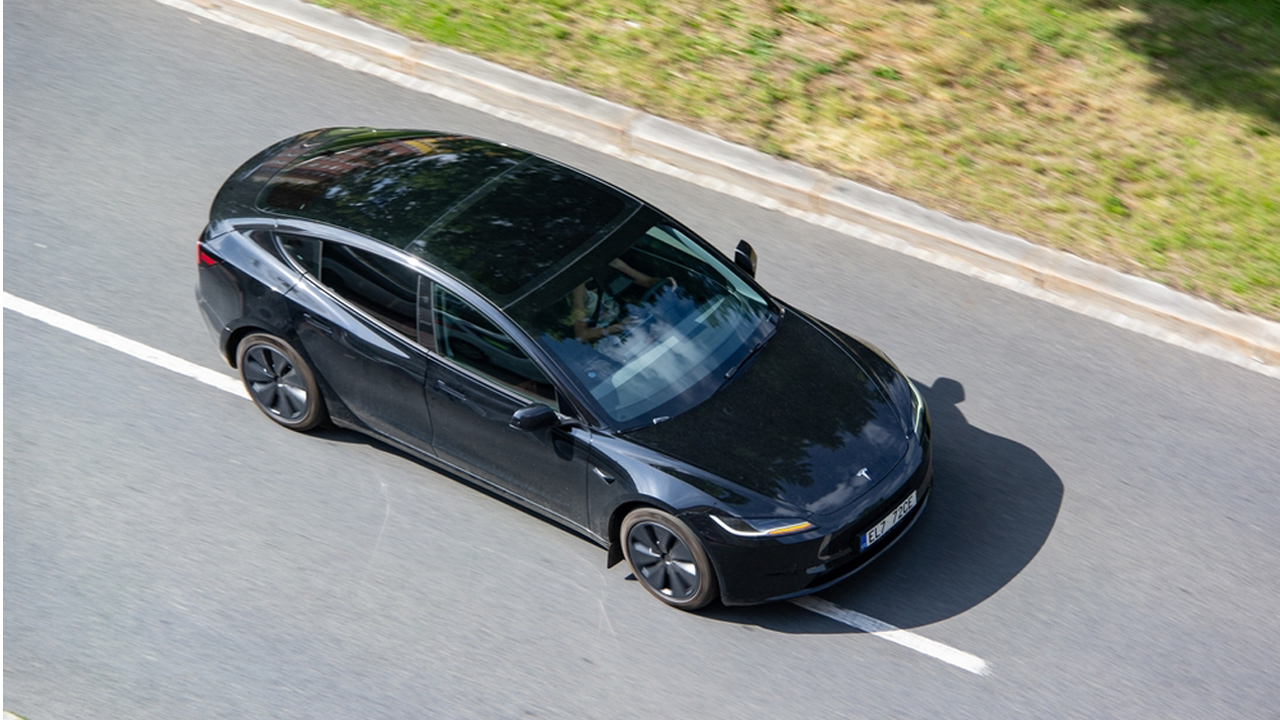
A Tesla Model 3 travels along a roadway. A Washington state driver reported completing a coast-to-coast trip using Tesla’s Full Self-Driving software without human intervention. | Image by Mino Surkala/Shutterstock
A Washington state Tesla owner has completed what is being widely described online as the first fully autonomous coast-to-coast drive using Tesla’s Full Self-Driving (FSD) Supervised software, according to the driver’s own account.
David Moss, a Tacoma resident who describes himself as a “LiDAR salesman” on X, documented the journey in a social media thread that drew attention from both Tesla enthusiasts and critics.
Starting from the Tesla Diner in Los Angeles, California, Moss said his Model 3 traveled 2,732.4 miles across 24 states before reaching Myrtle Beach, South Carolina. The trip took two days and 20 hours.
According to Moss, the drive required no human disengagements, including during parking at nearly 30 Tesla Supercharger stops along the route. Moss also reported no “close calls,” describing the system’s performance across highways and city driving as consistent throughout the trip.
Moss said the drive extended his vehicle’s total distance traveled using FSD without intervention to 10,638 miles, a milestone he described as significant as Tesla continues working toward a fully unsupervised autonomous system.
The claim quickly gained traction online. Tesla’s official North America account highlighted the drive on X, and CEO Elon Musk reposted Moss’s announcement with the caption, “cool.”
Moss’s journey has renewed attention on Tesla’s camera-based autonomous driving approach, which relies on computer vision rather than radar or LiDAR sensors. Tesla has said the strategy is central to its long-term plans for autonomous ride-hailing, including limited robotaxi testing that has recently appeared on public roads in Austin.
At the same time, the coast-to-coast drive has revived broader debate over the safety and reliability of Tesla’s driver-assist systems.
As The Dallas Express has previously reported, Tesla’s autonomous technology has faced increased legal scrutiny. In August 2025, a Florida jury found Tesla partially liable in a wrongful death lawsuit tied to a 2019 crash involving Autopilot. The jury awarded $129 million in compensatory damages and $200 million in punitive damages. After assigning Tesla 33% liability, the company’s financial responsibility was reduced to approximately $243 million.
The case intensified national attention on concerns about driver overreliance on automated systems, even as Tesla continues expanding its autonomous capabilities.
Critics have also pointed to prior failed attempts at similar long-distance drives. According to a September report from Electrek, two Tesla influencers attempting a coast-to-coast drive from San Diego to Jacksonville crashed into road debris after approximately 60 miles, damaging their vehicle’s suspension despite having time to react.
Separately, the National Highway Traffic Safety Administration has continued investigating multiple Tesla-related safety issues throughout 2025, including concerns involving emergency door-release mechanisms.
As 2025 comes to a close, Moss’s drive highlights the potential of advanced driver-assist technology for long-distance travel. For now, however, Tesla’s Full Self-Driving system remains classified as “supervised,” requiring drivers to remain alert and ready to take control at all times.