Aptera EV Explained: The Most Efficient Electric Vehicle Business Model
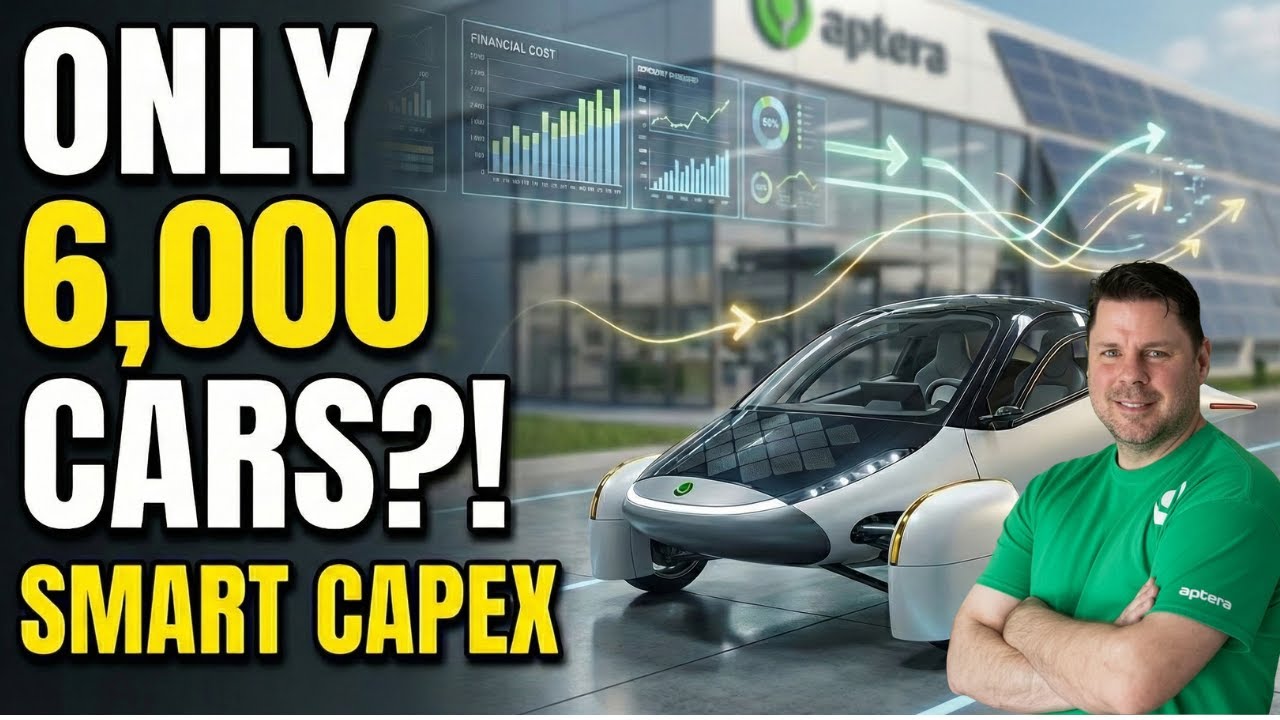
Holy crap. Let me just start there because when I heard this, I had to stop what I was doing and replay it to make sure I didn’t mishar the number. This is one of those moments where something sounds so good that your brain immediately goes, “No way. That can’t be right.” And yet, the more you think about it, the more it makes perfect sense. Aptterra recently revealed their break even point, the exact number of vehicles they need to sell in a year. just to cover costs and start turning a profit. Not someday in the distant future. Not after 10 years of burning cash. Right at the start, and that number is just 6,000 vehicles per year, 6,000. Let that sink in for a second. In an industry where electric vehicle startups routinely lose tens of thousands of dollars on every car they sell, where profitability is treated like some mythical endgame that might arrive a decade from now if everything goes perfectly. Aptterra is over here saying give us a year and we can be profitable. At first glance that sounds almost too good to be true. But when you start working backward and actually look at how EV companies operate and more importantly how they burn money, it all clicks into place. Aptterara’s obsession with efficiency doesn’t just show up in their vehicle design. It flows directly into the financial DNA of the company itself. On the surface, it’s easy to focus on the flashy stuff. The Aterra looks incredible. It charges itself from sunlight. It’s ridiculously aerodynamic. It’s fast, lightweight, and capable of getting around 10 m per kilowatt hour. All of that is impressive, no doubt. But the real story, the part that actually determines whether this company lives or dies, is what those design choices unlock behind the scenes. Aptterra has rethought manufacturing from the ground up. Instead of relying on massive, expensive, traditional factories, paint shops, and overly complex vehicle architectures, they’ve focused on simplicity and smart manufacturing. Working with CPC, they’ve developed carbon composite body structures that are not only incredibly rigid and durable, but also lightweight and safer, all while dramatically reducing the capital expenditure required to get into production. This is the key. Lower capex means appara doesn’t need to raise billions of dollars just to survive long enough to maybe become profitable. They don’t need to burn mountains of cash every quarter. They don’t need to sell hundreds of thousands of vehicles a year just to stop bleeding money. Compare that to the rest of the EV startup landscape. Take a company like Vivian. And to be clear, I like Rivian. Their products are cool. Their brand is strong. But their vehicles are inherently inefficient. Massive battery packs, over 7,000 pounds of weight, traditional paint shops. All of that complexity translates directly into brutal financials. Even in a hypothetical world where Riven only lost $5,000 per vehicle, which they don’t, selling 50,000 vehicles in a year would still mean burning $250 million just to keep the lights on. In reality, Rivian has been losing closer to $40,000 per vehicle sold. Now, imagine how much capital they have to raise, how much stock they have to dilute, and how much debt they have to take on just to reach the point where profitability even becomes possible. And that’s before factoring in shutting down factories, re-engineering entire vehicle platforms, and ramping up new product lines. That’s why you see statements like maybe profitability in 5 years being treated as optimistic. Aptterra is the polar opposite of this approach because the AERA is cheap to build, doesn’t require a paint shop, uses a dramatically smaller battery pack than any other highway capable EV in North America, and simplifies almost every aspect of manufacturing. The company starts the race with a massive advantage. Three wheels, two doors, two seats, extreme efficiency. Every one of those decisions compounds financially. That’s how you get to a break even point of just 6,000 vehicles per year. And here’s the part that really drives it home. 6,000 vehicles a year can be achieved with a single factory operating a single shift. The San Diego facility alone is capable of hitting that number even while taking holidays off. Add a second shift, which Atera has already demonstrated is feasible with help from Monroe and Associates, and suddenly you’re talking about 40 vehicles a day, and profitability within the first year of production. No other EV startup is even remotely close to that. Meanwhile, we’re watching other companies hire bankruptcy lawyers, lose hundreds of thousands of dollars per car, or openly question whether profitability even matters anymore. And yet somehow those same inefficient business models continue to attract massive amounts of capital. This is why the 6,000 vehicle figure completely destroys one of the most common criticisms of aptterra. It’s not enough demand. You hear it all the time. People say the business model will fail because Atera would need to sell hundreds of thousands of vehicles every year to survive. That there aren’t enough buyers for a three-w wheeled two seat vehicle. That it’s too weird, too niche, not practical enough. But that entire argument falls apart the moment you understand Aterara’s break even math. Let’s say Aterara only sells 20,000 vehicles a year. To some people that might sound small compared to Tesla numbers, but at that volume, Aterra isn’t just surviving. They’re profitable. And that profit can then be reinvested into developing new vehicles for different use cases. More seats, more wheels, more configurations, a gradual sustainable expansion instead of a desperate race for scale. And let’s be honest, this vehicle already fits way more people’s lives than critics give it credit for. It has more storage space than a Model 3, more range than any EV in its price category, lower total cost of ownership over 5 to 8 years than almost anything else on the road. It supports right to repair. It offers modern infotainment features. It has serious safety engineering with crumple zones, airbags, and side impact protection. And then there’s the realworld problem most EVs still haven’t solved, charging. Around 35% of Americans live in apartments, and that number is growing. Most of those people don’t have access to home charging. Relying on DC fast charging for a 250 m range EV is expensive, inconvenient, and often frustrating. Superchargers get busy. Prices go up. Now, imagine owning a vehicle that can sit outside your apartment and quietly add meaningful range every day just from sunlight. Even in cloudy areas, even with minimal solar input, the Aterara’s efficiency means that when you do need to fast charge, you get far more miles per session and you don’t have to come back nearly as often. This is why the demand argument doesn’t hold up. Aptterra has already surpassed 47,000 paid reservations. That’s 47,000 people who were interested enough to put money down on a startup vehicle that isn’t even in production yet. Even if Atera shut off reservations today, the first factory alone would take years to catch up with existing demand. And that’s before realworld reviews, before people start seeing them on the road, before everyday drivers start talking about how little they charge and how far they go. From personal experience, this vehicle turns heads like almost nothing else. Very similar to the Cybert truck. People are curious. They ask questions. They want to know more. Even if Atera isn’t for everyone, it’s impossible to ignore. And when the cost of charging keeps rising, when efficiency starts to matter more, when people realize they don’t want to keep feeding money into inefficient vehicles, that’s when designs like this suddenly make a lot more sense. That’s why this single number, 6,000 vehicles per year, completely changed how I look at Atera as a company. It’s not just a cool, efficient vehicle. It’s a fundamentally smarter way to build an EV business. And honestly, that might be the biggest bonus of
#Aptera #ElectricVehicles #EVBusiness #EVInvesting #EVProfitability #CleanEnergy #SustainableTransportation #SolarEV #GreenTechnology #FutureOfTransportation
Aptera just revealed how many electric vehicles it needs to sell to break even—and the number exposes a massive flaw in the EV industry. While most electric vehicle startups burn billions in capital, Aptera’s efficiency-first business model flips the entire EV profitability equation on its head.
In this video, we break down Aptera’s EV business model, explaining how low capital expenditures (CapEx), ultra-efficient vehicle design, simplified manufacturing, and a radically smaller battery pack allow Aptera to reach profitability at a scale most EV startups can’t even imagine. Unlike traditional electric vehicle manufacturers that rely on massive factories, paint shops, and oversized battery systems, Aptera focuses on capital efficiency, cost-effective manufacturing, and energy efficiency to reduce losses per vehicle and accelerate the path to profit.
We compare Aptera’s approach to other electric vehicle companies struggling with high production costs, negative gross margins, and unsustainable cash burn. From battery size and manufacturing complexity to break-even math and real-world demand, this video explains why Aptera’s strategy could redefine what success looks like in the EV market.
If you’re interested in electric vehicle investing, EV startup profitability, clean energy innovation, solar electric vehicles, or the future of efficient transportation, this breakdown shows why Aptera’s model is fundamentally different—and why efficiency might be the most important metric in the next phase of the EV revolution.
Topics Covered
Aptera EV business model
Electric vehicle profitability explained
EV manufacturing costs and CapEx
Efficient electric vehicles
EV startup finance and economics
Solar electric vehicles and efficiency
Break-even analysis for EV companies
Future of sustainable transportation
#Aptera #ElectricVehicles #EVBusiness #EVInvesting #EVProfitability #CleanEnergy #SustainableTransportation #SolarEV #GreenTechnology #FutureOfTransportation #EVStartups #ElectricCar #RenewableEnergy #TechInvesting