New 2026 Tesla Model 2 Senior $13K – 4.5-Sec Cast, 300 Mi, Minimalist Cabin, OTA/FSD Hardware!
Imagine seeing a car being assembled from scratch before your eyes in less than 5 seconds. Sounds like science fiction, right? But that’s exactly what’s happening inside Giga Texas in 2026. While you blink, the new Tesla Model 2 has already rolled off the assembly line, faster than it takes to make coffee. And it’s not just fast, it’s frighteningly efficient. The entire production line has been redesigned to achieve this mind-blowing speed. And believe me, it [music] has nothing to do with what you see in traditional car factories. There, the idea of factory has taken on a new meaning. Everything pulsates with robots and machines that move in a synchronized mechanical dance like a futuristic ballet. What’s most striking is that there are almost no humans involved in the process. Model 2 production is so automated that engineers can’t even approach the line while it’s running. And that’s no exaggeration. It moves so fast that according to Tesla itself, the human eye can barely keep up. It’s as if the factory has taken on a life of its own with robotic arms operating at speeds that would be impossible for any ordinary person. This level of extreme automation not only impresses but also redefineses what it means to produce on a large scale. Of course, many people raise an eyebrow and wonder, “But what about quality? Where does it fit into all this?” After all, a car made in 4.5 seconds seems like something out of a magic trick, not a real manufacturing process. Except that Tesla seems to have found a way to maintain rigor and at the same time accelerate like no one else. It’s not just about speed, but about absolute precision. Everything has been designed to reduce flaws and waste with almost zero margins of error. The most curious thing, this speed isn’t even the final point. Elon Musk has already hinted that this time could drop even further. Now consider the impact this has on the market. While other automakers still face logistical bottlenecks and scalability issues, Tesla has simply reinvented the way cars are produced. By 2026, it’s no longer competing with industry standards. It’s creating a new one. And this has a ripple effect. If rivals previously had time to react, now they need to race against a technology that advances faster than any strategic planning. The game has changed and those who don’t keep up will be left behind. And what’s behind this incredible speed? The answer lies in Giga Texas’s very DNA. The facility was designed from scratch to be the nerve center of the next generation of electric vehicles. Every square meter was conceived for speed, efficiency, and operational autonomy. It’s not just about assembling cars, but about orchestrating an assembly line where time, energy, and robots form a harmony almost impossible to achieve in conventional factories. It’s not just mass production, it’s intelligent mass production. The goal is simple and ambitious. To launch a new Model 2 every 33 seconds. That equates to more than 90,000 cars per month. But the most insane thing is realizing that this acceleration didn’t come with more workers or more shifts, but rather with fewer people and more mechanical intelligence. Hundreds of intermediate robots were removed, simplifying steps and relying on leaner processes. This means less chance of error, less maintenance, and better results. And all this without losing quality control, which is already difficult when assembling one car a day. Imagine every four five seconds. It’s as if Tesla took the automotive industry playbook and threw it away. Because if before the challenge was to assemble quickly and cheaply, now it’s to assemble quickly, cheaply, and better. The Model 2 isn’t being assembled hastily. It’s being shaped within a new paradigm. One that blends brute force with robotic elegance. A car that upon rolling off the assembly line looks like it was manufactured in a Swiss precision laboratory, but on an industrial scale. That indeed changes everything. If the speed of the assembly line already seemed absurd, the secret behind it is even more fascinating. And it has a name, Giga Press. This machine is not just a part of the process. It’s the beating heart of the revolution. For those who have never heard of it, it’s a high-pressure aluminum casting press capable of doing something that seemed impossible until recently. Transforming hundreds of parts and weld points into a single metallic block. And when we say block, we’re not exaggerating. We’re talking about an entire chassis molded in seconds like a giant toy coming out of a mold. The most curious thing is that this idea came from Elon Musk himself. He looked at Hot Wheels toy cars, the ones you used to race in your living room, and thought, “Why not make real cars like that?” It sounds crazy, but it became a reality. And the result is a machine capable of applying up to 50,000 tons of force to mold a single chassis piece. To give you an idea, a single Giga Press replaces more than 400 manual and robotic welds. With that alone, you can cut about 40% of the structural cost of a car. The savings are huge, and that completely changes the game. But what’s most shocking is the new version of this machine, specially created for the Model 2. It can produce not just one, but five chassis structures per cycle. Yes, five at once. This is a level of efficiency that puts any other manufacturer to shame. And if the Model Y’s rear chassis was already considered revolutionary for being made from a single piece, Tesla is now going even further. The Model 2 will have its entire chassis made from a single mold. This drastically reduces production time and eliminates margins of error that were previously unavoidable. The impact of this isn’t limited to speed. With fewer parts, the car gains more [music] structural strength and less weight. Without those dozens of welds, screws, and joints, the end result is more solid and lighter. And in an electric car, this means more range and better performance. And you know what’s even more interesting? With fewer robots on the assembly line, more precisely about 450 fewer, the system is less prone to failures, maintenance, and operating costs. Fewer machines, more results. The kind of logic that seems simple, but that no one had managed to apply until now. Inside Giga Texas, this entire process unfolds in a hypnotic choreography. Molten aluminum is poured into the mold, shaped in seconds, cooled to 50° in a thermal pool, and then immediately placed on the assembly line. All done by robotic arms without human touch, without pause, without error. It seems like a scene from a futuristic movie, but it’s happening now. It’s a type of manufacturing that combines industrial brutality with surgical precision. And the most impressive thing, this happens 24 hours a day without rest, like a metallic heart that never stops beating. The simplification of the assembly line is another point that cannot be ignored. Previously, manufacturing a chassis involved dozens of robots, positioning and welding panels, generating heat, noise, and waste. Now, you just press a button and presto, a single piece comes out. This piece goes directly to the line where the rest of the vehicle will be assembled. And this not only speeds things up, but also cleans up the factory. Fewer steps, less energy, less dust. It’s almost like comparing a busy restaurant kitchen to a clinical laboratory. It is from this structure fused in seconds that the Model 2 begins to take its final form. And that’s where one of the most underestimated yet crucial steps comes in. lightness and structural efficiency. It’s no exaggeration to say that the entire concept behind this car revolves around a single objective to do more with less. Less weight, fewer parts, less fuel consumption, but with more performance, more range, and more durability. And believe me, it all starts with the choice of aluminum. and the monolithic design that seems simple but requires an absurd level of engineering to work. When you think about an electric car, weight is one of the biggest obstacles. After all, the batteries already occupy a good chunk of the total mass. And every gram saved makes a difference. And that’s where the magic happens. By transforming a large part of the structure into a single cast piece, Tesla managed to eliminate hundreds of kilograms in structural reinforcements, welds, and overlapping metals. This gives the Model 2 an advantage that few cars have. It’s light on the scale, but extremely rigid on the road. The perfect combination for performance and safety. Another detail that goes unnoticed by many is how this lightness translates directly into energy savings. A lighter car requires less effort to accelerate, less braking to stop, and of course, less energy to keep moving. In a batterypowered car, this is invaluable. This structural efficiency allows the Model 2 to achieve surprising range figures with a relatively modest battery. This means you get more range, paying less and without having to constantly charge the car. And it doesn’t stop there. The structural rigidity provided by this new design also improves handling. You know that car that feels glued to the ground, that responds instantly when you turn the steering wheel. That’s the feeling Tesla wants to provide. The more rigid structure helps reduce torsion, vibrations, and even internal noise. And all this was possible precisely because the Model 2 chassis wasn’t assembled, but molded as if it were a single piece of engineering designed to be lightweight, strong, and precise. Another interesting factor is how this structure functions as a kind of backbone of the car. The battery, for example, isn’t just an isolated block inside a compartment. It’s an integral part of the structure mounted directly in the center of the chassis. It distributes weight more evenly and helps lower the center of gravity. The result, [music] a more stable, safer, and much more fun car to drive. It’s the kind of thing that seems simple on paper, but requires a deep understanding of automotive physics. And it’s impossible to talk about lightness and structure without mentioning the electric skateboard. This affectionate nickname comes from the final shape of the chassis. After receiving the battery and the two [music] sets of cast parts, front and rear, the whole assembly really does resemble a giant skateboard. Flat, balanced, and ready to glide. This modular design also facilitates repairs, upgrades, and even future adaptations for other versions of the car. And the most incredible thing is that this idea, which seems so simple, ended up becoming the basis for the entire efficiency of the project. After assembling such a lightweight and robust skeleton, Tesla couldn’t simply stuff it with just anything. The next stage of the Model 2 was meticulously designed to keep costs down, but without sacrificing the brand’s identity. And that’s where one of the most controversial and at the same time most ingenious points comes in. The simplified interior. Unlike what many expected, the Model 2 isn’t designed to impress with luxury. It’s designed to deliver the essentials with maximum efficiency. And honestly, the idea behind it makes perfect sense. Forget heated seats and premium sound systems with a thousand speakers scattered throughout the car. Also, forget the panoramic sunroof and double acoustic windows. Here, the proposition is different. The Model 2’s interior is straightforward, functional, and extremely minimalist. Everything has been reduced to the essentials to maintain the Tesla driving experience, but within a price range that truly competes with popular combustion engine models. The seats, for example, are upholstered in durable fabric. No synthetic leather or frills. And you know what’s even crazier? Even so, the look remains modern and wellfinished. It might seem strange, but this simplicity is what makes this car so brilliant. Tesla understood that the target audience for this model isn’t looking for ostentation. They’re looking for accessible electric mobility. And for that, every screw needs to have a purpose. The dashboard is clean, almost zen-like. The control center is a touchscreen that replaces almost all the buttons, maintaining the brand’s already known standard, only now without the expensive frills. A car that doesn’t try to look luxurious, but delivers what matters most, range, technology, and efficiency. Interestingly, this simplification doesn’t affect the car’s intelligence. Contrary to what one might imagine, the Model 2 comes equipped with all the necessary hardware for autonomous driving. That’s right. Front sensors, cameras, and onboard processors are part of the package. Even being the cheapest Tesla, it’s still a Tesla. In other words, it’s ready to receive future updates and who knows, even be integrated into the robo taxi fleet when regulations allow. The intelligence is still there. Only the embellishments are missing. Another point that’s causing a stir is the sound. Without a premium system, the Model 2’s audio is quite basic. Don’t expect powerful bass or that cinematic effect inside the car. But if you think about it, that also makes sense. The idea is to cut everything that isn’t essential so that the final price isn’t too high. And let’s be honest, there are many people who don’t even use half the features of the more expensive models. It’s the kind of cut that might displease some, but it makes perfect sense within a strategy of democratizing electric cars. And when you look at the whole package, you can see that every decision was made based on real costbenefit analysis. The windows, for example, aren’t double glazed or soundproofed, but they do their job well. The lack of sophisticated details might be noticeable at first, but you soon realize that the focus is on what really matters, the lightweight structure, energy efficiency, and the performance of a true Tesla. and that in itself delivers more than many cars in the same price range. While the Model 2’s interior already demonstrates its straightforward design, its exterior reveals even more of the project’s urban essence. Tesla decided to completely abandon the idea of creating something flashy or excessively futuristic. The car’s design was conceived to be functional, discreet, and adapted to the chaos of urban centers. A compact hatchback with four doors, well-defined lines, and lean proportions. No rear LED light bar or useless chrome trim. What counts here is aerodynamics and practicality. And this is evident in every curve of the body. The most interesting thing is that this more restrained design doesn’t mean a lack of modernity. Quite the opposite. The front features taller, more angled headlights with a clean and efficient look. Tesla [music] opted to leave aside the aggressive look and chose something younger, simpler, and at the same time contemporary. The Model 2 doesn’t want to look like a concept car from an auto show. It wants to be seen as a daily use companion, the kind that parks easily, navigates narrow city alleys well, and doesn’t cause headaches in tight parking spaces. Another detail that stands out is the near disappearance of the traditional trunk. Instead of that protruding rear volume, the Model 2 has a short rear end, well integrated into the body. This helps not only with aerodynamics but also with reducing manufacturing costs. The idea is to take advantage of every centimeter of the interior to maximize usable space even if the trunk itself is more limited and this decision was made based on realworld usage data. Most owners of city cars rarely use the entire trunk capacity. The doors also received special attention. Unlike models that prioritize only design, the Model 2 features doors with new opening angles and more efficient hinges. This makes it much easier to get in and out of the car in tight garage spaces, crowded parking lots, or even on the street. It seems like a small detail, but in everyday life, it makes all the difference, especially when you think about who will be using this car. ride sharing drivers, students, young professionals, small families, people who need practicality above all else. Furthermore, Tesla made sure to keep aerodynamics as a priority. Even as a compact hatchback, the Model 2 has a surprisingly high aerodynamic coefficient for its category. Smooth lines, the absence of exaggerated side moldings, and an almost entirely sealed undercarriage help improve air flow and consequently energy efficiency. Every curve was designed not to attract attention, but to save energy.
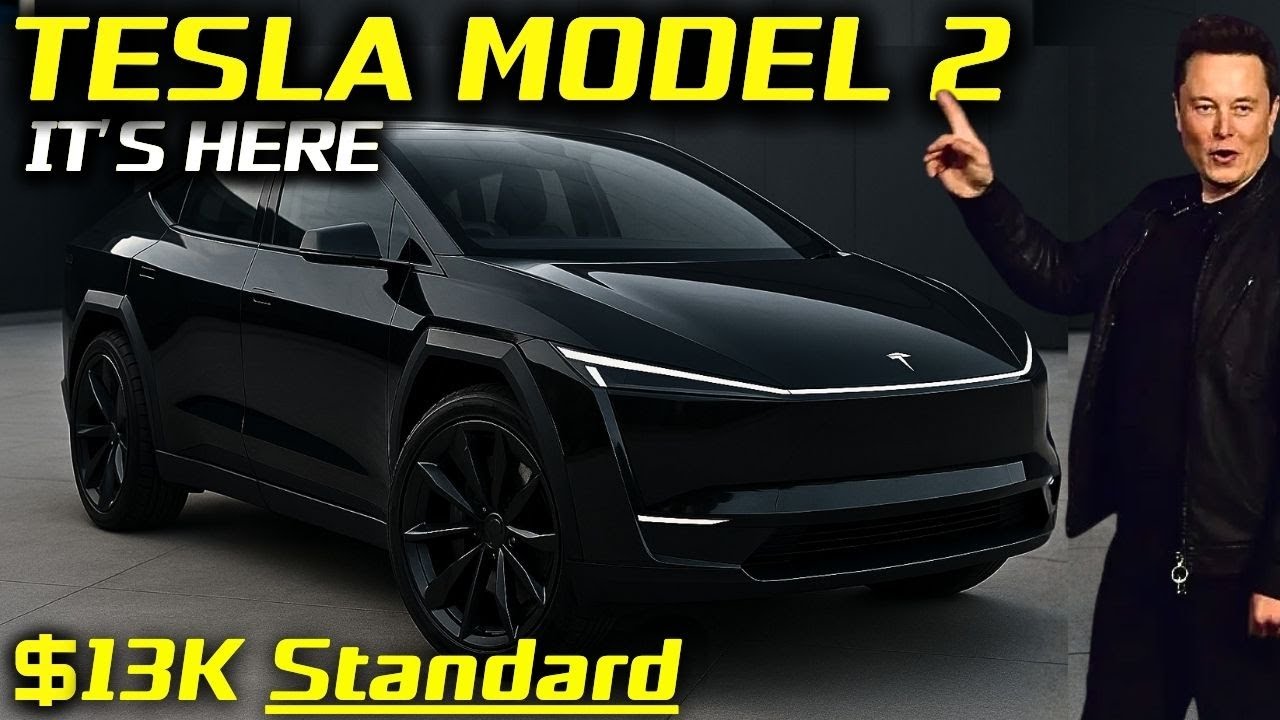
Elon Musk has just unveiled the car that’s about to flip the automotive world upside down: the new Tesla Model 2. With an insane production rate of one vehicle every 4.5 seconds at Giga Texas, this electric car is launching in 2026 priced at just $25,000 and delivering up to 300 miles of range. All of this is made possible by the revolutionary Giga Press — a machine that molds the entire chassis in a single piece of aluminum, eliminating over 400 welds and cutting costs like never before. In this video, you’ll discover how Tesla achieved this absurd feat, transforming the production line into a show of speed, precision, and automation.
We dive into the shocking details of the project: a lightweight structure like an electric skateboard, a minimalist design optimized for city driving, and a simplified interior that still carries all the smart tech needed for the autonomous future. Elon Musk hasn’t just launched the cheapest Tesla in history — he’s triggered a direct strike on Chinese rivals like BYD, aiming straight at the heart of the global EV market. If you thought electric cars were still out of reach, this video will prove that the game has changed — for good. Get ready to meet the Tesla even your neighbor will want to drive.
___________
Here on the EV Briefing channel, you’ll get the latest updates on Elon Musk, Tesla, new Tesla Model 2, Model 2, Tesla Model Y, Model Y 2025, Tesla Model S, Model S, Model X, and Model 3. Our focus is to bring you everything about each Tesla EV, whether it’s an affordable Tesla, a potential Tesla cheap car, or a new Tesla car on the horizon. We cover daily Tesla news, EV news, Tesla update, and tech advancements coming straight from the Gigafactory.
If you’re into electric car, future EV, Tesla 2025, improvements in Tesla battery, increased Tesla range, and everything involving Tesla innovation, you’re in the right place. We also track every Tesla reveal, Tesla launch, and of course, all major Elon Musk news and developments shaping the world of electric vehicles.
_____________
#tesla #elonmusk #teslamodel2 #teslamodely #modely #gigafactory #electricvehicles