The EV bubble finally BURSTS | MGUY Australia
Well, 2025 has been a positive year for sanity in the automotive industry. All the momentum has swung away from EVs and back towards a rational mix of powertrain options for car buyers. Governments decreed from on high that drivers should buy EVs and nothing else. And drivers promptly said, “Nope, we’re not having it.” Add to that the European automakers that would have struggled under the pressure of cheap Chinese EVs causing massive economic harm and you have a recipe for disaster. And with the 180° shift in policy that’s taken place in the US this year with punishing emissions regulations being wound back and it feels like the peak of the electric vehicle hype is well and truly behind us. As we’ll see in this video, the signs are that the mandated switch to an all EV future is now just a fading memory and combustion engines will be part of the automotive landscape for decades and decades to come. As I’ve always said, there is a very limited use case for EVs. People who have short commutes in city areas and who have the luxury of off- streetet parking and charging overnight. But to expect them to be a one-sizefits-all drop-in replacement for all petrol and diesel vehicles is and always has been a complete pipe dream. Reality is starting to return. Finally, if you’re one of the many MGY viewers who are not subscribed to this channel, please take a moment to subscribe right now. It doesn’t cost anything and you’ll be directly helping this channel push back on all the EV and netzero nonsense we’re constantly being fed with. Just click the subscribe button down below and enable all notifications and you won’t miss out on any future videos. We’ll look at some interesting research from consulting firm EY in a minute. But firstly, an excellent article that chronicles the rapid rise and the subsequent decline of the electrification dream, the electric vehicle collapse. Wow, that was quick. It was less than 3 years ago, early 2023, that I was writing about the then universal government and industry line that electric vehicles, EVs, would soon be taking over the American car market. In April 2022, the Biden administration had adopted aggressive vehicle mileage standards intended to be achievable only through rapid transition to EVs. Our climate leader states, California and New York, had then adopted regulations in August and September 2022, respectively, mandating a phase out of sales of combustion vehicles to culminate in 2035, after which only EVs would be allowed. In a post in January 2023, I linked to the websites of Ford and GM where they both touted their grand plans for rapid conversion of their companies to the manufacturer of mostly or entirely EVs. At that time, Ford was claiming that it would lead America’s shift to EVs and would achieve 50% of its sales in that category by 2030. GM bragged about its path to an allect electric future by 2035. In a post on February 23rd, 2023, I expressed skepticism. It seems like all the smart people have made up their minds that the future of automobiles belongs to electric vehicles. So, are electric vehicles about to sweep the country and become the dominant form of transportation? I bet against it. Here was my reasoning. This is just a specific instance of the general principle that it is always wise to bet against central planning of the economy. EVs may be a successful niche product for a small number of wealthy consumers, but the idea that they will fully replace gasoline powered cars in short order is the dream of central planners who think they can implement their dream by coercion. Central planning never works and won’t work this time either. The past few weeks have brought a lot of news on the EV front. The short version is that even I would not have predicted how quickly and completely the EV fantasy has collapsed. The background of course is that the second Trump administration took prompt steps on re-entering office to end the huge federal support that had been propping up EV sales. The large tax credit for EV purchases was ended by the One Big Beautiful Bill Act signed on July 4th and effective after September the 30th, 2025. On December the 3rd, the administration announced the roll back of the vehicle mileage standards known as CAFE to levels at which combustion vehicles can comply. The collapse of EV sales began immediately with the end of the tax credit. On October 31st, trade publication Inside EVs reported on the first month’s results after the end of the credit. Both JD Power and S&P Global Mobility estimate that October’s EV market share plummeted to around 5% in the US from a record high of over 12% in September. The battery powered share of sales also dropped significantly on a year-over-year basis from over 8% in October 2024. The last time EVs made up 5% of US vehicle sales was in early 2022. According to S&P Global Mobility, some 64,000 new electric vehicles were sold in October. That’s an epic drop from September when Americans bought or leased nearly $150,000 EVs as they scrambled to cash in on the expiring $7,500 incentive. Well, look, I’ll leave you to read the rest of this excellent piece at the link in the description. Automakers, including Ford and GM, are now pivoting away from EVs and back towards combustion and hybrids because nobody, unless you’re a brainwashed evangelist, wants to spend even 30 minutes at a charging station for 100 km range when we’ve been used to a 5-minute fill up that will give us many times that. And unless you have a combustion engine on board, either in the form of a hybrid or as a range extender generator, you will always have the inconvenience of charging a battery. And because of the charging conundrum that I’ve talked about before, you can either have fast charging or cheap electricity. You can’t have both. And so on to consulting firm EY which has released the latest EY mobility consumer index confirming a massive swing away from EVs and back towards reliable and convenient petrol and diesel. Global consumers driven back to IC vehicles as EV enthusiasm cools EY research. Global car buyers are putting the brakes on adoption of electric vehicles with many shifting back to internal combustion engines, ICEs, and reassessing electric vehicle ownership. According to the new EY mobility consumer index, MCI, a global survey examining sentiment and buying intent across major automotive markets. Constantin M. Gaul EY global aerospace defense and mobility leader says consumers are weighing the realities of policy shifts, cost pressures and uneven charging infrastructure. The long-term trend appears to be a shift away from a purely electric e-only approach toward a more diversified future for vehicle powertrains with different vehicle technologies serving different customer needs. We are also seeing a more pragmatic less ideological policy discussion. Policymakers are returning to a fact-based approach, allowing the market to do what it does best, identify the right solutions for different customers. The report arrives ahead of CES 2026, where EY leaders will speak on the electric vehicle to grid ecosystem and the innovations needed to build confidence in electrification. The 2025 MCI shows a clear change in consumer intentions. 50% of global car buyers intend to purchase an IC vehicle in the next 24 months. An increase of 13 points from 2024. Wow. BEV preference has fallen to 14%, a drop of 10 percentage points. And hybrid preference has declined to 16% down 5 percentage points. 51% of prospective EV buyers say their plans remain unchanged, but 36% are reconsidering or delaying purchases due to geopolitical developments. Regionally, the percentage of consumers who say they want to buy an IC vehicle rose by 12 points in the Americas, 11 points in Europe, and 10 points in APAC, while BEV intent fell across all major markets. Policy shifts, including the removal of US EV tax credits and evolving emissions targets, are shaping these trends. At the same time, major automakers are renewing focus on IC and hybrid portfolios and moderating EV programs in response to changing consumer demand. Range anxiety continues to be one of the top barriers for consumers choosing IC over EVs. 29% site range anxiety as a top concern. 28% highlight the lack of charging infrastructure. 28% point to high battery replacement costs. Existing BEV owners remain concerned about range, 32%. While firsttime buyers focus on battery replacement costs, 37%. Charging frustrations persist with consumers most concerned about locating chargers 39%. long wait times 37% and high charging costs 32%. Well, I hate to say it, but looking at those figures, I’m afraid no amount of persuasion and reassurance that range anxiety and battery longevity are just urban myths will swing car buyers back to electric. Just give buyers the choice. That’s all we want. allow each driver to choose the powertrain that works best for them rather than force battery electric vehicles down our throats. If you want electric, good for you. Go and buy an electric car. But for the rest of us, let us buy what we want. It’s hardly rocket science.
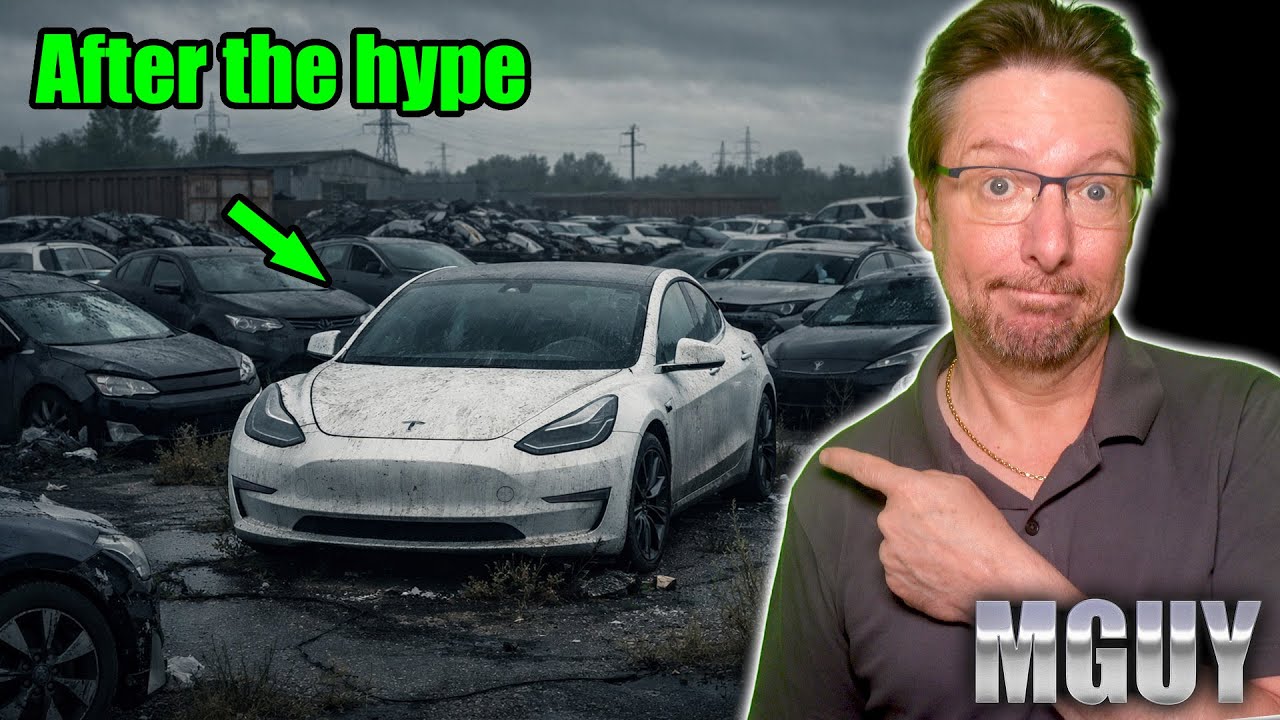
Just like the 1920s when the combustion engine relegated electric vehicles to the dustbin of history (only for them to be taken out again), the second EV bubble has well and truly burst this year.
EV collapse: https://m-g.uy/1e53c7
Research from EY: https://m-g.uy/d7bbb2
Want early access to ad-free versions of MGUY videos, plus other perks like merch and bonus content? Become a member on Patreon! ➜ https://patreon.com/mguytv
👕 Annoy your local EV zealots with some cool MGUY “No EV’s” merch! 🧢 Check out the MGUY store ➜ https://store.mguy.tv
☕️ Want to support this channel? Buy me a coffee! ➜ https://m-g.uy/donate
✉️ Send tips and stories ➜ simon@mguy.tv
🗞️ Signup for MGUY newsletter ➜ https://m-g.uy/news
MGUY social media links:
Twitter/X ➜ https://twitter.com/mguytv
Instagram ➜ https://instagram.com/mguy.tv
Contact MGUY: simon@mguy.tv
#electricvehicle #electriccar #evfire #ev
FAIR USE DISCLAIMER
Under Section 107 of the Copyright Act 1976, allowance is made for “fair use” for purposes such as criticism, comment, news reporting, teaching, scholarship and research. Fair Use is a use permitted by copyright statute that might otherwise be infringing.
The Copyright Laws of the United States recognizes a “fair use” of copyrighted content. Section 107 of the U.S. Copyright Act states: “Not withstanding the provisions of Section 106 and 106a, the fair use of a copyrighted work, including such use by reproduction in copies of phonorecords or by any other means specified by that section, for purposes such as criticism, comment, news reporting, teaching, scholarship, or research, is not an infringement of copyright.”