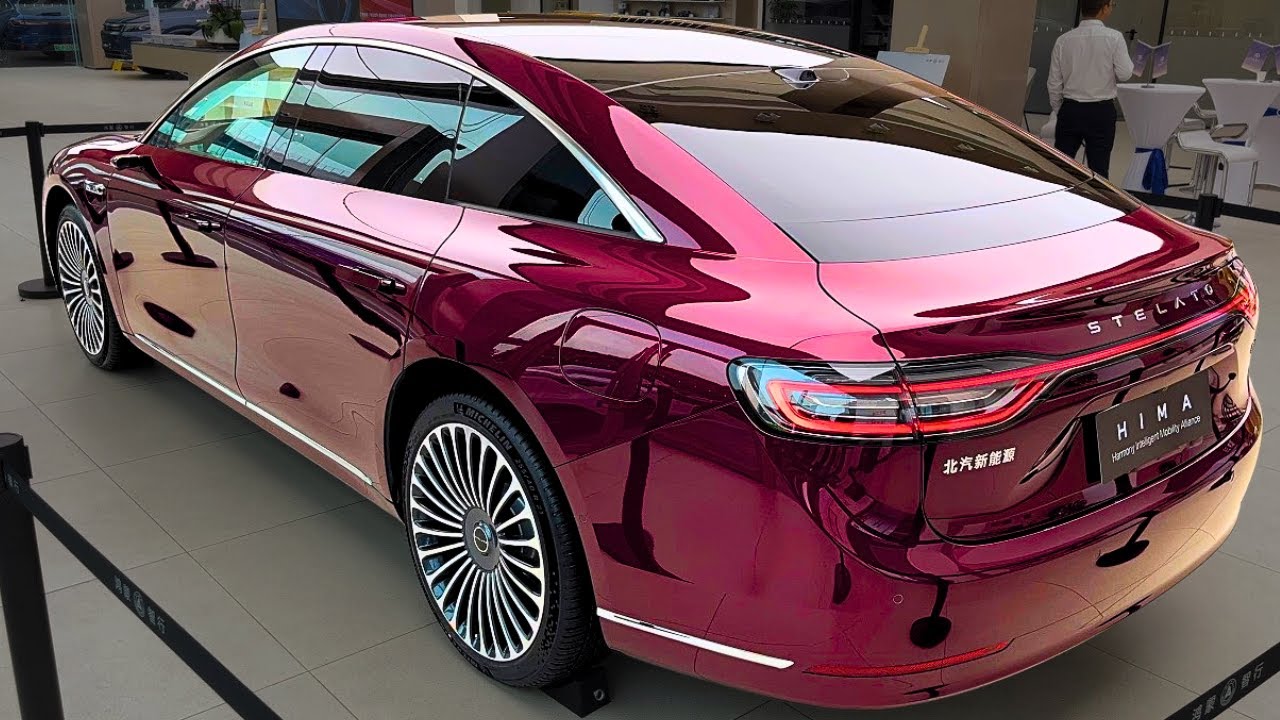
China’s Most Shocking Luxury EV Yet! Huawei Stelato S9T
We were taught to believe Chinese cars were cheap, unreliable, and never meant to be taken seriously. But what if that entire belief system just collapsed overnight? Because while Germany was polishing badges and Japan was playing it safe, China went quiet and then rewrote the EV rule build. Today, I’m bringing you a car that doesn’t just challenge the luxury giants, it embarrasses them. This is the Huawei Stellato S9T, and I’m warning you right now. Once you see what this thing offers, your definition of premium is never going to be the same. It can drive itself from a parking spot to another parking spot without a map. It has zero gravity seats that feel better than a first class flight. It costs less than a base model Tesla Model Y. I’m not joking. Today, I’m showing you the car that proves the United States is officially losing the EV war. Buckle up. Let’s start with exterior. Most wagons look like Herses. This looks like a fighter jet that decided to settle down and have kids but didn’t give up the gym. It is massive. That is longer than a BMW X5. But look at the shape. It is slippery. And because it’s the year 2025 and we’re in the future, look at the mirrors. There aren’t any. These are highdefin cameras. Now, I know I know cameras are a gimmick. I thought so, too, until I saw the night vision on these things. You can be driving in pitch black darkness and the screens inside show you the road like it’s high noon. It eliminates blind spots completely. It’s not just cool. It makes glass mirrors look like stone age technology. But the face, this is where it gets spooky. This design language is called galaxy light. And these headlights, they aren’t just lights. They are Huawei’s XPixel system. Get this. These things are effectively 2 megapixel projectors. If you’re waiting for a friend, you can literally project a movie onto a wall using your headlights. A full 100in display. If you’re letting a pedestrian cross the street, the car projects a lit up crosswalk onto the asphalt to tell them it’s safe. Bro, my Ford doesn’t even tell me when my door is open. This thing is communicating with pedestrians. It feels alive. When you walk up to it, the lights ripple. It acknowledges you. And check the top of the windshield. See that bump? That is the LAR, the 192 line laser scanner that sees the world in 3D. It looks a bit like a taxi sign, I’ll admit, but when you find out what it does, you’ll forgive the bump. We’ll get to the self-driving in a minute, and trust me, it’s going to scare you. Round back. This is the money shot. This is where the wagon flex happens. Most EVs trail off at the back for aerodynamics and ruin the headroom. This keeps going. It has a shooting break vibe. The tail light bar, called the Star River, stretches the entire width. Inside the red plastic, there are thousands of tiny crystal facets. When it lights up, it doesn’t just glow, it sparkles. It looks like crushed diamonds. It looks expensive. If you put a German badge on this, if you slapped a Mercedes star or an Audi ring on the back, people would pay $150,000 for this car without blinking. But spoiler alert, it is nowhere near that price. We’ll get to the number at the end and it is going to make you mad. Like write a letter to your congressman mad. Okay, popping the hood. Is there an engine? No. Is there a massive frunk? Yes, you can fit a carry-on suitcase in here. But the magic is underneath. This uses Huawei’s Drive 1 powertrain. You’ve got dual motors pushing out nearly 530 horsepower. 0 to 60, 9 seconds in a family wagon. That means you can gap a Mustang GT with your kids, your dog, and a week’s worth of groceries in the back. It’s violent. And the battery, this is the whale battery from CL, 100 kW hours. The range, 816 km on the CLTC cycle. Now, CLTC is usually optimistic, but even if we convert that to strict US EPA numbers, you are looking at over 400 m of real world range. that beats almost everything we can buy in the states. But here is the stat that actually matters, the charging speed. This runs on a full 800vt silicon carbide architecture. You can add 200 km, that’s 125 mi, of range in 5 minutes. 5 minutes. That is a bathroom break and a coffee. By the time you’re back, the car is ready to go another two hours. Why is this tech not in America? Seriously, I want answers. We are still sitting at chargers for 40 minutes like peasants and they are doing splash and dash charging. Okay, welcome to the future. I’m not exaggerating. First, the dash. It’s running Harmony OS4. If you have a Huawei phone, the integration is seamless. You tap your phone to the dash and the car becomes your phone. But look at the materials. This isn’t vegan leather that feels like plastic. This is real, supple Napa leather. The headliner is micro suite. The wood trim is open pore. The crystal buttons feel like jewelry. Everything you touch feels heavy, dampened, and expensive. There are no squeaks, no rattles, and the screens. You have a 12.3 in instrument cluster, a massive 15.6 in center screen, and two more screens for the digital mirrors. The UI is fluid, 60 frames per second, no lag. You can drag and drop windows, play games, edit videos. It is a computer. But forget the driver. The passenger seat is the throne. This is called the queen seat. Watch this. This is zero gravity mode. It lifts your knees to heart level to improve circulation. It feels like you are floating. And while you’re floating, the seat is heating you, ventilating you, and giving you a hot stone massage. I’m not talking about those weak little vibrations you get in a Ford. I mean a real massage with rollers that dig into your back. I could genuinely sleep here for 8 hours. In fact, the car has a nap mode. You press one button, the windows dim, the AC goes to a gentle breeze, the seat recines, and soothing nature sounds play through the speakers. It is an isolation tank on wheels. But wait, I told you there was a feature in this car that no US brand would ever dare to try. Look at the roof. A 32in cinema screen. This isn’t a tiny iPad stuck to the headrest. This is a movie theater. It’s a laser projector system, so the image is crisp even in daylight. You can watch Netflix, play PlayStation, attend Zoom meetings, all from the backseat of a wagon. And the sound, it has the Huawei Sound Superior system, 25 speakers, 2080 W. The headrests have speakers in them. I watched the Dune trailer in here earlier, and I felt the sand in my teeth. It shakes your chest. Compare this to the premium audio in a Model Y. There is no comparison. This is better than my living room. And check the center console back here. A fridge, not a cooler that just blows air. A real compressor fridge. You can set it to freezing. You can keep ice cream in here. Or you can set it to warm mode to keep your takeout hot. Who thinks of this? Okay, let’s talk about the elephant in the room, the ghost in the machine, the self-driving. Levy. In the US, we talk about FSD, full self-driving, and it’s impressive. But this, this is different. It doesn’t rely on highdefinition maps. It doesn’t need to know the road beforehand. It uses that LAR on the roof and the cameras to see the world in real time. Since this is the S9T touring version, we have to talk utility. The boot is massive. You can lay the back seats down and you basically have a double bed. Camping mode, easy. Costco run. You could fit the entire store in here. It has the luxury of a Rolls-Royce, but the practicality of a Subaru humpback. That is a combination that simply does not exist in the Western market right now. We have to choose luxury sedan or practical SUV. This car says, “Why not both?” And look at the details. There are 220 volt outlets back here to power your laptop or a coffee maker. There are tie- down hooks that are made of aluminum, not plastic. Even the carpet in the trunk feels premium. So, let’s talk about the price. We’ve got a car that is faster than a Porsche, more comfortable than an S-Class, and smarter than a Tesla. If this was sold by BMW, it would be $120,000. If it was sold by Lucid, it would be $100,000. The Huawei Stelato S9T starts at around 309,000 RMBB. Do the math. That is roughly 42,800 USD. 42,000 for the base model and the fully loaded maxspec ultra version I’m driving about 55,000 USD 55k that is the price of a midspec Ford Explorer that is cheaper than a base model Y longrange for this for a car that parks itself has a cinema inside drives 500 m and massages your back while you sleep this is a cheat code they are selling a spaceship for the price of a taxi and that is why I’m scared for the legacy automakers Because how do you compete with this? So, I have to ask you a serious question, and I want you to be honest in the comments. If this car came to the US and it cost $55,000, would you still buy a BMW 5 Series or would you switch teams? Because looking at this, I think I know the answer. And it scares the hell out of the industry. The Chinese car isn’t coming. It’s here, and it’s better than ours. If you enjoyed this mental breakdown of a review, smash that like button. Subscribe if you want to see what else we’re importing next week. Hey, hey, hey. Hey, hey, hey.
We were told Chinese cars were cheap, unreliable, and years behind Tesla, BMW, and Mercedes.
That belief just died.
In this video, I take a deep dive into the Huawei Stelato S9T, a luxury electric wagon that feels less like a car and more like a spaceship on wheels. This EV packs self-driving without maps, a 32-inch cinema screen, zero-gravity massage seats, 800-volt ultra-fast charging, and over 400 miles of real-world range — all for the price of a base-model Tesla Model Y.
This isn’t a concept car. This isn’t vaporware.
This is a production EV that proves China is miles ahead in the EV race.
#car #automobile #electricvehicle #luxury #electriccar #luxuryautomobiles #futurecars #luxurycars #chinesecars
Fair Use Disclaimer:
This video contains copyrighted material used under Fair Use for commentary, criticism, and review. All rights belong to their respective owners.