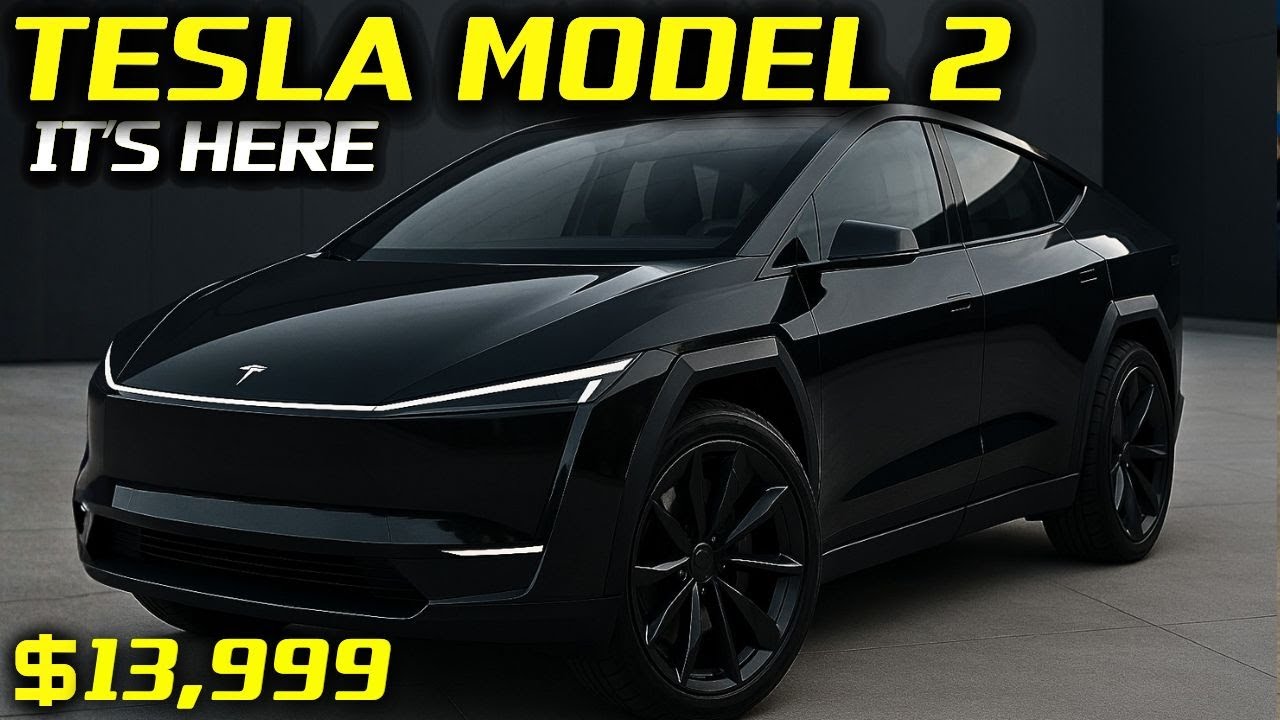
Elon Musk’s New 2026 Tesla Model 2 Senior $13k: Aluminum-Ion 2m-Mile Target, 50,000-T Cast
Have you ever imagined a car so well-built that it practically eliminates any chance of problems? That’s exactly what Tesla promises with the Model 2, expected to revolutionize the market in 2026. It’s no exaggeration. The engineering behind this model seems to have come from a futuristic laboratory, one where every screw has its own monitor. There are 1,800 sensors spread throughout the assembly line. each meticulously monitoring torque, vibration, and even the slightest deviation in position in real time. As the car takes shape, artificial intelligence cross references millimeter precise data to ensure nothing goes wrong. And if something deviates from the standard, the line stops. Simple as that. No, we discovered it after delivery. Here, the error doesn’t even get to the point of being born. Now, if you think that’s an exaggeration, just wait until you see the level of precision this AI achieves in fitting the body panels together. While other automakers accept variations of 2 mm in the spacing between parts, Tesla keeps the standard between 0.4 and 0.6 mm. This, in addition to making the car more beautiful and aerodynamic, drastically reduces the chance of dust, water, or even noise getting in. It’s as if the car were a sealed capsule against time. The body practically fits like an iPhone, as the engineers themselves say. And yes, this changes everything because a misaligned panel today is a leak tomorrow. But it doesn’t stop there. Tesla implemented a system called SPC 2.0, which tracks variations in torque, vibration, and even equipment temperature over time. This means that even before a problem occurs, the system detects the trend and alerts the engineers. And this isn’t just marketing talk. This system has reduced post-p production defects by up to 70%. In other words, instead of waiting for the customer to complain about a small noise in the dashboard or a creaking door, Tesla has already corrected it back in the factory without anyone having to discover it on their own. And speaking of prevention, the Model 2’s electrical system underos a complete check before leaving the production line. Every wire, every connector, and every sensor is tested with surgical precision. No waiting for the dashboard light to come on in the garage. And there’s more. After all that, the car enters a chamber that simulates heavy rain for 2 hours. Yes, 2 hours. taking an artificial downpour from all sides, roof, doors, windows, and every little crevice that could turn into a nightmare for the owner. Just one drop inside, and the car is taken off the line for immediate repair. Now, tell me something. When was the last time you saw a car manufacturer test doors and seats with robots operating on a micrometric scale? Well, Tesla does it. The door hinges, seat rails, and even the opening force are calibrated with such precision that they practically eliminate that annoying wear and tear that appears after a few years. And most drivers don’t even realize that these small flaws are the ones that bother them the most over time. Tesla understood this and attacked precisely where others ignore it. This is all part of a philosophy that Elon Musk has been repeating for years. The best component is no component. What does he mean by that? That the secret is not to make parts that last longer, but to eliminate everything that could cause problems. Every sensor, every system, every robot in the Model 2 factory is there to ensure that the car is born without defects and remains so for a long time. And honestly, it seems they are very close to achieving this. And here’s something curious. All of this happens without the end consumer seeing it. The person buys the car and only feels that it’s solid, quiet, and reliable. But they don’t imagine that behind all of that was an army of sensors, AI, robots, and rigorous testing that guaranteed every detail. And that’s the secret. When a car doesn’t have problems, you don’t even think about it. And that ultimately is the greatest compliment a product can receive. And that’s precisely where the conversation gets even more interesting. Because after eliminating assembly defects, Tesla decided to tackle the biggest fear of any electric car owner, the battery. For the Model 2, scheduled to hit the market in 2026. The company is betting on a technology that sounds almost absurd at first glance. The aluminum ion battery promises a lifespan of up to 2 million miles. This is not an exaggeration nor a number thrown to the wind. We are talking about something designed to last for decades of realworld use, spanning generations, extreme climates, and demanding routines without needing replacement. The difference starts with the chemistry. While traditional lithium batteries begin to show visible wear after one or 2 thousand charge cycles, aluminum ion batteries operate on a different level. They can last 8 to 10,000 cycles while maintaining most of their original capacity. Translating this into everyday terms, it’s like charging your car almost every day for over 20 years and still having enough range to continue using it without any headaches. For those who have heard stories of very expensive battery replacements, this completely changes the perception of cost over time. One of the secrets to this longevity lies in the triple mesh anode. During fast charging, ions move with great intensity, putting pressure on the cell’s internal structure. In conventional batteries, this generates micro cracks that accumulate silently. In the model 2, this mesh functions almost like a flexible net, distributing stress evenly. Instead of cracking, the material absorbs the impact. It’s a detail invisible to the user, but fundamental to ensuring that the battery can withstand years of fast charging without degrading. Another noteworthy point is thermal resistance. Lithium batteries hate extremes, and everyone knows that. Too cold, performance drops. Too hot, wear accelerates. The aluminum ion battery operates comfortably from minus30 to over 50° C. This means the car maintains predictable behavior in both harsh winters and scorching summers. For those who live in regions with unstable climates, this is not a luxury. It’s peace of mind for daily use. And then there’s the issue of safety, which many people ignore until the first incident. Aluminum ions are naturally more stable and much less prone to the dreaded thermal runaway effect. In case of failure, the cell tends to dissipate heat locally instead of triggering a chain reaction. In practice, this reduces fire risks and even impacts insurance premiums. It’s the kind of advancement that doesn’t make headlines every day, but makes a difference when no one is watching. From an economic and environmental standpoint, the choice also makes sense. Aluminum is abundant, cheap, and easy to recycle. Unlike lithium, which depends on unstable and expensive supply chains, aluminum guarantees cost predictability. This helps Tesla keep the Model 2 price competitive, even while delivering a much more durable battery. In particular, it’s hard not to see this as a strategic move to reduce dependence on critical minerals and protect the project in the long term. All of this converges on a simple yet powerful idea. The battery ceases to be a wear and tear item and becomes a structural part of the car. It’s no longer something you will replace someday, but something that accompanies the vehicle until the end of its useful life. And when you add that to the philosophy of flawless production, it becomes clear that Tesla is not just launching a cheaper electric car, but redefining what it means to age in the automotive world. What many people don’t know is that behind the clean, minimalist design of the Model 2 lies a hidden revolution in structural engineering. Instead of using hundreds of welded metal parts, as is the case in conventional cars, Tesla fuses almost the entire underside of the car at once with a single piece molded by a 50,000 ton Gigapress. Yes, 50,000 tons. The force involved in this process is so colossal that it would be capable of crushing entire buildings. And the result is a solid chassis without weak points, without welds that come loose over time, without joints subject to rust. It’s as if the car’s skeleton were sculpted from a single block of metal. And this completely changes the game in terms of durability. In a traditional car, there are over 300 welds spread throughout the structure, and each one is a point of stress, a potential source of cracking or vibration over the years. In the model 2, that number drops to just 12. That’s right, 12 welds across the entire underside. And as a direct consequence, the chance of structural cracks over time plummets. If you think about it, this kind of structural robustness used to be found in military aircraft. Now it’s present in a passenger car that can cost less than many popular SUVs. But the impact isn’t just on durability. It also has to do with comfort. This cast structure reduces cabin vibration by about 28%. Anyone who has driven a car that’s a few years old knows it starts with a creek here, a noise there, and suddenly it feels like you’re inside a samba school out of rhythm. By eliminating seams between parts, Tesla blocks a large part of these noise and vibration transmissions. The result, a car that remains quiet and solid even after a long time on rough roads. And there’s more. The torsional rigidity of the Model 2 reaches up to 70,000 Newton meters per degree of torsion. If that number doesn’t mean much to you, just know that it’s 230% greater than that of the already robust Model Y. This rigidity is what prevents the car’s structure from bending on sharp turns, potholes, or uneven terrain. Furthermore, it ensures that doors don’t misalign, windows don’t rattle, and panels don’t come loose over time. In other words, the car ages well, even with intensive use. Tesla also applied a protective coating called Gigalive Ultra, which acts as armor against rust. This treatment can withstand road salt for up to 30 years, something essential in regions where winters are harsh. Rust is one of the most silent and cruel enemies of older cars, and it usually starts from the inside out at the weld points. But since the model 2 has almost no welds and also has this anti-corrosion shield, it practically cuts the problem off at the root. Another technical detail that often goes unnoticed but makes all the difference is that the cast structure also reduces the number of attachment points for seats, doors, panels, and electronic modules. Because structural vibration is lower, these components experience less stress over time. This means the dashboard won’t start creaking, the seats won’t wobble, and the electronic connectors won’t come loose with use. Everything stays where it’s placed for much longer. This type of construction also has a direct impact on safety. In the event of a collision, a cast unibody structure responds much more predictably than a tangle of welded parts. It can better absorb and redirect the impact energy, protecting the occupants. And even though the Model 2 is an affordable car, this engineering is more reminiscent of a tank than a popular hatchback. Honestly, what Tesla is doing with largecale casting is impressive. Many people don’t realize it, but the biggest long-term financial villains aren’t the large parts that suddenly break. They’re the small components that slowly wear out without warning. That suspension rubber that starts to cak, the wheel bearing that begins to vibrate, the door hinge that gives way and forces you to raise your arm to close it. It’s at this level of detail that the Tesla Model 2 stands out because instead of only dealing with these problems later, Tesla decided to redesign everything so that they simply don’t happen. It’s as if the car was made to cheat time. Let’s start with the suspension. Forget that traditional system with rubber bushings that dry out, deform, and need replacing after 50,000 or 60,000 km. In the model 2, the suspension is made with fiber reinforced elastic compounds, a type of advanced polymer that not only resists compression and torsion, but also maintains its original shape for much longer. The life expectancy of this system between 500,000 and 800,000 m. That’s equivalent to driving for decades without hearing a single creek. And what about the wheel bearings? In regular cars, they’re usually made of steel, and the constant friction from the vehicle’s weight and the heat generated by movement end up eroding the smoothness of the rotation. The result, that muffled noise and the wheel that seems to drag. Tesla solved this with a hybrid ceramic system. Lighter, smoother ceramic balls rotating on special steel tracks with heatresistant lubrication. This combination guarantees virtually frictionless rotation for up to 500,000 m. And the best part, less noise, less vibration, and greater energy efficiency. Another issue that often goes unnoticed, but that everyone has experienced is the doors. How many times have you seen an older car with a sagging door that needs to be pushed up to close? This happens because the hinges made of ordinary steel give way over time and with the weight of the door itself. Tesla combed this with an anti-syncing alloy designed to withstand 300,000 opening and closing cycles. It’s the kind of thing that ensures the door remains firm and smooth even after 30 years of use. These examples illustrate a different philosophy. Instead of reinforcing where there are problems, Tesla decided to rethink the materials and design so that the problem never arises. It’s a proactive, almost surgical approach where each component has to last as long as the rest of the car. It’s not just about reducing maintenance costs. It’s about creating a user experience where the owner almost forgets they’re driving a car with moving parts. And that, let’s face it, is rare. There’s also the issue of downtime. In regular cars, certain wear and tear issues are so predictable that the owner schedules a visit to the mechanic every year, replacing shock absorbers, aligning the suspension, checking the hinges. In the Model 2, this schedule practically disappears, and that changes the relationship between the user and the car. You stop thinking of the car as a fragile piece of equipment that needs constant attention and start seeing it as something solid, reliable, almost like a state-of-the-art appliance. Another important point is the invisible savings. Fewer parts to replace means fewer visits to the mechanic, less expense, less headache with maintenance. But it also means fewer breakdowns along the way, less risk of breakdowns on trips, more peace of mind in everyday life, and of course, a higher resale value. After all, a car that requires almost no maintenance becomes much more attractive in the used car market. If there’s one thing that truly changes everything when we talk about automotive maintenance, it’s when it simply ceases to exist. And with the Tesla Model 2, the idea of annual servicing, parts replacement, or worrying about wear and tear has become almost a joke. In 2026, the car isn’t just promising savings. It’s proposing the end of maintenance as we know it. That’s because everything in it has been designed to last, avoid wear and tear, or function so reliably that the owner forgets there’s anything there that could break. maintenance ceases to be a part of the routine and becomes an outdated concept. Think about it. If the car is assembled with sensors that detect any fault before it happens, if the battery lasts more than 2 million miles, and if even the screws are tightened by robots with millimeter precision, what’s left for the workshop to do? Even the doors are calibrated by robots to never sag. The seat won’t wobble. The suspension won’t cak. The sensors won’t fail over time. Tesla took every point that used to cause headaches and redesigned it so that it simply doesn’t happen anymore. And that completely changes the owner’s emotional connection to the car.
In 2026, Elon Musk and Tesla shattered all limits with the launch of the Tesla Model 2, an electric car designed to outlive every vehicle ever made. With an aluminum-ion battery capable of lasting up to 2 million miles and a structure forged by a 50,000-ton GigaPress, the Model 2 completely redefines the concept of automotive durability. Forget about checkups, part replacements, or unexpected failures—every inch of this machine was engineered for long-term resilience with a level of precision never seen before in the industry. With 1,800 sensors, artificial intelligence, and advanced materials, this car is practically failure-proof.
While other automakers still struggle with common issues like rust, suspension wear, or frame cracks, Tesla has built a vehicle that eliminates the need for maintenance. Elon Musk makes it clear: the era of problematic cars is over. From reinforced door hinges to ceramic wheel bearings and the Gigalve Ultra anti-corrosion shield, every detail of the Tesla Model 2 was made to last for decades. The future of electric vehicles has already begun, and it carries the name Elon Musk, Tesla, and a bold promise: never pay for car repairs again.
___________
Here on the EV Briefing channel, you’ll get the latest updates on Elon Musk, Tesla, new Tesla Model 2, Model 2, Tesla Model Y, Model Y 2025, Tesla Model S, Model S, Model X, and Model 3. Our focus is to bring you everything about each Tesla EV, whether it’s an affordable Tesla, a potential Tesla cheap car, or a new Tesla car on the horizon. We cover daily Tesla news, EV news, Tesla update, and tech advancements coming straight from the Gigafactory.
If you’re into electric car, future EV, Tesla 2025, improvements in Tesla battery, increased Tesla range, and everything involving Tesla innovation, you’re in the right place. We also track every Tesla reveal, Tesla launch, and of course, all major Elon Musk news and developments shaping the world of electric vehicles.
_____________
#tesla #elonmusk #teslamodel2 #teslamodely #modely #gigafactory #electricvehicles