This New BYD Engine Just Threatened the Entire Electric Vehicle Industry
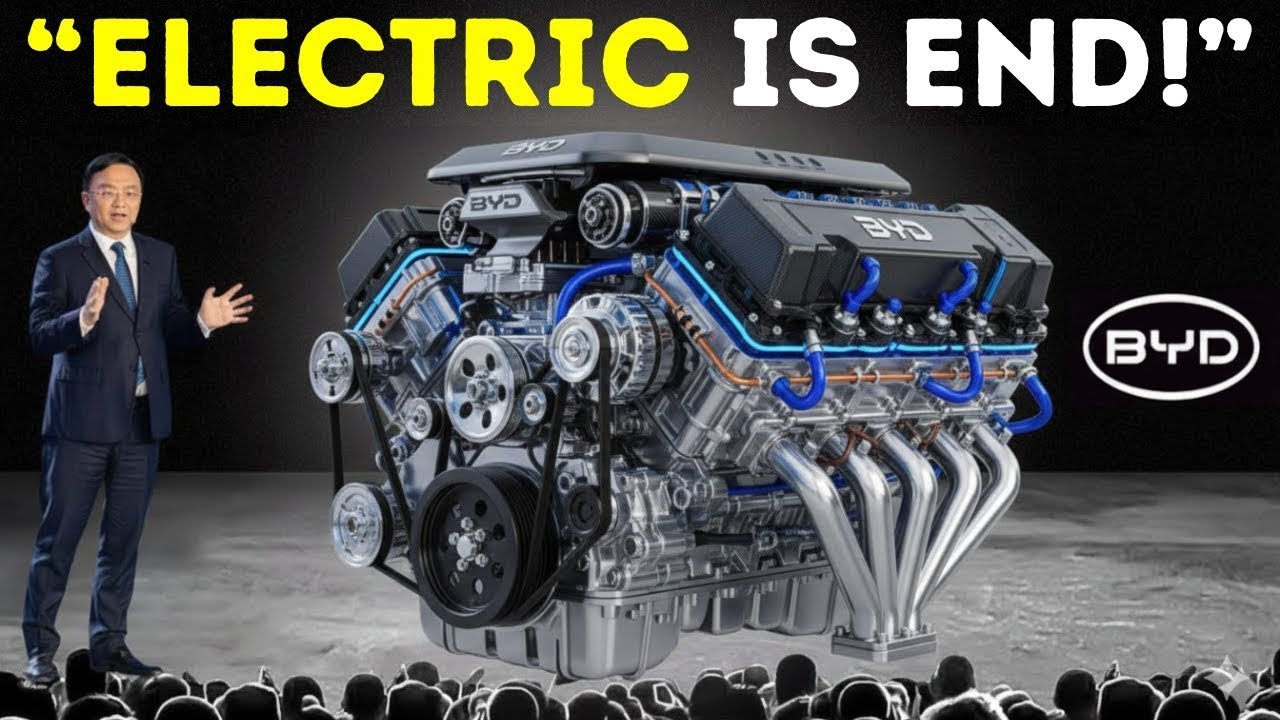
In a world h hurtling toward electrification, BYD, the Chinese automotive powerhouse, is changing the rules of the game in such a way that it cannot be played the same way ever again. The company has risen to global prominence as the bestselling car brand in China and the undisputed leader in electric vehicle production worldwide. With over 4.3 million vehicles produced in 2024 alone, BYYD is shaping the future of mobility. Now, the BYD CEO has claimed that their new engine will shake the entire EV industry. This is one update you cannot afford to miss. The fifth generation DM hybrid system. BYD has already made its mark in the EV industry, surpassing Tesla and claiming the number one position. Now, it is ready to dominate the hybrid vehicle market, too, thanks to its fifth generation DM or dual mode hybrid platform. At the heart of this system lies a meticulously engineered 1.5 L gasoline engine delivering 74 kW or approximately 99 horsepower and 126 newton meters of torque. Though these figures might seem modest compared to traditional internal combustion engines, the magic of this powertrain is in its synergy. Paired with one of two high efficiency electric motors offering outputs of either 120 kW or 160 kW, this engine serves as a power generator and range extender rather than a standalone drive mechanism. The system is built on BYD's DMI, which is fuel economy focused, and DMP, which is performance focused architectures with the Chinel DMI and Seal 6 DMI serving as its flagship models. These vehicles not only embody BYD's hybrid engineering prowess, but also reflect a broader shift in consumer demand toward vehicles that offer both performance and sustainability without compromise. These are the passenger vehicles of the future. It seems the new engine boasts an unprecedented thermal efficiency of 46.06%. a figure that firmly establishes it as the most thermally efficient mass market internal combustion engine on the planet. To understand the weight of this achievement, it's worth noting that most conventional gasoline engines operate with thermal efficiencies ranging between 30 and 38%. Even Toyota, which has long been considered the benchmark in hybrid technology, only recently approached the 40% mark with its latest Prius models. BYD's surpassing of the 46% threshold really places it in a league of its own, reflecting years of focused research and development, component refinement, and system integration. The high thermal efficiency results in significantly less energy lost as heat, so more of the fuel's energy is effectively converted into usable power. Naturally, the total combined driving range is, well, very impressive. With a full tank of gasoline and a fully charged battery, BYYD's fifth generation DM hybrid vehicles can travel an astonishing 2,100 km or roughly 1,34 m without requiring a refill or recharge. In comparison, the Toyota Prius can go on for 980 km or 610 mi. This number is not just impressive on paper. It actually addresses one of the most persistent limitations of electric vehicles range anxiety for consumers in countries with underdeveloped EV infrastructure or for those who frequently travel long distances. This development offers honestly unparalleled practicality. The range easily covers a round trip from Beijing to Shanghai. The new hybrid models, the Chin DMI and Seal 6 DMI serve as technological showcases and market disruptors. The Chinel DMI is an elegant, familyoriented midsize sedan, while the Seal 6 DMI targets younger, techsavvy, urban professionals with its sleek couplike profile and futuristic cockpit. Both models leverage BYYD's new eplatform 3.0, a modular architecture optimized for hybrid and electric drivetrains. This platform allows for smoother integration of components, contributing to the reduced weight, improved energy distribution, and enhanced safety standards these vehicles offer. Additionally, both cars come equipped with BYD's signature blade battery, an ultra safe lithium iron phosphate or LFP, battery known for its long cycle life, structural integrity, and thermal stability. Charging and refueling logistics have also been streamlined. In urban driving, the electric motor takes the lead, silently and efficiently powering the vehicle. On highways or under high load, the petrol engine kicks in not only to provide power directly to the wheels when needed in DMP mode, but also to recharge the battery, ensuring that the vehicle can continue to run in electric mode even in the absence of external charging infrastructure. Its ability to retain capacity over time ensures consistent performance throughout the life of the vehicle, further enhancing the appeal of EVs. The blade battery also plays a crucial role in making electric vehicles more space efficient. As EV demand grows, manufacturers are looking for ways to maximize interior space. The Blade Battery's slim flat design allows it to be integrated into the vehicle floor, freeing up room for passengers, cargo, and advanced features. This design also lowers the vehicle's center of gravity, improving stability and handling by optimizing space. In this way, the blade battery enables manufacturers to create more spacious and comfortable interiors without sacrificing performance or range. One of the most promising applications of the Blade battery is its ability to power a wide range of vehicles. From compact sedans to large SUVs and buses, BYD has already begun integrating the Blade battery into models such as the BYYD Tang SUV, the BYYD Chin, and the BYD E6 electric MPV. With plans to expand its use even further as EV demand continues rising globally, the Blade battery is set to play a defining role in shaping the future of transportation. BYD's architecture, you know, really acts as the intelligent brain behind its electric vehicles, integrating and centralizing all core systems to deliver a seamless, adaptive, and highly responsive driving experience. Instead of relying on the old network of isolated ECUs, it now uses real-time data processing, machine learning, and sensor fusion to anticipate and respond to changing road, weather, and traffic conditions with truly exceptional speed. Building on this formidable foundation, BYD's vision honestly goes far beyond just individual technological breakthroughs. The company is orchestrating a comprehensive ecosystem that aims to redefine global transportation. This holistic approach covers energy generation, storage, and consumption creating a closed loop system that positions BYD not just as a car manufacturer, but as a total energy solutions provider. A key pillar of this strategy is BYD's investment in renewable energy integration. The company is in fact a global leader in photovoltaic technology and energy storage systems. The synergy between its solar panels, residential and commercial battery storage units like the BYD battery box and its electric vehicles really presents a compelling proposition. The ability to power one's home and car with clean, self-generated energy. This integration significantly reduces the overall carbon footprint of electric vehicle ownership and you know lessens the strain on public charging infrastructure addressing another critical concern for potential adopters. Then there is the AI system which functions as a collective intelligence system embedded within BYYD's electric vehicle fleet turning each car into a learning node. Working with the vehicle architecture, it collects and analyzes real-time and historical data to optimize performance, predict maintenance needs, and enhance safety. It monitors battery and motor health, driving conditions, and user behavior, anticipating issues before they arise, and suggesting improvements in energy efficiency. Through its network structure, if one car encounters a problem, the rest of the fleet can learn from it instantly. Moreover, on the 10th of February 2025, BYYD unveiled a cuttingedge intelligent driving assistant marking a major leap toward fully autonomous vehicles. It integrates neural networks, machine learning, and multi-ensor technology to deliver human-like decision-making, rapid reflexes, and contextaware navigation. Offered in three tiers, it provides advanced features like high-speed navigation on autopilot, automated valet parking, and memory navigation that adapts to user routines. Altogether, these systems make BYYD vehicles incredibly advanced, competitive, and future ready. Well, that is it for now. Thanks for watching. If you like this video, please consider liking, dropping a comment, and hitting the subscribe button so you do not miss out on new uploads. Also, do not miss the video on your screen right now.
This New BYD Engine Just Threatened the Entire Electric Vehicle Industry
BYD, China’s top-selling car brand and the world’s leading electric vehicle manufacturer, is transforming the automotive industry with its fifth-generation DM hybrid technology. Officially unveiled in 2024, this breakthrough system introduces the most efficient combustion engine ever created, reaching a record-breaking thermal efficiency of 46.06%, far surpassing Toyota’s previous 41% benchmark.
The system pairs a 1.5-liter petrol engine producing 99 horsepower with powerful electric motors delivering 161 or 215 horsepower, resulting in a staggering maximum driving range of 1,304 miles on a single tank and full charge. That’s comparable to driving from Los Angeles to Seattle and back without refueling. Even when the battery is nearly depleted, fuel efficiency exceeds 80 miles per gallon, making it ideal for everyday family vehicles.
At the heart of this innovation is BYD’s Blade Battery, featuring ultra-thin lithium iron phosphate (LFP) cells designed for superior safety, durability, and efficiency. The battery boosts energy density by 50% and has passed extreme puncture, heat, and compression tests without thermal failure.
BYD’s Xuanji Architecture integrates powertrain, battery, and control systems to deliver split-second decision-making and optimized performance. Meanwhile, the DiPilot intelligent driving system brings advanced autonomous features across BYD’s lineup—from affordable models to premium vehicles—including hands-free highway navigation, adaptive driving assistance, and fully automated parking.
With pricing up to 15% lower than Tesla’s Model 3 and an astonishing 4.3 million vehicles produced in 2024, BYD is rapidly emerging as a dominant global force. This technology doesn’t just challenge traditional automakers—it accelerates the transition away from conventional gasoline engines.
This isn’t just an upgrade. It’s the future of driving. 🚗⚡