
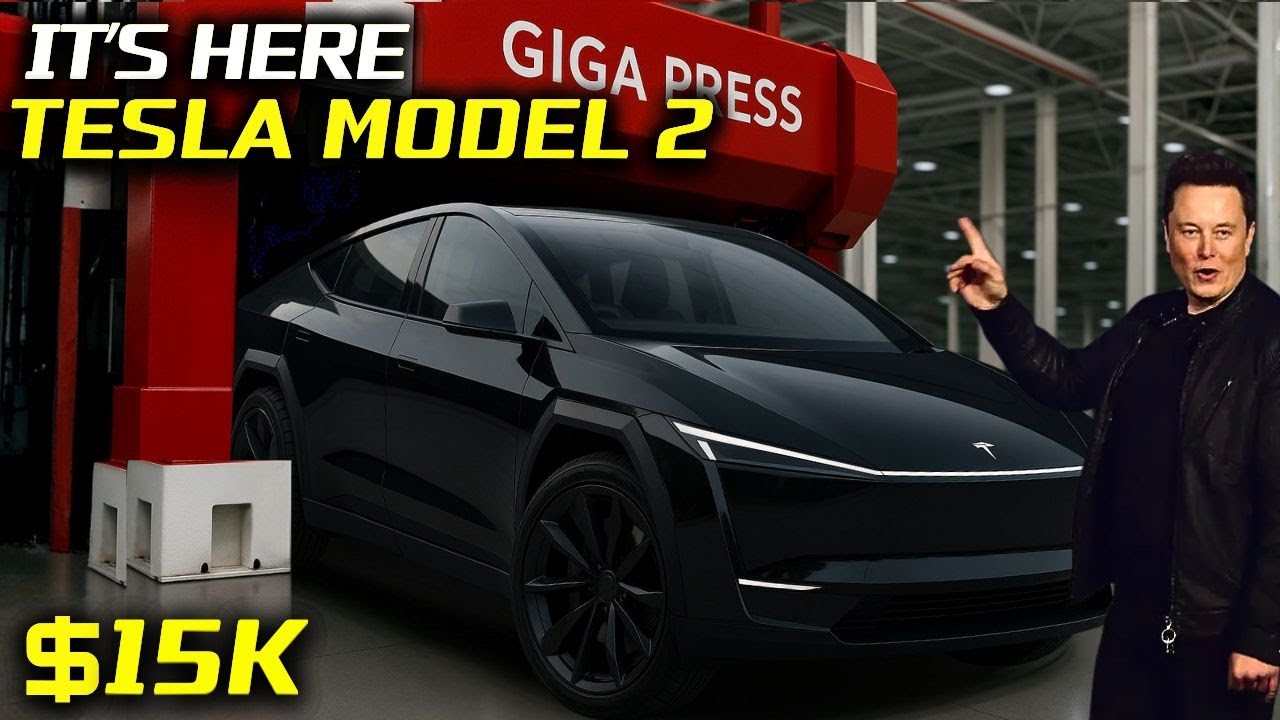
New 2026 Tesla Model 2 Senior For $14,999! 4.5-S Gigacast, 48V Zonal, OTA/FSD Hardware!
She came to change everything. While the world was still digesting Tesla’s advances with the Cybert truck, a new turning point emerged on the Giga Texas production line. A car coming out ready in just 4.5 seconds. That’s right, less than 5 seconds. If you blink slowly, you’ve already missed it. The feeling is one of industrial magic, but it’s pure engineering. And the most insane thing, this isn’t a futuristic marketing promise. It’s real. It’s 2026 and it’s already happening. In the time it takes someone to serve coffee or adjust the rear view mirrors, Tesla has already delivered six brand new cars. The Model 2, the star of this revolution, is the pivot of this feat. The brand’s cheapest electric car and also the fastest to produce. But what exactly is behind this absurd speed? Because it’s not just about speeding up a process. It’s about rewriting the entire playbook of the automotive industry. What used to take days and involve dozens of stations, hundreds of people, and thousands of micro adjustments now happens almost in real time. Analysts were speechless. After all, it’s not every day that a complex vehicle with body, structure, powertrain, and electronics is assembled as quickly as an idea. This raises the eyebrows of even the most skeptical. Is it really possible to do it fast and with quality? The answer begins to emerge when we observe Elon Musk’s focus. Extreme efficiency combined with massive scale. The obsession is not just with speed, but with perfection repeated in series, without stumbles. The production of the Model 2 has become a silent spectacle where machines dance in absolute synchronicity without drama, without rest. Robots, sensors, and artificial intelligence work together as if they were a single mind. It sounds like science fiction, but there’s nothing fictional about it. In fact, if a child visited Giga, Texas today, they would think they had fallen into a technological amusement park. And the choice to do this with the Model 2 was no accident. We’re talking about a car designed for mass production like no other at Tesla. The challenge was simple and brutal. Deliver something modern, safe, and affordable to millions of people and fast. When Musk said he wanted to build a car like someone who manufactures toys, many people laughed. Now nobody is laughing anymore. The machines are shaping aluminum, fitting batteries, and releasing the cars in countdown timers. The analogy with toys, by the way, is no exaggeration. Anyone seeing the assembly line for the first time would swear they were watching a futuristic version of how it’s made. Cars glide along tracks like turbocharged matchbox cars. The logic is simple. Eliminate anything that causes delays. No long stages, rework, or excessive manual checks. Everything is automated from the chassis mold to the final assembly of the components. It’s a silent but relentless revolution. While the entire industry still grapples with production schedules in weeks, Tesla measures time in seconds. Every four turns of the dial, another Model 2 is ready to hit the streets. It’s hard not to be impressed by this level of efficiency. Especially since in a market where time is money, Elon Musk has essentially decided to double the time and deliver twice as many cars at half the cost. If someone were to say that the greatest leap in the history of the automotive industry would be caused by a machine the size of a small house, many people would doubt it. But this machine exists. It’s real. And it goes by a name that sounds like it came straight out of a comic book. Pressilon Musk called this invention a fullscale Matchbox car factory. And he wasn’t exaggerating. The Giga Press is a high-pressure die casting machine that has completely changed the way cars are manufactured. Instead of assembling a chassis with dozens or even hundreds of parts, Tesla now simply casts the car’s skeleton all at once. Imagine a giant mold ready to receive liquid aluminum at nearly a,000° C that in seconds transforms into the chassis of an entire car. This is the new heart of the model 2 production line. Before each part of the vehicle required complex steps, stamping, welding, fitting, robots working in unison for minutes or hours. Now, 3 seconds. Three. The Giga Press can sculpt the rear of the car in less time than it takes you to unlock your cell phone. What’s most impressive is that this new generation of Gigapress doesn’t just make one piece at a time. It’s capable of molding five complete chassis in a single cycle. It’s such an absurd pace that it almost seems like cheating. And this has a direct impact. The production cost of the Model 2 plummets. When Tesla used the old method, the rear of the Model Y alone required more than 70 individual parts to assemble. Now with the Gigapress, this puzzle disappears and the cost drops by up to 40% in that step alone. The secret to this revolution isn’t just aluminum and brute force. The engineering behind the Giga Press involves millimeter precise calculations of pressure, cooling time, and automatic part extraction. After casting, the chassis emerges still hot, is immersed in a 50°C water bath, and immediately goes to the assembly line, ready to become a car. No waste, no pauses. The machine operates 24 hours a day as if it were on industrial energy. And the key is precisely in cutting out steps. Previously, the process involved individual stamping, folding, welding, reinforcement, and alignment checks. With the Giga Press, all of this becomes a single movement. What once required hundreds of robots is now done by a few robotic arms with specific functions. Fewer robots, less maintenance, fewer points of failure. And as if that weren’t enough, this simplification also makes the car lighter and more resistant. Weight, in fact, is a crucial factor in electric cars. Every kilogram less means more range, more performance, and more efficiency. Because Gigapress uses aluminum and reduces the number of seams and welds. The result is a more rigid and lighter chassis. This allows the model 2 to achieve the same 300 kilo range as other models with much larger batteries simply because it is more efficient from the structural level. If you walk into Giga Texas today, you’ll feel like you’re watching a futuristic spectacle where the main actors are robots. That’s no exaggeration. Inside, humans practically disappear from the assembly line. The production of the Model 2 happens in metallic silence with meticulously choreographed mechanical arms executing tasks with surgical precision. The environment looks more like a scene from science fiction than a car factory. And honestly, it’s enough to leave any engineer speechless. What you see there isn’t just automation. It’s almost total autonomy. Tesla took seriously the idea of assembling cars like a toy assembly line only on an industrial scale. And this vision is only possible with the intensive use of autonomous systems, state-of-the-art sensors, and artificial intelligence applied in real time. While other automakers still rely on hundreds of workers side by side in critical stages, Tesla shows how a fleet of robots can do the same job or better without pauses, distractions, or human error. The result is a factory that never sleeps. Literally, the line operates 24 hours a day, 7 days a week. The robots don’t take days off, don’t need coffee, and don’t complain about long shifts. They simply do what they were programmed to do at the right pace, at the right time, with the same quality from the first to the last car of the day. And all this with controlled energy consumption since fewer steps, less movement, and less rework also mean more energy efficiency in the assembly process itself. But the dominant presence of these machines isn’t just for show. There’s a strategic reason behind it. By drastically reducing the number of employees on the production line, Tesla cuts operating costs while simultaneously ensuring a near unbeatable standard of quality. Fewer human variables result in fewer defects, less waste, and greater reliability. In a market where every second and every penny counts, this advantage could be the deciding factor in the affordable electric vehicle war. And there’s another interesting point. The less direct labor required, the easier it is to scale. A system that depends on thousands of workers needs to be replicated with care, training, and logistics. A system that is 95% automated, on the other hand, can simply be copied and pasted into another Geiga factory in the world. Just send the machines, the data, and press the start button. It’s the globalization of efficiency Elon Musk style. Inside Giga Texas, each robot has a clear function. Lifting parts, painting car bodies, welding specific points, assembling electrical systems, aligning doors, adjusting sensors. It’s like an orchestra of steel and code. And each step is monitored in real time by computer vision systems that identify any anomaly before it becomes a defect. Everything seems to work at the limit of perfection, as if the cars were 3D printed, only on a brutal scale. And perhaps the most curious thing about all this is the contrast. From the outside, the Model 2 looks like an ordinary car. Compact, modern, even discreet. But those who know how it was born, those who saw the robotic choreography behind its creation, understand that it is the result of one of the most sophisticated processes ever built by modern industry. A simple car made in an incredibly complex way. The Model 2 doesn’t carry its battery. It is the battery. Literally, Tesla has transformed the heaviest and bulkiest component of an electric car into a structural part of the vehicle. No more batteries tucked away like backpacks under the floor. Here it and the floor, a single piece that supports the entire car like a spine. This completely changes the internal architecture, reduces the number of parts, and increases the overall rigidity. And of course, this also helps with that insane production speed. After all, fewer fittings, fewer welds, less time wasted. This type of structure brings another huge benefit, lightness. The aluminum used in casting the parts, combined with the absence of unnecessary reinforcements, makes the Model 2 lighter than any Tesla electric car ever released. In an electric car, weight is the enemy of range. And since the idea here is to offer a cheaper car with a smaller battery, every kilogram saved translates into more kilometers on the odometer. Tesla isn’t just optimizing production, it’s sculpting range with engineering. Even though it’s lightweight, the car is incredibly robust. The singlepiece cast structure avoids weak points common in joints and welds. The result, greater safety for occupants, more stability on the road, and less interior noise. The feeling of rigidity is even noticeable in the way it drives. The car responds faster, handles curves better, and absorbs less vibration. This is because each component is mounted directly onto the main structure without intermediaries. The magic of Tesla lies in this type of choice. It’s not just about new parts. It’s new ideas. Transforming a battery into part of the car body is the kind of thinking that redefineses what a car can be. And this has a direct impact on assembly. Robots fit the seats directly onto the battery itself with millimeter precision. And this happens at the same time that the roof, doors, and electrical systems are installed, all in a continuous flow. It’s like watching a body being assembled in real time with muscles and nerves connected in seconds. Moreover, the motor is also integrated into this structural base. There are two motors, one front and one rear, which fit together like Lego pieces at the ends of the battery. This gives the model 2 doughy four-wheel drive and more balanced performance without complicating the process. Suspension, brakes, and wheels are also directly attached to this base, forming an electric skateboard, ready to receive the body. It is at this point that the car can already move on its own within the factory. Still without an interior, without paint, but alive. This skateboard approach isn’t new in the world of EVs, but Tesla has taken it to the extreme. Here, the skateboard isn’t just functional, it’s structural, it’s intelligent, it’s beautiful. And this frees up interior space. Since everything is concentrated on the floor, there’s more usable area for passengers. Even though it’s a compact car, and here’s a detail that few people notice. This design also facilitates repairs. Fewer parts, more accessibility, simpler maintenance, everything designed to last and cost little. Of course, all this efficiency would be of little value if the car weren’t comfortable. But even with a minimalist design, the Model 2 surprises with its stability, interior quietness, and sense of unity. It’s like driving a solid piece without creeks or unwanted flex. The combination of the structural battery and the complete die casting transforms the car into a single unit. Light, strong, and agile. The first thing that strikes you when you get into the Model 2 is the emptiness, but not in a negative way. It’s a deliberate, thoughtful, almost zen-like emptiness. Tesla decided to cut everything that could increase costs, and they didn’t hold back. No heated seats. Goodbye panoramic sunroof. Farewell premium sound system. The dashboard is smooth, clean with the bare minimum. It almost feels like you’re stepping into a futuristic car model. But this clean look isn’t just aesthetics. It speeds up assembly, reduces defects, and reinforces the idea that the Model 2 isn’t a luxury car. It’s an entry-level car. And this proposition is clear in the materials as well. No synthetic leather, no acoustic glass. The seats are fabric, the windows are simple, the panels are lightweight. Everything is carefully calculated to fulfill a single mission to cost less and last longer. For some, this may seem like a step backward, but to be honest, in a city car costing less than $30,000, it makes perfect sense. Especially because what really matters remains. The technology that makes Tesla a Tesla. Even with all these comfort cuts, the Model 2 retains the brand’s technological core. Cameras, sensors, autopilot system, all of that is still present. And it’s not just for safe driving. It’s because in the future, this car could be part of a fleet of robo taxes. Elon Musk has let slip more than once that the Model 2 was designed to be Tesla’s workhorse in the future of autonomous mobility. A simple but smart car, inexpensive, but ready for something much bigger. If the goal is to make the car accessible to millions of people, choices had to be made. A cinema quality sound system or a six layer metallic red paint job out. Instead, a simple white paint job. Fewer layers, easier to produce, and cheaper to maintain. This logic applies to everything. Fewer LEDs, fewer sensors in the seats, fewer frills. The result, a lighter car, quicker to assemble, and less expensive to repair. It’s as if Tesla has fasted from luxury to focus on efficiency. And you know what? It works. The interior still has that futuristic charm with the multimedia center in the middle and the minimalist steering wheel, but now everything revolves around function. There are no distractions. There’s nothing there that doesn’t have a practical purpose. The car is honest. It doesn’t try to be something it’s not. It delivers exactly what it promises. Modern electric mobility with the best possible cost benefit ratio. And that’s rare these days. Most affordable cars still seem to be made with leftovers. The Model 2 isn’t. It was designed from the start with that goal in mind. The exterior design follows the same line. Nothing exaggerated, no overly bold curves, or outlandish solutions. A compact hatchback with clean lines, higher headlights, and a youthful look. It’s somewhat reminiscent of the Model 3 from some angles, but even more compact and functional. In fact, practicality was taken seriously down to the smallest detail. The doors were redesigned to open better in tight garages. The hinges were optimized. Even the roof angle was designed to facilitate entry and exit for people with reduced mobility. Nothing there is by chance. Everything has a reason for being. And that’s what sets the model 2 apart from its competitors. It doesn’t try to seem innovative. it and innovative even with the simplest clothing possible. If the Model 2 were just another affordable car, it would already be a remarkable achievement. But what’s at stake goes far beyond that. Elon Musk isn’t just launching a new model. He’s positioning Tesla as a protagonist in a new era of global electric mobility. [Music]
Tesla rips up the rulebook with the 2026 Model 2 at $14,999. A 6,500-ton Gigacast forms major body sections in a ~4.5-second shot, feeding an “unboxed” robotic line that slashes parts, weight, and assembly time. A structural battery pack, 48 V zonal electronics, and a minimalist, repair-friendly cabin keep costs down while retaining Tesla DNA—FSD-ready hardware, OTA software, and city-first ergonomics. Net result: an EV cheaper than many flagship phones without ditching core tech.
Built to scale globally, Model 2 targets tight streets and tight budgets: lighter mass for better efficiency, simplified trims, and modules that speed service. The strategy aims straight at value leaders like BYD while opening EV access to markets that never had it. If you want to see how a car can move from single-shot cast to final assembly faster—and for less—this is the turning point.
___________
Here on the EV Briefing channel, you’ll get the latest updates on Elon Musk, Tesla, new Tesla Model 2, Model 2, Tesla Model Y, Model Y 2025, Tesla Model S, Model S, Model X, and Model 3. Our focus is to bring you everything about each Tesla EV, whether it’s an affordable Tesla, a potential Tesla cheap car, or a new Tesla car on the horizon. We cover daily Tesla news, EV news, Tesla update, and tech advancements coming straight from the Gigafactory.
If you’re into electric car, future EV, Tesla 2025, improvements in Tesla battery, increased Tesla range, and everything involving Tesla innovation, you’re in the right place. We also track every Tesla reveal, Tesla launch, and of course, all major Elon Musk news and developments shaping the world of electric vehicles.
_____________
#tesla #elonmusk #teslamodel2 #teslamodely #modely #gigafactory #electricvehicles