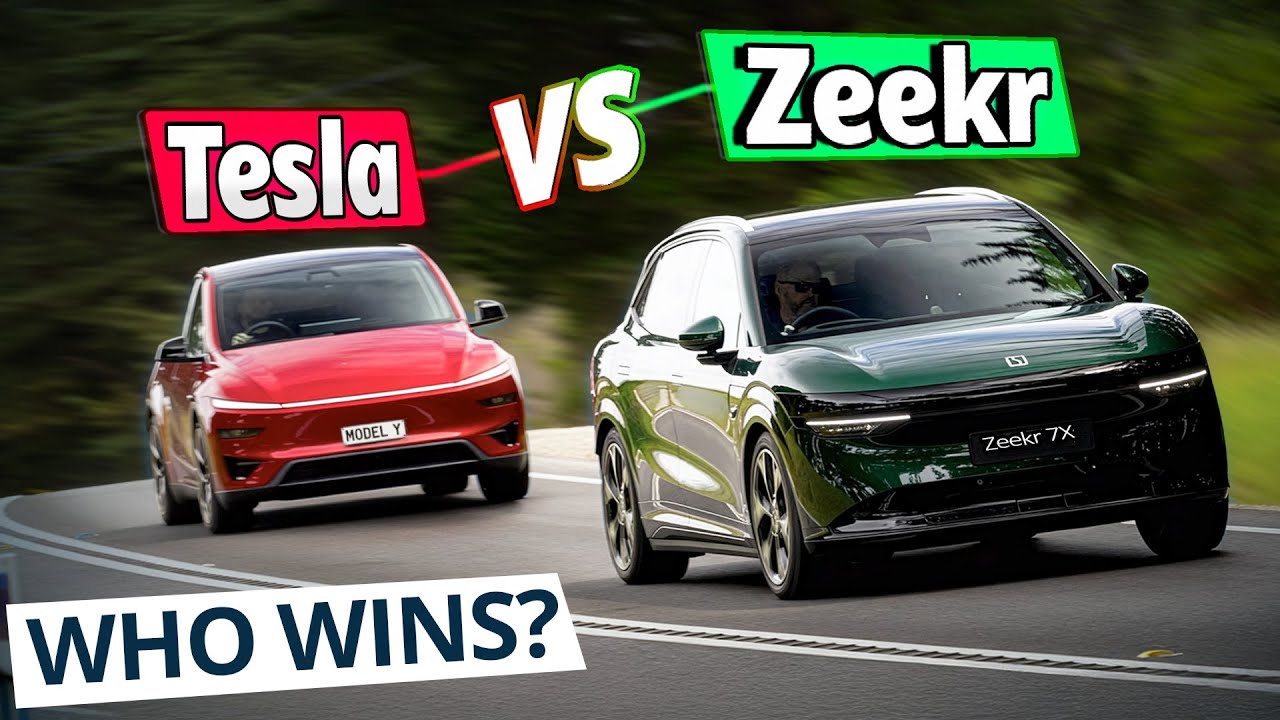
Zeekr 7X vs Tesla Model Y Performance | AU Buyer’s Guide
Is the Zika seven x the
next genuine EV disruptor, or is the hype running
well ahead of reality? Some say it’s a giant slayer, others
that it’s just a pretender. Well, to find out, we are taking the flagship Zika seven
x the performance or will drive and testing it against the
world’s biggest selling ev, the Tesla model Y, and
not just any model Y. This is the performance with enough punch
to embarrass the mightiest of sports cars. So how are we going
to go about this? Well, we’re going to check the price and
spec we’re going to get inside them. Very importantly, we’re
going to drive them. We’re going to see how economical
they are, how fast they recharge, and then we’re going to recommend to
you which one to buy. So hang in there. It’s going to be a super fast silent ride. If you’ve seen this video,
you need to watch this one. We’ve heard your comments,
we know you’ve got questions. Now we’re going to answer them. Medium SUV is where the action is
when it comes to EVs. Five doors, five seat waggons. The Tesla model Y has been the dominant
player since its launch and this year’s Juniper update has kicked that along. Zika is one of the plethora of
recent Chinese arrivals in Australia. There are three Zika models in the launch
range and it’s clearly targeted at the Model Y when it comes to pricing. The Zika seven X definitely
has the advantage Bog stock no options fitted. It’s more than $16,000
cheaper than the Tesla Model Y performance. Now in this
case with our test car, the Model Y actually adds
full self-driving supervised, which is Tesla’s semi-automated
driving assistance package. That adds a cool $10,000. Pretty big hit. Now if you want
to understand more about FSDS, check out the video, which has hopefully just popped up on
the screen here that you can click on by my colleague Dan Gardner. That
delves right into how FSDS works. The Zika seven X has a distinct advantage
when it comes to vehicle warranty, but the Tesla model Y does slightly
better in terms of battery coverage. While the Zika offers an Orthodox service
schedule and cap price servicing Tesla offers, neither the model
Y is serviced as required. The Tesla model wide performance has the
same fundamental look and dimensions as its brethren, but there are some key exterior
differences designed to make it stand out, including the front bumper and
the air blades attached to it. The black wing mirrors and at the
rear, the carbon fibre lip spoiler, unique rear bumper and black diffuser
topping it all off are these 21 inch arachnid alloy wheels
and larger red callipers. The Zika seven X flagship
is harder to pick from. Its cheaper rear wheel drive relations. The big giveaway of
these 21 inch LOE wheels, and if you see it bouncing
up and down on the spot, that’s because it’s the only one with
height adjustable Air Springs one seven x feature. Everyone universally despised during
this test were the power doors that were anything but intuitive to open and close, and half the time they cited there
was an obstacle in their path so they wouldn’t open properly anyway, ditch them Zika and give us normal
doors and openers. Thank you. Well, they both have performance in their
names and they both have performance in their natures. There’s
no doubt about that. Dual motor all wheel drive power trains
with an enormous amount of power and torque equals sub four seconds, zero to 100 kilometre hour
acceleration times in both cases. Now that is super fast in
anyone’s language. Okay, what about the other side of
the equation consumption? Well, the Tesla model Y from a smaller
battery claims to be more frugal and have a longer range look. It’s 400
kilos lighter than the seven x, so that’s probably got something to do
with it, but that is a claim figure. We’re going to hit the road and test
out whether that stacks up or not. Settle into the ca of the Tesla model Y
and you are met with the very definition of Spartan minimalism. There is
just not a lot going on here. There are a couple of features that
separate the performance though. One is these heavily
bolstered sports seats. Another is this carbon fibre trim and
you also get some aluminium pedals. Now this is the only Tesla model
Y that comes to Australia from Tesla’s gigafactory in Berlin, Germany. The mainstream model Ys
come from Shanghai China. So what does that mean for fit
finishing quality? To be frank, early model threes that came to Australia
from Tesla’s California plant were a bit of a horror show, but this car looks to be as well bolted
together as anything from Shanghai. The model y offers plenty
of storage features, include deep bins in the centre
console and in the doors. One less likeable feature though
is the panoramic glass sunroof, and that’s because it has no sliding
inner cover driving on a warm cloudless day, it really heated up in the cabin to the
point of starting to feel sunburned. Now this is where the model Y gets
really idiosyncratic. This is Tesla. If you want to control anything, you basically do it through this
big 16 inch central infotainment screen. You want to change
the gears. That’s drive, that’s reverse parks in the
middle. When you get rolling, the speedo is displayed up here. You
want to adjust the steering wheel, you want to adjust your mirrors, you
want to adjust the regen settings. It’s all done through the screen. Very few things are not adjusted this way. Happily seats can be adjusted down
here at the power settings at the front seats. So what else can you
do on this screen? Well, it makes great fart noises,
which is kind of fun. I guess the Tesla goes its own way
on infotainment by not offering Apple CarPlay or Android Auto. Look, I found it nowhere near as
easy to interact with as
the smartphone based systems spending too much time dabbing at the
screen to access the stuff I wanted. However, Tesla assure me it’s a very good
system once you figure it all out. The dash cam and 360 degree cameras in
this car are absolutely spectacular. Like it’s handy, very handy because
the view out ain’t that great. In fact, to the rear, it’s like a
mailbox and it does record. So the beauty of that is you see
something weird in the traffic, you can always save it
and watch it back later. The Zika seven x is cheaper
to buy than the Tesla model Y, but from the moment you settle inside,
it certainly feels more expensive. Settle into the soft Napa leather seat
and cast your eyes around the interior. And there’s a feeling
here of well premium. It all seems well bolted together in
that typical Chinese way without obvious panel gap discrepancies or rattles
upfront storage is good with deep bins in the centre console and the
doors and cup holders hidden under well damned lids. The seven X is more conventional in
its controls and therefore easier to interact with than the model Y, at least when you first start
trying to understand it. You’ve got the big central touch
screen, of course, like the model Y, but there’s also a digital instrument
cluster and a head up display, so plenty of information
still in front of the driver. You don’t have to look over
here to see what the speed is. Now there are also some physical keys
retained across here across the bottom of the touch screen for a few basic
functions including volume. In more good news, this car has Apple
CarPlay and Android Auto Connection, which makes life easier than the model Y, at least in terms of that
initial acclimatisation. So there’s no doubt when it comes
to presentation and features, the Zika gets the job done
over the Spartan model Y. There’s even speakers for its audio
system in the driver’s headrest, which is pretty funky on safety equipment. These two are very close when
it comes to standard equipment, although as already mentioned, our model Y comes with optional
FSDS both come with seven airbags. The model y range gets
a five star end cap rating. The seven X also gets a five star
rating, but from Euro end cap, which is closely aligned to end cap, a long wheel base and a flat floor
means there’s plenty of space for taller passengers in the rear seat of
the Tesla model wide performance, but it also has a couple of party tricks. One is it’s got a
reclining power seat back, but also this screen
between the front seats. It allows rear seat passengers to direct
airflow from the air conditioning, but also watch shows and play
games. One thing missing though, map pockets at the back
of the front seats. The usual features are here two USBC
outlets, large door bins of fold down arm, rest with dual cup holders, the
seat back, even reclines 10 degrees. The Zika seven X has the same amount of
impressive rear seat space as the Tesla model Y. Absolutely no shortage
of room here for taller people. Also has the same reclining
seat back as the Tesla model Y. And what it does miss though is
the screen between the seats here, bit for the kids on those long journeys. There is something else here which is
appreciated. This is its party trick. There are map pockets, door bins,
air vents in the B pillars, and yes, there are USB outlets hidden
under this flap in the armrest. There are cup holders in here too. Now these are what I call
a couple of big boots, truly befitting family SUVs outright. The Tesla has a slight advantage in
terms of sheer space and both cars have under floor storage as well, although I’d rather there was a
spare tyre under there. To be honest. There are FRS up the front too, and again, the Tesla has the size advantage and
a plug to drain out the ice after the beers are done with the Tesla also has
slow motion remote folding rear seats. The Zika can raise or lower its rear
end thanks to those air springs. There are also lights in a
12 volt outlet in a seven x, neither of which the
Tesla gets to this point. Got to say the Zika seven x is winning
a saver with its value equipment and welcoming presentation, but now we’re getting to the driving
and surely this is where the Tesla model Y really fights back. Okay, first thing first, changing gear by the
screen is a bit weird, but because these cars basically
drive on a single speed reduction gear like an
automatic or even a CVT, you really don’t need to worry about
gear selection once you’ve picked DRR. So while it’s weird and a bit annoying
in a tight situation like a car park or something, once you
get out on the open road, it recedes a bit into the
background as an annoyance. The thing I struggle with a bit more
actually in terms of trying to integrate with this car and feel connected
to it is the seating position. I find it’s a bit high for me.
I cannot get the car low enough. It’s partly exacerbated because
the dashboard is so low, but I’d rather sit in the car than on. It just means it’s not quite
as connected as I like. Of course, in a car this fast,
the more integrated you feel, the better. And this car is incredibly
fast in a straight line. It’s got what’s called insane
mode and that taps into all the power and talk, and then you’ve got
a traction control as well. That’s very, very easy to fire up. It’s just insane mode break on away we go, whoa. I mean, I’m holding my guts in
here, substantial guts. Now that has got to a ridiculous speed. I’m not even going to admit to on camera
in a very, very short amount of time. It’s so accessible and I think
that’s the thing about it. Even if you don’t feel like tapping
into all 7 million kilowatts or whatever it’s got, even just accessing a fraction of
it gives you the sort of power and acceleration that is great for any passing situation. Any hill dashing
across any intersection, inserting yourself into any busy
roundabout, it’s instant. It’s on. It’s always there and it’s so quiet. Tyres are more obvious than the emos. And for someone who’s come out of a
background where performance meant big, barking waffling, growling,
backfiring, v eights, slurping on petrol, it’s quite surreal how fast
and quiet this thing is to go with the massive
powertrain performance. The model y performance has a pretty advanced chassis, but it also feels a
bit digital, especially the steering. The steering is not that well connected.
It doesn’t offer a lot of feel. Sure it’s quick, it’s darty, it’s go-kart ish I guess would
be the way you might term it, but it just doesn’t have
that reassuring confidence and intimacy that something
like a nine 11 might deliver. And I’m sorry to use the nine 11. It’s the obvious junos example we
always pull out, but it’s true. This car would be
improved by more feel some steering. The tune of the adaptive
suspension is actually very, very good in comfort mode. You could live with it every
day and the sports mode, the tor mode you could live
with every day as well. If you’re prepared to put
up with a bit of bump thumb, probably the weakest point
of the car’s dynamic package is the braking. There’s a real noticeable
transition in hard braking from regen to friction brakes,
and it gives you a little bit of concern. That initial press arriving at a corner at
speed, that initial press, there’s not a lot going on there. And then you kind of have a press and
a golf and it starts working for you. It lacks progression. It’s a bit concerning to be honest. After sampling the insane
acceleration a couple of times, really the desire to drive the model
white performance really hard like a sports car sort of washes away. And that’s because the cohesion of the
car isn’t quite there for me in terms of the communication and really
enjoying it through a set of winding roads. Take it back a notch and
it is really a very nice car to drive confidently
and competently at decent speeds. Cross country of course.
Then you come into the question of, if I’m not buying this thing
to really work its performance, why don’t I just buy a Tesla
model Y cheaper Tesla model Y. That’s a very good question.
And what of FSDS? Well, both myself and Trent Junco, the journalist who’s on this comparison
with me writing the written review, have sampled it over the time
we’ve had these cars and we both left feeling the same way. FSDS is mighty impressive
technology that does a lot of things right? The trouble is
everything. Every now and again, it does something we’re not expecting. And that kind of makes it a
little bit of a tense experience. Spend time wondering is this is the
time where it doesn’t quite do the right thing and it happens rarely
enough that it’s a little bit unpredictable. So $10,000, yeah, I dunno if I go there, already talked about how much more
welcoming the Zika seven x feels inside compared to the model Y. And it sort of continues that theme. When you get rolling softer seat,
better seating position, lower, higher dashboard accentuates that, okay, the seat doesn’t have as much
bolster for real sports driving. But then what quickly becomes
apparent is this is not as much of a sports drive as the model Y. The model Y has a higher
ultimate performance limit. It’s a more focused car.
The ride, the handling, the steering of this vehicle is
more progressive and comfortable. It kind of tops out where
the model Y is beginning. There’s a crossover point at
its most focused where the model Y is at its most relaxed. That’s
the easiest way to put it, and that makes this an easier
car overall. The drive, the model Y feels very fast, but also a little bit far away from you. It has a limit that it’s hard to
reach and understand where it is and therefore it could be easier
to step over it. Whereas this car, everything’s very progressive.
It’s got a lot of weight going on, so you’ve got a bit of roll,
you’ve got a bit of movement, you’ve got a bit of
push from the front end. If you go a little bit too
quick into a tight corner, it’s kind of telling you where it’s
at. The steering is more progressive, it’s not as quick. So you put more lock on in a corner
and it’s quite progressive in the way you do that. You’re not
darting into the corner. The rod quality on Air
Springs is lousy at the most comfort oriented setting, getting up to reasonably tight
in the sportiest setting. But they’re still, as I
said, body roll and movement. The car feels like a more
mainstream vehicle than the model Y. They’ve both got incredible
straight line performance that they share, but this car is the one I’d choose
to drive to and from the racetrack in comfort and enjoy it. Whereas the model wise, the one
when you get on the racetrack, you go for the timing.
So much more focused. One area where the seven x
isn’t quite so impressive is tyre noise. On course chip surfaces, this car rolls on Conti Continentals, which noticed in the past have a bit of
an aversion to Australian course chip roads and they do generate a bit of noise
on the rawer surfaces more so than the Pelli P zeros on the model Y. The controls in the seven
X are not as screen centric as the Model Y. There’s
less distraction here. You’re not constantly looking at the
screen trying to figure out what to do next, how to enact
things. It’s not optimal. There’s not enough buttons,
there’s not enough ease of access, but it’s better than the model Y. The model Y to honest stresses
me out because I’m trying to figure out how to access things
when I should be thinking about what’s going on on the road. Familiarity
would help there of course, but yeah, just as an initial experience, this car is really
welcoming by comparison. Not one person involved in this comparison
test has had one good thing to say about the doors, the power doors. Can we please just go
back to mechanical doors? Just a door that you open and
close. That’d be great. Thank you. So let’s talk about economy and charging. The model Y lives up to its claim by
being more frugal in back-to-back driving. It consistently averaged around three
kilowatt hours per 100 kilometres better than the seven x pressed hard. Both were at 20 kilowatt hours per 100
kilometres and above, but when cruising, they were both in the teens. That’s pretty impressive
and charging well here. The seven x with its 800 volt
architecture fights back spectacularly. It is a super fast charging vehicle
plugged in alongside the model Y. At a three 50 kilowatt
DC fast charging station, it ran as high as 296 kilowatts
with the battery starting at 40% full. The model Y started at 27%
and never top 150 kilowatts. That’s an amazing
performance by the seven x, especially when you consider how good
Tesla powertrains traditionally are at this stuff. So put me on the spot for which of these
I’d grab the key card to just for the driving experience. I think it
would depend on the mood I’m in. The model Y would be a challenge to unpick
the seven X easier and more malleable without the razor sharp peak. Most
of the time I’m feeling more relaxed. So most of the time it would be the Zika, in fact expand the picture and
the seven X stands up. Sure, there’s some weirdness
here like the power doors, but there’s also terrific
dollar value, lots of equipment, a spacious interior and a pleasing
drive. The model Y, it’s more expensive, has less gear, is more focused, harder to interact with and less
inviting to access its higher levels of performance, all of which means the Zika seven X
performance all wheel drive wins this comparison test quite comfortably.
In fact, that’s the key word here. The seven X is welcoming and encouraging
the Tesla model Y performance, more demanding, less welcoming. In fact, for all its impressive performance, the model Y is difficult to warm
to. At the start of all this, we asked the question, is the new
seven XA pretender or a contender? Well, not only have we found our
winner, I think we’ve found our answer. Thanks for watching. Don’t forget to like and subscribe for
more videos and let us know what you think of this video down
below in the comments.
This electric SUV comparison dives straight into which of these medium family EVs is the smarter buy, pitting Tesla’s established bestseller against one of the most talked-about new Chinese electric SUVs. If you saw our earlier Zeekr 7X review, this video answers the questions and doubts that followed.
In this medium electric SUV comparison, we put both cars through the same roads and tests to see how they stack up for real Australian buyers. We revisit the big questions from our earlier Zeekr 7X review, look at how this new brand fits into the local market, and ask whether it is a genuine EV disruptor or just hype.
Across the test we compare running costs, energy efficiency, real world range, ride comfort and noise levels, then dig into usability for school runs, commuting and longer trips
Chapters:
00:00 Zeekr 7X vs Tesla Model Y: Introduction and Comparison Plan
1:02 Zeekr 7X vs Tesla Pricin, specs and warranty Australia
2:26 Exterior Design: Unique Features Zeekr vs. Tesla Model Y
3:25 Zeekr 7X vs Tesla Model Y power, acceleration and range claims
4:09 Tesla Model Y Performance interior, infotainment and build quality
6:46 Zeekr 7X Performance interior, tech and comfort vs Model Y
8:36 Zika 7X Rear Seat Space and Practicality: Comfort and Cabin Tricks
9:59 Zika 7X Boot Space and Frunk: Cargo Practicality and Storage
10:46 Tesla Model Y Driving Review: Insane Speed, Digital Steering & Brakes
17:03 Zika 7X Driving Review: Comfort, Progressive Handling & Ride Quality
21:02 Zika 7X Charging Speed and Economy: 800V Architecture Advantage
21:58 Zeekr 7X vs Tesla Model Y verdict which EV should you buy
We also look at Tesla Full Self-Driving Supervised, cabin tech and safety, and see how the 7X’s 800V DC fast charging performs next to Tesla’s system at a high power charger. By the end, you will know which electric SUV makes more sense for your money in Australia and why.
Subscribe for the latest advice, reviews and comparison tests 👍
https://www.youtube.com/user/carsaleschannel?sub_confirmation=1
STAY UP TO DATE AND CONNECT WITH US
https://www.carsales.com.au/
https://www.facebook.com/carsales.com.au
https://www.instagram.com/carsalescomau/
@carsalescomau
carsales. Buy it. Sell it. Love it.®
For over 25 years, carsales has been Australia’s go-to place for buying and selling vehicles – connecting people across the country with confidence and ease.
So for expert reviews, comparison tests helpful advice and everything cars, Like and Subscribe to the official carsales YouTube channel today. https://www.youtube.com/user/carsaleschannel?sub_confirmation=1 #carsaleschannel
#carsales