
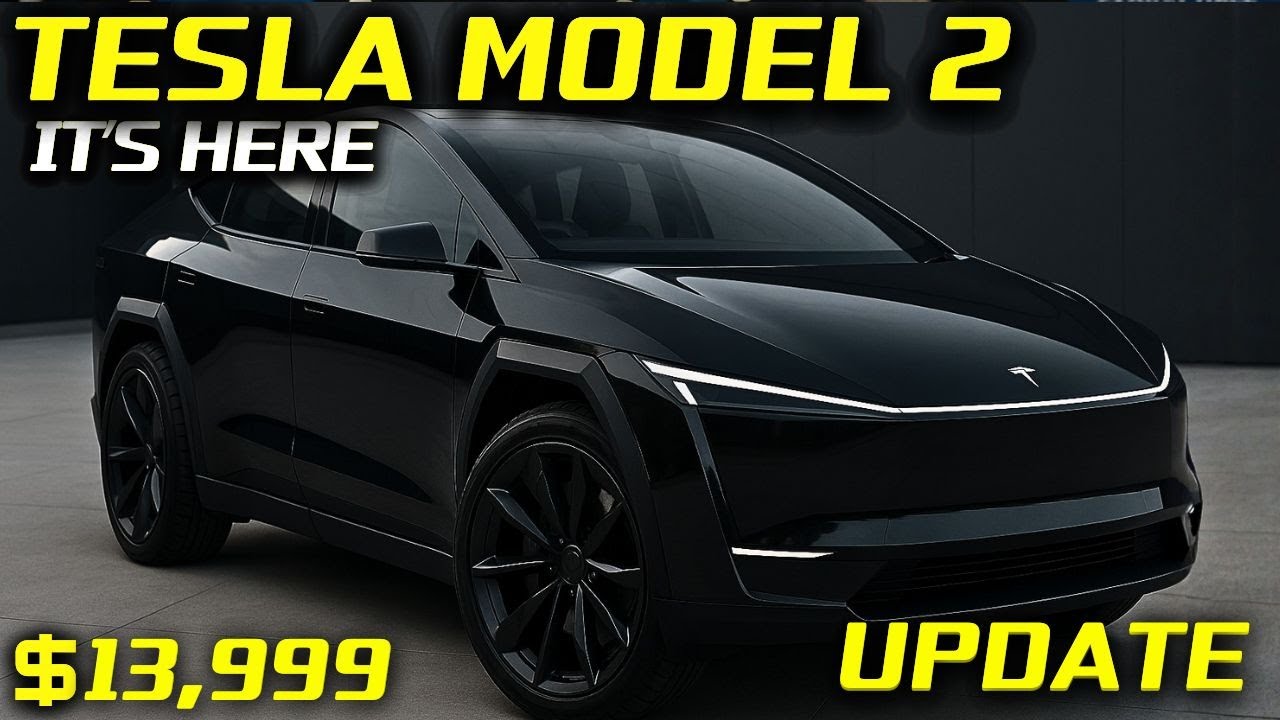
NEW 2026 Tesla Model 2 Senior Revealed $14K: 6,500-t Gigacast, AL-ION path, FSD hardware
In 2026, when everyone thought the future of electric cars would be dominated by increasingly expensive and sophisticated models, Elon Musk decided to turn the tables with an announcement no one saw coming. A brand new Tesla for just $14,990. Yes, you read that right. Less than 15,000. It was like throwing a grenade into the automotive market. Everyone stopped because until yesterday the magic number was 30,000 and even then with a lot of negotiation involved. Now Musk promises a fully equipped electric car for half that price. And the craziest part it’s scheduled for release this year. The reaction was immediate. Internally, sources close to Giga, Texas said that projected demand already exceeds any Tesla forecast. Outside, social media exploded. Thousands of people saying they will finally buy their first Tesla. And you know what’s most curious? Elon isn’t calling this launch a new car, but a new way of making cars. That says a lot about what’s coming. It seems like an exaggeration, but there’s something different about this project. something that could change everything we know about how an electric vehicle is conceived, assembled, and sold. Tesla, which has always been synonymous with premium innovation, now wants to be synonymous with accessibility. And that completely changes the playing field because at that price, it’s no longer competing with BMW or Mercedes. It’s going straight for BYD, Wooling, and the Chinese automakers that were dominating the entry-level category with $12,000 models. Musk understood that if he continued trying to compete only at the top, he would be overtaken from below, and he hates losing. This change isn’t just strategic, it’s existential. The timing is surgical. Tesla had been under pressure from criticism about elitism with cars that despite being electric were still inaccessible to a large part of the population. The Model 2, a name not yet officially confirmed but widely speculated, appears as a direct response to this criticism. A small compact car designed for urban use that brings back an idea that seemed forgotten. Cuttingedge technology can indeed be cheap or at least cheaper than ever before. But how do they achieve this? Because let’s face it, that value is almost surreal. The answer begins with an old obsession of Elon’s own. To cut costs where no one else can. It’s not just about cutting luxuries or simplifying the design. It’s about reinventing the entire process from how the structure is welded to the software that controls the assembly. Every screw, every gram of material, every second of work has been rethought. It’s not just about a product. It’s about a new business model. Of course, some people are skeptical. Many still think that at that price, the car will be too basic, uncomfortable, or even unsafe. But the leaks that escape the production lines tell a different story. They speak of a futuristic, elegant design with its own visual identity. And most importantly, with the Tesla DNA intact, even simplified, it will still be a Tesla. That’s enough for many people to open their wallets without a second thought. And there’s more. With this move, Tesla is not only changing its own positioning, but also forcing the rest of the industry to react. Because if it can deliver an EV for under $15,000, what’s stopping others from doing the same? The question is already being asked in meetings at Ford, GM, Stalantis, and other giants. And you know what’s worse for them? Tesla isn’t just cheaper, it’s faster. Musk promises thousands of units leaving the factory every day. Something that even the company’s current models haven’t managed to achieve. If there’s one thing that’s clear about the 2026 Model 2, it’s that it was designed from the ground up. First came the price. Those $1490 that shook the entire market. And only then came the engineering, forcibly molded to fit that price. The big breakthrough production. Elon Musk decided to use the most advanced technology in industrial manufacturing, the Giga casting process, which basically molds huge car parts into a single piece. It’s as if the car were printed in solid blocks, saving on welding, labor, and even assembly time. That alone saves thousands of dollars per unit. The result is a simpler, lighter structure with fewer points of failure. And this has a direct impact on the car’s aesthetics. The Model 2 doesn’t come with those exaggerated curves or chrome details typical of more expensive models. It’s straightforward with clean lines, a flatter look, and a distinctly urban feel. Many people compared it to a Mini Model Y, but those who saw it up close assure it has its own personality. And that’s important because this new Tesla doesn’t want to be the cheapest. It wants to be the smartest in what it delivers. Anyone expecting leather seats, a panoramic sunroof, or sophisticated interior details can lower their expectations. These items have been left out and rightfully so. The focus is on the essentials. The Model 2 will come with durable fabric seats without heating and with a simpler but well assembled finish. None of those cheap solutions that make the car look like a toy. It has a modern and practical visual identity. Designed for those who will use this car in realworld everyday situations, traffic, tight parking, supermarket trips, and short journeys. This new assembly process has allowed Tesla to accelerate like never before. The promise is that production will reach thousands of units per day. And that’s crazy, especially since the Model 3 itself at the peak of production still had some bottlenecks on the line. Now, with the unboxed system and fewer moving parts, the car simply flows through the factory. And the less time it spends there, the cheaper it becomes. It’s an equation where everything revolves around scale. Musk knows that the secret to democratizing the electric car is not just reducing costs, it’s multiplying production. Another interesting thing is how the exterior design and the internal structure interact. The doors, for example, have been completely redesigned. No falcon wings or eccentric entrances. They are traditional doors, but with a new opening angle, optimized hinges, and a seal that improves sound insulation without inflating the cost. Small details, but they show how meticulously the project was calculated. Tesla cut corners where it could, but where it couldn’t, it innovated. Despite its apparent simplicity, one thing stands out. Its futuristic look. the straighter lines, the clean front, the compact and elevated headlights. All of this gives the Model 2 the appearance of a concept car. But it’s not a concept. It’s a production car that will be on the streets as early as 2026. And that gets people thinking because from the outside, it looks more expensive than it actually is. This already generates a strong psychological effect on people who see it in traffic. And this kind of perception is gold for Tesla. What becomes clear when looking at the Model 2 is that Elon Musk decided to play the game his way. He’s not trying to copy the competition’s compact cars. He’s rewriting what an affordable car can be. It doesn’t need to look simple, weak, or old. It just needs to be efficient. And with the new production line, Tesla has created a car that looks sophisticated. costs like a luxury cell phone and can be manufactured as quickly as freshly baked bread. This isn’t just innovation, it’s pure provocation. Even with all the visible costcutting measures in the Model 2, what’s most impressive is how Tesla managed to keep the essence of the brand intact. It’s no exaggeration to say that even being the company’s cheapest model to date, it still carries technologies that many competitors only offer in models three times more expensive. The key here is simple. Less luxury, more intelligence. Instead of spending on expensive materials or aesthetic features, Tesla decided to invest where it really matters, performance, efficiency, and onboard technology. To begin with, the Model 2 continues to come with the complete autonomous driving hardware. It’s not an optional feature. It comes standard. The camera, sensor, and processing module is all there, hidden in a clean and discrete design at the front of the car. Tesla knows that the future of transportation lies in automation. And it wouldn’t make sense to launch a car in 2026 that is already outdated in this respect. Even if the owner doesn’t buy the complete FSD, full self-driving package, the car is ready to evolve along with system updates. Another brilliant move was the use of aerodynamics as an ally for fuel economy. The Model 2’s design, although straighter and more compact, was sculpted with a wind tunnel in mind. Everything about it, from the curves of the rear to the creases of the sides, was designed to cut through the air as efficiently as possible. This reduces energy consumption and increases range even with a smaller battery. Tesla didn’t need to inflate the car with a giant battery. It squeezed every meter of distance from the efficiency of the entire system. Of course, some concessions were made. Internally, the car delivers a more Spartan experience. The seats are made of durable fabric, easy to clean, and without electric adjustment. Forget about heating, ventilation, or massage functions. The sound system has fewer speakers. The acoustic insulation has been reduced, and the glass is single layered. There’s no panoramic sunroof or that wow factor when you get in. But you know what? None of that matters when you remember you’re driving a Tesla that costs less than $15,000. In fact, this contrast between what was removed and what was kept is part of the Model 2’s charm. Tesla didn’t try to hide the cuts. It honestly acknowledged them. Want luxury? We have the Model 3, Model Y, Model S, but the Model 2 is the car that says, “I’m straightforward. I do what needs to be done and I do it well.” And this proposition is working because surprisingly the card doesn’t sound cheap, it sounds efficient. It gives the feeling that every decision was calculated as if it were a military costbenefit project. And that’s where the software comes in. Because even without physical luxury, the Model 2 delivers a top tier digital experience. Responsive central screen, optimized Tesla OS system, intelligent navigation, overthe-air updates. All of that remains strong. And that changes the game because even in a car with simpler trim, the driver still feels like they’re driving something cutting edge. And for many people, that’s worth more than leather seats or ambient lighting. The minimalist dashboard follows the design of its larger siblings. No instrument panel behind the steering wheel. No thousands of buttons. Everything is on the screen. The user experience remains the same that has already won over millions. Simple, intuitive, and fluid. This makes it easy even for those who have never owned an electric car before. The Model 2 feels more like an extension of a cell phone than a traditional car. And this fits perfectly with the younger urban and connected audience, which is exactly the target of this new phase for Tesla. If the Model 2 had already made headlines for its price and production, what leaked afterward about its battery is what really set the internet ablaze. Was Tesla abandoning lithium? That’s right, you heard correctly. The hottest rumors coming from within the company point to this being the brand’s first car equipped with an aluminum ion battery. A technological shift that could break paradigms not only in electric vehicles but in the entire energy industry. And man, when Elon Musk decides to swap the heart of the car for something completely new, it’s because he has a hidden ace up his sleeve. The logic behind this choice is simple and brutal. Lithium became too expensive. Even with the popularization of EVs, lithium prices remained unstable, making building a cheap car almost a suicide mission. Tesla needed something more abundant, cheaper, and if possible, more efficient. And aluminum was there all along. Abundant in the Earth’s crust, easy to recycle, and much cheaper to process on an industrial scale. It was only a matter of time before someone tried something serious with it. But the advantage of aluminum ion technology goes beyond cost. This technology is based on trivalent ions meaning each aluminum ion carries three positive charges unlike lithium which carries only one. In other words, more power per ion. This means the battery can deliver more energy with less volume. Initial laboratory tests already showed figures in the range of 500 dodis wack almost double what the most commonly used current lithium batteries can achieve. And if this is confirmed in practice, we are facing a generational leap. Now imagine this lightweight and powerful battery installed in a car that was already designed to be compact and aerodynamic. The combination is almost perfect. According to leaks, the model 2 would use a pack of only 53, but even so, it would deliver around 480 kimonus of realworld range. This matches Tesla’s most optimistic promises and leaves many competitors in the dust. And the craziest part, even with this performance, the cost of the pack would be used $2,000 cheaper than the equivalent LFP batteries used today. And it doesn’t stop there. The aluminum ion battery would also have ultra fast charging. We’re talking about less than 10 minutes to reach a full charge. This completely changes consumer behavior. With this time, refueling the car becomes almost as practical as stopping at a gas station. And without the typical anxiety of those who drive electric cars and are constantly searching for charging stations along the way. If this is confirmed, it will be difficult to go back. The market will have to adapt. Another relevant point is safety. Aluminum batteries do not present the same risks of overheating and explosion as lithium batteries. They are thermally more stable and less flammable. In a popular car that may be in the hands of millions of people, this characteristic is not a detail. It’s about the brand’s survival. Imagine the damage to Tesla if an entry-level car exploded due to thermal failure. With aluminum, this risk plummets. What makes everyone even more curious is that Elon Musk hasn’t officially confirmed this battery change. He knows it’s too groundbreaking, but the signs are everywhere. Partnerships with battery startups, quiet investments in new assembly lines, and registered patents for alternative chemistry. Everything points to Tesla betting big and the Model 2 being the largest scale car ever planned by the brand is the perfect testing ground. While the world was still trying to digest the Model 2 bombshell, Elon Musk was already preparing another shock. And this time the target wasn’t the steering wheel, but the legs. Yes, legs. Because Tesla’s humanoid robot, the famous Optimus, started walking and now it’s running. That’s right. In 2026, the robot is officially in testing with a speed of over 11 kilome. It may seem slow compared to an Olympic sprinter, but for a 2 m tall machine with a metallic structure, that’s practically a sprint. The way Optimus runs with balance, smoothness, and a firm posture makes it clear that Tesla is no longer playing with science fiction. And the most impressive thing isn’t even the speed. It’s the way it moves. The robot now moves its arms naturally, rotates its torso to maintain balance, and adjusts its knees as if it had body awareness. In some leaked videos, it even looks like a human training for a marathon. And this shows that the movement algorithms and sensor system have been completely refined. It’s no longer that stiff robot that walks slowly, afraid of falling. It’s a machine that knows where it’s stepping, literally, and can adapt in real time to changes in the terrain. But the most striking part of Optimus isn’t its legs. It’s its hands. And that’s where things get serious. The new generation of the robot received a brutal upgrade in its manipulation system. Now the fingers have more joints, more pressure control, and a precision of movement that rivals human hands. Tesla drew inspiration from real biomechanics, artificial tendons, structures that mimic muscles, cables that function as flexor fibers. This allows the robot to do things that were previously unthinkable. Assemble tiny parts, screw in bolts, fold clothes, and even open bottles without breaking the glass. This completely changes the game because now Optimus isn’t just a walking doll. He’s a functional robot that can perform repetitive tasks with speed and consistency.
Meet the 2026 Tesla Model 2 at $14,990: a compact, city-first EV built for scale with 6,500-ton Gigacast sections, a 48V zonal architecture, and FSD hardware included. Cost drops come from modular interiors, simplified trim, and an aluminum-ion battery path (targeting 0–80% in ~9 min, higher cold-weather resilience, and lower $/kWh). Expect tight-street usability, OTA-driven features, and a spec that aims to out-sell Model 3 + Y combined.
Part two dives into Optimus: faster gait, delicate object handling, and pilot roles across factories and homes. We connect the dots—shared AI stacks, manufacturing synergies, and why this duo (Model 2 + Optimus) is Tesla’s boldest ecosystem play yet. Risks remain—safety, scale-up, and public trust—but if the 2026 roadmap holds, this could be the year price, performance, and autonomy flip the EV market on its head.
___________
Here on the EV Briefing channel, you’ll get the latest updates on Elon Musk, Tesla, new Tesla Model 2, Model 2, Tesla Model Y, Model Y 2025, Tesla Model S, Model S, Model X, and Model 3. Our focus is to bring you everything about each Tesla EV, whether it’s an affordable Tesla, a potential Tesla cheap car, or a new Tesla car on the horizon. We cover daily Tesla news, EV news, Tesla update, and tech advancements coming straight from the Gigafactory.
If you’re into electric car, future EV, Tesla 2025, improvements in Tesla battery, increased Tesla range, and everything involving Tesla innovation, you’re in the right place. We also track every Tesla reveal, Tesla launch, and of course, all major Elon Musk news and developments shaping the world of electric vehicles.
_____________
#tesla #elonmusk #teslamodel2 #teslamodely #modely #gigafactory #electricvehicles