The Future of Hybrids? | MAGNA PHEV Powertrain!
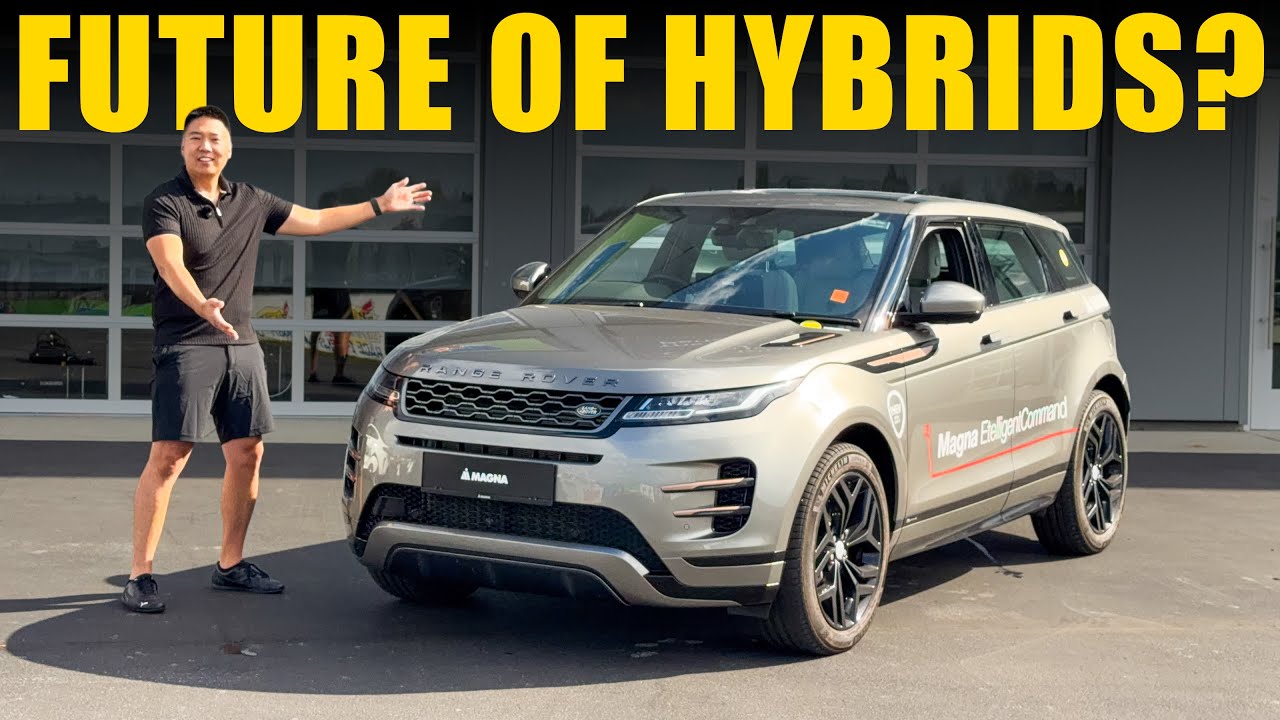
Currently in the automotive industry, we have a lot of different powertrain choices. You have your pure gasoline internal combustion options. You have hybrids, mild hybrids, conventional hybrids, plug-in hybrids, range extended electric vehicles, and pure EVs. And they all have their various pros and cons. But a realm where there’s a lot of potential for innovation is plug-in hybrid electric vehicles. They bring some pros from both sides of the spectrum. Today we are with Magna checking out this. It may look like a regular Range Rover Evoke, but under the skin, this is a test bed for various powertrain technologies. This has a little bit of everything. A gas engine. It’s got a dual clutch transmission, electric motor up front, electric motor in back, ability to do torque vectoring, lots of really cool tech. We’re going to get up close with a subject matter expert. He’s going to show us some of the cool things, talk about what’s under the skin with this Magna Intelligent Command drivetrain demonstrator, and then we’re going to get to drive it and see what it’s like. So, we’ve hopped in the car with Will from Magna. What’s your role? I’m a program manager for North America. Well, you did a lot of the integration with this thing, right? Yeah, I’ve uh I’ve been involved a lot with the systems integration for our electrified products. So, a lot of the demonstrator vehicles that we make, um, I get the pleasure of calibrating, tuning, and, uh, you know, making sure that all of that hardware comes to fruition on the track, cuz there is quite a bit of complexity here with this demonstrator cuz it’s two electric motors, a 5-speed dual clutch transmission, a gas engine, and then all the control for everything and all of that. So, you want to give me the quick elevator pitch summary. What exactly are we in right now? Yeah, absolutely. It’s our version of what a plug-in hybrid electric vehicle could look like. Um, and what we’ve done is we’ve leveraged a few different technologies that we currently have today in the marketplace and combine them into maybe a different style approach that either, you know, the customers or, you know, everyday drivers may want to use or leverage um, for their needs. Some of those technologies include, as you mentioned, the dual clutch transmission. We’ve taken our base DCT and we’ve paired it with an electric motor, 120 kW to be exact, and we bolt it to the engine. And what that does is that allows us to drive either in a full ICE driving scenario as we’re used to today with a regular vehicle, more traditional vehicle, or we’re able to do a hybrid approach. So you could drive in pure EV operating mode, or you could do a blended strategy between the engine and um the electric motor, give you the best fuel efficiency or the best power depending on what you’re looking for. Some of the other technology in the rear of the vehicle, we’ve integrated an electric motor as well that actually has twin clutches to do torque vectoring. Okay? So, more sporty, gives you a dynamic benefit of actually getting around the track a little bit quicker and a little bit more efficiently um in an all-wheel drive based vehicle. Uh so, with all of that, we actually have to do all the software controls for the electric motor, the inverters, and then as you said as well, the the vehicle controls to do torque proportioning front to rear and then left to right with that torque vectoring axle in the rear. So, it’s it’s a quite a complex problem. That’s a lot cuz there’s no mechanical connection between the front and rear powertrain setups. No, it’s fully disconnected. So, you need to make sure that talks to each other and is happy. And then I want to dig in up front because the upfront is essentially a unit that you could throw into a vehicle in just a front-wheel drive application, right? Yeah. So, is there any instances where the ice engine, the gas engine can drive the wheels just on its own without the electric motor? Yeah, you can absolutely drive with just the ice because of these like two There’s a cool diagram. This actually really cool diagram with the two clutch packs right there. Right. Yeah. So, the two clutches here are meant to represent the DCT clutches and then you have a third clutch here which actually disconnects the engine. So, you can open this up and drive with just the electric motor through the gear train or you can close this and drive the ice uh through the gear train. And you can choose to spin the EM or you can choose not to. It depends on how you want to operate it. And then the ice engine can then charge the electric the charge everything up while you’re stationary or driving. Exactly. I can be stationary and charged with the electric motor in the engine or I can be driving on the road. Oh, that’s pretty cool. Yeah. So, we have it primarily set up so it drives in EM or EV mode the majority of the time just to benefit the end user of having the the better fuel efficiency or fuel economy of a hybrid vehicle. But it’s truly up to kind of the customer how we would want to tune this and set this up. Okay. Um, but it it shows really the technology in a number of different ways that it could be used. And as you were getting at, the flexibility to be able to charge while driving, charge while stationary, drive in a hybrid mode, drive in just an in mode, or drive in a pure EV drive mode is a really cool part of this technology. Let’s do some driving. Yeah, absolutely. So, this is definitely intended for more performancey applications, right? That’s the problem. Yeah, this is set up to be more of a performance vehicle, hence the helmets. And we’re going on a racetrack. And you’ll also note that uh I’m not driving and I’m sitting on the left side. So, this this clearly came from the UK. This vehicle is a right-hand drive Range Rover Evoke. Yeah, it throws you off a little bit, but um we’ve been able to develop global powertrain solutions that kind of fit all different markets. So, we really look at the European market, the Asia-Pacific market, and then the North American market as well. Um so, you have to be able to adapt to all different types of driving uh vehicles and chassis. Okay. Total combined output between electric motor up front, which is 120 kW, 160 in the back, and then the gas engine. What’s the total system output you guys are estimating? Yeah, we have about 5,000 Nm on the front axle because that’s one powertrain. And that is the engine and the e- motor combined. And then in the rear, we have about 3,700 new meters to the rear. All right. What is that in like freedom units? Like we’ll have to do the conversion afterwards. I’m going to focus on the driving. It’s it’s it’s a lot. It’s like once you convert the kilowatt itself to power, I mean, it’s over 500 horsepower. So, we’ll use a combination of ice and EM uh here. So, we’ll use the electric motors and the gas engine to do the acceleration during the hard launches. When you start to, you know, throttle down and we’re coasting down into a turn here, we’re actually just regenerating through the electric motors, okay, to add back into the battery. There’s no need to have the ice connected to the wheels there. And we can do that very quickly with the different uh uh clutches in that DCT transmission. For the clutches in the back, for the torque factoring for the electric motor, you can send a substantial amount of power to just an indiv individual wheel, right? Yeah. So, as we come through this turn, it’s a left-hand turn here. We’re loading up that uh right rear tire. I’m going to send more torque to that right rear tire via those clutches to help steer the car naturally around that corner. It’s going to be less aggressive feedback on your steering wheel. Your front end’s not going to slide or walk out on you. Um, and you can really use the dynamics um of the vehicle itself to help benefit that that turnin performance. It’s a lot better than brake based ones, too, right? It’s true sending the torque to the outer one. It is true torque factoring. Absolutely. All right. So, here’s a question. How does this system compare? And why did you guys go for this versus like a range extended powertrain? Cuz that’s seemingly becoming a little more popular where you just have the electric motors driving the wheels all the time and an engine acting as a generator. Yeah, it’s definitely an important technology um that I I think we see in the market today and and maybe where the market’s even going. But with the benefit of this system, we’re able to focus on a performance driving aspect. We’re able to get some charging performance out of the EM while we’re driving and then we can also use the ice engine to power the wheels if let’s say you’re out of your battery and you’re going on a long road trip. I see. So you get the benefit of all three different systems kind of in one here and this is in an approach that we haven’t really seen, right? We haven’t really seen that 400vt DCT platform that has serial and parallel operating modes to it. So, we wanted to be able to give the best possible options um without limiting ourselves to one type of style of system. Okay. From a efficiency standpoint, this thing has a 20 well 20-ish kilowatt hour battery pack. Yeah, it’s it’s 21 kWh usable, so it’s slightly sler than that. It’s a prototype battery pack, but we’ve been able to demonstrate the performance of this because it has enough output, but it also has enough range that we can get 110 km of all electric driving range, which is about 70 mi. Yep. about 70 mi all EV and then if you need more it just engine kicks in or if you are commuting less than that you can just simply plug it in and keep going. Oh, a little bit of sideways. You can feel the rear a little bit. Yeah. Allows you to get out just enough to give you that sporting driving event. The rear kicks out a little bit but not so much that you feel out of control after what do you say we let you get in the driver seat? Yeah, we’re on a racetrack. I want to try this thing out. So this whole time you’re driving the DCT transmission is shifting in that background. And we’re running through a number of different gears and it should be seamless. You should never really feel feel a gear shift. You get that smooth, consistent, fast shift that we come to know and love out of dual clutch technology. So, it’s a five-speed, which is interesting choice because, you know, everybody’s just born and more and more speeds for example, like you got nine speeds, 10 speeds now, right? Why five? Yeah, five is the magic number here. One, because of packaging, but two because we can uh we can optimize the um the gear ratios. Okay. to give you that low-end torque performance and acceleration based on the EM and the engine. And then your top speed requirement will also um you know, you can still hit that with an optimized fifth gear ratio. So interesting. It’s kind of the right spread with the right technology. And then removing those two gears from let’s say a traditional, you know, seven-speed DCT allows you to package that EM uh in the transmission a lot better. All right, we’re on a track and a right-hand drive Range Rover Evoke, which is not something I ever expected to do. Does take a second to get used to like where you’re positioning the car when you’re in right-hand drive. Makes your entries into the corners just a little bit different. Like, oh, I’m closer to the apex than I’m used to. But honestly, this thing feels extremely nice. Yeah, it gives you the kind of comfort and uh confidence that you can take all of these cur, you know, curves and turns at the speed you’re really going at without feeling like you’re going to get out of control. It’s pretty quick, too. Yeah. 147 kW engine, 120 kW transmission, and 160 kW rear axle. Get this thing going pretty quick. Oh, is that top speed? Are we limited to 135 km? Yeah, we’ve software limited the vehicle to 135 to the prototype. Uh, okay, that does make sense. But it was very quick getting up to that speed. And Magna does some really cool stuff. If you’re not familiar, there was a Ferrari 12 Chelindri, the Dodichi Chelindri, and a G580 because you guys developed the dual clutch for the Ferrari and the electric motors for the electric G Wagon, right? Yeah. Yep. We do both of those. So, that’s uh that’s some pretty good resume padding right there. Yeah. Magnets’s got a lot of history in a lot of different products, specifically four-wheel drive and all-wheel drive products, transmissions, and then components for other uh other applications of the vehicle. Um, just in the powertrain division alone. So, yeah, the number of cars that our technology touches is is uh quite diverse. Yep. And like this would see benefits in low mu like friction, low friction situations, right? Absolutely. So, we do a lot of our testing up in um you know, colder climate areas in the snow and in the ice to make sure that all of the powertrain components that we make are performing as expected or better than the customer would ever need in any situation. And living somewhere where we do in Michigan in the winter, that’s important. Yeah, all-wheel drive and four-wheel drive is a must for a lot of people in their everyday lives. Magna also has a system called DHD Duo that brings two electric motors for hybrid and plug-in hybrid applications. This is more for improving range and efficiency for mass market passenger cars and SUVs. It can also drive in full electric, serial, and parallel drive modes depending on the driving conditions and demands. It is designed to be scalable to different power levels and match different number of transmission gears. and it’s very packaging efficient, so it can be used on existing internal combustion engine platforms. In this video, you see how the electric motor is able to either do all the driving if there’s enough charge in the battery, get assistance from the engine when needed, and also do regen braking. While the intelligent command powertrain demonstrator is leaning much more towards performance applications, this DHD dual system is for those front-wheel drive based cars and SUVs that are prioritizing range and efficiency. These kinds of hybrid powertrains are definitely becoming more popular as an option that brings the best of both worlds between EVs and traditional internal combustion engines. Well, thank you so much for the experience getting to try it out and learn about the Magna Intelligent Command plug-in hybrid electric vehicle demonstrator. Yeah, thanks. Which is a little bit of a mouthful. Imagine that as an acronym. This was really cool. Hope you guys enjoyed this video learning a little bit about this system. We’ll see it in a future car probably at some point. We’ll see. Thanks for watching.
This video is sponsored by @MagnaInternationalTV
There are quite a lot of different powertrain options on the market today, ranging from your traditional internal combustion engines, to full electric, with various levels of combinations in between. Magna International is a huge automotive supplier with experience ranging from transmission development for the Ferrari 12Cilindri to the electric motors in the all electric Mercedes G-wagon. They see a future for plug-in hybrid technology with their EtelligentCommand PHEV system, which combines a gas engine, DCT, electric motors and a battery pack giving you tons of powertrain flexibility, torque vectoring, solid power output and plenty more benefits. Join me as we get the cool opportunity to meet one of the engineers behind this system and even try out their demonstrator vehicle on track!
Follow me on IG and FB at @eddiex616 to see daily posts and updates!
Instagram: https://www.instagram.com/eddiex616/
Facebook: https://www.facebook.com/EddieX616/
#hybridcars #technology #pluginhybrid