With rules shifting, Chinese-built Teslas next for ‘Full Self-Driving,’ gap may widen unless Hyundai speeds up
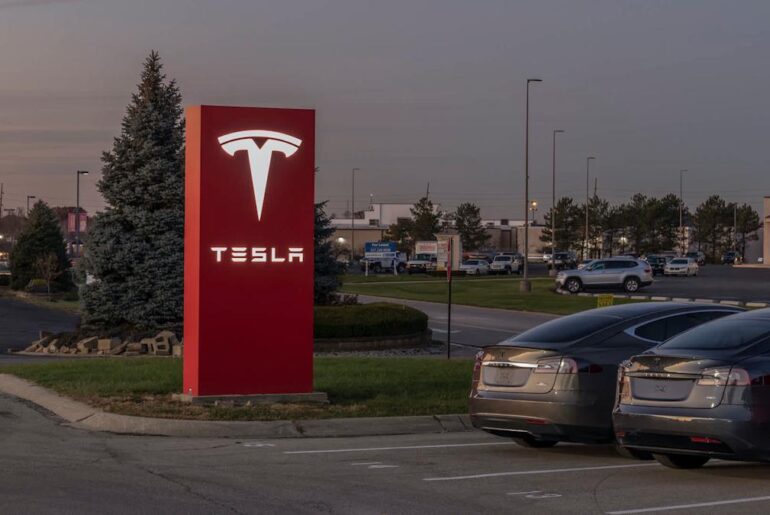
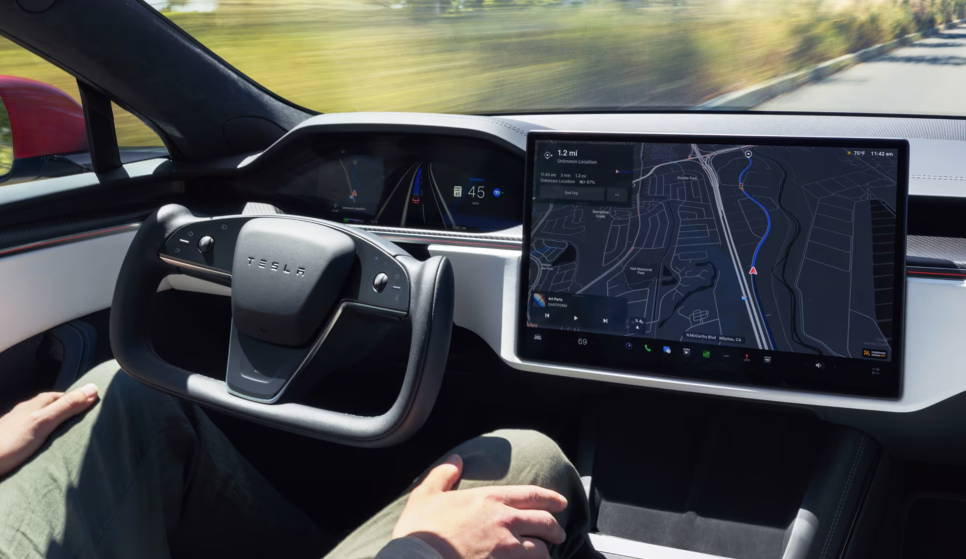 Tesla’s autonomous driving system in Model 3 (Tesla)
Tesla has begun rolling out its supervised “Full Self-Driving” system in South Korea, making the country the seventh market to gain access to the advanced driver-assistance feature — a capability not yet offered by Hyundai Motor Group or other local carmakers.
Industry concerns are mounting with the system arriving just as Korea-US trade revisions scrapped the 50,000-vehicle limit on US-made cars entering Korea under US safety standards. With that cap removed, Tesla now faces fewer regulatory hurdles than Hyundai, which must comply with Korea’s stricter rules — an uneven playing field that could accelerate consumer shifts toward Tesla and widen the gap with Hyundai in the autonomous-driving race.
Tesla’s FSD flexibility outpaces Hyundai
Tesla’s FSD is a Level 2 autonomous driving system, meaning drivers must stay attentive even as the vehicle handles steering, speed control, lane changes, route planning and parking. In the case of an accident, liability remains with the driver.
The feature is currently limited to US-built models equipped with Tesla’s HW4.0 platform — the refreshed Model S and Model X, as well as the Cybertruck. For this year’s buyers, that means barely 0.3 percent can use it. Of the 47,941 Teslas sold in Korea, 99.7 percent were made in China, with only 145 vehicles imported from the US.
So where does the imbalance arise for Hyundai Motor Group? Industry watchers say Tesla enjoys far greater expandability in its driver-assist functions because US-built vehicles can enter Korea under US safety standards and can add new Level 2 features via over-the-air updates without prior review by Korean regulators.
By contrast, Hyundai and Kia must follow Korea’s stricter safety framework, which imposes more detailed requirements on electronic control units and functional-safety validation — giving them far less flexibility than Tesla to leverage lower regulatory thresholds or push Level 2 as aggressively.
As a result, the Korean automaker has been taking a more cautious approach, advancing its Level 2 system step by step toward a Level 2+ capability by 2027 while preparing for Level 3 approval.
However, the recent resignation of Song Chang-hyeon, who was CEO of Hyundai’s self-driving subsidiary 42dot, has created a leadership vacuum that further clouds its autonomous-driving ambitions. On Thursday, Meritz Securities suggested that removing Song from Hyundai’s autonomous-driving road map reflects a strategic shift — the view that deepening its partnership with Nvidia, rather than pursuing fully independent smart-car development, may offer a faster path to closing the gap with Tesla.
According to Lee Ho-geun, a car engineering professor at Daeduk University, this widening gap could accelerate a shift in consumer loyalty toward Tesla. “Once Korean consumers start to view Tesla’s autonomous driving technology as clearly ahead of Hyundai and Kia, Tesla will gain a marketing lift that even hundreds of billions of won in advertising could never achieve,” Lee noted.
Unlocking FSD for Chinese-built Teslas
With the removal of the 50,000-vehicle cap, the regulatory barrier for US-built Teslas entering Korea has effectively come down. Although Tesla has so far supplied Korea primarily with China-made vehicles due to price advantages, there is the growing possibility the company will begin expanding exports of US-made models.
In the meantime, Teslas from China, which make up most of the EV maker’s sales in Korea and currently cannot activate the supervised FSD, may gain access to the system as early as 2027.
Korea’s Land Ministry is preparing to adopt the United Nations Economic Commission for Europe’s Driver Control Assist Systems regulation, which permits automated lane changes without manual turn-signal input while requiring continuous driver monitoring. Once DCAS is integrated into Korea’s safety framework — likely after the two-year transition period — Chinese-built Teslas following UNECE standards would be able to use the same supervised FSD features now limited to US-built models.
Lee noted, “With China-made Teslas likely gaining supervised FSD by 2027 — around the time Hyundai and Kia plan to debut their Level 2+ systems — the Korean automakers will need to offer consumers a more compelling driver-assist experience before Tesla extends its lead.”
hyejin2@heraldcorp.com