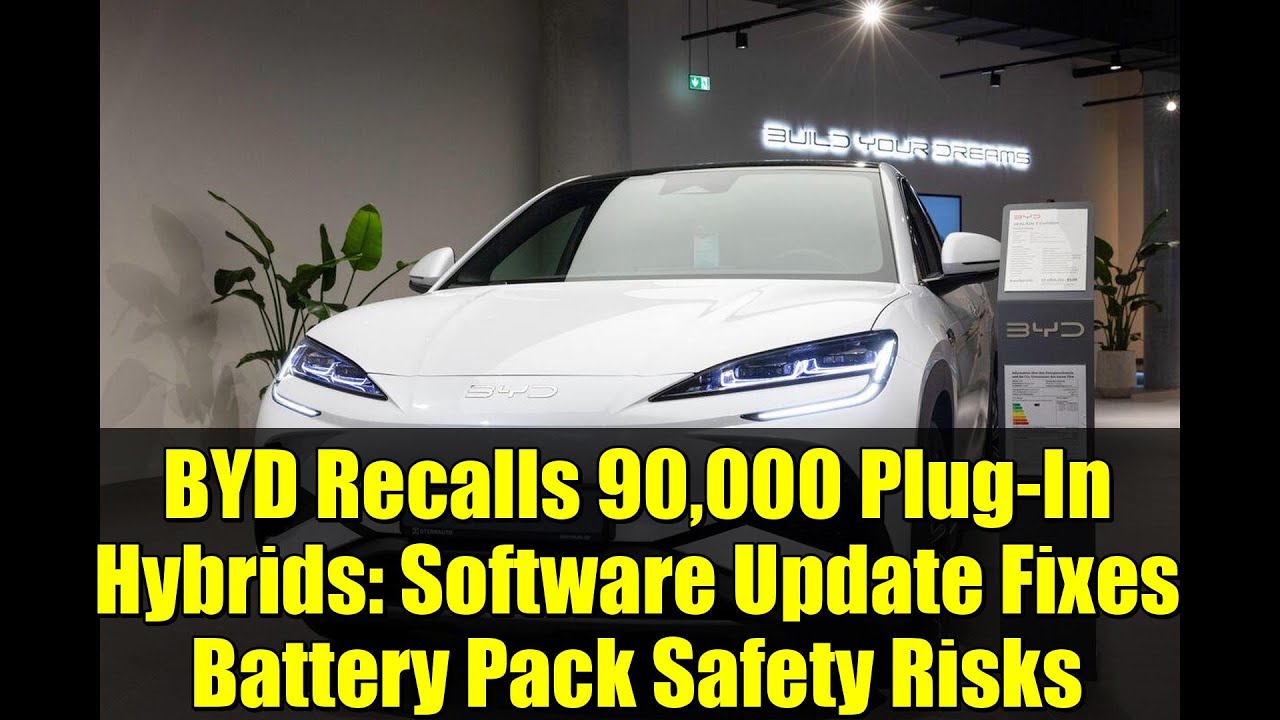
BYD Recalls 90,000 Plug-In Hybrids: Software Update Fixes Battery Pack Safety Risks
Imagine driving your brand new eco-friendly hybrid only to discover there’s a potential safety flaw lurking in its battery. That’s the reality for nearly 90,000 BYD owners in China. Here’s the story. BYD, the Chinese automotive giant. You can check out their stock performance here. https/www.bloomberg.com/quote Bloomberg.com/quote1211HK is rolling out a crucial software update for a massive number of their plug-in hybrid vehicles. This isn’t just a minor tweak. It’s a response to concerns raised by China’s national regulator regarding potential safety risks associated with manufacturing defects in the battery packs. Think of it like a vital patch for your car’s brain to prevent unforeseen issues. The recall or rather proactive software update affects a significant 88,981 sheen plus DMI sedan models. These vehicles were manufactured between January 2021 and September 2023. That’s a pretty broad time frame indicating the potential issue might stem from a specific manufacturing process or component used during that period. The official statement from the state administration for market regulation available here. https colon/www.samar.govcnzw/h/art/2025/art_94d gov cnzw/hart/2025/art_94 d5b 59 d5 4 c 4420 by 386 c 463 c9 717 html details the specifics the action was prompted by a formal investigation launched by Chinese authorities this underscores the seriousness with which regulators are taking electric vehicle safety, especially as the market rapidly expands. It’s not just about performance. It’s about ensuring consumer confidence and preventing potential hazards. So, what exactly is the problem? While the official statements don’t delve into the precise technical details of the battery pack defect, the software update likely aims to mitigate the risks. This could involve adjusting battery management system parameters such as voltage limits, charging rates, or temperature thresholds to prevent overheating, or other potentially dangerous scenarios. But here’s where it gets controversial. Some industry experts argue that a software fix might not be a complete solution for a hardware defect. Could this update merely be a temporary band-aid? Or is it a comprehensive fix that addresses the root cause of the issue? This is a critical question for affected owners and the broader EV community. What happens if the software update doesn’t fully eliminate the risk? And this is the part most people miss. This incident highlights the increasing complexity of modern vehicles and the reliance on software to manage critical components like battery packs. It also raises questions about the long-term reliability and safety of electric vehicle technology, especially as manufacturers push the boundaries of performance and range. What are your thoughts on the situation? Do you believe a software update is sufficient to address a potential hardware defect in a battery pack? Should BYD offer additional guarantees or hardware replacements to affected owners? Let us know what you think in the comments below.
BYD plug-in hybrids battery pack update safety recall China
ev vehicles software fix manufacturing defects
BYD Co. is pushing a software update to nearly 90,000 plug-in hybrid vehicles in China after regulators identified manufacturing defects in battery packs that pose safety risks.
The recall affects Qin Plus DM-i sedans produced between January 2021 and September 2023.
This action follows an investigation by Chinese authorities into the battery pack issues.
Watch for details on the update process and what it means for EV safety standards.
Byd news electric cars hybrid vehicles recall