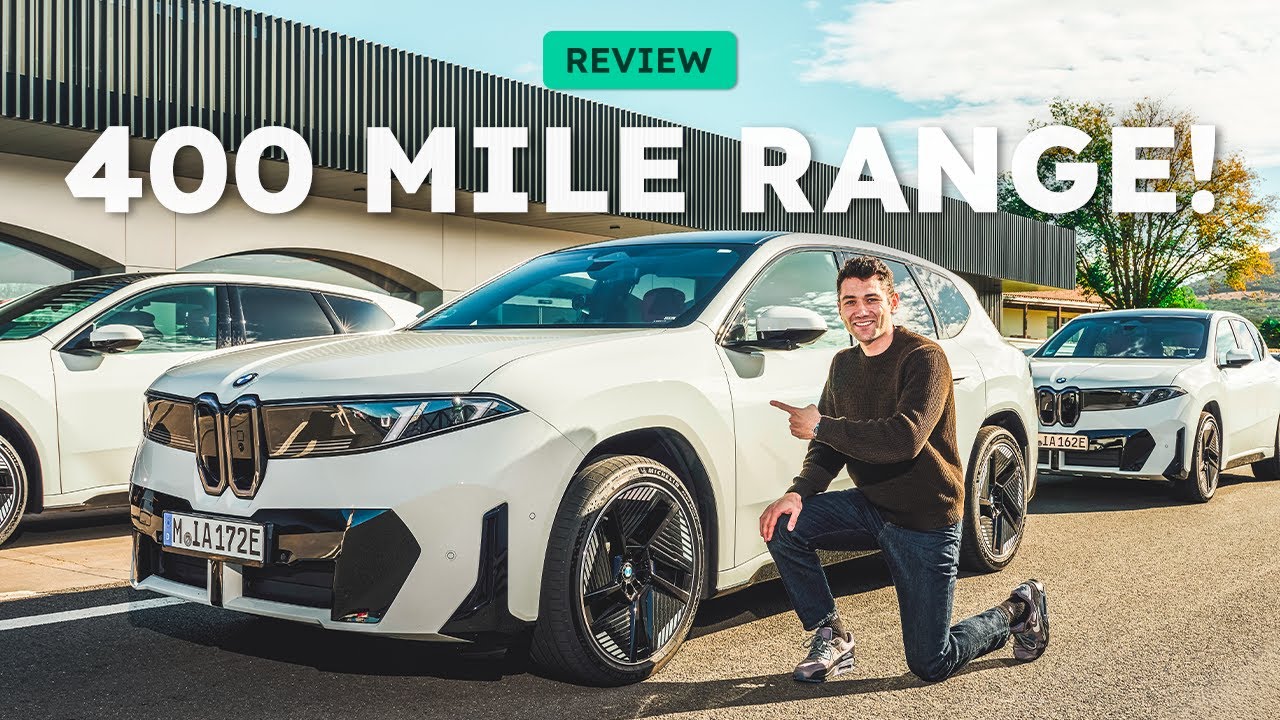
We Drove The BMW iX3: It’s BMW’s Best Electric Car Ever | Review
This is the EX-3 and it is BMW’s most important EV ever. It’s a groundup rethink of how the company makes electric cars with better batteries, more range, faster charging times, more powerful software, and a stunning new screen setup. In short, this is the most advanced electric car BMW has ever made. But how does it actually work on the road? And can it hang with those aggressive competitors like Tesla, Rivian, and the Chinese? Stick around. Let me show you everything that is special about the BMW i3. [Music] [Music] BMW has been quietly crushing the EV game with its lineup of the i4, i5, i7, and iix. But the i3 is a different beast. Most of those current EVs were designed around existing combustion platforms. This was developed from scratch to be electric and it’s the first vehicle on BMW’s latest Noya Classic technology platform. Over time, there will be a bunch of Noya Classic EVs, including a 3 series sedan, but this is the first, and it’s a real shot across the bow at the whole EV industry. 400 m of estimated range in an all-wheel drive SUV puts it right up there with the best of the best in the US. There just aren’t a lot of EVs that can do that. 400 kW charging is more power than most EV chargers can even manage, and that too puts the EX-3 in a very small club. The EX-3 will be BMW’s first EV that operates at 800 volts instead of the more typical 400, which makes it lighter, more efficient, and boosts charging speeds. BMW has been developing the next generation Noya Classic cars for years, electric vehicles that are supposed to put it on the same level as Rivian, Tesla, and the Chinese. Now we finally get to see if it was worth the wait. All right, so before we get into anything else, we should talk a little bit about what this car looks like, the styling of the EX-3, because this is what BMWs are going to look like going forward. So like it or not, get used to this. Up front here, we have kind of the classic BMW design elements. You have the kidney grill and you have the dual twin headlights up here, but just kind of a more futuristic and sort of newer take on this for the EX-3. I wasn’t quite sure what to think about it from the press photos, but after looking at it in person, I think this is a really good looking BMW. So, from the side profile here, it really has almost a wagon look. You know, it’s low roof line, long, and that’s kind of the way a lot of electric SUVs are going these days. you know, kind of like a Lucid Gravity or some of these other vehicles that are really not tall crossovers anymore. They’re long and low for aerodynamics. Another thing that helps aerodynamics on this car is going to be these flush mounted door handles, which should help air go by just a little bit easier and give it more range. And as we’ve discussed, the BMW EX-3 does have a lot of range. And I think the back profile is actually probably one of the best looking angles of this car. It gives a lot of ex, you know, BMW’s existing electric SUV with these big side hunches and kind of the way that the roof line slopes up in the back. And one thing I really like, or at least that is definitely really interesting, is the treatment on these tail lights. This is a totally new look and I think really forward-thinking design from BMW. [Music] All right, so here we are in the inside of the EX-3 and it is a really nice place to spend time in. We’re in the kind of upper trim Model and the interior finishes in here are really nice. There’s lots of nice leather and suedelike material. Overall, the quality in here is exactly what you’d expect from a BMW. We’ve got this really interestingly shaped steering wheel over here. There’s only two spokes. These kind of notches for your thumbs. You’ve got a very interestingly shaped infotainment screen, wireless charging pads, you’ve got USBC ports, and you’ve even got a little extra cubby under here for your bags below the uh center armrest. So, this is kind of like the sporty design package that you get on this car. That’s why the seats have this really aggressive bolstering and they look sporty. They have the M logo on there. If you get one of the more entry trim or non-M cars, it’ll look a little bit different in here. So, I think one of the kind of standout elements in this car, the kind of centerpiece of the EX-3’s interior is obviously this screen. It is this interesting tilted parallelogram shape that is actually nice because it puts some of these functions that you actually want while you’re driving sort of closer to your right hand. This is BMW’s new infotainment system. It’s called OSX and it works really well. Super responsive to touches and to swipes and taps. As you can see, it really feels like a big step up from what you got in cars like the i4, i5, and iix. There’s not that many buttons in here. There is the drive mode selector and there is the defroster, which kind of makes sense because you might want to hit that really quickly if your windshield starts fogging up. But basically everything else, everything that is not in this little section over here by your right hand or on the steering wheel is in the screen. And that includes the climate control. A lot of people may not love this. I personally don’t love it either, but I do think it’s something that we’re going to have to get used to as screens get bigger and as car companies try to put more and more stuff in the infotainment screen. And a lot of that stuff is actually really cool. One example of that in this car is this little strip of screen that you see at the bottom of the windshield. It is something that’s completely new to BMWs and that you won’t find in other EVs, but this is something that’s going to come to other future BMW vehicles. And I think it’s really, really cool. It is basically showing you all of your basic information that you want, plus some customizable widgets right in your line of sight. So, you can be driving, you can basically be looking at the road, and you just glance down a couple of inches, and you see these widgets that you program to be up there. So, if you scroll down from the top, you hit panoramic vision display. And from here, you can customize what goes into that screen. You hit configure. And from here, you have this really nice interface for putting whatever you want in the panoramic display. So, you can delete things if you want just that kind of really simple look. You don’t want to maybe be distracted by too many things. or you can drag and drop from all these different icons. There are a lot more interesting features in BMW’s new panoramic iDrive system that we couldn’t get into today. So, if you want to learn more, go check out our deep dive video with Patrick George. All right, so let’s check out the back seat of the EX-3. For reference, I am a little over 6 ft. I’m sitting behind my personal driving position, and I’ve got plenty of room back here. As you can see, I’ve got a few inches between my knees and the back seat. I’ve got good amount of headroom. And overall, there’s a lot of space back here. One thing that I notice that stands out to me is you have a mostly flat floor in the back seats, which even makes the middle seat probably pretty habitable for adults. That’s different from BMW’s older EVs based on these combustion vehicle platforms. And so, they had a big hump down there even though they didn’t really need it. There was no transmission to put down there. So, this is a really nice feature to see in BMW’s groundup EX-3. Another great thing about building your EV from the ground up is that the EX-3 actually gets a pretty sizable frunk. This is something that its previous cars didn’t really have, and it’s nice to see in the EX-3. And you get a little bit of space down here to put your groceries or whatever you want to keep under the hood. So, with that, now that we’ve taken a look at the EX-3’s exterior, all around its interior and its frunk, let’s go take this thing for a drive. And this wasn’t just a normal drive. BMW arranged the legendary Ascari circuit for us to drive on. This is going to be some fun. So, we’ll see um how this car handles when you really push it to its limits. [Music] [Music] Emergency braking maneuver. Going to launch, then slam the brakes, change lanes. [Music] All right, there we go. Obviously, most people who buy the EX-3 a midsize family crossover probably aren’t going to buy it for its ontrack performance, but it’s good to know that this thing can handle quite well when you push it hard, like during an emergency break and lane change, which people might actually do in the real world. With the extreme tests out of the way, it was time to drive the EX-3 the way most people will on public roads. The way that this car drives is really impressive. I think what might even be more impressive than that is the way that it stops. And we’ll try to find a little bit of road up here somewhere when there’s no cars behind us. And I can show you that because BMW basically says that this is the smoothest stopping car it’s ever made. And I don’t know, you see that in the press release and you kind of assume, yeah, okay, whatever, BMW, right? But it is actually extremely impressive. You come to a stop and you just do not feel a thing. I think if you had your eyes closed, you maybe wouldn’t tell that it was stopping at all. I’m at uh 50s something km/h, whatever that is. And I’m just going to let off. And just like that, we’re at a stop. It kind of never gets old. You don’t feel any of that little head jerk. You know, even in the smoothest braking, even if you try really really hard or in a really smooth uh regen setup at the very end, you still get that little head jerk that tells you you stopped in this. There’s absolutely none of that. I got a little stretch of road here. I’m going to do a little uh acceleration test. Why not? All right, launch control active. I’m gonna let it go. And there’s a 100. So yeah, this I mean I think for almost anybody in the world that is going to feel really really quick. I think if you do compare this to some of the other very sporty electric cars out there. It doesn’t have that same like absolute gutwrenching, gut punchy acceleration that you get. I think this does 0 to 60 in a little under 5 seconds, but um that was still pretty quick and also very smooth. Yeah. So, one thing I wanted to talk about is the adaptive cruise control. Now that I’ve had some time to drive this on the highway, it’s really, really good. I’m in that hands-free mode right now, which they call pro, and it is pretty much just locked in. It responds to cars cutting in front of you really well. One of the coolest features of this is the fact that so in a normal adaptive cruise mode, if you just barely tap the brakes, it’ll knock you out of it completely. You have to reset. And this is kind of annoying because a lot of the time when you do that, it’s just because somebody’s merging onto the highway. And all you want to do is just just um just adjust a little bit. And this lets you do that without knocking you out. So you can see I’m in about 120 km an hour right now. And I’m hitting the brakes right now. We’re going down, down, down, down. That doesn’t knock me out. And then you let go and it just brings you right back up to speed, which is a super great feature from BMW, I think. Overall, it is really, really smooth. Really, really comfortable. Right now, I’m in the personal mode, which is basically your your basic comfort mode. And I am super impressed with the way that this suspension just soaks up basically anything you throw at it. you know, we hit cobblestones, big speed bumps, um all sorts of different roads, and it has just been really, really comfortable the entire time. Most EVs big and heavy and sort of lumbering even when kind of the car company claims that you can drive them um you know, in a sporty way. And this really does live up to that. It feels lighter than it is. It feels super agile around these turns. um you feel super confident just placing it on the road. If you put it in sport mode, the steering just kind of stiffens up a little bit. It’s not that kind of overly weighted artificial feeling you get in some other sport modes and other cars. And overall, yeah, just like in both everyday situations, driving around town and also if you want to push a little harder, the EX3 has been performing really, really well today. Yeah. Yeah. So according to BMW, the reason that this car drives so well is something that it calls the heart of joy. So what is the heart of joy? Basically this car, this first Noia classic car that BMW has made is on this completely new platform, this new architecture and this new importantly electronics and computing platform. So instead of hundreds of different ECUs that are controlling all these different functions of the car like you’d get in a traditional car, uh this car uses the new, you know, the new buzzword technology, right? A zonal architecture. So in place of all of those different little computers that do different tasks is a handful of very very powerful what it calls super brains. One of those is the heart of joy and this is what handles the driving dynamics. So, it takes the steering, uh, braking system, stability control, all those things, all of that now is handled by one central computer and that is why this car drives the way it does. Sure. So, the EX-3 drives well, as any new BMW should, but how good is it as an EV? The EX-3 is a beast in terms of both range and charging power thanks to BMW’s sixth generation battery technology. There are a few major upgrades on that front and I asked Philip from the BMW battery team to talk us through what’s new. All right. I mean there three big differences. The first I hold in my hands now. That’s the round cell. The BMW round cell. The cylindrical format 46 mm in diameter, 95 mm in height. And that’s the the core of our BMW Gen 6 high voltage battery. In EVs there are three main shapes of battery cells. Prismatic pouch and this one cylindrical. Previous BMWs used prismatic cells, which are basically like rectangular boxes, and it’s not really a question of which one is better overall. As Philip explains, I can I think you cannot say what’s what’s better, but it’s it’s always depending on what you want to achieve. And what we wanted to achieve in our EX-3 is having the most range and the best charging and at the same time perfect longevity and perfect safety for our customers. What came out is this battery cell with an 20% increased energy density if you compare it to Gen 5. So, the EX-3 is a range monster, thanks in part to its new cylindrical cells. Their large size means BMW can pack more energy into each one. What’s also really key here is how those cells are installed in the pack. Instead of using modules, basically subasssemblies within the pack, BMW is putting the cells straight into the pack. That means there’s less weight, less structure taking up space, and ultimately a lighter, more efficiently packaged battery. We don’t only use those cells, but we put those cells with a we call it cellto pack approach. So we put them directly into the casing of the battery. So we just stack them next to each other cell by cell. Then we have cell rows and then we put rows after row after row into the car. And with that we get this really high energy density. What’s also notable is how the pack itself is mounted. It’s a structural component of the vehicle which is becoming more and more popular in EV design. We are mounting the battery directly from below underneath the car. So if you look into the car and there’s no battery inside, you can basically see the floor. Yes. The battery is literally the floor of the car. And then we mount the battery directly from underneath and put the um the floor mat. Yeah. The floor on top um and the seats on top. So it’s perfectly integrated into the overall vehicle. And with that, we can achieve a lot more sporty silhouette of the car because it’s it’s um not that high. Um, and you save weight, you save cost, and has many big advantages. And therefore, we aimed for that cell to open pack approach. And this might seem simple, but BMW hasn’t done it before. That’s because with a car platform that can be used for engines or electric vehicles, they can’t build it without a floor. A clean sheet EVON design makes the structural pack possible. And everything comes together in the Energy Master, a new battery and power management unit that’s completely developed and built inhouse. It also gets installed in the car in a smarter way than before. In Gen 5, we had the the electrics, electronics, all these components, the battery management unit directly inside of the battery. So, if you want to take it out, you have to open the battery up, you have to take it out, you have to exchange parts, and then you have to close it again and mount it again underneath the car. Now, you can completely do it just in service. Yeah. If you go to uh to your workshop and you want you have you have some issues or whatever, then you can directly do it via the rear seats. So, you can just take out the rear seats. You can go to the to the energy master, take things out, exchange whatever you want to do, and then close it, but without taking the whole battery out. But a long range EV isn’t worth much if you can’t charge it quickly. In the EX-3, you can expect to add 175 mi of EPA range in just 10 minutes. That has to do with a lot more than batteries. As Leonard Lanka from BMW’s charging team explains, you have to improve a whole system like cooling for those high charging powers. You have to design the whole wiring harness um or charging socket to make it robust uh that it works under all conditions like hot and cold temperatures. And of course speaking about cold temperatures uh the preconditioning of the battery gets even more intuitive with the new system here. But when it comes to charging the 800 W architecture helps us very much to charge at very high powers. So we don’t need excessive currents for this. So helps us charging up to 400 kW. So when it comes to long distance travel, so we can like travel at the same speed as with a fuel powered car. So we don’t have longer charging stops. So we can drive very fast. We can make really great road trips with this charging experience. That is if you can find a charger and that charger is working properly. As we know, that’s not always so simple. But BMW has thought of that too. We can do the road planning already before we starting the trip. So, and we’re bringing even new features like the AI based correction layer. So, if you have inaccurate positioning of the chargers, so we know exactly where cars are charging. So, we are correcting the position. So, on an AI based algorithm so that uh also older cars are getting even more precise routting. So, you no longer have to look very long for a charger because maybe it’s inaccurate in the map. Yeah. So that’s um making it more convenient if you’re in an area where you’re not so used to the charging infrastructure. Yeah. And also like when we’re talking about long distance travel. So sometimes there are chargers uh that are maybe rated at a 300 350 kW system but in real life uh due to many reasons they don’t perform as advertised. So we are having a power learning here. So also we’re collecting data from the cars and uh we will show the customer the highest power ever seen on different charge uh points. So this makes it uh more easy to plan is this a really good charger or is it maybe not such a good idea to charge there? Yeah. And so does that mean in the app you’ll see okay you’ll see some information about that charger maybe a warning. You do also see that in the infotainment system if you’re just routing to a charger from the screen here. Yeah. And there’s another layer to the EX-3’s charging capability. This is BMW’s first car with birectional charging. That means it can output power via its charging port to power your home, for example. That’s actually a pretty big power bank here in your car that you can use. So like uh when you’re at home, so let’s talk about the energy storage use case first. Yeah. So uh you can connect your car with the BMW Warox Professional. So that will be the new Warbox we’re introducing. And that’s a DC war box and it’s able to feed back power to your home or also to your grid. And um if you like have a use case with um a PV installation, you charge your car during daytime and you discharge your car when the sun is shining. so that you can use the battery in your car and you can also control of course uh what’s the lowest SU so you can set your uh remaining range so that the car is always making sure that you have um enough range uh on the go and you can also set your departure time when the car should be charged to a um yeah level you can set the level to whatever you want so for the US we’re talking about the 19.2 2 kW rated wall box. So you can charge and also discharge with the 19.2 kW. So that’s pretty much uh power for powering uh your house for powering uh heating systems, air conditioning. So um that’s pretty much power of course. Yeah. Yeah. So and also if you have a blackout situation, so for us and Canada specific, we are having this blackout function that you can also power your house uh when there’s a a shortage. So when uh yeah you have a blackout your car helps you to power up your house. So that’s also uh I think especially for some regions in US is a very important feature. If you don’t need that much power or don’t want to buy a whole DC charging system for your garage, you can also choose a simpler setup. BMW is offering a whole menu of birectional charging adapters that let you plug in appliances or gadgets like when you’re out camping or tailgating. So uh we have a multi-function charger so that we also introduce um with the car. So um you have different adapters that you can connect to it. So starting with um our blackout scenario, we have a vehicle to home adapter that you can still power your home with 3.6 kilowatt. So a little uh less power, but in a blackout scenario, you can at least feed everything that you need like a fridge or lights. We have also uh the adapter for the glamping use case. So you have three power sockets. So and also 3.6 kW available here. So makes it a very good travel companion. So if you think about glamping, if you think about some electric espresso cooker or whatever you want to use with this. So and you have lots of energy for staying for a very long time um on the power of the car. Last but not least, BMW gave the EX-3 an AI charging flap, which should make one-handed charging possible. If you route to a charger in the navigation, the car knows that and the flap will open. If you charge at home, the car knows that, too, and the flap will also open. But how does the car know when to open it? We have to recognize when the driver really wants to charge or when he just wants to open the door or something. So that’s why we’re using an AA based algorithm. So we know exactly where the driver is moving around the car and when he’s approaching the charging flap then we recognizes and then we open just in this time the charging flap. So and you can charge one hand operation you don’t have to hle with charging flap. So doing it everything automatically. [Music] So there you have it. The EX3 is a very very impressive electric car. It is definitely the best EV that BMW has ever made. The big question is, will it sell? This thing goes on sale in the US next summer and it starts at around $60,000 and there’s good news and bad news about that. The bad news is that that is several thousand more than a gas powered X3. The good news is that’s less than a BMW iX and you get the very latest in BMW design and technology. Of course, this car launches into a very uncertain time for EVs in America. There’s no more $7,500 tax credit, which would have gone a long way to making this competitive with combustion powered vehicles. Regardless, it is really, really nice to see BMW sticking to its guns and putting out a really special EV. I think the super fast charging, that long range, that really cool infotainment system, and the way this thing drives could really convince a lot of people to ditch gasoline or even trade in their Teslas. All right, that’s the video. Thanks so much for watching. Make sure to subscribe to the Inside EVs YouTube channel, like this video, and let us know in the comments, would you buy the BMW EX-3? See you next time.
BMW’s best electric SUV ever is launching at a weird time for EVs in America. But can it overcome the EV slowdown?
With 400 miles of range, ultra-fast 400 kilowatt charging and a whole bunch of new tech, the 2027 BMW iX3 has a great shot at success. Plus, as we learned when we spent some time with the iX3 in Spain last month, it delivers in real life too. It drives well, has incredibly smooth regenerative braking, and features an impressive new screen setup called the Panoramic Vision Display.
Follow along as Senior Editor Tim Levin takes you on a tour of the iX3, drives it on track and on the road, and interviews BMW engineering experts about the new SUV’s batteries and charging system.
Read more on our site here: https://insideevs.com/reviews/780771/bmw-ix3-review-first-drive/
Sign up for InsideEV’s Newsletter to get our content sent straight to your inbox:
https://www.insideEVs.com/newsletter/
00:00 – Introduction
01:57 – BMW iX3 Exterior Design
03:45 – BMW iX3 Interior Design
04:45 – BMW iX3 Panoramic Vision Display
07:10 – BMW iX3 Rear Legroom
07:55 – BMW iX3 Frunk
08:23 – BMW iX3 Track Review
09:37 – BMW iX3 Driving Review
15:01 – BMW iX3 Battery Technology
18:25 – BMW iX3 Charging
21:09 – BMW iX3 Bidirectional Charging
24:01 – BMW iX3 Ai Charging Flap
Follow InsideEVs at:
https://www.instagram.com/insideevscom/
https://www.facebook.com/InsideeVs
https://x.com/insideEVs
https://www.insideEVs.com/newsletter/