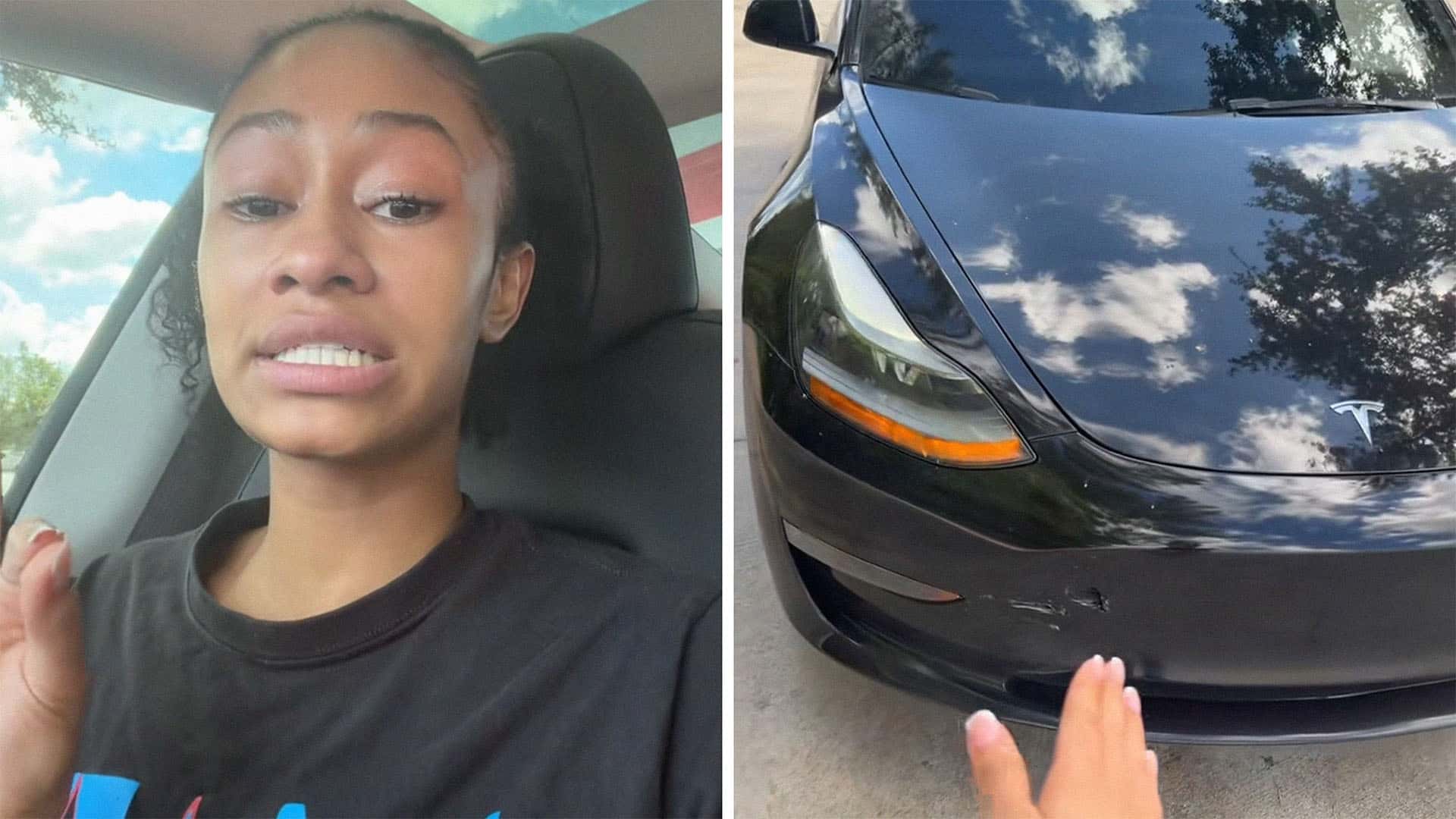
Trust is everything in an electric vehicle—until the moment it isn’t. A TikTok clip now spreading across social media shows the aftermath of a Tesla that rolled forward into a tow truck even as its driver insisted she was braking hard. What happened in those few seconds is now driving an increasingly tense debate over how much control Tesla owners really have when something goes wrong.
The clip from Tesla owner Brooke (@happygirl1080) captures her moments after the incident, when her electric vehicle decided to be insubordinate and act autonomously, pulling forward while stopped in a turn lane. And the only thing that stopped the misbehaving Tesla was the tow truck, which also stopped in the turn lane, causing a sizable dent and scratches on the front of the car.
“I’m jamming on my brakes. Nothing’s happening,” a visibly flustered and shaken Brooke said in the clip that’s been viewed more than 20,000 times. “I could have really [expletive] died. This could have been something really bad.”
As the video circulated, the comments quickly revealed just how polarized conversations about Tesla have become. Some blamed Brooke outright, with one person accusing her of “trusting a computer full electric car.” Another sneered that Tesla owners “want the status symbol and never do the research.”
But others pushed back just as hard. “Girl, how is it her fault the car don’t do what it said?” one user wrote, while another reminded critics that most buyers aren’t software engineers: “Not everyone knows how they really run. Blame these big companies. They leave important things like this out.”
One commenter cited the 2023 Netflix film Leave the World Behind as supposed evidence that Teslas could be hijacked, echoing a broader wave of misinformation around EV cybersecurity. In reality, there is no documented case of Teslas being remotely taken over by malicious actors in the wild, and the automaker remains one of the most frequently scrutinized targets for industry security testing.
Meanwhile, pragmatic voices chimed in with their own theories. One commenter proposed that the car may have lost power, a scenario in which a Tesla can still display lights and screens while the high-voltage system shuts down, reducing brake assist. Others wondered whether the vehicle had creep mode enabled, though that setting does not override firm brake input.
Viral stories from across the web
Our team of experts tracks what owners are saying about car-shopping, repairs, the daily driving experience and more on social media.
What Could Cause An EV To Move While Braking?
Tesla vehicles use an electronic brake booster rather than a traditional vacuum system. If the booster loses power, whether due to a low-voltage issue, a software fault or an internal sensor error, the brake pedal may feel stiff and provide reduced stopping force. Tesla addressed a related concern in 2022, issuing a recall of more than 53,000 vehicles for potential issues with brake actuator calibration.
There have also been documented instances in which Teslas temporarily lose power or enter “limp mode,” including several NHTSA complaints describing reduced braking with no warning.
Those cases remain rare relative to Tesla’s overall fleet, but they’ve prompted federal scrutiny. The National Highway Traffic Safety Administration recently directed Tesla to recall more than 2 million vehicles to improve Autopilot driver-monitoring safeguards, citing risks associated with users assuming systems are engaged when they may not be.
Unintended acceleration, a frequent allegation against Tesla, has been the subject of repeated federal investigation. According to NHTSA’s 2021 analysis, the agency “did not identify evidence of any fault” that would cause acceleration without pedal input, instead attributing most cases to pedal misapplication.
But a low-speed, low-energy roll like the one in Brooke’s video is a different category, one the public tends to misunderstand. EVs rely on layered systems including regenerative braking, electronic brake assist and friction brakes. If any element in that chain fails or deactivates, stopping distances can increase, especially at crawling speeds where regen braking is minimal.
Without access to Brooke’s vehicle logs, which Tesla continuously records, there’s no way to know whether this incident stems from a component failure, software behavior, or something as straightforward as the car entering low-power mode. Tesla typically reviews logs when owners submit service tickets, and the NHTSA uses the same data when evaluating complaints.
Flashpoint For EV Anxiety
The Tesla community has seen dozens of similar viral clips over the past few years. Some have stemmed from real defects, such as the Model Y suspension failures documented in 2023. Others were later shown to be driver error or misunderstandings of EV behavior, especially around regenerative braking limits in cold weather or low-battery scenarios.
But the emotional core of clips like this one is hard to ignore. They tap into the growing tension between EV trust and EV complexity. For many buyers, the switch from mechanical systems to software-dependent control layers is still unfamiliar. And for Tesla owners in particular, the company’s minimalist design philosophy, reliance on software updates and extensive automation can amplify confusion in unusual situations.
Brooke hasn’t yet posted a follow-up describing Tesla’s response, and it’s unclear whether she has opened a formal service request or filed a complaint with NHTSA. If she does, the vehicle’s log files will provide a definitive second-by-second record: pedal force, system status, warnings, battery level, and whether any control modules were powered down at the time of the roll.
For EV drivers concerned by the clip, experts recommend understanding how the car behaves during a power-loss event, keeping software up to date, and making sure alerts related to brake assist, battery management, or power-train modules aren’t ignored.
InsideEVs reached out to Brooke via direct message and a comment on the clip. We’ll be sure to update this if they respond.
We want your opinion!
What would you like to see on Insideevs.com?
– The InsideEVs team
![Tesla's entry-level Model 3 sedan [SCREEN CAPTURE]](https://www.evshift.com/wp-content/uploads/2026/01/1768620872_0fecd24b-2e4f-40e4-acb9-19e23f494e3f-770x499.jpg "Tesla’s Standard Model 3 sedan priced in 30 million won range after gov’t subsidies")