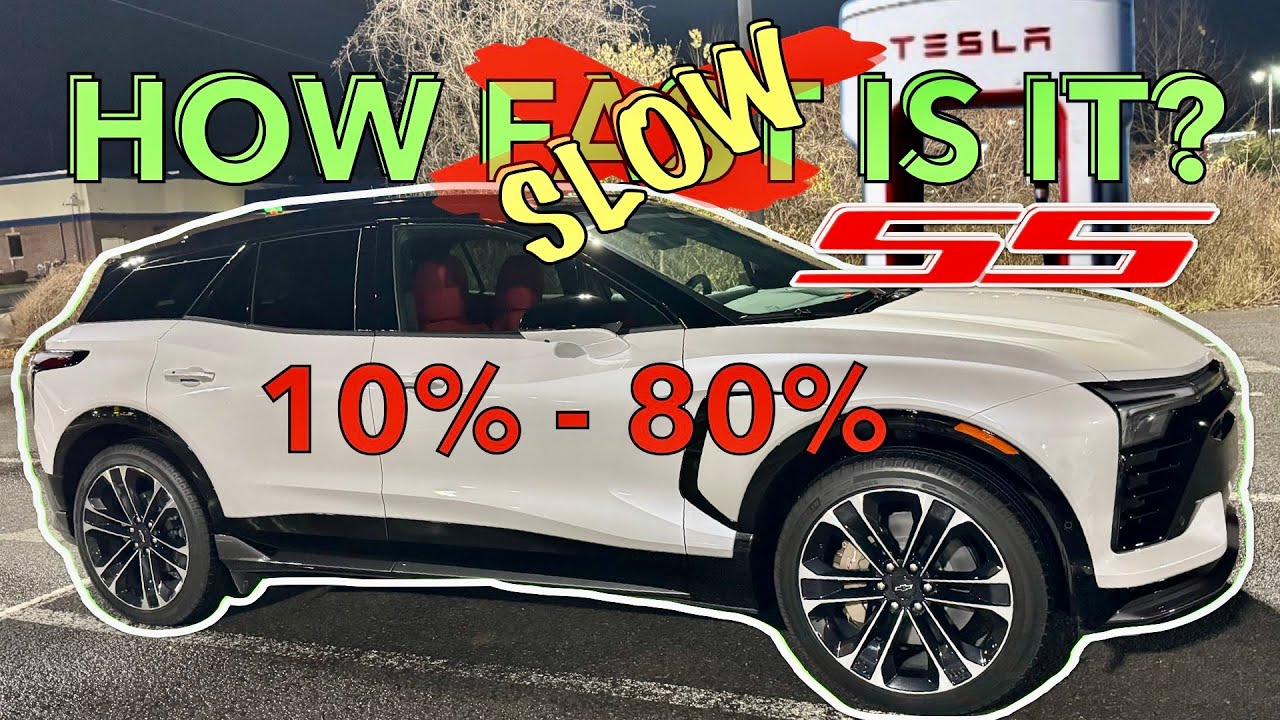
Blazer EV SS – 10% to 80% Tesla Supercharging Session
Welcome back to the Blazer. If you aren’t already questioning my purchase decision or haven’t found something terribly wrong with the Blazer SS already, I got a really good opportunity for you here today. Let’s do 10 to 80%. I’m fresh back from last night’s trip all the way through Ohio. And I plugged in on my level one, which means I woke up with 34% range. Not really woke up. It’s 400 p.m. So overnight and through the day, I went from the teens to 34%. That’s just part of charging on level one. What we need though is 10%. I did not precondition the car before I got in it. So, my heated seats are going to be working hard. My climate control is going to be working hard. So, I can use as much power as possible to drain the battery to 10%. I don’t recommend you do this. It’s winter time. You should definitely precondition. I’m not really worried about efficiency either because it’s so cold. I need to put air in my tires right now. They are 42 in the rear and 38 in the front. requested. I’m a little under. That’s that winter air. Today, I’m going to show you how to remove the winter air from your car or truck tires. And add in summer air. Let me know in the comments if you know what I’m talking about. Let’s do some facts first. 47°. So, that’s going to be a regular charge. This is not going to be a cold weather charge. It’s not a hot weather charge, which might be an advantage in this case. But, we’re going to test it either way. And while it’s still early in the trip, I need to do this as soon as possible. Fast charge prep. I’m just going to do it. Now that we’re on the interstate and I’m doing some super cruise, we can talk about my last video. Is the Blazer super slow at charging? My first stop yesterday was at a charge point. And that charge point is a 62 1/2 kowatt maximum. Absolute dead maximum. And it’s a voltage thing. It’s a 200 amp cable. Nobody’s going to get more than 75 kW at that thing. Maybe 80 no matter what because of the amperage limit of 200. So, did I spend a bunch of time at that charger? Yeah, I did. But the purpose of that was to save some money, which I also did. It was 35 cents a kilowatt hour. I spent 20ome minutes. I got 20ome kilowatt hours. That’s how it works at about 55 kW. So, was that slow? Yeah, it was slow. But you have to understand, I pulled six chairs out of my trunk and wiped them all down with a bunch of cleaners. So, every single minute of that time was used. utilize your charging experience and take what you can get. As far as the voltage of the car, there are two packs when it comes to the Blazer. This pack is the rearw wheelel drive, which was very limited production and is done. And this one, and that’s it. Frontwheel drive, all-wheel drive, RS, LT, they all have an 85 kWh pack. This one doesn’t. It has 102, same as the Cadillac L. And because of that, the voltage is one step higher as far as the Altium platform. The lowest is that 85 kWh pack and it’s got a 288 nominal voltage. Yuck. This one is more like 350. Is it a 500vt car? Absolutely not. I have evidence when I was at the IANA ripping away high in the pack, it was 400 volts. So that’s what it does. It is a technical actual 400vt pack. We all know that because they’re called 400 volts doesn’t mean they are. The prologue and the other 85 kWh packs. That’s Equinox, Blazer, Prologue are all included. They don’t actually do 400 volts. 800VT cars don’t either. The nominal voltage of an ionic 5 is like 5 and a/4. So, it doesn’t do 800 either, but it’s really high compared to 288, for example. The second charge stop I did not input in enough time to get any kind of a happy charge because I didn’t navigate to the one charger as a charger. I just navigated to it as a location. And I didn’t navigate to the other charger as a charger either. And if I was going to try to charge to get the fastest possible charge, I wouldn’t have gone to the charge point first because my big opportunity low in the pack was squandered. The Blazer charges really, really well for 10 to 15% at a time low in the pack, which I actually did in a recent video. I charged to 40 or so or 50 maybe once. And other than that, I pulled in low and I charged to not very much, which allowed me to average a very high kilowatt rating, at least for this car. Now, what is a high kilowatt rating? If you say that cars charge at 250 kW, they don’t. They can. Teslas can charge at 250 kW. But anybody who’s owned one, which is a lot of people, knows that that’s what, 3 minutes, give or take. By 3 minutes, you’re probably already down to 180. And by the time you’re at 50% in a Tesla, it’s time to leave. You should not be at that charger anymore. And in fact, that’s what the navigation in a Tesla is going to do. It’s going to tell you to leave. It wants you to arrive at 10% every time, and it wants you to charge to around 50% every time. And that’s how the network’s set up, too. So, to think that a car is going to charge at 250 kW for a very long time. In fact, the Ionic 5 driver beside me yesterday had owned his Ionic 5 for 3 years and thought he could charge at 350 kW. He can’t, especially a 3-year-old Ioni 5. It doesn’t charge at 350 kW. It charges at 230. Let me know in the comments if I’m wrong, and that’s not for the entire time. The Ionic 5 is actually more impressive at the top of its pack at a supercharger where it’s still doing 125 kW. And that’s really where you make up the time. Today, I’m going to show you how bad the Blazer really is at 10 to 80% and why you should never do that. You should ride the curve. charge to get to the next one at 20%. That’s how these GMs should run. They’ll still get a massive helpful happy charge from 20% to about 40. And if you want to run 20 to 45 or 20 to 50, and if that’s the case, why wasn’t I getting a good charge at the pilot station? Because I drove a long way and I was decently low in the pack, like 40% again, 30 some% maybe. Why didn’t I get a really good charge there? Well, I had to split power with an Ionic 5 and it got there first. So, whatever’s left is what I got. No car is going to get a good session there. They got to be done at an empty charger or a charger that doesn’t split power, which is what we’re going to do today. I’m going to supercharge this car from 10 to 80% and it’s going to be a long wait. I’m going to be sitting in sheets taking screenshots for a while. But the misconceptions I want to identify is your EV is not going to charge really fast for a really long time unless it’s $100,000 or more. The Hummers that are the stacked up packs, those will charge fast. The Escalade IQ is going to charge fast, but the Vistic that has this same battery is not. It’s going to charge the same as this one. The max rating is not the rating you’re going to get. If you pull up to a 50 kowatt charger, you’re going to get 50 kow. Is it bad to pull up to a 50 kilowatt charger? That’s up to you. If you’re in a hurry on a road trip, don’t do that. But if you have to stop to go to the restroom and the difference is not getting 5 kwatt hours and getting 5 kwatt hours, well, getting 5 kwatt hours is a better deal. That’s 15 more miles you can drive. And of course, how do I drain the battery the fastest? Cooper Rock Hill, which I just went up. Now I’m on the way to the state park. I’m going to turn around and I’ll probably go down to 43 and run the rest of it out to 10%. And we’re going to find out 10 to 80%. I’ve never had this car down to 10%. And this will be the only time it ever sees it. I promise you. Don’t run your battery too low. What’s the main reason? People on the forums and stuff, I see their batteries die on a regular basis. My 12volt battery died. I’m like, how does your 2024 vehicle have a dead battery? Well, it’s probably because you let it sit somewhere below 20%. When these cars get low in the pack, the high voltage battery can’t recharge the 12vt because it has to preserve itself. But if you keep it high, as in like 30% or more, then it can do whatever it needs to do to keep everything healthy essentially. You can’t park these at low battery charge and then just walk away. I did park mine at 34% for a few days, but 34% is high enough. As far as winter, slow charging is going to happen as soon as you leave. If you are leaving for a trip and you have a low state of charge, let’s say 34% like I did today, and you have to charge, you want to get as far down the road as possible before you do. It gives your battery a chance to precondition. It gives the navigation system a chance to find a charger and do that preconditioning for you. If you pull up to a charger cold, don’t expect more than 20 kows in cold temperatures. Just don’t. You won’t get it. But in that same scenario, what do you have at 34%? 100 miles of range, 85, 90, drive 50 of those miles, show up at 10%, plug in, and you’ll get a much better number. What is a good average kilowatt speed to get? I’d say 100. If you can average 100 kilowatts for an entire journey, that’s good. If you do better than that, you’ve had a good trip. Unless you’ve got an Ioni 5. But if you want to compare an Ionic 5 to everything else, it’s the best. Go to a better route planner, put in an Ioni 5, put in New York City to San Francisco. Nothing beats the Ionic 5 or maybe the Ionic 6, but the EGMP platform beats even Tesla as far as that. So, is the Blazer going to be the fastest charging? It might be the slowest. We’re about to find out. My guess is that this 10 to 80% is going to take 45 minutes. [Applause] When my GPS on my trip home from Silver Spring told me I needed to charge for an hour, I charged for 35 minutes because I rode the curve. So, I saved 25 minutes of charging. Others are going to argue I had to spend more time getting on and off the interstate. I had to spend more time unplugging and plugging in. That’s true. If you find a really good place, like for example, I went to that mall. The Clarksburg Mall is a really nice place and you can definitely blow an hour very easily. But if you’re just stopping to charge at the most convenient place, grab what’s convenient. And when you start getting bored or like, I’m done scrolling my feed. I can’t find anything else to look at that makes any sense. Move on. Go to the next one. You won’t be bored. It’ll feel like an adventure. And the next time you plug in, you can celebrate the speed instead of being annoyed by it. I had another commenter on my most recent video try to compare a plug-in hybrid cost on a road trip to mine at 40 cents a kilowatt hour. The problem is that you don’t realize that I have 225 mi of range when I leave. So that 225 miles of range that you assume I’m going to spend 40 cents a kilowatt hour to get, I would be getting for 13 cents a kilowatt hour because my 400 mile road trip would already have that amount in the battery. So you can’t do that in a plug-in hybrid. You only get what 3540 mi if you’re really lucky. And that’s not counting the winter. I had a plug-in hybrid in the winter. Mine got 18 mi when I normally got up to 52 in the summer. I’m down to 21% and the sun’s going down. I’m going to go up Cooper Rock Hill one more time and come back down and see if I get to 10%. This will be the first time in my life I’ve ever had to wait to charge. I really want that Tesla Model Y on the end. I want this one over here. This one on the end because I can pull in and not take up more spaces. Luckily, I still have 11% and my climate is off. So, I’m just going to chill. And why would the Morgantown Supercharger have six Teslas charging at once? probably because it’s Thanksgiving weekend and it’s Sunday at 5:37 p.m. This is not my favorite move in the world, but I’m going to have to boguard this thing until I get to 10. But I made it. I’m in the space. We did it. I got 10%. I’m set at 68. I’m leaving the climate on. We’re going to 80. It’s 544. And if you wonder why GM drivers leave their door open to plug in, it’s this noise that you get when you shut the door and have the keys in your pocket. I’ve got the A Toz adapter. Next, we grab the handle. No buttons necessary on the A Toz to plug it in. Back in the car, I’ve got the Tesla app open. I’m going to charge my other EV. The station is going to populate automatically. This is the one. Let’s charge here. 1A. Start charging. almost instant. Right here we see the supercharger authorizes in $20 increments. I’ve got the Tesla app on the left and my display screen on the right. So, you can see cost, kilowatt hours, percentage, ramp up, and ramp down. This was a good start, up to 180 kW just as we hit 11%. Notice the My Chevrolet app keeps you posted on when your charging session starts as well. And in just 5 minutes, we were up 12%. By 10 minutes in, I was back to the 34% I left the house with. There was a nice plateau around 40%, right around 150 kW. and we ride that all the way to 53. And it’s here I would unplug as the rate drops over 40 kW between 53 and 57%. By 25 minutes in, we were at 62%. That’s over half the Blazers range during this session. And at 30 minutes, we were at 68%. That’s 190 mi of range in 30 minutes. And we’ve been in the 80 kW range since we hit 60%. And we never go below 80 kW as we hit 80% at almost exactly 40 minutes. And at this point, you can be the judge. Is the Blazer slow? Did I have a better result because it was cold? And could I have gone even faster had I turned off the climate and left the vehicle? Let me know your thoughts in the comments down below. Join Patreon or become a YouTube member for early access to videos and subscribe for more. We’ll see you on the next one. Hey, smash the like button. Thank you. [Music]
Join this channel to get access to perks:
https://www.youtube.com/channel/UCTPJmDZPJt17iq4lsTuH61g/join
patreon.com/aslash304
The EV80quette Tee – https://tinyurl.com/29hwcerw
Watch a 1000 Mile Prologue Trip That was Cheaper than Gas – https://youtu.be/LIrh09Ydtd0
Full Prologue Ceramic Coating Process – https://youtu.be/dFlGW0p4B-w?si=qStLL9UyZuLtXPOz
Learn Everything You need to know about the Prologue Here:
Honda Prologue Fast Charging Master Class – https://youtu.be/jZoIl3gSn5s
Honda Route Planning and Winter Travel Explained – https://youtu.be/xA7HXHhR8LA
Honda Prologue Full Infotainment and Menu Walkthrough – https://youtu.be/39JkgRHVB3Q
Honda Prologue Highway Efficiency Test – https://youtu.be/Gs_mYLbxaNY
Honda’s Future EV Strategy – https://youtu.be/oJv1nSu8Hik
Having Trouble With Your Prologue – https://youtu.be/5cT5LhRT-d0
Report a Problem With Your Prologue to NHTSA – https://www.nhtsa.gov/report-a-safety-problem#index
Honda Prologue Playlist – https://www.youtube.com/playlist?list=PLR40AGThaETDdWsuamCWYnJ8rvPX21m3R
How Does the Prologue Perform in the Snow – https://youtu.be/l4cd4RUEpHY
Lectron Adapter
https://ev-lectron.com/?utm_campaign=affiliate&utm_medium=sas&utm_source=text&sscid=91k8_4378e&
A2Z EV Adapter – https://a2zevshop.com/products/nacs-ccs1?variant=43186507579592
My Wife’s First Impressions of the Honda Prologue – https://youtu.be/x5PT496GX44?si=NkQXvWCLcvbQksJC
Hyundai Ioniq 5N first impressions:
#coldweather #charging #2026 #electriccar #trending #blazerev #electricvehicle
Patreon https://patreon.com/aslash304
Can I review your EV? Any Make/Model/Year Let me know at this Email
Contact email: adamsevreviews@yahoo.com