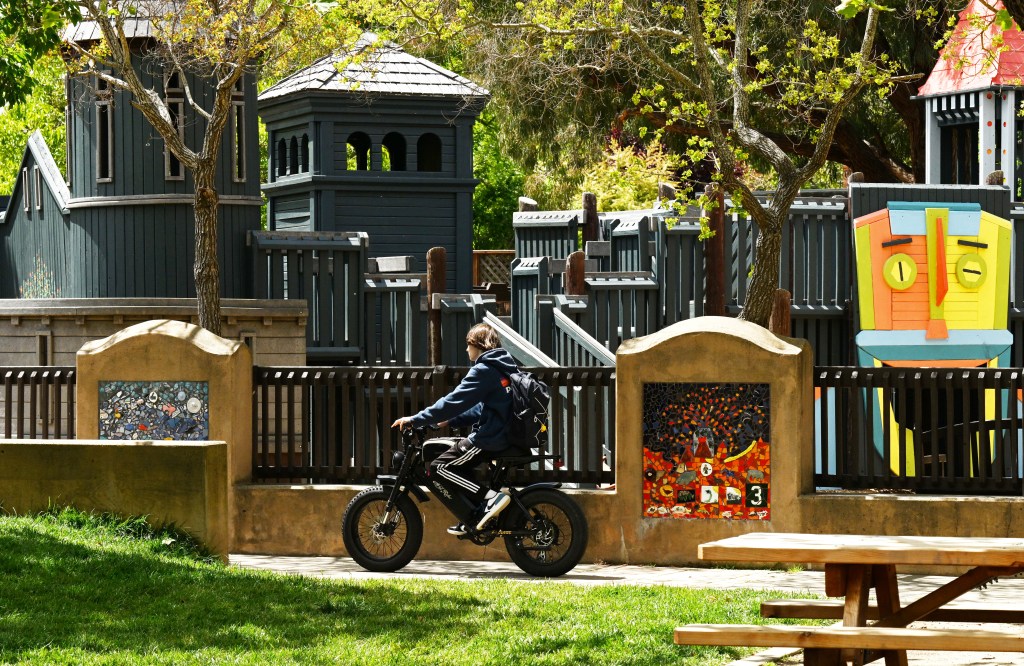
Enforcing new e-bike rules has been difficult, according to some police officials.
Central Marin police Lt. Alberto Duenas, addressing the San Anselmo Bicycle and Pedestrian Committee this month, said, “It’s been a challenge since the beginning and it still continues to be.”
Duenas said officers “love to see really high numbers” of warnings and citations. But in the case of e-bikes, the violations are usually traffic infractions, and often the riders do not stop for police.
“They’re much quicker on the throttle,” Duenas said. “They’re going to places where cars can’t get into. And quite frankly, we’re not going to pursue these riders just because the risk of injury is so much higher when anybody’s on a motorcycle or a bicycle or e-bike or e-motorcycle.”
Duenas’ comments were similar to other early reports by police on enforcing new local laws that seek to stem accidents and injuries among motorized bike-riding youths. After a grace period that coincided with the start of the school year, police have begun ticketing riders and impounding bikes.
Duenas said the challenges include youths fleeing, parents buying vehicles that are more like motorcycles than bikes and kids parking the bikes off of school grounds to avoid scrutiny.
“We have experienced similar issues with a small segment of electric devices here in Mill Valley,” police Lt. Shaun McCracken said.
“It’s the high-speed devices that are giving everyone in our industry a bad reputation,” Gwen Froh of the Marin County Bicycle Coalition, an adviser to the Marin County Youth E-bike Safety Task Force, told the San Anselmo committee. “Don’t call them e-bikes. They’re e-motorcycles.”
State law already bans anyone under 16 from riding class 3 e-bikes — pedal-assisted bicycles that can travel up to 28 mph.
Earlier this year, Marin County and its cities and towns imposed the same age limit for class 2 bikes, which have throttles and a top speed of 20 mph. Class 1 e-bikes are pedal-assisted but the motor stops at 20 mph. All riders under 18 are required to wear helmets.
Under Marin’s new rules, violators receive a $25 fine and must take a police safety course.
“The elephant in the room is that 90% of the vehicles being sold as class 2 are not class 2,” said San Anselmo Mayor Terrell Kullaway, who is the executive director of the Marin County Bicycle Coalition. “The legal definition … is not what is erroneously being sold in our stores and online.”
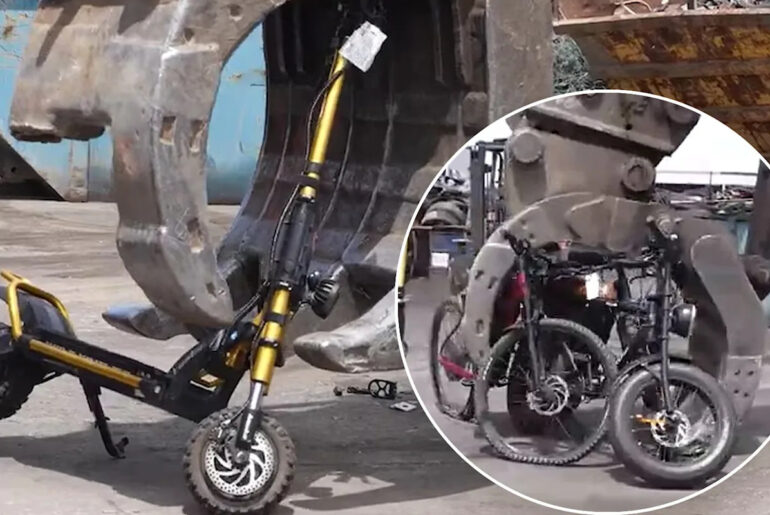
Central Marin police issued 15 citations as of early November, Duenas said. Police contact the rider’s parents and, in some instances, tow the bikes. The bikes are impounded and held for up to 30 days, which can increase the cost to retrieve them to $1,000.
“My school resource officer … has mentioned that he has been hearing from the kids at different schools that he’s visiting that these juvenile riders are getting the message,” Duenas said. “They’re talking about bikes that are getting towed. They’re talking about not parking on school campuses.”
McCracken said Mill Valley police will contact parents for youths riding an “out-of-class” bike. It will impound electric motorcycles, “not electric bicycles.”
Several San Anselmo committee members asked if police stop youths who look too young to be on the bikes.
Officers can’t stop youths based on appearance, Duenas said, because there is no visual way to tell a youth’s age. Also, e-bike laws are written so police can only stop riders for an infraction, he said, such as not stopping at a stop sign, not wearing a helmet or having a tandem rider on the same bike.
Froh and Duenas told the panel that educating parents was as big a challenge as policing young riders.
“The direction we give all the officers is anytime you make a stop for a juvenile on an e-bike violation or motorcycle that the parents have to be contacted, especially when we tow the vehicle,” Duenas said. “So we get them involved right up front.”
McCracken said it is hard to pinpoint what is prompting parents to buy overpowered bikes.
“It is difficult to say whether it results from parents ignoring laws or from business practices by some retailers/manufacturers,” he said.
Both officers said more public communication is needed.
“There was a recent incident where a juvenile was riding, crashed, suffered some injuries, and the parent was issued a citation for him riding that vehicle without a license because of the type of vehicle … which was like riding an e-motorcycle, essentially,” Duenas said.
McCracken said, “We continue to administer an e-bike safety course for juveniles who are cited on an e-bike for the first time. Our goal in developing this course was to continue offering education to youth in our city while keeping these violations from entering the justice system by avoiding a referral to traffic court.”