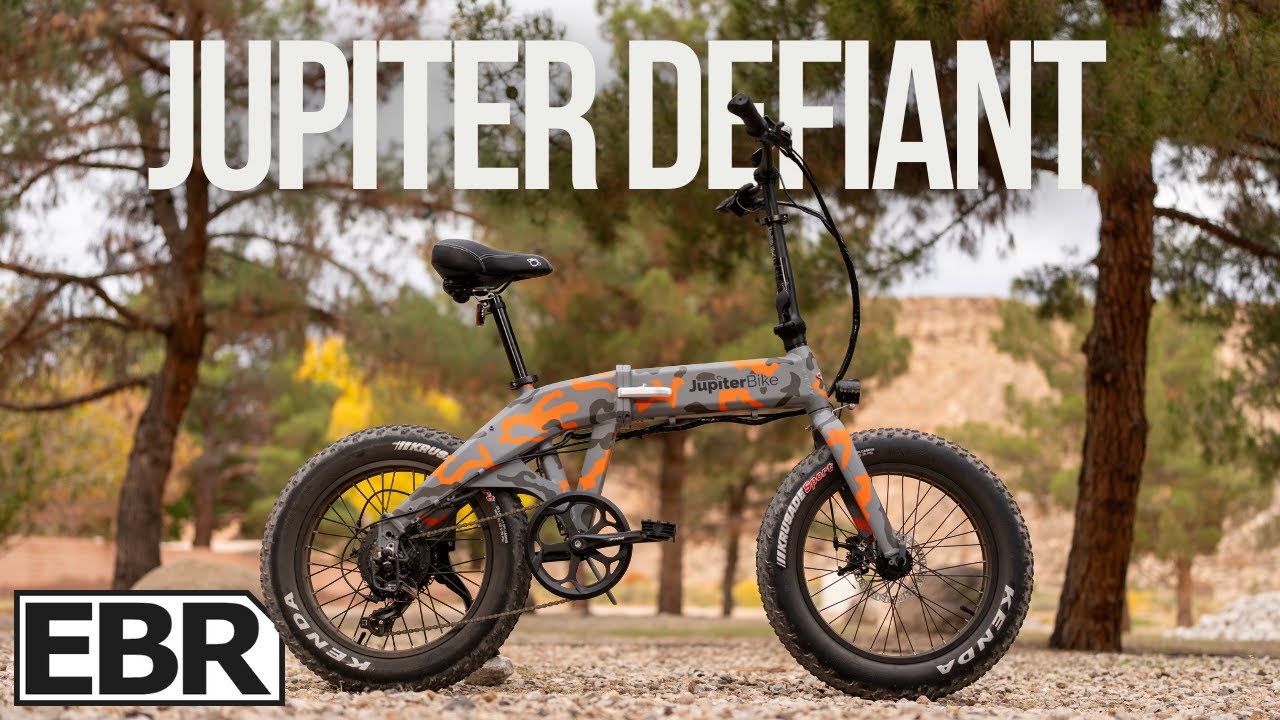
Lightweight but Strong?! Jupiter Defiant Review
All right, guys. This is the Jupiter Defiant. It’s a folding ebike that ships as a class 2. And at first glance, you can see this breaks some of the molds from what we typically see in a folder. Not only from this paint job, but the frame design itself is a little unique. And then beyond that, sometimes folding ebikes can be 60 lb, upwards of even 70, and in some cases 80 lb. But this one breaks that mold by coming in at just 52 lb. So, let’s run through all the specs and features and see what else is unique in this review of the Jupiter Defiant. [Music] [Applause] [Music] All right, let’s go through the basics of the Jupiter Defiant. Now, this is a class 2 ebike, meaning it ships to you with pedal assistance and throttle to 20 mph, but of course, you can unlock it to class 3 speeds with an interesting caveat that we’ll talk about in just a few minutes. Now, this is priced at $1699 and it’s UL2849 certified. Now, when it comes to weight, they say this bike weighs 55 lb, but I threw it up on the scale without the battery and it was just 52 lb. And the battery is not very heavy. It’s only around 6 12 lb. So, when I put the battery in it, the bike is still only 58 lbs, making it a lot more manageable than many of the ebikes we see. Now, when it comes to the frame colors and geometry, this is the orange camo, but of course, if you’re not into camo, this is obviously kind of a more expressive paint job. If you don’t like this, they also have a very normal looking white or black you can pick from. And then there’s one other camo. It’s like a green camo. So, you have several options between two different camos and two different a white or a black as well. Now, in terms of size, it’s a one size. Fits most from 5 foot on the low end all the way to 6’2 on the high end. Now, I’m 5’11, so I’m kind of right in the middle of that range, kind of on the taller end of it. But either way, I felt it fit me just fine. There was no issues anywhere. So, I don’t have any concerns about their fit range that’s advertised. Now, when it comes to the geometry numbers of this frame, this has a 43in wheelbase from front hub to rear hub or vice versa. We have a um 16inch reach up top and we have about eight and a half inches of adjustability here in the seat post. Now, when it comes to max payload, the max payload on this is 300 lb. When it comes to tires and wheels, we have 20in x 4in wide Kenda Juggernaut tires. These have a nice beefy all-terrain tread pattern pattern on them, and they are on a 20-in alloy wheel with offset spoke patterns to help with a better connection from that wheel totire setup. Now, in terms of things like the accessories, practical everyday features, this bike does ship with front and back fenders. I happen to just have them removed from different off-road testing I was doing, but it does come with two fenders. They’re kind of cool moto style fenders. I actually like the fenders a lot on this. I just have them removed right now, but you can also add a rear rack if you want to. And then on top of that lighting up front, we have an adjustable angle LED headlight up front. There is no tail light or brake light. Obviously, this doesn’t look like a downtown city commuter, so it doesn’t surprise me not to see that. You do have a reflector on the rear end just in case you do get into traffic or where someone has lights behind you, they will at least get that little visibility from the reflector as well. Now, also, there’s one thing I did wish it had that it doesn’t, and that’s just any mounting points for a water bottle cage. Obviously on a folding bike, the frames are a little unique and it’s not as traditional to be able to put water bottle cage mounts on these, but you can always slap on one on the handlebar up top, some sort of handlebar mounted cup holder if you wanted to or cage mount. Um, but none built into the frame. And again, you can add a rear rack for extra storage as long as you stay within that 300lb max payload. All right, so let’s talk about the power delivery on the Jupiter Defiant because that’s where this bike is really, really strong. So, in the back, we’ve got a rear hub motor, 750 watts, and it peaks at 1130 watts. Now, normally I’ll give you the torque specs on this, but they don’t disclose the torque specs. They just advertise it as being high torque. Now, meaning depending on the manufacturer, that could mean a lot of things, but at the end of the day, you always know if the torque is good just by how it rides. And when you take this off-road, it is extremely punchy. It’s extremely quick with acceleration, and it can crush hill climbs. So, while they just say it’s a high torque motor, the way it rides really does back that up. I don’t know the number, but it is a high torque motor. And you’re not going to be buying this thinking, “Oh, it’s underpowered or it can’t make it up hills,” cuz this certainly has no problem getting up them as you’ll see when we go out on a ride here in just a bit. Now, the battery, excuse me, the pedal assist levels on here, they are activated with a cadence sensor. The motor’s activated with a cadence sensor, and you have five levels of pedal assist, one through five. Now, this ships as a class 2, so max speed 20 mph and throttle speed 20 mph as well. So, when you want to go to class 3 because they do advertise it as being able to go to class 3 speeds or 28 mph, there’s an interesting aspect of that like I kind of told you in the intro and that is when you put this bike together, when I was putting it together, there’s a card inside that says essentially says, “Yes, you can go to 28 miles an hour. Here’s how you do it. But if you do, you’re probably going to void the warranty and you may cause damage. Now, I thought that was an odd thing to ship with the bike, especially one that’s advertised as going 28 mph. But after all, it’s called the Jupiter Defiant, and I figured, well, let’s be Defiant and see what happens. So, I unlocked it to Class 3, as you’ll see on our range test, or excuse me, when we go out on a ride. And I had no troubles at all. It just made it more fun to ride. It was very punchy, very quick. Um, I enjoyed it on class 3, but at the end of the day, they do throw that card in there. So, take that for what it’s worth as far as buying one and riding it every day at class 3 speeds. They did throw that in there, so it’s worth at least mentioning. Now, when it comes to the battery, it’s fully enclosed right here in this section of the frame. I’ll pull it out in a second when I fold it for you guys, but this battery is 48 volts, um, 10.4 amp hours, giving us 499 W hours. Now, the bike is UL2849 certified. That’s the overall ebike electrical system. And I contacted them and said, “Hey, is the battery UL2271 certified?” Because they did not list that in the paperwork. And they told me it was. So, that’s good to know as well. Now, the battery also has a locking key, so you can secure it um off the bike charging storage, things like that, winter storage. You can take it out, secure it, lock it in place. That’s nice as well. Now, when it comes to range, this setup they say gives us a total range of 40 plus miles, which is really kind of open to interpretation. It seems like a kind of reserved number. Um, and so we put that to the test. We ran it in two iterations with a full charge. We ran it in PAS level one or assistance level one. And we got 53 miles on a single charge, which is really solid and far exceeds their 40 mile estimation. Now, when you when we took it home, recharged it, and took it out again on a full charge. This time, we went at pedal assist number five at that class 2 level. So, basically 20 mph the entire time, maxed out, and we were able to get 21 mi. So, it’s reasonable to say anywhere between 20 and 50 miles, no matter how you’re riding the bike, um, is a pretty safe estimate. I would think if you’re not staying in pedal assist one, and you’re somewhere in the two to three, like most people do, your numbers are going to be somewhere in that 30 to 40 or 30 to 50 mile range on a single charge. And finally, when it comes to the warranty, you have a 2-year warranty that covers the bike and the battery. All right, so let’s talk about the components set up on the Jupiter Defiant. Starting in the rear here, we have a Shimano Tourney seven-speed drivetrain, and that is consisting of the Shimano Tourney rear derailer, a Shimano Hyperglide cassette, which has a 14 to 28 to cassette on it, and then we have a 52 to chain ring up front with 170 mm Proheel alloy cranks. Now, attached to those, we do have folding pedals because it is a folding bike. They are platform pedals. They’re plastic with some traction studs and some reflectors for visibility for night or evening riding when other headlights illuminate you. Now, on top of that, in terms of braking, this is probably one of my critique areas of the bike. It does have um disc brakes on it, but they’re mechanical disc brakes, not hydraulic powered. These are 160 mm rotors front and back. And the calipers are made by Zoom, and they are mechanically actuated, so cable tension actuated. And then they have star union levers up top. Now the good thing about the levers up top is you do also have e- cutff sensors. So if you’re using the throttle, using the pedal assist levers, and you happen to tap the brake or slam on the brake for any reason, it will cut power to the motor, which is just a nice extra safety layer where you’re not fighting the bike trying to stop it as it’s trying to give power. As soon as you touch the brakes, the bike just basically will come to a stop and kill power. Now, in terms of the saddle here, let’s take a look at this. This is a Jupiter branded called a comfort saddle. It does have spring supports on it and a little area where you can kind of grip underneath it to lift the bike as well. Here in the seat post, you have an alloy seat post with a quick release lever so you can change the height of the seat post with relatively no issues at all. And if you notice, there’s no suspension on this bike. That’s because it’s a rigid frame. But that’s where 4-in tires really become valuable because you can air these down to quite low PSI where they’ll maintain the bead with the wheel. But they’ll give you a lot of little squish, what I call squish suspension, which is where the tires will kind of give impact and give way if you air them down. If you air them all the way up, they’re not going to be very forgiving and you’re going to feel more bumps in the road. But if you air them down, even 10 PSI, it goes a long way in the comfort on this bike. And really, the bike is fairly comfortable and easy to ride off-road. Now, here in the center, we have the handlebar, which is a 20, excuse me, a 680 mm alloy bar. It’s got a slight ergonomic sweep back to it, but it’s mostly a flat bar. Um, on both ends, we have ergonomic platform rubber grips. We have an electronic horn. We have our pedal assistance buttons here. We also have Shimano index shifters. They are a sevenspeed shifter. You can use your thumb to shift them. And we have these star union levers on the bike as well. And then all of our cables come off into one single tie and then go back to their final destination on the bike. Now, the only thing um that’s extra on here is besides having a folding stem for folding the bike, we also have a little bit of adjustability in the height here. So, based on how high you want that handlebar, you can raise or lower this about 4 and 1/2 in or so to kind of make that dialed in and a better fit for you. But let’s take a closer look at the Jupiter Defiance display and see what you can do in there. All right, so this is the home screen on the Jupiter Defant. As you can see, it’s a duo tone LCD. Um, right in the center is our miles per hour, which we can change to kilometers if we want to. I’ll show you how to do that in just a second. Below that’s a five bar battery meter. Below that’s currently the odometer, and below that is your current pedal assist level, which we can change with the buttons on the display control pad here on the handlebar. Now, if we tap the power button, we can cycle through some data screens. So, I’ll tap it once, and we get the average speed of around 14 miles an hour. Tap it again. We get the max speed at 32 miles an hour. Um 57 minutes it looks like it has as the time right now or I guess 12 a.m. or almost 1:00 a.m. it has the time which is obviously incorrect. Um kals 115. Power is going to be more real time when you’re riding the bike using power. Um voltage 48 and trip meter at 13.4. And then overall mileage has been almost 100 miles on this bike since I got it. Now, if we want to go into the advanced settings, we’re just going to hold the plus and minus button. And it’s a very simple setup here in the advanced settings. Right now, it’s in class 3 mode, as you can see, 48 mph, 48 km/h. But if I was to bring that down to 32 km/h, that would be the um that would be the class 2 speed of 20 miles hour max. Now, tapping that again took me to the next screen, which was units, which is currently in miles per hour. But, as you can see, we can change that to kilometers/ hour. I’ll put it back to mile. Save it. Nope. And then this is the time it takes the bike to power off when you walk away. It’s currently set at 10 minutes, but you can go higher if you want, and you can go lower just how long you want to wait before the bike turns off when you walk away. That is if you forgot to turn it off. So, we’ll just leave it at 10. And then here, the screen brightness is the highest level. It’s a levels one through five. So, we’ll just leave that at five. And then we’re back to the original of the speed settings. So, we’ll bring that back up to class 3 speeds. And we’ll save it. And then I’ll hit both buttons and we’ll go back to the home screen. So, really simple menu, but everything you’ll need, screen brightness, units, um, power off timer, and your class adjustment, which, as you could see, it does go past that 28 mph. Um, so we’ll see on the ride how that went, but I would not recommend going beyond 28 mph just because of that liability card they sent with the bike. Um, but that is the screen display. There’s no app for this bike, so everything is pretty simple and right where you need it. All right, so I’m going to do a quick folding demonstration for you on this one take, no edits. We’ll just see how it goes. Sometimes they go well, sometimes they don’t. We’ll just see how it goes this time around. So, first thing I’m going to do is fold this pedal up. It just kind of folds up really easy by pushing in and pushing it up. Then I’m going to lower the seat post here, which is more optional, but it does lower the overall footprint of the bike when folded. Here, I’m going to lower the stem to the lowest position. And then lower the folding handlebar. Bring that down by its side. And now we have the folding mechanism itself. I’ll just pop that open. There is a little clasp that you pull back as you open it. It keeps it locked and from sliding open, which is a good thing. And then I’ll just kind of pick it up and rotate it and set it down. And that wasn’t bad at all. Pretty smooth process, actually. And since we were able to get that hinge a little bit looser with some lubrication, it’s actually been pretty cooperative. Now, the dimensions on this are about 38 in in length, 27 in height, and about 21 in width. And as you can see, pretty smooth folding process. It’s not a lot to complain about and pretty easy overall. All right, here we are on the Jupiter Defiant. And this bike shipped as a class 2, so you know, we got throttle and pedal assist, 20 mph, but I’ll show you in just a second how to unlock that and we’ll see what it can do when it’s unlocked. We got a nice flat straightaway ahead of us. I know a lot of you guys will want to know how fast it can go. Um, first things first though, like the fit on here is pretty solid. I’m 5’11, so I’m on the upper end of their range, but I still got a few inches where I feel like you could make this comfortable all the way up to 6’2 like they advertise. Sorry, there’s some rushing water today. We had a lot of rain. Um, so it fits good at my 5’11. So if you’re on that fit range of 5 foot to to 6’2, I think this will be no problem, you know, making it work for you. Now, if you look, I’m pedaling in pedal assist one. You might be able to hear the motor a little bit. It’s kind of subtle. Um, but it will get louder when we get to those higher PAS levels or pedal assist levels. Now, this one has a 750 watt motor, but obviously it can peak, you know, much higher over 1100 watts. Um, and they don’t list the torque specs, but I think you’ll see when we go hit some of these hills, there’s plenty of torque. And it’s actually something that really stands out on this bike is the power of it. But right now, PAS1, I’m just pedaling casually. I’m going, it says 11 to 11.6 miles an hour. Now, if I hit level two, you feel a little bump there cuz we got a cadence sensor. So, there’s no ramping up. And it starts going all the way to 20 right there. So, I’d say pedal assist one is going to be your cruising speed. Two looks like it’s topping out here at about 16 miles an hour. Hi. And then if I go to three, it’ll just bolt up to 20. And so that kind of overruns that. Oh, we’re in I think class 3 right now actually cuz it’s cruising at 21. So let’s let’s uh make sure it’s clear up ahead and then I’m going to go up this little hill up here. I’m going to use throttle only. See if we lose any speed. I don’t think we will. And so you can see we’re cruising all the way up quickly. 26. I mean, it just shoots up hills. Let’s slow down for these folks. On your left. Thank you. On your left, sir. All right. So, when we turn into this neighborhood here, there’s another um there’s another hill, but it goes up about a/4 mile. And this one is a little bit more nuanced in its grade. It’s about anywhere between about a five and a 9% grade. So, in some areas, it’s kind of mild, in other areas, it starts to get a little steep, but over the quarter mile, it’s pretty good climb for any motor. So, let me stop at the stop sign. All right, we’re clear. And so, as you can see, pedal assist level one is really relaxed. It’s not it’s not going crazy. Just kind of casually rides, but everything after that starts to get pretty quick. So, let’s just bump it up to five. [Music] I don’t think I can with these gloves on. Hold on. There we go. All right. So, now pedal assist 5. And we’re going up the hill. And it’s all the way uphill in front of me, even around the corner. And we’re climbing speed. We’re at 22 mph. [Applause] Still climbing 24 miles an hour. This right here is the steepest part. It looks like it backed off just a hair. 24 miles an hour. Still 239 237. We’re still going to the top here. So, it looks like it’s bottoming out at 234 and it’s already starting to creep back up in speed. So, now we’re at it’s holding 235 and then soon as it levels out, we’ll probably ride back up to 28. Right about here at the top of the hill, you can see the speed going back up and it quickly starts covering speed. So power on this, as you can kind of tell, there’s nobody behind me, is definitely it’s definitely punchy for a bike that, you know, at first glance looks kind of small. It’s got a shorter wheelbase around 41 42 in. It’s got the folding design, so it just doesn’t look huge, but it’s got plenty of punch. I’m trying to feather it while I talk, but we do have a cadence sensor. So, if I ro rotate the cranks, we get power. But one area that I was a little critical on this bike was getting mechanical disc brakes. So, let’s get up over 20 mph on this downhill. Nobody behind me. 3 2 1. So, I mean, so the brakes are really effective. At the end of the day, cable actuated brakes have been around a long time and they’ve served their purpose. They still get sold on new bikes. Um, but we start to get a little used to seeing hydraulic disc brakes. Got a passer here. And would I prefer to see hydraulic disc brakes? Sure. But these mechanicals do just fine. Again, I’ll speed up to over 20. 3 2 1. Yeah. So, I can complain as much as I want, but these brakes are actually doing really well. you will have a little bit more maintenance with them. You know, they’re cable actuated, so cable tension is something that to be aware of. But, as you can see, they perform good going downhill with a rider over 20 mph and a short stop, it’s doing well. Now, it’s important to remember that this is just the base level model, too. Um, if you spend $100 more on the Pro version, not the Pro, excuse me, um, the next level up, I don’t believe it’s the Pro, but it’s the next level up. That one has hydraulic disc brakes and a rear cargo rack for the additional $100. And in my opinion, that’s going to be um a really solid upgrade for 100 bucks. I think hydraulics will feel better, last longer, and then you get the rear rack included, which is pretty cool. And then they have the higher tier. Oh, and for the extra $100, I believe you also get um front suspension. I might be confusing these prices. I believe it’s actually $200 to go up to the next tier where you get hydraulic disc brakes and a rear rack and front suspension. But then if you go up $300, so $19.99, um that one gives you full suspension, a bigger battery, uh more range, you know, front rear suspension, the rear rack. So you get a little bit of everything. So really, they have really nice upgrades that they’re not charging a whole lot for to just get that higher tier if you want to go that route. But if you want something that just gets you on the bike, um, and it’s ready to roll and it’s punchy and fun, this is where this kind of already shines. All right, so let’s see how top speed we can get. This isn’t exactly flat. We’re kind of going up and down a little bit, but here we are at 28 mph. We’re still climbing. 29 m an hour. So, it looks like about 292 is what I saw. So, plenty of speed, plenty of power. Just a fun little, you know, folding ebike. I think a lot of people who live in areas where they hunt, this thing has a cargo or utility trailer you could buy for it that has a 220 lb capa uh capacity. And I saw some pictures when I was looking through their reviews of users out there who have this bike and they’ve been carrying it with their hunting setups. Pretty sure I just swallowed a local bug. That’s cool. But as you can see, a lot of options, a lot of fun ways to ride this. And if you want to keep it mild and slow, you can keep it level one. And it really doesn’t, it’s not overboard at that at that pedal assist one. It just kind of chills like this. And then soon as you go to level two, you start getting a little more felt push. And then anything after about three and you’re really just kind of cruising up pretty quickly. Let’s do a dead stop to a top speed. Let’s do dead stop to 20 mph. 3 2 We get on level five. 3 2 1 10 15 20. So, as you can see, pretty quick. And then we’re already at 25. So, it’s a fast little bike. It’s a fun little bike. Um, I think it fits me well. I don’t feel a lot of flex in the frame. You’ve also got the ability to fold this, which I think a lot of people are going to like. Just makes it easy to ride. So, let’s go back, put it up on the stand, and talk about it from more of an ownership standpoint. I’m trying to cover the things that aren’t so obvious when you’re looking at it online. All right, so let’s talk about the Jupiter Defiant less from a review standpoint and more from an ownership standpoint. These are the things I like to point out that aren’t so obvious when you’re looking at it on a website and about to spend your hard-earned cash on it. and that way I can kind of give you a heads up on some of the good and some of the not so good before you actually receive it. So that way you just feel like you can make a good purchase decision. Now kicking it off with some of the good things on here. This is a fully open frame design, meaning all the cables come off. They run alongside the bottom of the frame here. They go behind this crossbar, but they never go through the frame. So you’re never having to deal with fishing out cables or wires if you have to change anything, upgrade anything, or maintain anything. Everything’s very easy to access. And from an ownership standpoint, even for your local bike shop, that just makes everyone’s life a lot easier. So, I do appreciate that about the design. Now, also, we have a lot of adjustability. We have micro adjust rails on the seat post, which is allow you to move that seat forward or backwards. Not all ebikes provide that. It’s kind of a 50/50 basis right now. And that does allow you to kind of just dial in a better fit based on your leg length, torso length, arm length, things like that. On top of that, we have an adjustability of about 4 and 12 in in this telescoping stem here, which allow you to also raise and lower that handlebar height just to work in a better fit for you, whatever works best for you. So, having the adjustability and the open frame design just goes a long way in terms of maintenance and comfort level, which kind of go hand in hand with owning a bike these days. And on an ebike, maintenance can be kind of a headache depending on how technical the wires are routed. And this just keeps things nice and simple. Now, for some things I would say I would just caution you about or to be aware of. Um, I brought it up one time already, but the mechanical disc brakes on this bike feels like we should have hydraulic disc brakes on a bike like this because they just have better stopping power and they’re not much more expensive. But there is a good side to that, and that is the hydraulic disc brakes. If you wanted to upgrade them on this bike, you have a couple options. One, there’s multiple tiers of this bike, and the next level up, I think it’s for $100 more, does have hydraulic disc brakes. That’s one quick and easy way to take care of that. But on top of that, if you go on Amazon, you can get a set of Shimano hydraulic disc brakes with levers and calipers already routed. You don’t have to bleed them. They’re already connected. And on this frame design with no cable routing, you could do this yourself and probably under an hour and it would be around $60 shipped to your door. Pretty smooth process. Um, but with mechanical disc brakes, you will be kind of finicking with them a little bit more than you probably like to because you have cable tension responsible for compressing that um, slide caliper piston in and out. And so when that tension can be adjusted as that cable gives over time, you’ll need to retighten it and rettighten it. It’s not super annoying. It’s not very common, but it will be more so than having hydraulic disc brakes that really you don’t have to mess with much at all. And outside of that, the other thing I would caution you about is this is on all folders, not just this bike in general, but when we have all the cable wires bunched up near the hinge mechanism, it’s just a greater chance of over time eventually starting to clip those, pinch those in the folding mechanism. So, as long as you’re aware of it and you just make sure that mentally you’re knowing to keep those cables out of the way every time you open and close it, I think you’ll be probably fine. But in the event you’re not paying attention to it, it is something that could get pinched and cause you a headache down the road. But all in all, not that big of a deal. Other than that, that’s pretty much all I have on the Jupiter Defiant. All right, there you have it. The Jupiter Defiant. Kind of a fun little folder. It’s got some cool paint jobs. You can do green or orange camo or just keep it simple with a solid black or a solid white color. On top of that, we got over 50 mi of range. It does punch really well. Punch punches above its weight class when it comes to acceleration and hill climbing. And I really enjoyed riding the bike. Now, is it perfect? No, it’s not perfect. I would rather see some hydraulic disc brakes instead of the mechanical disc brakes for just better braking performance and it seems like kind of become a standard expectation these days in ebikes to get hydraulics. Um, and then on top of that, this was a very stiff folding mechanism for the folding um, aspect of the bike’s frame, but using a little grease lubrication, you can make that a lot easier like I did. And all in all, it was a wellperforming bike. Outside of those two small issues, I thought it was a lot of fun to ride. Now, if you have any questions about this bike that I forgot to answer, just drop them down below in the comments and I’ll get that information for you and reply personally so you can have that info before you make a purchase decision. And until the next review, I’ll see you out on the trail.
🚴 Jupiter Defiant Review (2025) — This Little Folder Didn’t Skip Leg Day
📌 Check the latest price & deals here: https://ebreviewdeals.com/jupiter-defiant
🔗 Read the full written review: https://electricbikereview.com/jupiterbike/defiant-review/
The Jupiter Defiant is one of the lightest fat-tire folding e-bikes we’ve tested, coming in at just 58.5 lbs (or 52 lbs without the battery). But don’t let the size fool you — this bike packs a 750W motor peaking at 1130W, giving it surprisingly strong hill-climbing power for a portable folder.
In this review, I break down everything from its acceleration and fat-tire ride comfort to real-world range results, braking performance, folding process, and long-term usability. If you’re considering the Defiant or comparing folding e-bikes for 2025, this will help you decide whether it’s the right fit.
🔥 What Stands Out on the Jupiter Defiant
– Under 60 lbs — actually portable compared to most 70–80 lb folding fat-tire e-bikes
– 750W hub motor (1130W peak) delivers strong acceleration and climbs surprisingly well
– 20×4” all-terrain fat tires give shock absorption even with no suspension
– Predictable PAS system with five distinct assist levels
– UL 2849 certified for electrical safety
– Folds down fast into a compact footprint (38.5″ x 22″ x 28″)
#ebikes #foldingebikes #electricbikereview #jupterbike
00:00 – Intro
00:50 – Overview
03:45 – Motor & Battery
07:22 – Components
10:27 – Display
13:07 – Folding Demo
14:12 – Ride Quality
24:31 – Mechanic’s Take
27:50 – Conclusion