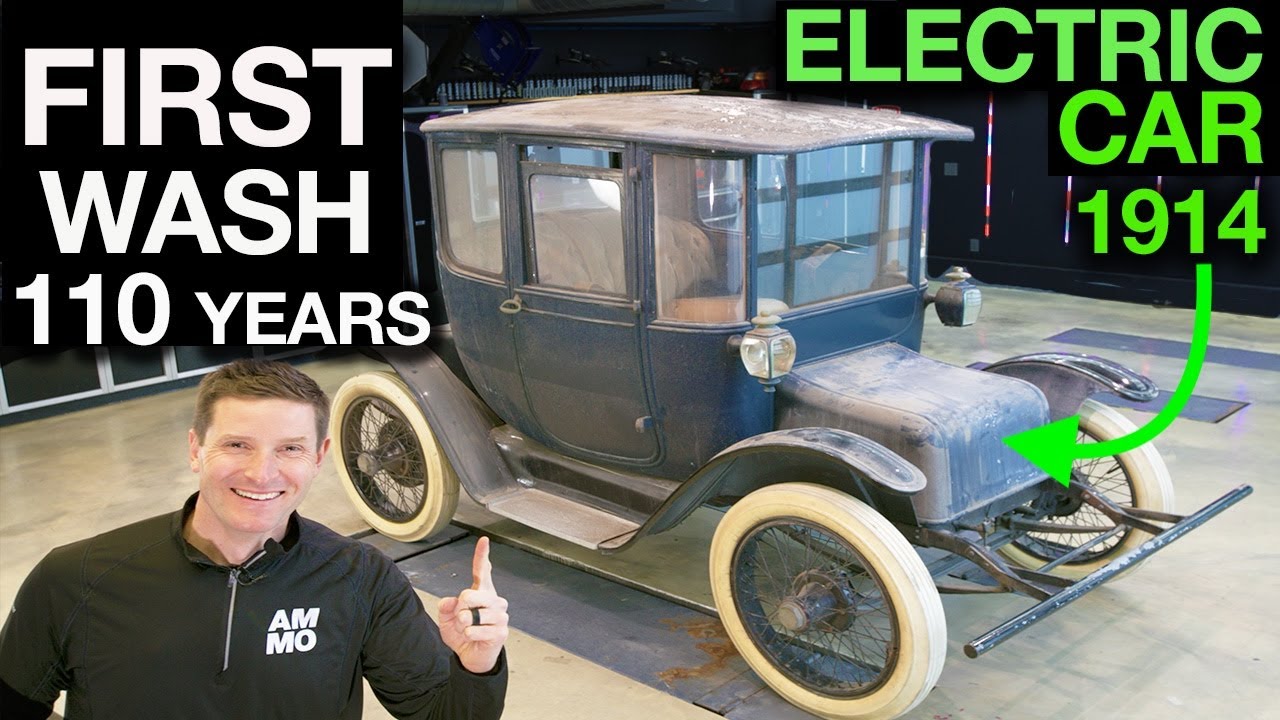
First Wash 110 Year Old Detroit Electric Car! Will This 1914 Legend Run?
Yeah, I should look how awesome that looks. ground. Wow. There she is. We left you all the dirt that you ever could ever ever want. I see that. And this is like all this is original. Yes. Just the way the the glasses. And here, take a look inside. Wow. So, it’s really fragile. It’s got like how what do you do with it? How do you how do you preserve it? So, this is original like Yeah, we had bud voses. Look at that. Yeah. Yeah. And we have little friends here. So, I I know that uh we’re going to find something fun. So, now strap up the horses. Let’s go. All right. All right. So, we got the Detroit Electric in the studio. I’ve always wanted to work on an early model uh EV. This is 110 years old. Let me give you a quick tour as to why this is so cool. Look at the front here. Now, this is one of two sections that would hold the batteries. The front is a little bit smaller than the back. I’ll show you that in a second, but you can see the firewall made out of wood. You have a little bit of insulation. I can’t imagine that saving you in the event of a fire, but the frame is actually metal and um the floor is wood. Look at the size of these gauge wires. Very, very cool. So, that’s the front. You have your powerful headlights here. And I have no idea how you would actually see anything, but again, electric powered. But if you move the camera back a little bit, you can see this looks exactly like a carriage where a horse would be in front, right? So, this is the the quintessence of a horseless carriage. If you look inside, you have a little pass through here. And what was really interesting was this particular car was very much geared towards the female crowd, the the female driver. You see one of the old signs that came with it. It says uh the old lady’s luxury car. In fact, um Henry Ford’s wife had one of these. Why? Because they didn’t like to have to crank it, which totally makes sense. With the dress, they may get the the dress caught. Uh it’s there was oil with combustion engines, smoke, noise. This didn’t have any of that. And if you look here, there’s uh there was flowers and vases on both sides. The cushions were extraordinarily plush for the time. You can see we’re like in a bit of a fishbowl here, so there’s plenty of viewing. And then this here, um, I heard a couple of stories that the captain’s chair here, which swivels, uh, when women would go in this car, which was designed for them, uh, they would have conversations outside or whatever, and they could hold the conversation whilst driving into the city or in the city, and they could see each other, which I thought was pretty cool. And then this, the big one, there’s a tiller. There’s not actually a steering wheel. And the reason why is the steering wheel came with a steering column and that steering column you couldn’t necessarily get over uh if you were wearing a dress. So a lot of the interior aside from the aesthetics of it was really designed for the female driver. Now around back here we have battery number two. And you can see there’s a perfect weight distribution from the front to the rear. So we have a little bit of a 1914 race car here. But anyhow you can see wood again. This is all original. Very very cool. And the frame of course is metal. Now, if you’re asking yourself, what is the range? Everybody wants to know. They have the range anxiety. Back then, you would get between 60 and 80 m per uh charge. And of course, you can go about 25 maybe 30 mph downhill. So, this was pretty advanced for its time. And the most interesting part that I find that relates to EVs of today, the Teslas of today, is the fact that this had a different type of regenerative braking. You know, of course, the new ones have a little bit different, but it’s the same technology. 110 years old. We’re still using that today with the Tesla. So, next, let’s get this thing cleaned up. To find an original 1914 electric car is pretty rare. And so, to bring this back and to conserve the paint, we have to really start slowly. We do that with normal cars today, super cars. We want to be very gentle and then we can get more and more aggressive. This one, we have to kind of change the entire script because I have no idea if it’s just going to flake off altogether. So, you can see here I have uh like a makeup brush. So, I’m going to go in lightly and just get the dust off because you can see some of this is starting to flake off. And if we lose this material, we’re we’re literally losing a piece of artwork here. So, um when we’re doing, let’s say, upholstery or tapestry or maybe paintings and things, this is how you would start. Archaeology, for example, you’re not going to go in there with a power washer or dump water on it, that kind of thing. Now, we may be able to get there, but step one is just to remove this. I got to put a mask on because it’s going to get pretty dusty. And just remove the dust and see if any of these little flakes come off. So that’s step number one. Now, although this may look like an extreme process, I’m really just assessing the strength of each panel by gently agitating with a very soft bristle brush to see if the paint or any material comes off from even the gentlest of agitation. The goal here is once I move the dirt away, I have to decide for myself, hey, can I do a more aggressive method or do I need to stick with this one here? So, I repeated that same kind of philosophy around the entire car just to get a baseline of how weak or how strong the material is. As I worked around the vehicle, I could see that the paint was actually in decent shape. So, I went one level more aggressive and I used compressed air, but I hopped up on a chair and went to my master valve and just basically shut it down and just had a little bit of air come out in case I made a mistake and accidentally squeezed and then, you know, a big burst of air came out and that I would blow all the paint off. So, I had it so it just kind of whisked air out. So, as I was using the brush and the air, I could kind of speed up the process. Again, that was just like a half step more aggressive. Now, although using the brush for step one seems a little excessive or extreme, the goal here was try to remove the dust so I could see, uh, you know, the material. Now, three things popped out. You can see here, uh, this was all covered in dust. I couldn’t see that, but you can see this is completely flaking off. So, I have to address this somehow and be very careful. You see it moving right now. The little bit of paint right there. It’s wobbling back and forth. If I hit that with compressed air, it would just all fly off. So, I couldn’t see that and that’s why I use that little duster. Second thing is we talked about on the other side, the wood is starting to to go. Right here is a perfect example. Now, this is actually not the worst spot. The back is even worse. But the moral of the story is I couldn’t see this because it was just caked in in uh in dust. Same thing on the back here, completely falling apart. What I do next is I take uh spit and I will mist this. Get this nice and wet and lay it on here. Push. And I’m really confident that this is going to be in decent shape. And now I’m just trying to use a little bit of capillary action to see if this this picks up the dust. And I’m not scrubbing right now. You can see I’m literally just blotting. And so far so good. And so the idea is really just to test the strength of material because at some point I’d like here and just wipe it. so I can move on. But we really want to test for the next hour or so. I’m doing fullon triage. With the first few cautious steps now done using the brush and there was no damage or no stress done to the surface. I moved up the scale, introduced a little bit of moisture by spraying frothy onto a microfiber towel and gently wiping. As you can see, when I was done, there was no paint transfer, and it was way easier than the brush method, of course. Obviously, I’m being incredibly cautious here, but Frothy does add tremendous amount of lubrication and it acts as a hctant to increase the level of moisture on the material. With each progressive step, I was becoming more and more confident in the durability and the strength of the paint on the EV. Okay, now that we got the body for the most part relatively clean, we’re going to focus on the wheels. Again, right now I’m kind of just pecking at things just to kind of get a feel for the strength of the material. We’re going to work on the wheels. Mark told me that these obviously aren’t 1914 original. I think at some point, I don’t know, it wasn’t last week, but it wasn’t, you know, 100 years ago, they replaced the tires here just so they can move the car around. So, we’re going to be a little bit more aggressive on this. Use some plum. I have steel wool here to kind of brighten these things up. And the wheels themselves actually look pretty good. So, we’re going to introduce a lot of frothy. And then I have a bucket full of uh water and and a light uh brute as well. So, step one, let’s put some frothy on here. Let it sit for a second. And then we’ll go on and scrub everything. Heat. Heat. After my success, ful wheel cleaning and my previous frothy test I did, I decided to give her a proper frothy wipe down on the entire vehicle. As you’ve probably noticed by now, the roof is just way too far gone. I tried to do a little bit of the brush and a little bit of the air and it was just flaking off everywhere. So, at this point, because of the sunbaked damage that’s up there, we’re going to just leave it alone. focus on the rest of the the vehicle beneath the roof. Now, at this point, the carriage has been cleaned. It was a bit of a jigsaw puzzle up top here. Very, very delicate. I could barely do the brush technique down below, including the wheels. I could actually put water on it. I could put frothy on it. I It was a little bit more robust, which is pretty cool and just a testament to how well they made these 110 years ago. Now, on to conserving the paint. Uh the goal here is just to add some moisture into it. And let’s see if I can just barely take the top layer of oxidation off. This is relatively thin as you can see the blue areas uh where we are getting paint transfer. So what I’m going to do is I’m going to use a polish. I’m going to try to see if I can have this uh sort of soak in all glaze. I don’t know if you guys remember years ago and I talked to Kevin Brown about this because this is so similar to furniture. There was a lot of products back then that would cross over from furniture to cars because this is basically like kind of isish like furniture. There’s a lot of wood and it’s just a unique material. And so the goal was to put a type of glaze on there, add some moisture in, and just barely work the surface because this is incredibly thin. So I’m going to be doing kind of the same thing I just did with respect to removing all the dirt. I It’s just this peck and kind of I just look at it like a little Rubik’s cube or some puzzle that needs to be solved because there’s not just one piece just like a a brand new car today. It’s pretty much all the same with respect to the outside, the paint. This is like 25 different materials. So we’re going to go in and do the same thing I did here and hopefully it’ll look better. But that is not the goal here. It’s just to preserve uh the material. So, I have a lot of hand polishing to do. Test one is to saturate the area with exfoliate. Let it sit for a few minutes into the surface to hopefully soften up the dry and brittle paint. After quickly wiping it, you can see that the paint did look much better, but more importantly, there was no damage that occurred during that application and wipe off process. So, again, we’re just going up the ladder in terms of aggressive behavior on the surface. I did a few more tests by hand and then tried the foam pad with exfoliate again on the DA on a low speed. Oh my gosh, look how awesome that looks now. It is absolutely incredible how robust uh this area is. Next, I repeated the same process on all of the black fenders and trim because I was very confident in the strength of the paint at this point with all the testing that I did. Now, check this before and after out. Oh my gosh, how cool is that? Look at the finish there. And then now, all right, so uh we’re we’re going to blast this out. This is going to look sick. Summer. Now, at this point, both fenders, front and back, looked absolutely fantastic. They were very, very robust. So much so that we could use the polisher, as you just saw. Now, I’m going to go on to this area, the blue, which I showed you before. There was a little bit of paint transfer. We’re going to do the same process. I’m going to go very very slow and then probably overuse the product. Meaning put a ton on there, let it soak in, kind of get a little bit soft because it is a bit brittle. Work it by hand and then the goal is that maybe we can get up to machine. I doubt it, but if I can, that will speed up the whole process. Otherwise, I got to slowly go in and just conserve the paint by hand, but fingers crossed we can actually use a machine. Much like the fenders, I repeated the same slow process just to test the viability of the body of the car. Hopefully, I could use the machine again to speed up this process. As you can see, the first few passes had no paint transfer, indicating it did have some type of strength and some type of resiliency. In other words, it didn’t fall apart after one wipe, which was good. For test two, I went a little bit more aggressive by hand. Put a little bit more pressure, and I saw a bit of transfer, but not much. And the oxidized areas that I was worried about didn’t didn’t get worse in that process. Up close, you can see the shrinkage from its age, and of course, the oxidation from the very top of the paint to the very bottom of the paint. All things considered, despite the fact that it’s incredibly dry and has now kind of shrunken down, it’s still quite strong, which is impressive. For test three, I went to medium to heavy pressure by hand. Okay, if you see this spot right here, there’s a line right there. That’s where I put a little bit more weight into it. And you can see the paint um came off in terms of paint transfer um right there a little bit. But I did get a bit more shine out of it. So now we’re we’re really uh we’re we’re walking on a fine line here. And that’s where I stopped with the hand polishing. So h I’m going to do a few more tests, but that’s that’s what this is all about. Just kind of pecking and poking and going thinking about which is the best move here. H for test four. I then used a 3-in pneumatic for 2 to 3 seconds at most. Oo, that looks good. We might be able to get away with this. Heat. Hey, Heat. Hey, hey, hey. Okay, so there you go. I just spent a couple hours polishing it and it came back really well. Now, the thing that I just realized as I was doing it, when I first started, I was super gentle, very delicate, and then by the end of it, I realized this thing’s a tank. It is so much more resilient than I thought it was going to be from the beginning. I’m glad I did what I did here. Uh, and the roof is pretty bad, so I’m going to leave that alone. But here, there’s a little bit of paint missing. And I I said, “You know what? I have this gut feeling. I can go in and polish it and nothing’s going to happen.” And sure enough, nothing flaked off. So, it’s a little bit of an anomaly or just it’s bending my brain a little bit, but it’s just a testament to 110 years old and the paint is just that phenomenal. I’m going to go in now and I’m going to put uh just a little extra shine and have it kind of pop with carnuba wax. And then, yeah, we’re going to hop in the interior. Hopefully, the interior is just as resilient. I don’t think so, but we’re going to going to be very gentle and start very slow like we did before. But, I can’t imagine being able to do a whole lot in there. I think it’s just going to vaporize, but I guess we’re going to find out in a minute. But before then, we’re going to put wax on the car. Is there any B? Oh boy. Now, when it comes to the interior, you can see it is incredibly brittle, sundried. There’s some stitching coming out here and there. So, there’s not a whole lot that we can do, but we are going to try to conserve as much as possible by removing everything that can be removed. And you can see there’s like this wood chips, and there’s things that we can vacuum, but I’m going to go over a couple techniques on how to vacuum this if possible. And then um some certain techniques that are used in the museum industry when you’re cleaning tapestries or maybe paintings and things of that nature that uh are very very fibrous. So in this case, if I were to take compressed air and just blow on it, this whole thing will just turn into vapor or dust. And obviously we don’t want to do that. So we’re going to be very very gentle in here. And then we’re going to give the boys a call and hopefully get the batteries installed and go for a ride. Under the carpets, I found a really old soap from Colgate called Cashmere Bouquet. At first glance, I didn’t really give it much notice, but after a bit of research, it turns out that this line of soap was first introduced in the 1870s and was marketed as luxurious floral soap blended with cashmere flowers. Obviously, today that doesn’t really do anything for us. We have floral soaps and scents or whatever. It doesn’t really matter, but back then this was a huge deal. Colgate specifically targeted affluent women, so it makes sense that this would be found in an EV designed for women. Either way, I found a ton of other things that I found an old handwritten note as well as the original motor schematics in charging diagrams. Just so cool to find something original, 100 years old, just wild. And of course, it wouldn’t be a barn find if I didn’t have some ancient feces as well. Next, I gently vacuumed. The sandlike material I’m vacuuming here is because the seats were originally stuffed with horsehair and natural fibers. But after 100 years, they tend to break down into dust that feels and looks like sand. A normal but eerie reminder of how old this car really is and the stories it could tell. When it comes to vacuuming really old or brittle upholstery like this one here, the first thing you really want to think about is having a vacuum with an adjustable suction on it like here. This has the rabbit and of course the turtle. And if you lower it all the way down, the suction’s almost nothing. Just enough to kind of lift up the very light dust and dirt. Now, this one here is much like the rest of the car, the outside, it’s more robust than I thought. It looks pretty bad. I’m not going to lie to you. But if you run a vacuum, I did a test spot over here and it was it was pretty strong. So, we’re going to do that with the lower suction. and I think we’ll be fine. But if you were in a situation where uh it it just disintegrated and you had to do something with it, very much like in a museum where you were trying to preserve something, there’s a cool technique with cheesecloth. You put cheesecloth over the material and then you take the vacuum. I won’t turn it on right now so I can talk. And you hold the vacuum above it and in theory the dust comes through the cheesecloth whilst keeping the fabric down. the the the challenge uh that this, you know, sort of defeats is uh the cheesecloth will prevent that fabric from being sucked up from the suction itself, thus pulling it out and and ruining it and causing the stitching to to uh sort of separate. So, this is kind of a cool technique. Thankfully, we don’t need that, but I always have some spare ones in the shop here. So, I’m going to go in gently vacuum all of this. Now, there are some pieces in here, like the door, uh, that I can’t really vacuum cuz it is starting to disintegrate, but for the most part, the the areas that you sit on is just really, really strong. So, I’m excited to clean these up and get them back in. deep within the motor, I found a few mouse nests as well, but for the most part, it’s in really great shape for its age. If you don’t have a vacuum that allows you to regulate the suction strength, then a brush attachment is a great way to whisk up the dirt and keep the tip of the suction head about 2 to 3 in away from the surface causing any potential damage. Next, I use Frothy on the floorboards just to sort of scoop up the last bits of feal matter under the carpets and the seats before reinstalling them. Finally, I cleaned up the incredibly thin glass that I felt like I could accidentally put my hand through at any moment while I was wiping it. At the time, they use single pane plate glass that was hand cut and the same that you would find in any house in the early 1900s. Now, this glass had no lamination, no tempering. So, any minor accident would cause the glass to shatter into large, razor sharp pieces. However, what’s interesting at the time is some luxury car makers offered what’s called safety glass, which of course was laminated, but it was really expensive. Detroit Electric didn’t offer this as a standard option. It wasn’t until the mid 1930s or so that safety glass became more of a standard in American cars. After cleaning up a few odds and ends, it was now time for Mark and the boys to pick up the EV and get it back to their workshop in hopes of getting it running very soon. Hey. Hey. Good to see you. Good to see you again. Come on in. Check her out. Wa! Holy cow. What do you think? I can’t get over. I can’t believe it. I You know, you know what I see? I can’t believe that those lights polished up. How did you do that? Wow. That that that was a late night look. That looks cool. I mean, it’s the weirdest thing that your eye catches, you know? It’s the blink, you know. Wow. Oh, the fenders, too. The fenders came out really well. You know, obviously, uh, you know, we got to get some batteries in there. That your department, but the the fenders were probably the easiest to polish. Incredibly robust. So, I could actually be relatively aggressive with this. So, I started that like super Well, you don’t know in these kind of things, you know, especially something, you know, that’s that’s this old and and you don’t know even what kind of paint it is, you know? So, so step number two, get this thing running cuz I’m dying to do a little tiller action. I’ve never done that before. Oh, yeah. No, this will be fun. This will be fun. And and it’s I appreciate you. And I think it’s probably pretty snappy, too. You know, these electric cars. I mean, you know, who’s going to be the tiller man? I’m going to be the tiller man. Yeah, you got her. Come on. All right. How what how you do this? I have no idea. You just go in there. Push the thing. Holy cow. This is awesome. I got to get one of these. Cut it over there a little bit to the left. Yeah. How we done backs? Oh, that is awesome. Okay. Got our work cut out for us. You You do indeed. Polish your Ferrari or something. Yeah. No, I got to go back to Ferrari. I would love to know who actually drove that. Look at this license plate. Steams. Wow. Hey, what’s going on? Hey, how you doing? Good, good, good. So, what do you got for me? Well, we’ve got uh the battery packs that we’re uh going to use as replacements for the originals. What were the originals? The originals uh on this particular car would have been a series of two-volt lead acid batteries all wired in series. Uh 40 batteries total. Really two packs of 20 each wired in series. Uh each given 40 volts. Um so you can’t go down to the store and just go get those. No. No. The other option would have been Edison batteries which are you know rarer than hens teeth. Um and uh so we don’t have those but we only are concerning ourselves with how much voltage we have to make uh and in what format. So, what we did is we’re going with um two separate packs like they did, but we’re going instead of 40 cells, we’re going with three cells of 12 volts as opposed to 20 cells at 2 volts for each pack. So, does it basically give the same thing just with the Yeah, we’re we’re 8 volts shy. Um but it won’t really matter to the motor. So, we built these trays to hold them so that I didn’t even notice that. Yeah. Yeah. that this way we’re not um modifying anything on the original car. All right, let’s see what it looks like. All right, so I think that’s super cool. This thing just drops in, latches in like that. Positive forward. Well, this is a marvelous little car. The uh the brains of the car are called the controller and that’s right down in this this part of the of the car. And you we’ve we’ve disconnected the batteries just for this demonstration, but you actually your speed selector handle is right here. It has five forward speeds that you click one at a time all the way through. And when you want to go in reverse, you flip up this little restraint here, hold the handle up, and the car goes backwards. So, it requires a little bit of coordination, but it’s not very difficult. When you want to secure the car, cut off all the electrics, you go all the way up in the air, and the and the electrics are killed in the car. But each one of these fingers down here, if you look at, it’s a pretty complicated mechanism. There’s an awful lot going on here mechanically and electrically. Each one of the fingers controls a different circuit. And as the uh you can maybe you can see the cylinder rotating as I move the speed selector. Uh and uh they uh complete different circuits to do different things, different speeds. Uh when we started working with this car, this is totally frozen up and we had to clean it up and uh get the circuits working. But it’s it’s a marvelous car because there’s no on these on these electric cars, you typically find a lot of uh melting of the contacts. And this car had none. Virtually none. So, it hasn’t been driven very much in its whole lifetime. I would I’d be surprised if it had gone a thousand miles. I have no idea. But there’s no wear on this. So, it’s it’s an original car that hasn’t been driven and it works just fine. So, oh my gosh, that is crazy. Don’t think I don’t have the speeds. You don’t have first gear. I don’t have anything. Oh, brakes work. All right, I’m going to operate this and just get on get on the running board and see if so that if I lurch forward. All right, you you guys hold that as opposed to under it. I got you. Oh, that was a big arc. That was a big arc. Yep. You okay? Yep. Good call on the GoPro, by the way. We can do the whole thing in reverse. It looks the same either way. Yeah, it’s true. It’s just that things are a little stiff and squeaky and and and all that. So, it’s again, it’s a matter of getting tension on the springs and cleaning it up, putting a little dialectric grease on it. So, we driving. We’re driving. Yes. It works. It’s alive. How awesome is this? Oh, it’s cool. Oh, and we got brakes, too. Oh, yeah. Brakes. Brakes for our kit. Ah, we did it. We did it. We did it. Let’s see if we can go backwards here on this. And it goes in reverse, too. Yeah, it does. Well, guys, we’re all done. The Detroit Electric looks great and drives great, too. I’ll see you on the next one. Bye-bye. It turns out this is a shopping list that was in the car and it said and we transcribed it 2 and 12 o eggs vegetables tomorrow Monday lettuce celery and roast is on that little slip of paper. Isn’t that crazy?
This is a 1914 Detroit Electric Car in fantastic yet dusty condition and getting a complete service from MS Herman & Company and Bills Vintage Cars. They tasked me with a preservation clean-up and I demonstrate the careful detailing techniques necessary to rejuvenate this 110 year old electric car. We also find some incredible relics during the detail and take a deep dive into the history of this legendary automobile. Afterwards, Mark and his team work to get this 1915 EV running.#carcleaning
Use Code AMMO15 for 15% OFF Car Care Products at 🚗 https://www.AMMONYC.com 🚗
SHOP AMMO AUSTRALIA HERE: https://ammonyc.au/
NEED A VINTAGE MOTOR CAR SPECIALIST? http://www.hermancompany.com/
NEED AN ELECTRIC CAR EXPERT? https://www.billsvintagecars.com/
AMMO TRAINING ACADEMY HERE: https://www.ammotrainingacademy.com/
Second Channel: AMMO STUDIO https://www.youtube.com/channel/UCJtF34yf_Y0iPLnIt-UdwKA
IG: AMMONYC
🎮 PLAY THE AMMO DETAILING VIDEO GAME!
https://store.steampowered.com/app/1433570/Car_Detailing_Simulator/
►CLEANING KITS from AMMO:
NEW CAR KIT: https://ammonyc.com/products/ammo-new-car-detail-kit
STARTER KIT: https://ammonyc.com/products/ammo-starter-kit
HOSELESS WASH KIT: https://ammonyc.com/products/hoseless-lift-kit-150
SHOW CAR KIT: https://ammonyc.com/products/ammo-show-car-kit
PAINT KIT: https://ammonyc.com/products/ammo-paint-regimen-kit
WHEEL KIT: https://ammonyc.com/products/ammo-wheel-regimen-kit
INTERIOR KIT: https://ammonyc.com/products/ammo-interiorregimen-kit
GLASS KIT: https://ammonyc.com/collections/kits/products/obey-glass-cleaning-kit
CERAMIC KIT: https://ammonyc.com/products/ceramic-maintenance-kit
►PRODUCTS & TOOLS from AMMO
PAINT COATING: https://ammonyc.com/products/ammo-reflex-pro-ii-enamel-coat
INTERIOR CLEANER: https://ammonyc.com/products/ammo-lather-interior-cleanser
CERAMIC SPRAY COAT: https://ammonyc.com/products/ammo-reflex-pro-top-coat-1
WHEEL CLEANER: https://ammonyc.com/products/ammo-plum-wheel-cleaner
PAINT SOAP: https://ammonyc.com/products/ammo-foam-paint-cleanser
DRYING LUBRICANT: https://ammonyc.com/products/ammo-hydrate-paint-moisturizer
LEATHER CONDITIONER: https://ammonyc.com/products/ammo-mousse-interior-conditioner
WHEEL COATING: https://ammonyc.com/products/ammo-gelee-pro-wheel-metal-coat
CERAMIC WAX: https://ammonyc.com/products/ammo-blush-pro-finishing-wax
CLEANER SEALANT: https://ammonyc.com/products/ammo-skin
TIRE GEL: https://ammonyc.com/products/ammo-mud-tire-gel
SPRAY WAX: https://ammonyc.com/products/ammo-spit
GLOSS WAX: https://ammonyc.com/products/ammo-creme-reflective-paste
HOSELESS WASH: https://ammonyc.com/products/ammo-frothe-hoseless-lift
POLISHING PADS: https://ammonyc.com/products/wafl-finishing-pad
CUTTING PADS: https://ammonyc.com/products/sheer-cutting-pad
POLISHING FLUID: https://ammonyc.com/products/x-foliate-polishing-fluid
GLASS CLEANER: https://ammonyc.com/products/ammo-obey-glass-cleaner
LEATHER BALM: https://ammonyc.com/products/ammo-silque-leather-balm
PPF WAX: https://ammonyc.com/products/ammo-conceal-ppf-wax
WHEEL WAX: https://ammonyc.com/products/ammo-gelee-wheel-wax
CARPET CLEANER: https://ammonyc.com/products/ammo-shag-fabric-cleaner
TRIM COATING: https://ammonyc.com/products/ammo-frame-pro-trim-coat
WHEEL SOAP: https://ammonyc.com/products/ammo-brute-wheel-soap
DEGREASER: https://ammonyc.com/products/ammo-titan-12-degreaser
DETAIL BRUSHES: https://ammonyc.com/collections/brushes
MICROFIBER TOWELS: https://ammonyc.com/collections/towels-and-pads
ANTI-SALT SOAP: https://ammonyc.com/products/boost-anti-salt
PET STAIN CLEANER: https://ammonyc.com/products/ammo-dygest-pet-stain-remover
MICROFIBER WASH: https://ammonyc.com/products/ammo-revive-microfiber-detergent
METAL POLISH: https://ammonyc.com/products/ammo-flux-metal-polish
Disclaimer:
Due to factors beyond the control of AMMO NYC, Larry Kosilla, and Make Rain Productions, we cannot guarantee against improper use or unauthorized modifications of this information. AMMO NYC, Larry Kosilla, and Make Rain Productions assumes no liability for property damage or injury incurred as a result of any of the information contained in this video. Use this information at your own risk. AMMO NYC, Larry Kosilla, and Make Rain Productions recommends safe practices when working on vehicles and or with tools seen or implied in this video. Due to factors beyond the control of AMMO NYC, Larry Kosilla, and Make Rain Productions, no information contained in this video shall create any expressed or implied warranty or guarantee of any particular result. Any injury, damage, or loss that may result from improper use of these tools, equipment, or from the information contained in this video is the sole responsibility of the user and not AMMO NYC, Larry Kosilla, nor Make Rain Productions. Video and Content are owned by Make Rain Productions © 2025