
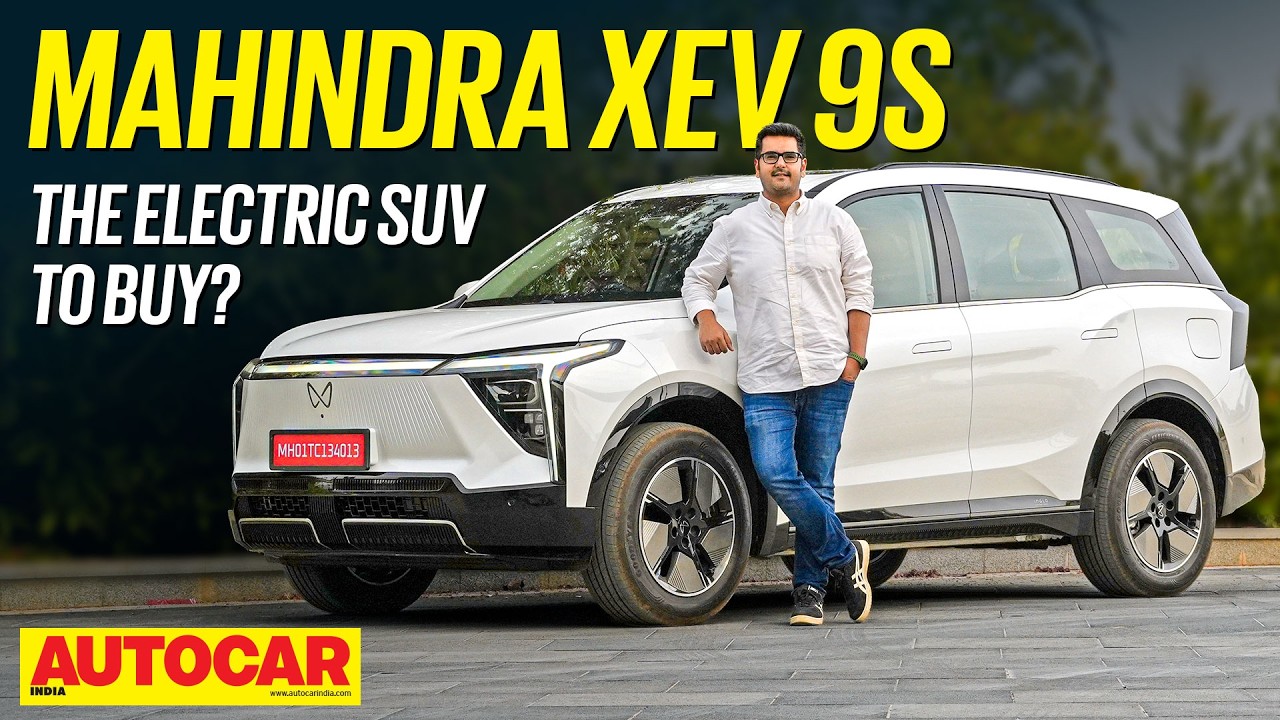
Mahindra XEV 9S review – Best of XUV 700 meets best of XEV 9E | Autocar India
If the BE6 was all about being radical and aggressive, the XEV 9E was all about a glamorous SUV coupe style. This XEV 9S is all about being conventional and practical with seven seats. Now, I know what you’re thinking. Isn’t this just an XUV 7O? Well, you’re partly right. You could think of the XEV 9S as an allect electric version of the XUV 7O, but under the skin, under that very familiar shape is Mahindra’s inlow electric architecture. So, there’s going to be a lot to uncover over this video. Let’s get straight to it. In its basic shape, the XCV 9S is no different to an XUV 7O, but the styling treatment is sharper, more modern, and closer to the XCV 9S. Now, in terms of styling up front, there is a strong resemblance to the XEV90, but I will tell you that they are not identical. The differences come through this thicker band of lighting. It extends the full width of the front end as well as flows right down. The main headlights are positioned here. The other point of difference is that the 9E positions its Infiniti logo up here while the 9S has it over this concealed section on the front. Now, under this bonnet lies a 150 L frunk, which is a very usable space. Now, it’s at the size that it is unquestionably a derivative of the XUV 7O, but there are certain differences. For instance, you get this gloss finish on the wheel arches and differences to the other Mahindra electric SUVs also come through in the size of tires. The XEV 9S uses 18 in while the BE 6 and XEV9E use 19 in and optional 20 in. But apart from that the door panels, the glass house and even this section is shared with the conventional XUV70. Now an interesting point to bring in is that the wheelbase is slightly shorter than the XEV9E and that was done to accommodate the XUV 7’s bodywork on the Indo architecture. unladen ground clearance is a reasonable 201 mm. At the back, there are detailed differences to tell it apart from the conventional XV 7O. There’s this thick band of black that goes around the lights. The lights are LED units and you get very nice detailing inside the tail lamps as well. There’s also this thick band of black that runs the width of the tail section. You get XV9s badging here. more gloss materials lower down. So, you won’t necessarily confuse it with the XUV 7O, but the similarities are there. Now, as for boot space, first things first, the tailgate isn’t part, so you’ll have to make a bit of effort to get it up. And when you open it, you’ll notice that there is not really any space. You will be lucky if you can get a laptop bag or two inside. So, if you’re planning to travel with the whole crew, you’ll have to have a separate car for luggage, but you can fold down the rear seats. They sit flush with the floor and when you do so, you get plenty of space for luggage. Now, before you ask, yes, Mahindra has packaged in a spare tire and it sits under here. Like the exterior, the XCV 9S’s interior is also part XCV90 and part XUV70 O. Now, if you’ve been inside a Mahindra XEV9E, you’ll feel at home in the XCV 9S because the atmosphere up front is exactly the same. The same dashboard, the same three screen layout is carried forward. And I must say that it still does look very cool even a year after we saw it first. Now, talking of the tech, you get uh three screens, 12.3 in digital dials, a 12.3 in central touchscreen, as well as a 12.3 in dedicated screen for the passenger. Now, this layout has a lot of haters, but it’s also a feature that is really driving sales in the showroom. Let us know in the comments section what you think about it. The passenger sidec screen is slick and onboard 5G connectivity means the passenger can stream movies and do a whole lot more on the go. But there’s still an area of concern. Now unfortunately the passenger screen still doesn’t get a privacy filter which means it is visible to the driver on the go and that can be a source of distraction particularly if a movie or something is playing on this screen. The center touchscreen really slick in operation, very smooth. But as before, packs in just too much. So you’ll need a few days and a lot of time to really work your way around this interface. Get comfortable with it. And what frustrating is that many commonly used features are also bundled into the screen. Air conditioning functions, uh, seat ventilation. So it’s always a two-step process. There are some shortcut buttons here, but it’s not as easy or intuitive uh to use as you’d have liked it to be. The few touch type controls on the center console, such as for the hazard lights, also don’t work with satisfying enough feedback. The driver environment is really nice as it is on the XV9E. The digital dials really crisp, pack in a lot of information. There’s also head-up display again loaded with information. Then there’s the steering really nice to hold. It’s not a perfect circle, but nice to hold. Uh, two-spoke layout. Looks cool. And what’s also nice is how it lights up when you start the car. Again, it gets these levers and paddles uh to control functions like the regeneration. What is an irritant is that often the touch buttons on the steering get pressed when you honk and this activates function on the touchcreen and dials when you don’t want them. Quality-wise, there are some really nice bits inside the cabin. I really like the finish that you get on the dashboard surface. There’s a generous use of gloss materials and even the seat perforations are very nicely done, but at the same time there quite a few scratchy plastics in clear sight as well. Also note you’ll need to take special care to keep the glossy surfaces scratch-free and the light seats clean. Now the front seats are really comfortable, very well judged on cushioning, nice and large. uh they get power adjust there’s seat ventilation as well and these are functions that you also get on the front passenger seat other talking points in the cabin include a 16 speakeraker Harmon Cardon sound system that packs in Dolby atmas sounds really really good there’s also Mahindra’s driver monitoring system so there’s a camera here it’s always observing you studying uh how attentive you are and it will alert you if it senses that you’re not paying enough attention to the Other features include ambient lighting, a decent 360° camera, and auto park. At the back, the XUV 9S feels like an upgraded XUV 7O. Getting into the 9S is convenient enough because the flow isn’t that high off the ground. And once you’re inside, you like the 9S for the very reasons you’d have liked an XUV7O, and that is for the ambience in the middle row seats. There’s lots by way of room, and the sense of space is accentuated by these large windows, and of course, this panoramic sunroof that lets in a lot of light. Now, an interesting point of difference to the 9E is that this glass roof actually opens. The 9E uses a fixed glass roof. Now, as for the seat itself, it’s again really nicely cushioned. This flat portion means a middle passenger will not feel like an unwanted guest. There’s enough by way of shoulder room. There’s a good deal of thigh support and the seating position isn’t that typical knees up type that you expect in an EV that positions its battery pack under the floor. It’s quite natural and you will like it for that. There’s also an adjustable back rest recline and Mahindra has also gone the distance over the XUV7O to add in a feature that was always missing and that is a slide function for the middle row seats and that means you can really balance out the space in the middle row seats and in the third row of seats. Some of us did find the lower back support a bit obtrusive especially when the seat is reclined. Other features at the back include these sun shades that do a very effective job of keeping the sun out on really hot days. Then there’s also seat ventilation for the second row. And Mahindra has also packed in a powered boss mode. So you can just use these buttons here, move the front seat all the way forward and sit in a great deal of space. There’s also other features of note. You get a wireless charging pad over here. uh dedicated AC vents at the back. Though this does not get a dedicated climate control zone for the rear section of the cabin. There’s also a 65 watt uh charging outlet. There is uh what Mahindra calls a bring your own device feature. So you can put your iPad here and create a rear seat entertainment system as well. Of course, all three seats get threepoint seat belts. There’s an adjustable headrest for the middle passenger as well. And when the middle seat is not in use, you can fold down the rear center armrest. Moving to the third row, accesses from the curb side, seat slide, and a one-touch tumble and fold function open up a decently large passage to the back. Now, the XCV 9S’s third row is not meant for an adult of my size. I’m just under 6t tall, and I cannot sit straight. But someone of average height can actually make the most of these seats. And helping that fact is that the middle row seats slide forward. A feature, as I’ve already mentioned, was missing in the XUV 7O. And one that makes a big difference to how you can balance the space inside the cabin. So if you move it just a couple of centimeters ahead, there is enough knee room. Sure, the seating position is very knees up. It’s not ideal, but the fact is that this is still a usable third row. The large rear windows do help the experience at the back. Features at the back include air conditioning vents on both sides. There’s also a blower control. You also get a 12vt charging socket here. And both passengers get dedicated cup holders. The XCV 9S fits the bill for buyers with large families. But what’s it like to drive? Before we proceed, it’s worth highlighting once again that the XCV 9S isn’t merely an EV conversion of the XUV 7O, but is completely different under the skin, sitting on a cuttingedge electric architecture. If you know your Mahindra EVs, you’ll note the specifications are familiar. Now, this black panel at the sides of the XCV 9S symbolizes where the battery pack sits in the body. Now, there are three options of battery packs. Yep, not two, but three. So, there’s a 59 kW and a 79 kW as well as a new 70 kW battery pack option. And that Mahindra says sits in a sweet spot in terms of range. Now to talk numbers, the 59 kWh delivers a certified range of 521 km. The 79 kWh delivers 679 km of certified range while the new 70 kWh battery pack option gives you 600 km of range. The LFP battery pack uses blade cell technology and first owners get a 10-year warranty on it. As for charging options, so the XCV 9S supports AC as well as DC charging, DC charging at up to 180 kW. Now, the interesting thing is Mahindra is setting up a network of chargers capable of 180 kW of charging. The good news, if you can find one, 20 to 80% takes just 20 minutes. Now, like the BE6 and XCV90, the XCV 9S also uses a rear-mounted motor that powers the rear wheels. Now, there are three motor outputs depending on battery capacity, though the torque figure remains constant at 380 Newton m. The 59 kWh produces uh 231 horsepower from its motor. The 70 kWh takes the power figure up to 245 horsepower while the range topping 79 kWh battery pack gives you 246 horsepower. For reference, rear wheel drive versions of the Tata Harrier EV make 238 horsepower. However, the Harrier does have bragging rights with the option of a more powerful 313 horsepower dual motor all-wheel drive variant. While the Inglow architecture supports a dual motor arrangement, Mahindra hasn’t confirmed any plans for this configuration on the XCV 9S. Featured here is the XCV 9S in topsp spec 79 kW and 286 horsepower form. With 286 horsepower and 380 Newton m, performance is really, really well taken care of. Overtakings don’t need much planning. Uh dab on the accelerator pedal and the job is done. You can fine-tune the power delivery and driving characteristics with four drive modes. Talking of the modes, there is a step up in performance as you go up the modes. And in top race mode, you really feel the best that the 9S has to give you. Mahindra claims a 7second 0 to 100 kph time for the 9S in race mode. Now to put things in the right perspective, think of how much more powerful an XUV 7 would need to be to get that kind of performance. The XCV 9S also stays quiet while at it. Now, of course, this being an electric refinement is really, really well sorted. uh you hear a distant ver from the electric motor and that’s more audible when you’re sat at the back. But from the driver’s seat, there’s really not much that you hear from the power train. Even road noise and wind noise are really well contained. So what you get is a very quiet and relaxing experience. The XV 9S uses an allindependent suspension with sophisticated adaptive damping. Now, the XCV 7S is set up softer than a 9E, and you will feel that uh over smooth wave undulations where the body will move up and down, and that vertical movement does carry on a bit longer than you’d want it to. It’s not what you’d call floaty, but it does feel a touch too soft. On the other hand, bump absorption is really good. The suspension does a really good job of softening the blow of potholes underneath. The XCV 9S is tall, heavy, and softly set up, but still manages to feel very neat around corners. The 9S corners with confidence, and you get a good feeling of connect at the steering wheel. In fact, the steering is really nicely done, very well calibrated. Now, what’s responsible for that slick handling behavior is the XCV 9S’s rear wheel drive layout. Now, in a front-wheel drive car, the front wheels are burdened with the task of not only transferring power from the engine to the road, but also doing the job of actual direction changes. So, that’s two axises for the front wheels to deal with. But when the power goes to the rear wheels, the front wheels only have the job of direction changes. And that brings with it that fluidity that you get only in a rear wheel drive car. Also nice is the regen braking that uses the motor to slow the vehicle down. There are five levels of regen. So you can have the car coast along without any regenerative effect. Uh then you have level one, two and three. And you also have the option of one pedal driving which is the most severe level of regen braking. What that does is when you lift off the accelerator pedal, uh it’ll use the regen braking to actually bring the car back to a halt. In smooth flowing traffic, you can actually get by with one pedal mode for long periods. As for the friction brakes, the XV 9S gets disc brakes on all four wheels as standard. Braking performance is good, but we’d have liked a higher bite point on the brake pedal. In an emergency situation, the car can also intervene with automatic braking that’s part of the comprehensive radar and camerabased ADAS suite. Now, there’s lots and lots of ADAS functions, but on our drive route today, I haven’t been able to try out all of those. Uh we’re driving on the outskirts of Bengaluru near Nandi Hills. So, I have tried out uh the traffic sign recognition which has worked well. Blind spot, blind view monitors worked well. Uh thankfully no need for auto emergency braking. Uh adaptive cruise control also done its job. Lane centering assist also has worked without problems. That said, we will need the XV 9S for a longer duration to better judge ADAS functions. On the subject, the XV’s list of standard safety features is long. There’s seven airbags, ABS, ESC, ISOIX, child seat mounts, and more. The XCV 9S doesn’t have a Bhat endcap or global endcap rating as yet, but there’s confidence in knowing that the closely related XV9E is a Bat Encap five-star rated model. A happy takeaway from the driver’s seat is how the XCV 9S manages to feel smaller than it is. Now, another highlight on the XCV 9S is its tight turning circle. Yep, this is a big SUV with a pretty nice and tight turning circle and that makes it all the more manageable in tight city driving conditions. The XCV 9S also fits the bill as a chauffeer driven vehicle. Now chauffeerdriven buyers will have it really good in the XCV 9S. The sheer sense of space, the silence that you get, it all comes together really well to deliver a very premium experience. However, that softness in the suspension setup is more pronounced at the back. When you’re driving on a smooth road, but there are these long wave undulations. You will find that the 9S also moves about quite a bit. These vertical movements are quite pronounced. It’s not uncomfortable, but that movement is hard to miss. We also discovered an XC 9S quirk over our drive. Now, an unusual quirk that we’ve noticed over our drive is that when all seats are up, the experience is nice and quiet, but when you fold the third row down, you can hear the rear-mounted motor. It’s not loud, but it’s just a point of difference. Now, onto the matter of pricing. Prices start at 19.95 lakh rupees for the 59 kWh variant and go up all the way to 29.45 45 lak rupees for the 79 kWh variant in fully loaded form. If you compare prices, the 9S actually works out about 2 lak rupees more affordable than a light spec variant of the XEV9E. The pricing isn’t just standout good within Mahindra’s EV lineup, but attractive enough to even pull some XUV 7O petrol and diesel buyers, at least in states with incentives on EVs. Of course, the low running costs of an EV make the switch more enticing still. Among electric options, the Tata Harrier EV is closest to the XEV 9S in size and price and has the advantage of all-wheel drive, but the majority of buyers will find the Mahindra to score bigger on that allimportant wow factor, aside from its obvious flexibility of a third row of seats. Low and midspec versions of the XCV 9S also pack in way more content than like versions of the Hyundai Creta electric. that’s fundamentally a smaller vehicle. The XEV9S also comes across as more wholesome than three row electric MPV alternatives like the Kia Karan’s Clavvis EV and BYD eBank 7. The XV 9S isn’t without its lesser points, though. The ride feels softer than it should, the user interface is confusing, and there are some ergonomic irritants as well. But if you zoom out and see all that you get for the money, be it in the refined powertrain, the tech and features, and of course three row seating, you’ll find the XCV 9S makes a very compelling case for itself.
The XEV 9S is the latest Mahindra electric SUV to go on sale. Nikhil Bhatia tells you why it’s worth a serious look.
Cameraperson: Roshni Manghani (+ official B-Roll)
Editor: Siddhesh Kadam
Chapters –
0:00 – Introduction
0:24 – Is it an electric XUV700?
0:50 – Design and styling
3:03 – Boot space and spare tyre
3:45 – Interior, quality and tech features
7:33 – Middle row space and comfort
10:17 – Third row comfort
11:20 – Battery, range and charging
13:02 – Motor outputs
13:48 – No AWD…for now
13:55 – Performance
14:58 – Refinement
15:20 – Ride comfort
15:50 – Handling
16:49 – Regen braking
17:25 – Braking performance
17:35 – ADAS
18:20 – Safety equipment and crash test rating
18:39 – Turning circle
19:02 – Rear seat experience
20:00 – Price, competition and verdict
SUBSCRIBE to Autocar India for the hottest automotive news and the most comprehensive reviews ► http://bit.ly/AutocarInd
Autocar India is your one-stop source for test drive reviews & comparison tests of every new car and motorcycle launched in India. We also offer a great mix of other automotive content, including weekly news, motor show reports, travelogues and other special features.
Website: http://www.autocarindia.com
Facebook: http://www.facebook.com/autocarindiamag
Instagram: https://www.instagram.com/autocar_india/
Twitter: http://www.twitter.com/autocarindiamag
New car reviews ►http://bit.ly/ACI-NewCarReviews
Comparison tests ►http://bit.ly/ACI-Comparison
New bike reviews ►http://bit.ly/ACI-BikeReviews
Features ►http://bit.ly/ACI-Features