
Best Hybrid Ute For Camping & Towing In 2025 | PHEV WINNER!
There are only three PHEV utes on sale right now. But don’t think for a minute that means all are created equal. In fact, each of these plug-in pickups does its thing very differently. So, which one best suits your lifestyle? That’s what we’re about to find out. I address all these vehicles biggest criticisms and flaws, not by reading brochures, but by getting out there and through firstirhand experience. We are doing all of this to find out which plug-in hybrid ute is the one to take you away from daily life. And then we found out we might have got it all completely wrong. Dan, where are you? You’re very pixelated. Are you in like middle of nowhere or something? I’m out in the field. I’ve got a theory. I’ve got a test. I want to run it by you know how you did that comparison between the BYD Shark and the Ranger and the BYD Shark and the Canon Alpha. Yes. Yes. Good fun. And the BYD was kind of the better allrounder, but it focused sort of more on like suburbia and day-to-day duties. You want to try something a little more hardcore? Exactly. These cars sell themselves with the promise that they’re freedom machines. They’ll take you away from day-to-day life. I want to flip the whole thing on its head. I want to tow this thing 2.2 tons. I want to take them off road. Of course, they’ve got V2L. You can run your campsite off the battery under there. And I reckon it could give us a very different result to the ones that you got. We didn’t test V2L out in the field. We didn’t tow. The shark will still do quite well. I think maybe its V2L will be strong. If my prediction is true, then uh you can buy me a case of beer. All right. Okay. Well, uh that means I have to drink this one immediately. Trying to keep them in one piece. No destruction. The BYD Shark 6 is a really impressive dual cab ute, and in previous comparisons, it’s proven to be the best allrounder. But what we have here are three plug-in hybrid utes and they all promise to take you away from the hustle and bustle of daily life. But can they? The Ford Ranger Sport has already proven itself is a very competent tradey truck and the same can be said of the GWN Canon Alpha. So what we have here is a plug-in hybrid rematch that could turn all our previous results on their head. In PHEV trim, all three have relatively small petrol engines paired with a battery and electric motors for plug-in hybrid power, which is great for the school run or a short trip to the shops or work. But what about if you want to get away on a camping trip and do what dual cabs have traditionally done so well, towing and off-roading? Ford has three other variants of the Ranger PHEV, including a cheaper XLT, but one wasn’t available for this test. However, it gets the same transmission, and its vital statistics are very similar to this one. The first test is towing, a job people frequently buy a dual cab specifically for. But how will these three go with plug-in petrol in place of more conventional diesel? The Ford Ranger has a couple of really good bespoke towing features. The first one is when we got in this car, it actually recognized that a trailer had been connected and then it asked us to either select a trailer in its menu. So you can pre-save one or we can enter one ourselves. That’s exactly what we did. You can tell it all the things you need to about a trailer, the length, the width, height, and the critically the weight. Uh and then it remembers it for next time. So a nice feature to make towing multiple trailers really easy. And the other thing that this car’s got is an inbuilt uh trailer brake system. So there’s none of that retrofitting boxes in little cubbies and making it look very aftermarket. The Ranger has a nice little unit fitted here from the factory. So this car looks to all intents and purposes like it was intended to tow things, but can it? Already we’re seeing some of that great nature of the Ranger coming through to towing duties. Um, and time will tell when it comes to the energy consumption. Already we’re down to 61%. So, I kind of find it hard to believe how someone who’s going to tow extensively, we were just chatting before and saying if you’re towing, you’re going to be spending hours on the road if you’re even slightly adventurous. So, a battery that lasts, you know, we were saying 16 km left, I don’t know whether that applies very well to to general towing duties. Well, this is where the true test starts. We’ve arrived at quite a decent hill climb with some nice winding roads as well. It’s actually very good. That balance of electric and petrol engine contributing torque into the system is pretty good. The one thing I have to say that I think plays in the RERS’s favor here is it has the biggest of the engines on test 2.3 turbo four-cylinder petrol. It has been d-tuned for more torque and efficiency purposes, but it’s still doing extremely well. And the peak power figures are 207 kW and about 700 new m. So, reasonable performance figures. But the question still remains, what happens when that battery, which is contributing to some of those power and torque figures. When that’s empty, what do we go down to? probably a good time to mention people talk about the weight of these vehicles and how they affect the efficiency and the battery degradation and also the weight of the caravan, how much you’re towing behind. But it’s absolutely, I think, as worth mentioning uh the aerodynamics and the drag of the vehicle or the caravan or whatever you’ve got behind the car that has probably just as big effect on efficiency and battery capacity than the weight of the vehicles in total. Fuel consumption about 14.4 L per 100 km which to be totally honest is lower than I was expecting. Of course, it’s not great and anyone who’s expecting to tow is also expecting those lower fuel economy figures. And finally, I do want to say that this car has a claimed fuel economy of just 2.7 L km when you’re just doing suburban duties, nothing on the back and using a combination of electric and petrol engine. Obviously, that’s all out the window for today, though. The BYD is an intriguing car because it approaches off-road and towing in an entirely different way from the conventional. But perhaps the best place to start is exactly the things that make this specific for towing. So, just like the other two cars, it recognizes when a trailer has been hitched up and automatically switches into uh the things that it needs to optimize towing. What it doesn’t do, like the Ranger, is allow you to uh program in a particular known trailer. So, if there are any settings, uh it has to work it out itself. It seems to prioritize electric power over using the engine, which is a strange decision because we haven’t been going far at all. And even though this has a larger battery, it’s about the medium size one, 30 kW hours, it’s already down to just under 80%. Because it hasn’t really been using that little petrol engine at all. I suspect that’s because the engine in this car is primarily there to charge the battery. So, it’s trying to use the battery as it as often as it can or prioritizing it. And that engine isn’t really doing very much, which seems like a mistake. It’s a wasted opportunity because we need that battery to be topped up and it’s only when I get my foot stuck in does the engine eventually start up and start contributing on the road without a trailer. One of the things everyone loves about this is how it rides. It’s got a wonderful soft uh primary ride certainly, but when you hook up a trailer, it really starts to show another side of its character which is not so favorable. You get a lot of scuttle shake. You get a lot of that classic ladder frame rattle through the car. It really feels like the trailer is exacerbating some issues that you might not detect were it not there. To an extent, it feels like it’s the cart leading the horse in this case. The one thing you have to say though, it is one of the quietest cabins I’ve ever spent any time in regardless of whether we’re on road, off-road towing or not. It is absolutely lovely and clearly a lot of efforts been put into NVH uh and noise levels generally in this car. It’s very relaxing. Power-wise, this has 321 kW with both motors working together and 650 Nm. So, it’s the most powerful, but it’s the least torquing. So, we’re on the down side of this this slope and we were down to about 47 or 46% and because we’ve been using a lot of regen down the hill, we’re back up to 50%. So, clearly it has the ability to recharge the battery very quickly because it has two electric motors and vehicles that are electric with two electric motors can use the full force of all four wheels to regen. So, you get very aggressive regenerative braking and that seems to be winning back a few percentages for that battery in this case. That is seriously impressive acceleration. It doesn’t seem to be bothered by having a 2.2 ton caravan on the back. But you know what’s coming? You don’t get something for nothing. If I just look at our averages to the point in this test, 36 kW hours per 100 km and the fuel consumption is saying 9 L per 100 km. But that’s better than perhaps you might be expecting. Remember, this car has been trying to use electric as much as possible, which is going to push down the fuel consumption with the engine running. So, there’s the cost to this good performance. The other vehicles allow you to conserve some battery according to what you want to use it for later, but the BYD won’t let you set that set point any lower than 50% when you’re in towing mode. So, even if you want to run the battery down lower, it insists on having at least half the battery ready to be able to contribute to that performance, which is great. It works well in practice, but then should we be looking at this car as if it actually only has a 15 kWh battery instead of a 30 kWh battery because it’s not ever going to let you use half of that down to zero. Either way, the result is impressive, but it’s managing its power very differently, and you can see some of the the plus sides to it and also some of the disadvantages. Earlier in the day, the GWM had cpped a bit of damage to its very vulnerably located trailer electrics plug. And when it was time to hook up the caravan, you guessed it, no lights. After a quick strip and inspect of the plug, it looked like we’d sorted the problem. And the Canon’s strong all round performance continued. This is the GWM Canon Alpha, and it’s got some pretty impressive statistics to its name. Not only does it make 300 kW combined, electric and petrol, it also is the most torquy with 750 new m. Yet, despite all that, GWM claims it is the most efficient at 1.7 L per 100 km. First of all, I’m not sure I believe that, and I definitely definitely don’t believe it with a 2.2 ton caravan hooked up behind us. To give you some context though, we started with 100% battery charge. We made sure this was fully charged before we left. And about 15 minutes into the drive, we’re down to 92%. So, what I like about this drivetrain already is it seems to manage its use of both electric and petrol better than the others. So, it makes sense that you don’t want to burn through your electric too quickly because if you’re on a long drive, preservation is is probably the most sensible. Performance is really good. So, I gave it a little full acceleration test before, and yes, you can tell you have a heavy caravan behind. It’s not quite so good as the BYD that doesn’t seem to blink when you put any kind of load behind at all. And also, the refinement isn’t quite as good as the Ranger. When you rev this engine, you know all about it. Perhaps a little bit more work with sound insulation and deadbing would have been a good thing. One of the reasons it’s the heaviest version we have here is because it has the biggest battery. 37 kW hours is pretty big for a plug-in hybrid of any description, which means this car can go when you don’t have something hooked up about 110 km. And also, it means you have more energy to play with when you’re back in the campsite using V2L. Because it’s been using the petrol engine a bit more, the fuel consumption isn’t looking great. But if you average that out over a long drive, which is exactly what you’re most likely to be doing in cars like this, I suspect the fuel consumption is going to be much better in this on a long journey. I’m not as emotionally drawn to it as I am the Ranger. I really love the Ranger for It’s just bespoke Australian engineering and and the the BYD just feels kind of special and futuristic and cozy and sporty and it just sort of instills this relaxed environment whenever you get in this car. It’s hard to get emotionally attached to it. But I suppose that’s not necessarily saying a bad thing about it because people who buy these kind of vehicles use their same logic when they’re buying a caravan hooked up behind. They’re pragmatists. They’re looking for a tool to do a job, not necessarily something to emotionally make them feel good. In exactly the same way they buy white goods and somewhat appropriately, this one is white. So now we’re about sort of 3/4 through our drive and it’s saying 14.2 L per 100 km, while the energy average consumption is 21.1. So that’s concurrent with our theory. If you drive further in this car, the fuel efficiency comes down over longer periods. And that I think is probably makes that makes the most sense in a vehicle like this. You’re never going to do long short journeys with a with a caravan on the back. It’s always going to be going somewhere further away. So, the way this system is calibrated in towing mode makes the most sense. And I think hopefully the figures suggest this in the long run that this is one of the more efficient ones. With its lowest overall maximum rating, the BYD suffered in tow testing, although its muscular performance was a bonus. The GWM and Ford, however, offer the industry standard 3.5 tons and feel more confident in practice when hooked up to our 2.2 ton caravan. Can you hear that? I’m literally just breathing on the throttle to maintain 95 km an hour. And the engine sounds like it’s revving at about five or 6,000 RPM. Absolutely in the rafters. And the reason for that is because the battery has dropped below 50% again. But we clearly need a bit more power to maintain a cruise. And all of the figures have gone haywire. The energy consumption has gone to 18.4 kW hours and the fuel consumption has now shot up to nearly 14 L per 100 km. But perhaps more importantly than that, and you’ll find more critically on a drive, you can’t cruise along with an engine screaming in your ears like that, it just it just detract detracts from the whole previously relaxing environment of this cabin. It’s in a word. It’s ruined everything. An engine that sits there all day long screaming at the rev limit. So that that can’t be good for longevity and reliability. Surely still going, like literally just cruising at a billion RPM. This is where it got really interesting. Early on in our efficiency test, the utes with the biggest batteries looked like they were going to prevail. However, as the test distance increased and stored electricity depleted, the trio had to rely more on conventional piston power. That’s partly why after more than 600 km, it was the Ford that used the least fuel. Conversely, the BYD with its small engine and a necessity to rev hard to generate electrical energy fell off an economy cliff when the going got tough. Regardless, all three returned a pretty impressive fuel efficiency figure for big utes being put to work. We’ve covered off a lot of what the GWM offers in its cabin onroad and in previous comparisons, but probably just want to touch on a couple of things that might make a big difference to a touring holiday or something off-road. Um, space and comfort and practicality will feature very highly if you want to take this car on an extended road trip and it does very well when it comes to places to put things and convenience. It’s actually very well thought out. First of all, the seating position is really ergonomic and it feels light in here. All light materials. Um, lots of glass. The thing that really makes a big difference is I have a sunroof. How many other utes do you know that actually have a sunroof? I hope you are. I think the Ram has one. But other than that, answers on a postcard or in the comments below. I’ve got loads of storage. Wireless device charging here with a nice little Heidi cover for that. Got heaps of storage in here beneath the this sliding drawer. And also I’ve got a cooled storage cupboard down here, which uses the air conditioning to keep things cool. The overall sense of space and practicality in here is very, very good indeed. quality is fairly understated and the materials feel reasonable. I’m not sure how well they’ll fare with uh hard duty and a hard life of loading things in and out grubby muddy people. Time will tell. One thing I definitely don’t like is this strange finish on the dashboard that looks like I’m not sure. It’s supposed to be fake wood, but it’s not fooling anyone. Comfort features very heavily with um beautiful leather finish on the steering wheel. uh these seats which as I say are ergonomically pretty good but they also have uh cooling and heating up front here and electric adjustment and you’ll find a lot of those features in the second row as well. The comfort levels back here are decidedly unmute like and there are so many features you simply won’t find in any other car and actually probably not many other vehicles at this price at all regardless of the segment. So, um, the seat position for a start back here is lovely, but if you’re not keen on it, it’s electrically adjustable to give you a more reclined position. Very comfortable. Ventilated seats and heated seats back here to match the ones in the front. And I’ve even got USB A charging down there. Uh, and a little switch for a window that I will show you from the tray in a moment. And in this center armrest, I have two more good features. storage in the form of cup holders and a little cubby and another wireless charging point there for a device. The only storage I really have is a little drawer down here. But all this comfort comes at a cost. There is no real storage beyond this little folding tray underneath. And down behind the seats, there’s nothing more than a little cubby for some tools and the jack. There’s no storage underneath because of all the electric motors for that adjustment. So, it’s a bit of a trade-off between practicality and comfort. One of the defining features of the Canon Alpha is this split tailgate, which gives you the option to have Oh, this is something that we’ve noticed before in our reviews. That little button there sticks, so it doesn’t do anything. You have to be really careful and then it will open as a conventional tailgate or like a barn door. So, that’s quite a nice little feature for easy access of deep items in the tray. We’ve been talking about the sizes of these trays. This one is comparable with the others. So, we’re looking at about 153 cm uh in depth. Uh it also has one of the narrowest clearances between the wheel arches. You can still fit a standard pallet in there only just it is bang-on 1100 mm. But of course, you can’t because there’s this look at this. All three of these utes have a fulls size spare. Good top marks for that. But because this one has the battery underneath here, there’s nowhere to put the spare. So you have to install it on the side there under a cover which ruins the whole ability to be able to carry a fulls size pallet. Take some of the space away from the tray for general use. And also uh in previous testing, we have found that this cover comes off in use. But I’m sorry Fen, it just wasn’t fitted correctly. I have now bolted it down fine and it was absolutely no problem on a 4hour trip. So, uh, just need to get better with your spanner skills. Fen, we also have the rear window which gives you access to an anxious dog in the tray. There’s one final cool storage feature which GWM doesn’t exactly specify what this cool little storage is for, but I think I found the only thing you can really do with it. The Ford Ranger set a bit of an industry standard when it launched because of its utilitarian but quite practical and rather car-like interior, but once again like its size, it’s already having some of its uh grass cut by some of the Chinese challengers. And you can see that with some of the materials. So, it feels a little bit mining spec in here perhaps. But I’m not sure whether that’s necessarily a bad thing because if you’re going to put this car to some hard duties, then dogs and damp people and kit and equipment coming in here, it’s probably no bad thing that it feels a bit durable and hardwearing. Uh space also isn’t particularly as outstanding as it once felt. We don’t have any under console storage here like you do in a couple of the others. Um the central storage bin is quite small by comparison. Only two little cup holders here. Yes, you still get the famous chips holder, which everyone went all about when it was new. Still love that feature. And you still get the cool triple glove box uh with the shelf arrangement here and pop out cup holders. So, there’s still some really great highlights to the interior to this car, but the stuff that it’s lacking really starts to stand out. Like, I don’t have heated or cooled seats up here. I only have electric adjustment for the driver’s seat. Um, so compared to some of those other higher spec vehicles, it is starting to show it’s been in the market for a little while. I do have to give it a notable mention for the operating system and the infotainment system because I think out of the three, it’s still easily works the best. It’s the most intuitive. I love the portrait oriented screen still. Another thing I have to mention is the digital instrument cluster. All three of these vehicles get one, but this one’s starting to look really small by comparison. Um, and its resolution is not as good compared to some of the others. One optional extra you do get in here are these wicked auxiliary switches up here for wiring all your extra kit, which no doubt you will do if you’re an off-road enthusiast or camping enthusiast. Keeps the interior looking really neat when you’ve got all that auxiliary equipment, but that is an optional extra. While we’re talking about things I like, let’s talk about the stuff that is notably absent. I do get electric adjustment for the driver’s seat, but not for the passenger. Uh, I don’t have any cooling or heating for the front seats. Uh, the leather feels decidedly unleathery, and I don’t have a head-up display. And once again, it’s more of the same in the second row of the Ranger. It wasn’t that long ago this car felt like the industry standard in terms of space and comfort. And now, it feels a bit sort of church pew bolt upright, and it feels a little bit uh confined compared to some of the other guys here. So, yeah, it is feeling its age a little bit. There is good news, though. I’ve got a 230 vol uh 10 amp socket down here alongside a USBA and USBC which is very handy in addition to the ones in the tray. Uh and you get these little convenient sort of storage pockets down here and a center armrest with cup holders. But beyond that it feels a little bit spartan. There’s no adjustment of the seats at all. Um and it feels a little bit utilitarian. And while you do have a folding back rest, you can put some stuff on that, but I’m not sure exactly what. There’s no storage in behind that back rest. And it’s the same story under here where if you lift up the seat, there is a small storage area for tools and toilet roll, for example. And you could put slightly larger items in here, but not a huge amount in the way of storage versatility. Like the BYD, the Ford has a sprung tailgate, but it doesn’t have dampers. So, if you let it go, it can crash down. So, not quite as sophisticated. And also, talking about sophistication, it has a liner, but it’s not a spray-in liner. You have to pay a little bit more for a Ranger to get the sprayin liner. Once back here, you have a really nice size uh tray with a little nook up here underneath for storing slightly longer objects. It’s around about the same size overall as the BYD. Um, and it has more than 1.1 uh meters between the wheel arch intrusions. So, you can store a full size pallet in here. But one thing that you will notice is it has this lovely adjustable sports bar. $2,800 extra that will cost you. And there are other options as well. These clever movable tie downs. That’s another optional extra. Um, you do have some standard tie down points in here, two of which are nice and low for securing items. But while we’re talking about optional extras in the Ranger, this one has nearly six grand worth of extra stuff put into it. So, when we’re talking about costs in context, this one is easily the most expensive. Well, the BYD has a very impressive cabin, and it’s easily the sportiest of the three cabins we have as well. But that’s not what this is about. This test is about practicality and usefulness. So although the interior materials are really lovely and I like this real stitching and the quality and the material seems very good everywhere, what I’m really looking for is practical features. Now the sport seats are actually both sporty and useful when you’re off-road because they hold you in position and they’re ergonomically really nice, comfortable, designed for someone of my proportions. So the same goes for the steering wheel as well. It’s chunky and sporty, but also feels like it’s going to allow a good purchase when you’re off-road. And also, look at all these panic handles everywhere. There’s somewhere to grab hold when the going gets tough, whether it be uh cutting corners or getting angle in the the chassis pitch and roll. So, I feel like this cabin has been designed for a whole variety of different worlds. It’s comfortable when you’re on the road and perhaps spending a lot of time in here, but also it’s been quite well prepared for when you leave the beaten trail behind. There’s also some great practical features down here. I’ve got lots of storage in here. Uh I’ve got device char wireless device charging for one device up here. Uh but loads of space to store around it. I love the switch panels here. They look different. Um the design is unique and not just for the sake of it. It’s easily the biggest of the screens in any of the vehicles we have here. And it does that. I’m not really sure why, but cool. It looks like a novel point of difference. Uh, you do get ventilation and heating in the seats up front and electric adjustment, which makes this car really quite a nice place to be. It’s dark and cozy. There’s no sunroof, so it lacks that, but it does get a head-up display. So, lots of technology, lots of comfort features. Um, but let’s see how well it does in the second row of seats. Well, there’s certainly a lot of space back here. It’s got good tow room, heaps of headroom up here. I’ve got more of these panic handles, uh, and maybe a sort of useful hook device up here. It’s comfortable. Look at the nice reclined angle of these seats. I don’t get adjustment of any form of them, but I feel like the fixed position has been really well designed and it’s really comfortable and it’s cozy. I like this black sporty theme throughout. So, we’ve got a good blend of space and practicality and comfort and that cool sporty theme throughout. nice touches like vents, little bit of storage for your rear passengers, and also USBA, USBC, and another one of those two 30 volt 10 amp uh sockets for running consumer items back here, household devices. Um, so it is a it is a reasonable second row. I’d say space-wise we’re somewhere in between the two uh the Ranger and the GWM. But there’s this which I don’t really understand because again the back seat will fold to allow this but I don’t know what because there’s a sign here which says suitcases cannot be put in. So you can’t do anything with that. And then you can lift up the bench and then there’s another sign that says no steps. So does that mean you can’t do anything with that? So I don’t really understand what you can do with this. Let’s hope it’s better news in the tray. At the back, you will find an electrically popping tailgate, which is on dampers, so when you let it go, it doesn’t crash down and potentially damage it. Once you get into the back, there is a spray-in tub liner, which is excellent for protecting all the metal work back here. Uh, you also get LED illumination back here, which is a nice feature also. And it’s big, so the tape measure is coming out. All important, you have enough space between the wheel arch intrusions to fit a standard pallet. In fact, you have a 100 mm to spare uh in this one cuz it is particularly wide. And you have about 155 cm across. So, it’s wide as well. And all three of these trays are pretty deep as well. This one is around about the 155 mark as well. It’s a nice square and deep tray at the back. You’ve probably heard the term V2L used before and perhaps not known exactly what it means. It stands for vehicle to load. So, right now, you probably still don’t know what that means. Now, not all electric vehicles and plug-in hybrid vehicles can provide V2L, but it just happens these three vehicles all can. What it means is you can power things using that big lithium ion battery that sits underneath the skin of the Body Shark 6 and the other two vehicles to power electrical items. So things like if you’re on the work site and you need to run electrical tools, you can plug them in via this three socket flap here. Now that accommodates uh three 230 volt sockets with 10 amp capacity of each, which you may find something similar in household uh scenario. Uh or for example, if you’re at campsite, you can plug in some of your creature comforts from home. As I say, all three versions provide this, but they all do it in a slightly different way. The Ranger Sport Plug-in Hybrid also offers V2L and in a similar fashion to the BYD. You’ve got a panel in the tray just like the BYD, but this one only has capacity for two sockets. And also, think of this. The battery in the BYD is about 30 kW hours. The one under the Ranger is about 12 kW. So, in this one, you can only plug in two items and they’re probably not going to be powered for quite as long. However, the advantage with all these vehicles is you have under the bonnet a petrol engine, which means if the battery gets low, you can fire it up and recharge it. So, essentially what this vehicle is doing is being a battery to store electrical energy and the generator to charge it all in the vehicle that took you to the campsite or the work site. You can look for as long as you like in the tray of the GWM Canon Alpha, but you won’t find any 230 volt sockets because this does V2L in a slightly different way. Instead, with this one, you have a special accessory which looks a bit like a charge cable, but instead of putting power in, it takes power out and provides it to this, a three socket uh extension cable much like you’d find in your home. It’s a different way of doing it and some people think it’s inferior, but actually I think it’s an advantage in some ways. It might not be quite as weatherproof as some of the other versions, but it offers one distinct advantage. There are a couple of pitfalls you’ll find with V2L, especially if the campsite. Let me explain. Perhaps one of the best things you can plug in at the campsite to your V2L is an entire caravan because then you have 240 volts straight into all your appliances and things inside the caravan. And this is where you may fall into a little bit of trouble because the lead that goes into your caravan is a 15 amp type and the sockets in the back of a lot of V2L are 10 amps. So, as you can see, that does not go. What you’ll need to make it work is a device similar to this. This is a converter, a fused converter, so you can safely plug a 15 amp cable into a 10 amp socket. But as you can still see, we have a problem. The solution for the GWM, while perhaps not quite as elegant as the versions in the other two models, works in this instance. Now, there’s lots of different ways you can do this. The converters look all different. Some have a cable on the end, but all I’m trying to point out is that it is not Nirvana. It is not the utopian V2L you were perhaps hoping for. Do your research before you go away because you don’t want to arrive at the campsite thinking you’re going to be able to power all your things over all the weekend and then fail miserably. While we’re talking about plugging things in, I used this vehicle to run my caravan on the campsite. And for one night of consumption, it topped up my house batteries. It ran the heater and some electrical things inside. And the next day, this battery, which is about 37 kWh, had only depleted by about 5 or 6%. So, that gives you an idea of just how much power there is in one of these batteries and how much you can do with it at the campsite. And again, if it goes flat, you just fire up the engine and charge it back up in a much more sociable way than you could with one of those noisy generators that sits pumping out stinky gases. This is a 37 kWh battery. The Ford has a 12 kWh battery. That fly, that’s one thing I’m going to run at the campsite is one of those little electric fly killers. That would be a brilliant thing to run off V2L. Uh the BYD has about a 30 kWh. So, this is a brilliant system. It has the the potential to change your comfort levels at the campsite. Uh, and in all three cases, they work absolutely brilliantly. Unlike some higher grade variants, the Ranger Sport felt a little utilitarian with plasticky interior and fewer luxuries, while it only offers a pair of sockets for V2L. That said, they are the larger 15 amp type. But the Chinese pair include many more comfort features as well as a more desirable combination of posh materials, sporty features, and the kind of things that make an adventure away just a little more special. Now, I know the traditional Australian campsite catering is of course the barbecue, and I hope this isn’t too unAustralian, but I thought, well, if we have access to V2L and 230 volts and potentially kitchen appliances, why wouldn’t you? So, I thought, let’s do something a little bit different. Now, there’s lots of recipes I could have tried, but I was uh inspired by my surroundings. And so, today I’m going to do a lamb roast. I thought maybe we’d go uh a leg um and perhaps we’ll go uh why not bit of Greek or Criate style. So, lovely lamb leg into my slow roaster. Next, I’m going to pop in a whole onion. In that goes, garlic cloves. I think somewhere deep down I always aspired to uh host a cooking show in the great outdoors. Cars is what I ended up doing, but uh who knows? Potatoes. Fit a few of those in around. And controversial. Now, this is where the the Greek element comes in. A little bit of lemon juice. A little bit of finessing. Now, if you don’t have one of these for camping, you absolutely should. My little herb stack. There’s some oregano. The ultimate pairing for lamb, rosemary from my own garden, a bay leaf, and finally some peppercorns. Don’t want to muck around with messy olive oil out here. So, a spray oil is infinitely more convenient. And last, but possibly most, salt, because meat loves salt. And then all there is to it is to top it up with a little bit of fresh water. Now, that’s not the final ingredient. There are two more final ingredients: time and electricity. In the interest of saving my time and yours, I’m not going to go into all the details about what these cars offer onroad and the options that are available and the stuff that’s included in the price. If you want all that information, you can find that in the links below. Instead, what I’m focusing on today is the stuff that makes these cars specific to off-road camping and that all important feature V2L. Price though is always a concern. So, just to let you know, the Ford Ranger is the most expensive one here at about $76,000. The next most expensive is the GWM. That’ll cost you about 68. And the cheapest here, believe it or not, is the BYD. That comes in at about $58,000. The BYD has a 6-year warranty, but it’s limited to 150,000 km, and servicing costs are relatively expensive at 2 12 grand over 5 years. The GWM is even more expensive, costing $2,800 over the same period, but gets a longer unlimited kilometer warranty that lasts 7 years. The Ford has the cheapest servicing at just $1,600 over 5 years, but has the shortest warranty of 5 years, although it is unlimited kilometer. And while I’ve got all three utes together, there’s one thing I want to draw your attention to. And that is when this car, the Ford Ranger, launched in its current generation in 2023, it was pretty much the largest ute in the standard size ute segment. But now look at it. It’s almost dwarfed by these two Chinese Challengers. The BYD and the Canon Alpha actually bigger. All three are big, and that gives you lots of space, lots of practicality, which we’ll look at in a bit more detail later. The other feature that the Ranger has, which is easier to see from this angle, is it has optional allterrain tires. Now, that adds a little bit to the budget. It’s something you can do to all three, but Ford wanted us to have this car with all terrains fitted. Bear that in mind later. And finally, let’s talk about towing points. If we’re talking about towing and off-roading, it’s probably worth mentioning the BYD and the Ford both have two towing eyes at the front, whereas the Canal Alpha has just one on the left hand side. All three of these utes are quick by ute standards. Two of them will do 0 to 100 in less than 7 seconds, and the BYD that’ll do the 0 to 100 dash in less than 6 seconds. They all have four-cylinder turbocharged petrol engines coupled with hybrid plug-in battery power systems, but the engines are very different. So, the Ford has the biggest of 2.3 L, the GWM has a 2 L, and the BYD has a relatively tiny 1.5 L 4-cylinder. How does that translate when we get these cars out on the trails? We’ll find out soon enough. All of these cars claim to be fuel efficient as well, but as you know as well as I do, if you take them off road or you couple anything up to their toeb bar, all of that stuff goes out of the window. They all have lithium ion batteries. The biggest one is in the GWM that gets about 37 kWh battery. The mediumsiz one is 30 kWh with the BYD and the Ranger gets a relatively tiny 12 kWh battery. Far more important than all those facts and figures arguably though is how much these cars can tow and their payload because that’ll have a far greater bearing on how much you can do out here and if you’ll get here at all. The GWM and the Ford have the industry standard 3 1/2 ton braked towing limit whereas the BYD is a whole ton less at 2500 kilos. The Ford is the only near one tunner with 934 kilo payload, while the Chinese pair are payload lightweights with 790 kilos for the BYD and just 685 for the GWM. Capacity payload at max gross combination mass is another key number. 540 kilos for the BYD. That’s the heaviest, but it has the lightest towing. Remember, it’s 435 kilos for the GWM and 514 kilos for the Ford. That means if you choose to tow the maximum permissible trailer, you won’t have a lot to play with in any of these three. The Ranger is an impressive allrounder, but it’s pricey even before you look at the nearly $6,000 of options it turned up with. And despite that serious coin, it still lacks a lot of the premium touches the others include for nothing. Value is unquestionably the realm of the Chinese challengers with accessible prices that offer a lot. But the Shark 6 and Canon Alpha demonstrate that value is not just about the lowest price. It’s about being confident you’ve got a good deal. With the BYD and GWM neck and neck in first, the Ranger needs to ace the final test to stay in the running. After this, we’ll be able to crown our winner, or will we? If you’re anything like me, you’re probably going to expect the least surprising results from the Ford Ranger. This car we have tested extensively off-road and on road for that matter and it just seems to impress no matter what we throw at it. So for an even fight, I’m going to leave it in four high. I’m not sure how much is coming across on the audio, but like I can barely hear the engine. Not only is the cabin insulation much better and the under bonnet insulation, NVH level seem a lot lower in this car, I think the engine is a little bit more refined. It’s that lovely 2.3 L turbo 4-cylinder. Believe it or not, it’s been under the bonnet of many things, including in a way the Focus RS. Anyway, here it job is to power all four wheels via conventional drivetrain uh lowrange box and the electric motor in this arrangement is incorporated into the transmission into that gearbox. So, the thing we have to consider here is it’s got the biggest engine of the three, but it’s also got the smallest contribution of energy from that relatively small battery. So, my feeling is this is the best arrangement for more hardcore off-road like this because you want maximum engine power for majority of the time. And if that battery goes flat or nearly depleted, then you’ve still got your conventional system to back you up. And so far, my logic is absolutely correct. I’m just going to get to this slightly more hardcore part of the track here. It is eerily quiet. That engine is barely barely registering. It says it’s doing just under 2,000 RPM, which is low, but it sounds even lower. And that challenging part of the track there, I do have to point your attention to the fact that this is on all terrain tires. I’m a bit disappointed that Ford insisted on this vehicle arriving with the optional allterrains because it didn’t need them. We know how good this car is even without a plug-in hybrid powertrain. It would have been a far more even fight against the other two which are on much more road focused tires. So, it’s not doing anything surprising. I knew it was going to be good at a challenge like this and that’s probably because it came to a knife fight with a pumpaction shotgun. It’s also just really easy to work out what’s going on through the steering. And I feel really connected to the chassis in this thing. It’s just it’s some of those on-road manners that we like so much about the Ranger seem to be infiltrating the cabin off-road as well. And yeah, I just it it just feels exactly as this car is honed and engineered and refined for the Australian environment. And we’ve got classic example of that here. And when you add a plug-in hybrid powertrain into the equation, it just seems to enhance things. I love the balance of torque from the electric and the petrol engine in this. And it’s honestly it did it without breaking a sweat. I am breaking more sweat in this car. It’s hugely impressive off-road. But as I say, is anyone surprised at that? The GWM Canon Alpha approach to off-road is a far more conventional affair. It’s got a 2 L turbo, four-cylinder engine up front, feeds power to all four wheels via a lowrange transfer box if you need it. But today, I don’t. I’m not even locking one of the two locking diffs. uh three if you count the transfer box. So, I’m literally in four high to see exactly how this car will go in pretty much its most mild off-road mode. And I have to say it is mighty impressive. I also thought this car was going to come a cropper when it comes to breakover angle because it is so long and that risks bellying out at the earliest opportunity, but that was a really good place to demonstrate that problem. Doesn’t seem to be a problem for the GWM. It’s also really not breaking much of a sweat. It It seems to rely on the balance of electric torque and conventional combustion torque really nicely. It’s well calibrated. And that’s same for the throttle pedal. It can be a little bit snappy and a little bit sensitive at times, but even when you’re going over some of these bigger rocks where it upsets the body, you don’t accidentally stab at the accelerator and input too much power. It’s honestly like I was expecting it to be fairly impressive cuz we’ve tested this car off road before and it’s always been a good performer, but I didn’t expect it to be quite this normal feeling. And I think that’s probably what it comes down to. Now, this is where this is probably the most challenging part of this particular track. And once again, yeah. So, more conventional occurrences. The engines revving higher to add more torque into the system. I can feel there’s a little bit more torque being added in via the electric motors. Now, I’m sure this would produce the best results in the most hardcore of situations because of that firmer suspension, but the overall result is has been pretty dramatic. It’s very impressive. And I dare say that when it comes to negotiating off-road sections like this, the old school approach is probably the one to go for cuz it is tried and tested. Now, I should also point out that this test is a really good outright challenge for traction and grip. There’s not a huge amount of axle articulation required on that. It’s fairly level apart from the French drains and the odd boulder here and there. Um, be good to get some ruts and and a few more dugouts to to check just how good that suspension travel is a little bit later. And I’m doing it in the vehicle that I’m most skeptical about. Not because of the way that this car goes about delivering torque, but in previous testing, it’s the one that has been most hesitant and the one that’s required the most encouragement from behind the wheel. And I should probably take this moment to explain exactly how this car goes about doing off-road. It’s got two electric motors and it doesn’t have anything like a normal drivetrain or transmission system. It delivers four-wheel drive because it has a motor at the front and a motor at the back and then it requires and relies on electronics to work out where to send all the torque. Now, we’re on some really loose rock garden stuff. Nothing hopefully too jagged cuz remember on uh road type tires. And those electric motors are fed partly by power directly from a generator that’s driven by the engine 1.5 L 4-cylinder and also the battery depending on how much it has in reserve. So the engine’s there primarily to work as a generator and only under extreme conditions can send a little bit of torque directly to the front wheels. But at the moment it it’s just sitting there in the background purring away and it’s you have to recalibrate the way that you you drive this car because the revs of the engine don’t really have any correlation to the speed of the car or the or the wheel speed. It just kind of purs away and works it all out. Right. Okay. Here’s our first little bit of trouble. Okay. So it it just hesitated slightly. The car almost came to a stop. and then it kind of worked it out and it sort of tested wheel speeds and torque sensing and and on it goes. So, it feels like it’s at the limit of of grip and then it kind of turns out it wasn’t. It definitely doesn’t feel as effortless as a car with a diesel engine up the front and a transfer box in the middle and and perhaps a live axle at either end in the best cases, but it still feels pretty effective at getting to the top of a pretty respectable bit of off-road. This vehicle, probably worth mentioning now that we got through it, has the least torque of them all. So, it’s about 650 new m, which sounds like a lot, but when you’re trying to drag a big, heavy dual cab up a quite a steep hill like that one, it starts to feel a little bit closer to adequate. So, I’m saying this is even though there are at times a struggle, this was a bit of a success and a win for the BYD. The GWM was almost as competent as the Ranger when its road focused tires were taken into consideration, but the location of vulnerable towing electrics and that battery robbed it of marks here. And while the BYD is surprisingly good off-road, it demonstrates that the tried and tested traditional approach to drivetrain paired with a goodiz engine is still king. The Ranger was always going to do well here, and it didn’t disappoint. It’s easy to understand why the BYD Shark 6 has done so well in previous testing, and it genuinely does make a good weekend freedom machine. But when you take it away from its natural habitat, which is suburbia and the day-to-day, it’s upstaged by two other plug-in hybrid utes. The Ford Ranger, when fitted with a diesel engine, is an exceptional off-road vehicle and a formidable towing vehicle. And when you give it a plug-in hybrid powertrain, really nothing changes. But it is very expensive. This car, by comparison, is a relative bargain. Unlike the other two, though, the GWM Canon Alpha doesn’t do any one thing exceptionally well. Instead, it does all things just well enough. And that’s why this car is the best plug-in hybrid ute to take you away from it all. But that’s not quite how this story ends. The next day, the video team had packed up and gone, and I was packing up this car to get ready for the drive back to Melbourne. But the trailer electrics failed. We headed to an auto electrician where they confirmed it’s probably not a fuse. It’s probably not the connector. It is most likely the entire trailer electric module has died. But while we were under the car investigating, we also found that the battery in this vehicle is in a pretty vulnerable place as well, not just the connector. So that’s why you see me here with the GWM, but no trailer hooked up behind it because that is still in the Grampians. I had to dump the caravan and head back without it. So this presents a problem. I still think this vehicle is the best allrounder, but if you’re thinking about using the car primarily off-road, then the Ranger with its better protected battery and better protective connector is probably the best option in this comparison. But wait, I almost forgot. Oh, it smells good. This has been in for just coming up to 8 hours. Look. Oh, it literally fell apart. That’s what they talk about, isn’t it? I hope this is all right, cuz this is the dinner plan for this evening. This for me is the best thing about plug-in hybrid utes. Doesn’t really matter whether they make the whole towing experience better or worse. It doesn’t matter for me if they’re comparable off-road. I think we’ve seen over the last few days that these cars can and do work in the environment that we’ve been testing the great outdoors. But for me, the very best thing is they allow you to make that noisy, dirty generator redundant and run electrical items at your campsite in complete silence and essentially without emissions. So whether it’s a stockp or a widescreen TV or a games console or a drop saw, you can take things into places you were never previously able to do that and improve the quality of your life. Make this amazing environment even more special. But you just have to be as special a cook as I am. If you’ve watched to the end of this video, you probably have some pretty strong feelings about dual cab utes off-roading and towing and camping. And if that’s the case, you should probably watch this video right here and let us know in the comments below. Is diesel still king when it comes to the dual cab ute?
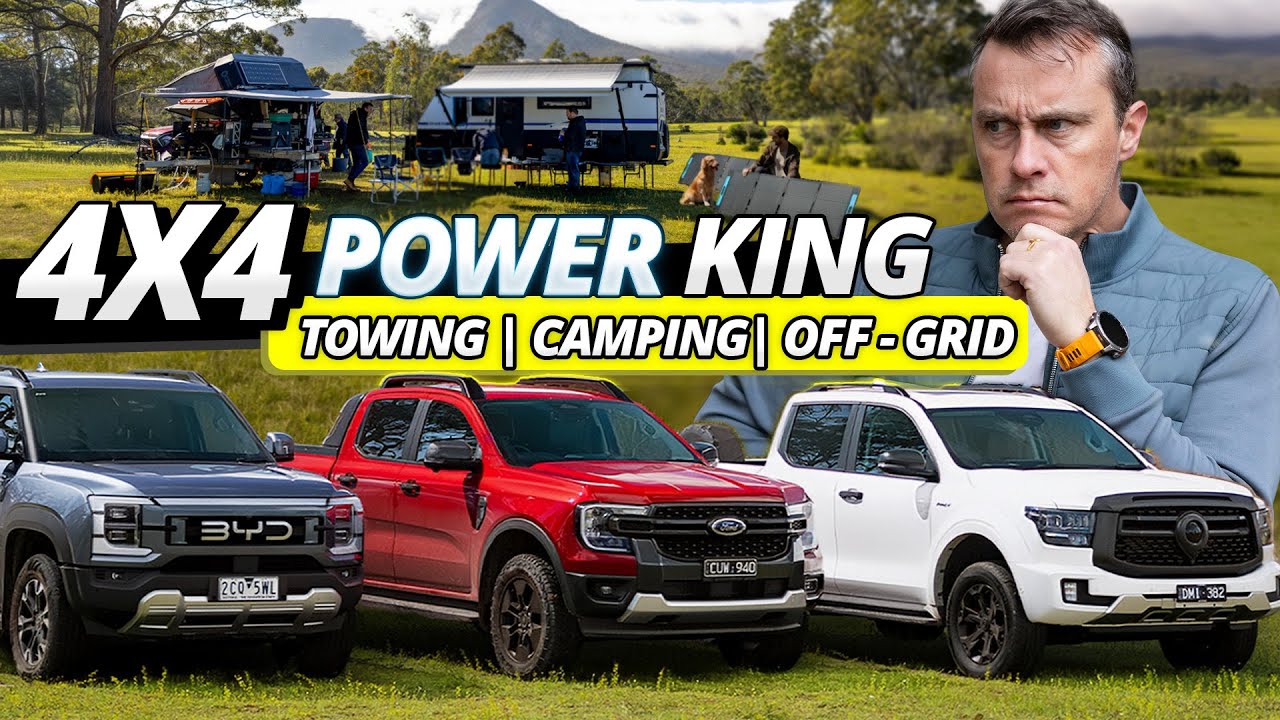
A Definitive real-world comparison of the Ford Ranger PHEV, GWM Cannon Alpha, and BYD Shark 6. We test each ute’s towing, V2L power, and off-road capability over hundreds of kilometres to find the best plug-in hybrid ute for towing and camping in Australia. We expose the unexpected weakness in one ute’s drivetrain when put under maximum load.
We take the BYD Shark 6, GWM Cannon Alpha Ultra PHEV and Ford Ranger Sport PHEV on a full hybrid ute towing test with a 2.2 tonne caravan, drive them off road on Victorian trails, and live with them at a remote campsite. Across more than 600 km we measure real fuel economy while towing, how each hybrid ute behaves once the battery is low, and how their different drivetrains cope off road.
Chapters:
00:00 Best plug in hybrid ute for towing and camping overview
00:39 Test setup – BYD Shark 6 vs GWM Cannon Alpha vs Ford Ranger PHEV
02:54 PHEV ute towing test with 2.2 tonne caravan
15:47 Towing fuel economy comparison for plug in hybrid utes
29:55 V2L explained – how PHEV utes power your caravan and campsite
37:03 Price, warranty and servicing costs compared BYD vs GWM vs Ford
38:09 Payload, GCM and towing limits for each PHEV ute
41:26 Off road test – PHEV utes on Victorian trails
50:37 Final verdict – best plug in hybrid ute for towing and camping
51:52 GWM Cannon Alpha towing electrics failure and battery vulnerability
At camp, we test vehicle to load (V2L) properly. Each plug in hybrid ute has a different way of running tools, fridges and a full cooking setup from its battery. We show what works, what does not, and how far a big PHEV ute battery really goes before the engine needs to fire up again.
We also cover hybrid ute payload and towing limits, GCM, tray size, underbody protection and how exposed the batteries and trailer wiring are for real off grid use. Price, warranty and servicing costs for the BYD, GWM and Ford are laid out so you can decide if a hybrid ute makes sense over a diesel dual cab for your touring plans.
Subscribe to carsales for more ute towing tests, off road reviews and EV and hybrid advice.
Subscribe for the latest advice, reviews and comparison tests 👍
https://www.youtube.com/user/carsaleschannel?sub_confirmation=1
STAY UP TO DATE AND CONNECT WITH US
https://www.carsales.com.au/
https://www.facebook.com/carsales.com.au
https://www.instagram.com/carsalescomau/
@carsalescomau
carsales. Buy it. Sell it. Love it.®
For over 25 years, carsales has been Australia’s go-to place for buying and selling vehicles – connecting people across the country with confidence and ease.
So for expert reviews, comparison tests helpful advice and everything cars, Like and Subscribe to the official carsales YouTube channel today. https://www.youtube.com/user/carsaleschannel?sub_confirmation=1 #carsaleschannel
#carsales