Jupiter Defiant Review | An Out of This World Folding Bike?
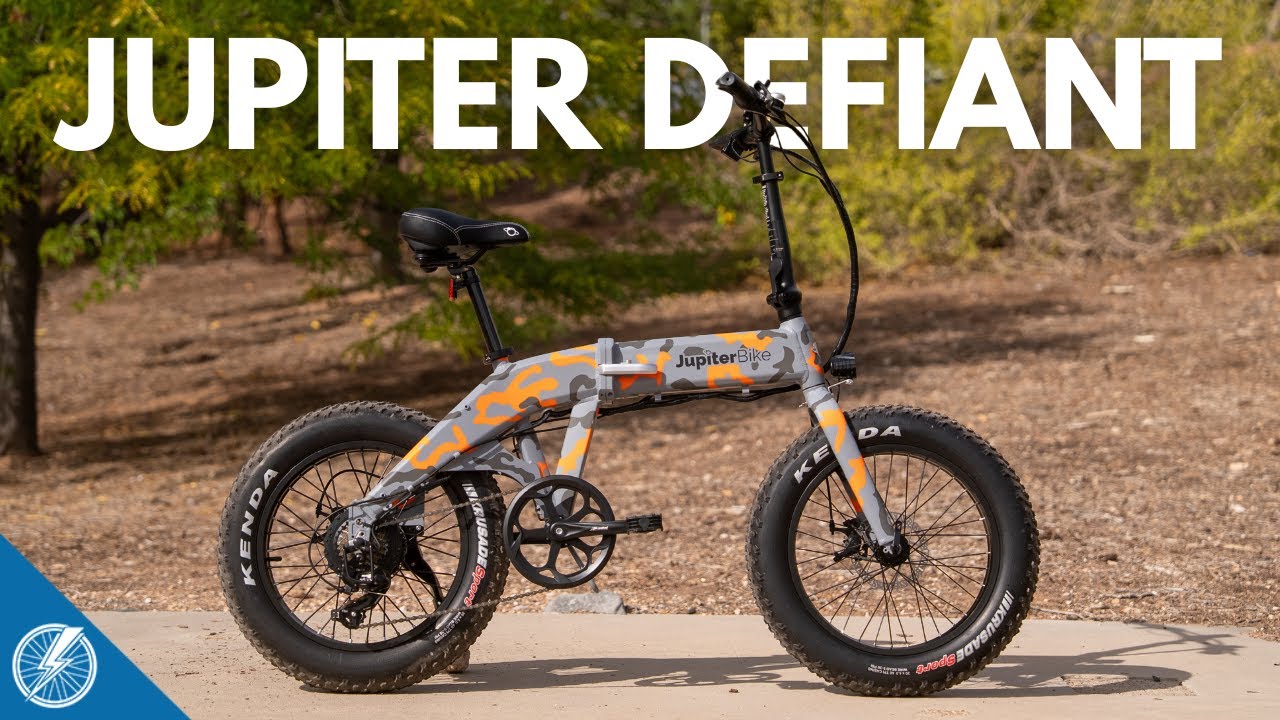
Folding ebikes are supposed to be portable, right? So, why are so many of them heavier than full-size ebikes? That’s what makes the Jupiter Defiant so interesting. It’s under 60 lb. It folds up small, and it still packs a 750 W motor that can climb hills like a champ. This is the Jupiter Defiant, a folding fat tire eBike that in more ways than one goes against the grain. Folding ebikes have become increasingly popular over the last few years, mostly because they promise to be easier to store, easier to travel with, and overall more convenient. But there’s been a bit of a trend lately that kind of contradicts that idea. A lot of Fulling ebikes have been getting heavier. We’ve tested plenty that tip the scales at 70 lb, and a few even creep up over 80. That’s about as much as a full-size commuter or even some adventure bikes on the heavy end of the spectrum. So, when the main appeal of a folding bike is supposed to be portability, that extra weight can really work against it. That’s why the Defiant immediately caught our attention. Jupiter Bike, based out of Tampa, Florida, managed to keep this thing comparatively light. Our test bike weighed in under 60 lb. And once you pop out the battery, that drops right around 52. For context, that makes it one of the lightest folding ebikes we’ve tested in recent years. So, yes, it folds, it travels well, and you can actually lift it without feeling like you need a gym membership. Now, typically, a lighter ebike comes with a few trade-offs. Most of the time, we’d expect that weight savings to come at the expense of power or ride comfort, but not here. The Defiant is rocking a 750 W rear hub motor with a peak output of 1,130 W. It uses a cadence sensor to deliver consistent motor output for a relaxed and easy ride. The bike’s top speed is 20 mph, which makes it a class 2 ebike. And it includes both pedal assist and a twist throttle for those times when you just want to kick back and cruise. And speaking of comfort, this is where the Defiant really earns its name. Most fulling ebikes just run tires that are around 3 in wide, but Jupiter decided to go allin with a set of 20x4in all-terrain fat tires. This tread pattern is knobbyby enough to grip on dirt, gravel, and other types of loose terrain, but it still rolls pretty smoothly out on pavement. That extra width gives this bike an impressively stable feel, especially at lower speeds, and it also adds a layer of cushioning that helps smooth out bumps. We also need to talk about that saddle because this is honestly one of the cushiest saddles we’ve tested on a folding ebike. It’s a dual spring customlabeled saddle that feels noticeably more padded than most, and it plays a big role in making the Defiant comfortable for long rides. Between that and the wide tires, this bike has a surprisingly plush ride overall, especially considering that it has a rigid aluminum fork instead of a suspension fork. Although Jupiter does offer two higher tier Defiant models, the Defiant Pro and Defiant ST, which do include suspensions. So, what we’re looking at here with the standard Defiant is a lightweight, portable, and powerful folding eBike that’s designed to handle both paved and unpaved terrain. The aluminum frame keeps it strong yet manageable, and the quick release front wheel makes it even easier to transport. The bike’s total payload capacity is rated at 300 lb, so there’s room for heavier riders or some added gear if you choose to equip the bike with an optional cargo rack. For power, the Defiant uses a 48vt 499watth battery that is UL2271 certified, which Jupiter claims can deliver between 20 and 40 mi of range depending on your assist level and terrain. The bike also has mechanical disc brakes with a 160 mm rotor on both wheels and a seven-speed Shimano Turney drivetrain with a 52 to chain ring and a 14 to 28 to cassette. Other nice touches include folding plastic pedals, a set of sport fenders that we don’t currently have equipped and a bright fourbulb LED headlight for visibility. The Defiant also has a set of 680 mm handlebars on a telescoping and collapsible stem. There’s an over the barar shifter and a half twist throttle on the right handlebar. A small button pad with an extra horn module mounted on the left and then a simple black and white LCD display. The Defiant is fully UL2849 certified for electrical safety and has a single frame size that comes in four color options. Our test bike features the orange camo color, but there’s also black, white, and a standard camouflage pattern to choose from as well. So, all told, the Defiant manages to stay compact and portable without cutting corners on power or comfort. And that’s not something we can say about many folding ebikes. Between its sub60lb weight, its stable ride feel, and that surprisingly powerful motor, it’s easy to see why Jupiter calls this one the Defiant. But how does it actually perform when we put it through our standardized tests? Let’s find out. All right, let’s do a quick run through of how to fold the Jupyter Defiant. Just going to run through everything here. Talk as I go. Flip up the kickstand. I’m going to fold the plastic pedals here. Going to drop the saddle. And then at this point, I’m going to undo the main hinge and swing this apart. Set this down. And then once we have the bike here, I will release the collapsible stem and fold down the handlebars. So all in all, that was pretty simple and straightforward. And then I found that uh Jupiter’s dimensions on the website are pretty accurate. We measured the bike to be about 38 1/2 in long by 21 in wide by about 27 in tall. All right, let’s do a speed test here on the Jupiter Defiant. So, starting things off, I’m riding with no pedal assist, and I am pedaling extremely casually, kind of right around 6 mph, just with my own leg power. Now, I could pretty easily pedal this thing significantly faster, but uh you know, the point of this test is to really see where the uh motor lands, where the sort of preset speed limits of the bike are. So, uh, as you’ll see here in a minute, we’re pretty close to the first of those already. So, yeah, again, just starting off pretty slow here, right around 6 mph. Let’s go ahead and go up to PAS1. And so, the motor is just coming on real gently, just giving us a little bit of a nudge here up to uh kind of right around 7 and a half miles per hour. And it kind of fluctuates a little bit depending uh you know if you fall sort of below the threshold of um motor power it’ll kind of kick you up a little bit and then let it fall back down before kind of nudging you up again. So yeah, here we’re kind of right in the middle between 7 1/2 and 8 mph. But let’s go up to PAS2. All right, so the motor definitely came on a little bit stronger there pushing us up to uh around 11 mph looks like. Uh, as you can see, we went above that for a little bit and then, yeah, kind of landed right here around 10.8. Let’s go up to PIS-3. So, again, a little bit of a kick in motor power and I’m shifting up to about sixth gear here. Looks like the motor kicked us up above 14, but then we’re falling back down a little bit. Right around uh I guess right Yeah, between 13 1/2 and 14 mph. 13.7. Let’s go up to PIS4. And just for the record, I am really not putting any pressure on the pedals. I’m just like turning the cranks, letting the motor do the work, and seeing where again those sort of preset limits are uh up to seventh gear now where we are topping out. And I’m going to get around the bend here before taking a final reading. But let’s see on your left. All right. And then looks like we are going up to right around 17 m per hour. Sorry, there was some poop on the path there. All right. Yeah, it looks like right around 16 and 12, actually. So, all right, let’s uh finish things off. Well, okay, hang on. We’re surging a little bit here. And it does look like we’re holding pretty steady around 17 now. So, all right, let’s go up to PA5 and finish things off. All right, moving nice and swiftly here. And I’m really just ghost pedaling now in order to keep up with the speed of the bike. Uh, with the gearing here, I’d have to pedal pretty quickly. And I’m just going to again relax and let the motor do it. But yeah, here we are right at that class 2 ceiling of 20 mph. Looks good. Feels easy, nice and quick. All right. Yeah, let’s uh check out the throttle and we’ll go from there. All right. All right. And then last thing here, we are going to do a throttle acceleration test from 0 to 20. We are in PAS5. And let’s go ahead and hit it in 3 2 1 go. All right. Little punchy. Oo, the uh front end of the bike actually wanted to lift up a little bit. So, do be careful of that. But picking up quickly. 17 18 19 and let’s see if we can hit 20. Kind of creeping up there. Yeah. Okay, there we go. All right, let’s call that our speed test. I’ll see you back in the studio. As you saw in those speed test clips, I took the Jupiter Defiant out on a flat paved section of our local shared use trail and rode through each of its pedal assist levels to see how fast it could go and how its power felt along the way. During this test, I kept my pedaling effort light since the goal was to hit the bike’s programmed speeds, not to see how fast I could push it myself. So, starting out with no pedal assist, I averaged about 6 mph. PAS1 brought me up to 7.8. PAS-2 was 10.8. PAS-3 to 13.7. PIS4 to 17 mph. And then finally, PAS5 topped out right at 20. I noticed that each level stepped up predictably and consistently with a quick burst of power. As the bike transitioned into the next assist setting, the motor engaged quickly and confidently, giving me solid acceleration without feeling overpowering. Personally, I found PAS4 to be the sweet spot for everyday cruising. There was plenty of help while still leaving me feeling in control. And then I bumped it into PAS5 when I wanted to climb or just pick up the pace. The throttle test was a fun surprise. From a dead stop, the Defiant jumped off the line fast enough to pop a quick little wheelie before settling into a steady climb toward its 20 mph speed limit. So, I’d advise keeping your weight on the handlebars when activating the throttle if you want to keep both wheels planted. Overall, the Defiance power delivery feels smooth, intuitive, and consistent, which is everything you’d want in a capable, easy pedaling, folding ebike. All right, next up is our range test, where our goal was simple, to find out how far a single battery charge can take you on the Jupiter Defiant. We ran two separate tests on our local network of paved paths, one using PIS-1 for the maximum range and another in PIS-5 for the minimum. So, our test riders covered 52.2 2 mi in PAS1 and 20.4 mi in PAS5 before the bike’s battery finally gave out. Jupiter advertises a range between 20 and 40 mi from the Defiance 48V 499watth battery. And I’d say those claims are pretty accurate. In fact, our results show that riders using the lower assist levels can stretch that upper limit a bit further depending on terrain, speed, and rider weight. When we compared those numbers to similar folding ebikes we’ve tested, the Defiance results landed a little below average. Comparable models gave us around 30 to 63 mi in their tests. There are two pretty straightforward reasons for that though. First, the Defiance battery is on the smaller side, 499 W hours compared to an average of about 667 with other bikes. Less capacity generally means fewer miles per charge. And second, this bike uses a cadence sensor instead of a torque sensor. Cadence sensors apply a steady, consistent level of motor power when the cranks are turning, while torque sensors are more dynamic and efficient because they adjust output based on how hard you pedal. And most of the competition here did have torque sensors. It’s also worth noting that we performed all of our testing with the bike in its stock class 2 settings, where pedal assist tops out at 20 mph. If you unlock the higher speeds through the settings menu, expect your range to drop a bit. But do be aware that Jupiter states that riding above 20 miles per hour can damage the controller and voids the warranty. Still, for most riders taking casual or commuter length trips, say 5 to 10 m per ride, the Defiant should easily last a couple of outings before needing a recharge. And when you do plug it in, the included 2 amp charger can top off the 10.4 Ah battery in about 5 hours. All in all, we consider the Defiance results to be a solid, realistic range that matches the bike’s size and purpose nicely. Moving on to our hill test, this one takes place at a location we call the Devil’s Backbone. This is a halfmile climb with an 8% average grade and about 217 ft of elevation gain. So, in other words, it’s no joke and it gives us a great way to measure how well an ebike can handle steep terrain. Our test rider, Justin, ran the Jupiter Defiant through this course twice. Once using only the throttle and once pedaling in the highest assist level, PAS5. Let’s go see the test and I’ll run through the results once we get back here. We are out at the Devil’s Backbone doing the hill test on the Jupiter Defiant. We’re starting out with the throttle test as always and got up to 20 mph. Pretty zippy there right before this first steep section. We’re now at 19.8.2. two and looks like we’re going to kind of bottom out of this first section right at 16.9 miles per hour. We’re getting back up at an 18.8 and yeah, just got to 20 right before the next steep section. We’re now at 18.0 17.2 2 16.7 and get a bottom at 16 mph right there. Tap the brakes to make this turn and see what we get to before this first lamp post. We’re cruising at 13 12 miles an hour right now. And we’re going to cross that lampost right at 15.6 mph. Now, as far as the motor noise goes, I I’d say it’s pretty good. Right about average, maybe a little quieter than average. Um, the frequency is on the lower lower side, so it’s not high high pitch, which I personally don’t love. Um, and so I like how this is a little bit lower. I’ll let you listen now as we’re cruising right at 14.6 mph. So, you hear it pick up a little bit there as we get up to 17 miles an hour. Um, this is doing fairly well. I think it’ll be a pretty decent score. Um, it feels pretty solid climbing wise again with throttle as we finish the ride at 17 mph. Okay, back out on the Jupyter Defiant now doing the pedal test. We’re in seventh gear. Got right up to 20 mph before this first hill and or this first steep section of the hill. And so far doesn’t feel like I need to downshift at all. Cruising right about 18.4. Bottoms out right at 18.3 right there. Getting me right back up to speed to 20 mph. Slightly above here. And I’m not sure I’m going to need to shift down. I might I’m going to I’m going to downshift one here. We bottom out right about 18 and 12 miles per hour. One more shift before this turn. So, we’re in fifth gear gear and we’ll see. I feel like I want to go back to sixth as we cross this lamp post. Riding 17.3 mph and I’m in sixth gear as far as engagement goes. I mean, I’m just barely more than soft pedaling, pushing a little bit down, but I could definitely back off and still get pretty decent speed up here. Um, motor noise is still nice. It’s just right about average. I’ll let you listen here. So, yeah, shift back into seventh gear. 19.6 6 19.9. It’s going to be a pretty good result here. And I’m not breathing very hard at all at the top as we cross at 18.8 mph. All right, the throttle only test clocked in at 1 minute and 51 seconds with an average speed of 16.3 mph. The pedal test in PAS5 was even quicker at 1 minute and 42 seconds with an average of 17.8 mph. Both results were faster than average for the folding ebike category. Typically, bikes in this class take around 1 minute and 56 seconds on throttle and a minute 54 when pedaling. So, the Defiance faster times were genuinely impressive. Now, on paper, you might not expect those results. This bike’s 750 W motor peaks around 1,130 W. And according to the brand, it delivers about 23 Nm of torque, which is lower than the average torque and power output we see from similar models. But the Defiant’s secret weapon is its weight. At under 60 lbs, this bike is more than 10 pounds lighter than most folding ebikes we’ve tested, and that gives it a big advantage on climbs. When I repeated this test at our secondary hill called Pilot Hill, the Defiant powered up quickly and smoothly, whether I was throttling or pedaling, the motor did push a bit past its 20 mph cap on the steepest sections, which I’d like to see tightened up for the sake of accuracy, safety, and legality, at least in areas where speed is limited. But there’s no denying its capability. All in all, the Defiance combination of lightweight and strong motor output makes it a confident, easy climber that should handle most hills without breaking a sweat. Next up is our brake test. As always, this one was performed by our test rider, Griffin, who is 6’1 and about 230 lb. He brought the Jupiter Defanti up to 20 mph, applied the brakes in a controlled and consistent way, and then measured how far it traveled before coming to a complete stop. He repeated this process three times and then we took the average of the results for a final test score. So after crunching the numbers, the Defiant came to a stop at an average distance of 24 ft and 8 in. That’s still within what we consider a safe range, but it is noticeably longer than average when compared to similar folding ebikes we’ve tested. Other bikes stopped in just 19 ft 8 in on average. A big part of that difference comes down to this bike’s brake setup. The Defiant uses mechanical disc brakes with 160 mm rotors on both wheels. Most of its competitors feature hydraulic systems with larger 180 mm rotors, which generally provide stronger braking power and also require less effort at the lever. I did notice that longer stopping distance during my own rides, though it never caused an unsafe situation. A firm squeeze on the levers was all it took to stop the bike relatively quickly and under control. Still, considering the Defiance price point, we’d love to see Jupiter upgrade to a hydraulic setup in the future. That would add stopping confidence, especially for heavier riders or those carrying extra gear. But until then, just give yourself a little extra room when braking and get familiar with how the levers feel before hitting top speed. All right, let’s talk about ride quality here on the Jupiter Defiant. So, of course, this is a folding ebike and uh as is pretty common with this style. We’ve got a pretty upright riding position here, a fair amount of adjustability, and a pretty comfy ride overall. So, uh there’s just a single frame size for this bike. I’m not really sure what the recommended height range is, but I did reach out to the folks at Jupiter to find that out on your left. Uh so, I’ll report back if we get that information in time. But in any case, I am 5’11 and uh you know, yeah, definitely plenty of adjustability for someone of my height and definitely someone shorter. Um I would say especially in the saddle height, uh you know, if you’re taller than I am, you might be a little bit more limited, but um there’s actually a little bit more handlebar height here than I’m used to. Uh, so there’s about eight inches in the seatost and then about five and a half inches in the telescoping stem so that you can raise your handlebars there and get a good fit. But so let’s see. I’ll just tell you bit a little bit about what I’m feeling. Uh, I do not have full leg extension here. Although I could raise the saddle a little bit more above where I have it set. Just kind of going for like a little bit of a comfy middle ground. And because of the fact that this bike has a cadence sensor, I don’t really need full leg extension. Um, you know, I’m just basically turning the cranks here. I’m not really putting any effort into the pedaling. Uh, so, you know, I’m not feeling any strain in my knees or anything like that, which is nice. But then up front, uh, you know, again, as is pretty common, we have a relatively long reach here. So, you can see that my arms are really pretty straight and projecting out in front of me. Not quite locked, but uh, definitely definitely forward here. Now, I have the handlebar height set kind of in the middle of its range, and I could raise that, but I find that the taller the handlebars are, the twitchier the handling feels. So, again, kind of looking for a bit of a comfy middle ground, and I I definitely have found it. Um, now, another thing that plays into comfort on this bike is the saddle. Uh, we don’t have a suspension here. There’s a rigid fork and, you know, a standard seat post, but we have a nice soft saddle, so that’s really doing a lot to absorb bumps. And then, uh, tires are also playing into that as well. Those are 20×4 knobby fat tires. Uh, and yeah, so with that wheel size and tire size, you get great handling and maneuverability, excuse me. Uh, we have great riding stability both on and offroad. And then of course, uh, you know, you can reduce your tire pressure to add a little extra cushion to the ride and great grip if you’re riding on sort of loose terrain here. But in any case, then we also have the 750 W rear hub motor, which as we’ve seen is uh powerful, can be a little bit punchy at times, uh, especially if you’re, you know, throttling from a dead stop. It’ll pop a wheelie on you for sure. But again, as we’ve seen, you know, this motor is plenty powerful to uh handle hills and, you know, just make riding very easy, especially with the cadence sensor here. Now, one thing that I do want to do is bump up to PA5 and show you the motor engagement. So, I’m just going to kind of coast, fall back down in speed a little bit, and then I’m going to spin the cranks so you can see how quickly the motor engages. Let’s do that now. Wow, that uh that picked up extremely fast. So, I would say maybe an eighth of a turn of the cranks to be honest. So, very quick engagement. Very nice to see. Yeah. All right. All around solid bike. Let’s go ahead and bounce back to the studio and we’ll talk a little bit more. Overall, I’d say the Jupyter Defant offers a good ride experience that feels confident and easy to control. To clarify the bike’s recommended height range, Jupiter designed it to fit riders from about 5t tall up to 6’2. As far as handling goes, the Defiant sub60lb weight makes it feel nice and nimble. Its 20×4 in tires and rigid aluminum fork give it a very predictable feel when cornering. And the smaller wheel size also helps make the bike feel snappy and maneuverable. Just note that if you’ve got larger feet like my size 12elves, you’ll probably want to pay attention to your pedal placement as I occasionally clipped my heel on the kickstand or the cable guides if I wasn’t careful. In terms of comfort, I want to reiterate that the dual spring saddle really stands out here. Another thing I liked is that the Defiance user interface is straightforward and beginner friendly. You’ve got a seven-speed drivetrain with a thumb shifter on the right handlebar, a half twist throttle, a basic black and white display, and a small control pad on the left. It’s intuitive and it’s easy to use, making it perfect for riders who are new to ebikes or maybe haven’t been on a bike in years. All in all, this is a comfortable, stable, and approachable ride that’s easy to just hop on and enjoy. All right, before we wrap things up, let’s run through some pros and cons for the Jupiter Defiant. Starting with the positives. First off, the Defiant is super easy to ride. The cadence sensor and pre-programmed speed limits make it simple to control your pace, and the power delivery feels natural and predictable. It’s also a surprisingly strong hill climber. That 750 W rear hub motor peaks at about 1,130 W. And even on steep grades, it had no problem keeping speed. At under 60 pounds, this is one of the more portable folding ebikes we’ve tested, especially with its quick release front wheel that makes transport and storage a breeze. The bike feels solid and stable thanks to its wide 20×4 in Na’vi tires. And those tires also give it great grip on loose terrain. The dual spring saddle deserves a shout out, too. It’s noticeably cushier than most we’ve tried. Add in crisp cornering from the rigid fork and a choice of four color options, including that standout orange camo, and this bike has a lot going for it. Now, for a few drawbacks, though, we’d love to see hydraulic brakes here instead of mechanical ones for better value and stopping power. The motor occasionally surged past its 20 mph cap, and we also hoped for an integrated tail light with brake light functionality. Still, none of these are dealreakers. They’re just areas where Jupiter could make a solid bike even better. Folding ebikes like the Jupiter Defiance are all about freedom. For riders living in apartments or tight spaces, a foldable frame means it can tuck away easily when you’re done riding. And for travelers, RV owners, or anyone who doesn’t have a truck or bike rack, it’s a convenient way to bring some two- wheeled fun wherever you go. The Defiant itself turned out to be a fun and capable little machine. It’s comfortable, it’s easy to use, and it scored well in nearly all of our tests. Its programming feels balanced and intuitive. The range is practical for its size and specs, and the motor has plenty of muscle for climbing steep hills and getting up to speed with gusto. We did find a few areas that could use improvement, mainly the mechanical brakes, the occasional surges in speed that exceeded its 20 mph limit, and the lack of an integrated tail or brake light. Otherwise, we came away impressed with the Defant simplicity, its crisp, predictable handling, and its cushy ride. Between its lightweight, stable feel and compact design, this is a great option for anyone who wants a portable, powerful ebike that’s ready for both city streets and relatively smooth off-road paths. If you’d like to learn more or check current pricing, you’ll find links to our full written review and Jupiter’s website down in the video description. As always, if you found this review helpful, please consider helping us out by subscribing and giving this video a like. We also ask that you use our affiliate link in the description when making a purchase. But I’m curious, would you be most likely to buy the Defiant? the Defiant Pro or the Defant ST? Let us know down in the comments and feel free to send over any questions. But thanks for taking a ride with me today. Again, I’m John with Electric Bike Report and this is the Jupiter Defant.
🔗Check Current Pricing: https://ebrdeals.com/JupiterDefiant
Learn More: https://electricbikereport.com/jupiter-defiant-review
In this in-depth video review, John from Electric Bike Report tests the Jupiter Defiant, a lightweight folding fat tire e-bike built for riders who want portability without sacrificing power. At just under 60 lbs, the Defiant is one of the lightest folding e-bikes we’ve tested — but its 750W motor with 1,130W peak power makes it a hill-climbing beast!
We put the Defiant through our full series of standardized tests, including Speed, Range, Hill, Brake, and Ride Quality evaluations to see how it stacks up against the best folding electric bikes on the market.
✅ Key Highlights:
-750W rear-hub motor (1,130W peak) with Class 2 pedal assist & throttle
-Lightweight 48V, 499Wh battery for 20–52 miles of range
-Wide 20×4” fat tires for stability on pavement, gravel, or dirt
-Comfortable dual-spring saddle and compact folding frame
Whether you’re an RV traveler, apartment dweller, or weekend adventurer, the Jupiter Defiant could be the portable e-bike you’ve been waiting for.
#ElectricBikeReport #JupiterDefiant #FoldingEBike #FatTireEBike #EBikeReview
00:00 – Intro
00:42 – Overview
05:08 – Folding Demo
06:05 – Speed Test
11:21 – Range Test
13:29 – Hill Test
18:54 – Brake Test
20:24 – Ride Quality
25:16 – Pros & Cons
26:35 – Conclusion